
Quick Summary
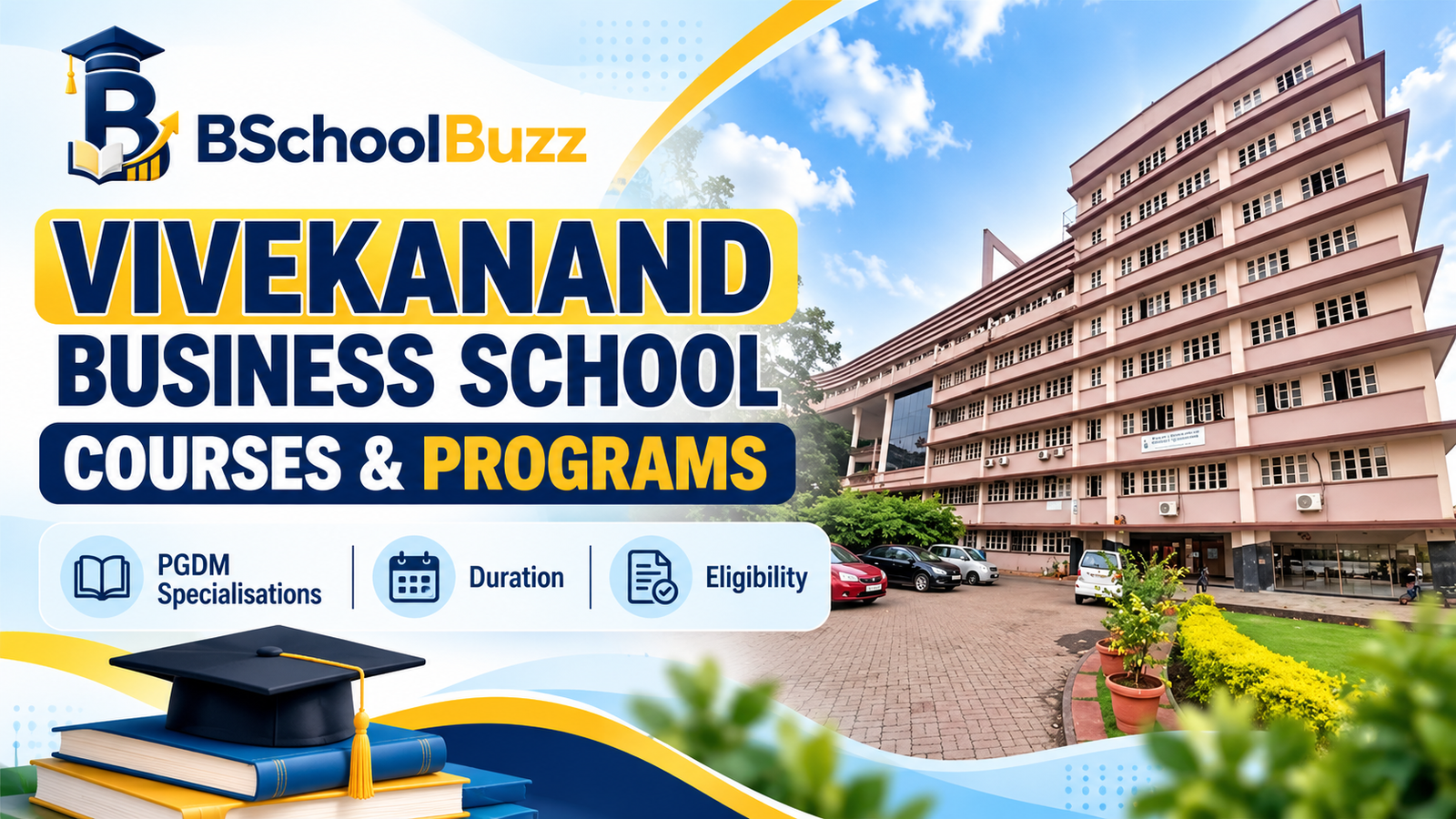
- Vivekanand Business School (VBS) is located in Chembur, Mumbai.
- The institute offers a Post Graduate Diploma in Management (PGDM).
- The published programme follows a 15:9 structure: 15 months of academic learning followed by nine months of industry internship orapprenticeship.
- Specialisation areas listed on the official website include Marketing, Human Resource Management, Business Analytics, Banking and Finance,and Operations and Supply Chain Management.
- Entrepreneurship Management is also described on a dedicated programme page; confirm its availability for your intended batch.
- The published admission page states a minimum of 50% graduation marks.
- Entrance examinations listed by VBS include CAT, XAT, MAT, MAH-CET, CMAT and ATMA.
- The selection process described by the institute includes entrance-test performance, academic records, a personal interview and extracurricular activities.
- The published PGDM fee for the 2026–2028 batch is ₹9.50 lakh, excluding any separately applicable hostel and living expenses.
- Check the latest official prospectus for current eligibility, cutoffs, fees, specialisation availability and application deadlines.
Vivekanand Business School Mumbai Courses & Programs: MBA/PGDM Specialisations, Duration & Eligibility
Vivekanand Business School (VBS), located in Chembur, Mumbai, offers a Post Graduate Diploma in Management (PGDM) for graduates seeking postgraduate management education. The institute’s programme combines classroom learning with industry exposure, and its published curriculum follows a distinctive 15:9 structure: 15 months of academic learning followed by nine months of industry internship or apprenticeship.
Students researching Vivekanand Business School Mumbai courses should look beyond the programme name. The right choice also depends on the specialisation, academic eligibility, accepted entrance examinations, selection process, duration, fee structure and the kind of work a student hopes to pursue after graduation.
This article explains the courses and specialisations listed on VBS’s official website, how its programme is structured, who can apply, and what applicants should check before submitting an application. Where admission information is specific to a particular published cycle, that context is identified rather than assumed to apply to every future intake.
Table of Contents
Overview of Vivekanand Business School Mumbai
Courses and programmes offered
PGDM specialisations explained
Course duration and the 15:9 learning structure
Curriculum and learning methods
Eligibility criteria
Entrance examinations accepted
Admission and selection process
Documents required for application
PGDM fee structure and hostel costs
Scholarships and financial assistance
Intake and campus location
How to choose the right specialisation
Career preparation and industry exposure
Important checks before applying
Frequently asked questions
Conclusion
About MBA Compass
Also Read
Related search keywords
1. Overview of Vivekanand Business School Mumbai
Vivekanand Business School, commonly referred to as VBS, is a management education institution located at the Hashu Advani Memorial Complex in Chembur, Mumbai. Its flagship management offering is a Post Graduate Diploma in Management.
The institute’s official website describes the PGDM as an AICTE-approved programme and highlights NBA accreditation and recognition by the Association of Indian Universities (AIU). Applicants should consult the current official programme and approval documents to confirm the precise status applicable to their intended admission year.
VBS presents its programme as a combination of academic instruction, practical activities, specialist learning, professional development and a longer industry internship. This structure is relevant for students who want to connect management concepts with workplace experience during their studies.
VBS Mumbai at a glance
| Particular | Details |
|---|---|
| Institute name | Vivekanand Business School (VBS) |
| Location | Chembur, Mumbai, Maharashtra |
| Main management programme | Post Graduate Diploma in Management (PGDM) |
| Programme duration | Two years |
| Published learning structure | 15 months of academic learning followed by nine months of internship |
| Specialisation areas listed on the official programme page | Marketing, Human Resource Management, Business Analytics, Banking and Finance, Operations and Supply Chain Management |
| Entrance examinations listed for admission | CAT, XAT, MAT, MAH-CET, CMAT and ATMA |
| Minimum graduation marks stated on the admission page | 50% |
| Official website | vbs.ves.ac.in |
The details above are based primarily on VBS’s published PGDM admission information and official programme page. Admission requirements, fees and application status can change between admission cycles, so candidates should verify the latest notice before making a payment.
2. Vivekanand Business School Mumbai Courses and Programs
The central programme covered in this guide is the PGDM. VBS lists several specialisation pathways within its management offering, allowing students to develop knowledge in a particular business function.
The official programme page lists the following areas:
PGDM in Marketing
PGDM in Human Resource Management
PGDM in Business Analytics
PGDM in Banking and Finance
PGDM in Operations and Supply Chain Management
The institute also has a dedicated page describing Entrepreneurship Management as a specialisation area. Because programme pages can be updated independently, applicants should check the latest prospectus and application form to establish which specialisations are available for their specific batch and how the institute allocates students to them.
Is the programme an MBA or a PGDM?
The qualification described on VBS’s official course pages is a Post Graduate Diploma in Management (PGDM). Students often search online using phrases such as “VBS Mumbai MBA courses” or “Vivekanand Business School MBA specialisations,” but the official programme name should be used when reviewing the course structure, application form and fee documents.
An MBA and a PGDM are not automatically the same qualification in every regulatory context. Before applying, students should check the programme’s formal award title and relevant recognition details. VBS’s official website states that its PGDM is AICTE-approved and AIU-recognised; applicants can review the corresponding official documentation if they need confirmation for further study or employment requirements.
Which programme should students examine first?
Applicants looking for postgraduate management education should begin with the flagship PGDM page and then compare the specialisation options. It is useful to assess each option against three factors:
Career interest: the business function in which you want to work.
Existing strengths: your comfort with numbers, people management, communication, technology or operational problem-solving.
Programme content: the subjects, practical activities, certifications and internship opportunities associated with the chosen specialisation.
A course title alone does not establish the full content of a programme. Review the current syllabus and ask the admissions team about subject choices, specialisation allocation and internship arrangements before finalising your preference.
3. PGDM Specialisations at Vivekanand Business School Mumbai
The specialisation you choose can influence the subjects you study, the projects you undertake and the roles you target after completing your programme. VBS publishes information on several management domains. The descriptions below explain what each field generally involves and connect it with the learning areas mentioned on the institute’s official website.
3.1 PGDM in Marketing
Marketing focuses on understanding customers, developing products and services, positioning brands and creating strategies to reach target audiences. It may suit students interested in consumer behaviour, communication, sales, brand development or digital channels.
VBS describes its Marketing pathway as covering marketing strategy, digital marketing, consumer analysis and brand management. The programme page also mentions an industry-aligned certification in digital marketing through the All India Management Association (AIMA).
Students considering Marketing should examine how the curriculum addresses both strategic and practical skills. Relevant learning areas may include market research, customer insights, campaign planning, sales management and performance measurement. The current course syllabus should be consulted for the exact subjects taught in a particular batch.
Who may consider Marketing?
Students who enjoy understanding customer preferences and market behaviour.
Graduates interested in brand management, sales or digital marketing.
Applicants who want to combine communication skills with commercial decision-making.
Students comfortable presenting ideas and working on customer- or market-focused projects.
Potential career directions include marketing executive, sales executive, brand associate, market research analyst and digital marketing roles. Actual job titles and eligibility depend on the employer, the student's skills and the opportunities available at the time of recruitment.
3.2 PGDM in Human Resource Management
Human Resource Management (HRM) focuses on the people-related functions that help an organisation operate effectively. These functions can include recruitment, employee development, performance management, workplace policies and organisational development.
VBS describes its HRM specialisation as preparing students for work involving talent acquisition, organisational development and HR analytics. Its published programme information also refers to an HRM master certificate from the Society for Human Resource Management (SHRM).
This pathway may suit students interested in people management, workplace behaviour, recruitment, training and employee engagement. HR work is not limited to conducting interviews: many roles involve data, policy interpretation, workforce planning and coordination with business leaders.
Who may consider HRM?
Students interested in employee development and organisational behaviour.
Graduates who enjoy communication, coordination and problem-solving.
Applicants interested in recruitment, training or performance systems.
Students willing to understand the relationship between people, policies and business goals.
Potential career directions include HR executive, talent acquisition associate, learning and development coordinator, HR operations professional and HR analyst. The precise opportunities available to graduates depend on their experience, skills and recruitment conditions.
3.3 PGDM in Business Analytics
Business Analytics uses data to help organisations understand performance, identify patterns and make decisions. It connects business knowledge with quantitative reasoning, data interpretation and analytical tools.
VBS describes its Business Analytics pathway as preparing students to support data-informed business decisions. The programme information refers to technologies and concepts such as Python, SQL, Power BI, Tableau, R programming, predictive analytics and machine learning in its published specialisation description.
Applicants should distinguish between an overview of the programme and a definitive list of compulsory subjects. The current syllabus will establish which tools are taught, how deeply they are covered and whether any prior technical knowledge is expected.
Who may consider Business Analytics?
Graduates who enjoy interpreting numbers and identifying patterns.
Students interested in business intelligence and data-based decision-making.
Applicants comfortable developing quantitative and technical skills.
Students who want to connect data analysis with marketing, finance, operations or other business functions.
Potential career directions include business analyst, reporting analyst, business intelligence associate and analytics-related roles. Technical positions may require stronger programming, statistics or domain knowledge than a general management role.
VBS’s official programme information mentions an applied analytics certificate associated with KPMG. Candidates should verify the current certification arrangement, requirements and delivery format with the institute.
3.4 PGDM in Banking and Finance
Banking and Finance focuses on financial systems, financial analysis and the decisions businesses make about capital, risk and resources. Depending on the syllabus, learning may cover corporate finance, financial institutions, investment concepts, financial reporting and analytical methods.
VBS lists Banking and Finance as one of its PGDM specialisation areas. Its published programme information also refers to financial data analytics through the National Institute of Securities Markets (NISM).
This option may be appropriate for students interested in financial services, banking operations, corporate finance or financial analysis. Applicants should review the detailed subject list and certification information rather than assuming that every finance-related role is covered by the same course.
Who may consider Banking and Finance?
Graduates interested in financial markets and financial decision-making.
Students who are comfortable developing numerical and analytical skills.
Applicants considering banking, corporate finance or financial services.
Students willing to build their understanding of financial statements, risk and regulation.
Possible career directions include finance executive, banking associate, credit analyst and financial operations roles. Investment, research and specialised analytical positions may have additional skill or qualification requirements.
3.5 PGDM in Operations and Supply Chain Management
Operations and Supply Chain Management focuses on how organisations plan, produce, procure, store and deliver products or services. It examines the processes that affect efficiency, cost, quality and delivery performance.
VBS describes this specialisation in relation to operational efficiency, logistics, data analysis, demand planning and supply chain management. Its programme page mentions CAPM and Lean Six Sigma certification pathways associated with the Project Management Institute (PMI).
The area may suit students who enjoy structured problem-solving and improving the way systems work. It is relevant to manufacturing, retail, e-commerce, logistics, procurement and service operations, although specific career options depend on the student's knowledge and employer requirements.
Who may consider Operations and Supply Chain Management?
Students interested in logistics, planning and process improvement.
Graduates who enjoy coordinating resources and solving operational problems.
Applicants interested in procurement, inventory, distribution or quality.
Students who want to learn how business decisions affect cost and delivery.
Potential roles include operations executive, supply chain analyst, procurement associate, logistics coordinator and planning executive. Advanced technical roles may require additional industry experience or specialised knowledge.
3.6 Entrepreneurship Management
Entrepreneurship Management is described on a dedicated VBS programme page. The focus is on understanding startup ventures, developing business strategies, identifying opportunities and managing growth.
This pathway may appeal to students who want to start a business, join an early-stage company or work on innovation-related projects. Entrepreneurship requires more than generating ideas: founders and startup teams also need to understand customers, pricing, cash flow, operations, hiring and the practical risks of launching a venture.
Students interested in this option should confirm its availability for their intended admission year and ask how it is organised within the wider PGDM structure. They should also establish whether it is offered as a separate admission option, a specialisation or a pathway within the programme.
Specialisation comparison
| Specialisation | Main area of focus | Useful interests or strengths | Examples of possible career directions |
|---|---|---|---|
| Marketing | Customers, brands, sales and market strategy | Communication, creativity, customer insight | Marketing, sales, brand and digital roles |
| Human Resource Management | Recruitment, employee development and workplace systems | Communication, coordination, people management | HR operations, recruitment, learning and development |
| Business Analytics | Data interpretation and business decisions | Quantitative reasoning, analytical thinking, technology | Business analysis, reporting and business intelligence |
| Banking and Finance | Financial analysis, banking and financial decisions | Numerical ability, financial interest, attention to detail | Banking, finance operations and credit-related roles |
| Operations and Supply Chain Management | Logistics, processes, procurement and efficiency | Planning, structured problem-solving, coordination | Operations, logistics, supply chain and procurement |
| Entrepreneurship Management | Startup strategy, opportunity identification and venture growth | Initiative, business planning, adaptability | Startup operations, venture development and entrepreneurship |
This comparison is a decision aid, not a guarantee of placement in a particular role. Students should use the latest official syllabus and admissions information to confirm which options are available and what each includes.
4. Course Duration and the 15:9 Learning Structure
VBS describes its PGDM as a two-year programme organised around a 15:9 model. The first 15 months focus on academic learning, while the following nine months are dedicated to an industry internship or apprenticeship.
The institute presents the extended industry phase as an important part of the programme. Compared with a shorter internship, a longer placement within an organisation may provide more time to understand processes, work with a team and contribute to projects. However, the learning gained will depend on the actual assignment, the employer, the student's performance and the supervision provided.
How the programme is organised
| Stage | Duration described by VBS | Main purpose |
|---|---|---|
| Academic phase | 15 months | Management fundamentals, specialisation learning, projects and developmental activities |
| Industry phase | 9 months | Practical exposure through an internship or apprenticeship |
| Overall programme | 24 months | Academic study combined with extended workplace experience |
The table describes the published structure, not a guarantee that every student's internship will have identical responsibilities, compensation or outcomes. Students should ask the institute about internship allocation, employer selection, evaluation, attendance, compensation and the conditions under which an internship may be extended or changed.
What does a nine-month internship mean for students?
A longer industry phase can give students more time to understand the working environment and demonstrate their abilities. It may also help them develop a clearer picture of the roles they prefer.
Students should nevertheless avoid treating the internship as a guaranteed job offer. An internship and a full-time appointment are different arrangements. Whether an employer offers a pre-placement offer (PPO) can depend on performance, business requirements, available positions and the organisation's hiring policy.
Before admission, ask whether the internship is mandatory for the intended batch, how the institute supports students in securing placements, how internship performance is assessed and whether the published programme schedule is subject to change.
5. Curriculum and Learning Methods
VBS describes its PGDM teaching approach as application-oriented, combining classroom instruction with activities intended to help students use management concepts in practical situations. The institute's published course information discusses case studies, workshops, simulations, projects, professional certifications and industry interactions.
The precise mix of activities may differ by specialisation and academic year. Applicants should check the current syllabus for course titles, credits, electives and evaluation methods.
Case-study learning
Case studies ask students to analyse a business situation, identify the underlying problem, compare possible responses and justify a decision. This method can help learners practise structured reasoning rather than relying only on memorised definitions.
In a management classroom, a case might involve a marketing decision, a supply chain problem, an employee issue or a financial choice. The value of the exercise comes from explaining why one option is preferable under the given circumstances and acknowledging its limitations.
Workshops and practical exercises
VBS lists workshops on areas such as analytics tools, performance management, digital operations and contemporary business practices. Workshops can provide guided practice and expose students to techniques used in professional settings.
The usefulness of a workshop depends on the level of participation and the work students complete. Before enrolling, applicants who are particularly interested in a tool or certification should confirm whether it is included in their batch's curriculum, optional or subject to additional conditions.
Simulations and projects
Business simulations allow students to practise decision-making in a structured environment. Projects can require learners to apply concepts to a defined problem, work with a team and present their recommendations.
These activities can help develop communication, teamwork, analytical thinking and decision-making. They are most valuable when students receive meaningful feedback and can explain the reasoning behind their conclusions.
Professional certifications
The VBS programme pages refer to certification opportunities associated with selected specialisations, including:
SHRM-related certification for Human Resource Management.
Applied Analytics by KPMG for Business Analytics.
Digital Marketing by AIMA for Marketing.
CAPM and Lean Six Sigma pathways associated with PMI for Operations and Supply Chain Management.
Financial Data Analytics by NISM for Banking and Finance.
These are the certification pathways described in the institute's published programme information. Students should confirm the current batch's exact certification name, eligibility conditions, examination requirements, fees if any and whether successful completion is compulsory.
Professional development and mentoring
The institute also describes initiatives such as its Accelerated Career Entry (ACE) course and Guru-Shishya mentorship. These initiatives are intended to support professional communication, career planning, networking, workplace readiness and interaction with faculty mentors.
For applicants, the important question is how these activities operate in practice. Ask about participation requirements, frequency of mentoring, access to career services and the way professional-development activities connect with the internship and placement process.
6. Vivekanand Business School Mumbai Eligibility Criteria
Eligibility is one of the first things applicants should check before preparing an application. According to VBS's published PGDM admission page, candidates must have graduated from a recognised Indian university with a minimum of 50% marks.
The same page states that final-year students can apply, but their admission remains subject to clearing the qualifying examination with at least 50% marks. Since admission rules can be revised, candidates should confirm the requirement for their intended intake.
Basic eligibility requirements
| Eligibility factor | Published requirement or guidance |
|---|---|
| Academic qualification | Graduation from a recognised Indian university |
| Minimum marks | 50%, according to the official admission page |
| Final-year applicants | May apply, subject to meeting the qualifying-examination requirement |
| Final-year condition | The admission page states that the qualifying examination must be cleared with 50% marks |
| Entrance test | A valid score from an examination accepted by VBS, as listed for the applicable admission cycle |
Does a candidate need a specific undergraduate degree?
The published eligibility statement refers to graduation from a recognised Indian university. Applicants should not assume that a particular undergraduate stream is mandatory unless the current official admission notice says so.
Students from commerce, arts, science, engineering and other backgrounds should verify any programme-specific conditions directly with the admissions office. They should also confirm how the institute evaluates grades, CGPA, backlogs, supplementary examinations and qualifications obtained outside India, where applicable.
Can final-year students apply?
The official admission page says final-year graduating students can apply, with admission held until they clear their qualifying examination with the required marks. This allows students who have not yet received their final degree results to begin the application process, subject to the institute's conditions.
A final-year applicant should check:
Whether the current intake accepts applications before final results.
The deadline for submitting final marksheets or proof of graduation.
The minimum marks required after the final result.
Whether any pending examination, backlog or supplementary result affects admission.
The process for confirming provisional admission.
Do not rely solely on a previous year's procedure. Obtain the applicable conditions in writing from the institute before paying a non-refundable amount or making arrangements based on provisional admission.
Is work experience compulsory?
The eligibility information cited above emphasises graduation and entrance-examination scores. It does not establish that prior full-time work experience is compulsory for every applicant. The admission page refers to work experience as one possible element of extracurricular or profile-based assessment, alongside awards, sports and competitions.
Applicants with work experience should report it accurately and keep supporting documents ready if requested. Fresh graduates should not assume that the absence of full-time experience automatically makes them ineligible. The latest admission notice should be consulted for any change in requirements.
7. Entrance Examinations Accepted by VBS Mumbai
VBS lists the following entrance examinations for PGDM admission:
CAT
XAT
MAT
MAH-CET
CMAT
ATMA
Candidates should verify that the examination they plan to take is accepted for their specific admission year and that the result will be available within the institute's application timeline.
Entrance examination comparison
| Examination | Full name | What applicants should check |
|---|---|---|
| CAT | Common Admission Test | Registration, examination date, scorecard and validity for the target intake |
| XAT | Xavier Aptitude Test | Current examination schedule and score-reporting process |
| MAT | Management Aptitude Test | Accepted test mode, test date and score validity |
| MAH-CET | Maharashtra Common Entrance Test for management admissions | Current state examination notification and VBS acceptance for the target cycle |
| CMAT | Common Management Admission Test | Official result availability and admission-cycle requirements |
| ATMA | AIMS Test for Management Admissions | Accepted test session and score-reporting conditions |
The table identifies the examinations named by VBS; it does not mean that every score is accepted under every possible circumstance. Confirm the current admissions notice for test dates, acceptable sessions, minimum scores and any additional conditions.
What is the cutoff for VBS Mumbai?
VBS's published PGDM admission page lists entrance-examination cutoff figures for a stated admission cycle. The page reports the following percentiles:
| Entrance examination | Cutoff listed on the published admission page |
|---|---|
| CAT | 70 percentile |
| XAT | 65 percentile |
| CMAT | 70 percentile |
| MAT | 80 percentile |
| ATMA | 80 percentile |
| MAH-CET | 80 percentile |
These figures should be treated as the cutoffs shown on the cited official page, not as a guarantee that the same thresholds will apply to every future intake. Applicants targeting a later batch should verify the current cutoff with VBS. A cutoff is also not the same as a guaranteed admission decision; the institute describes a broader selection process that includes academic performance and a personal interview.
How should students select an entrance exam?
Students should consider their preparation level, registration deadlines, examination format and the institutions to which they plan to apply. If VBS accepts more than one examination, an applicant may have flexibility in how they build their application profile, subject to the current rules.
A sensible approach is to:
Read the official notification for the chosen examination.
Track registration and result dates.
Confirm that VBS accepts the specific test session.
Prepare a realistic study plan based on strengths and weak areas.
Keep a copy of the scorecard and application details.
Confirm the institute's score-submission process.
Avoid choosing an examination solely because an older page displays a lower cutoff. The actual selection process, test availability and requirements for the target intake must all be considered.
8. Admission and Selection Process
The admission process generally requires an applicant to meet the academic eligibility criteria, provide an accepted entrance-examination score and complete the institute's selection requirements. VBS describes its process as profile-based, with academic records, the qualifying entrance examination and a personal interview contributing to the decision.
The published admission page lists the following selection weightage:
| Selection parameter | Weightage listed by VBS |
|---|---|
| Qualifying entrance examination | 40% |
| Academic performance in SSC, HSC and graduation | 25% |
| Personal interview | 30% |
| Extracurricular activities, awards, sports, competitions and work experience | 5% |
| Total | 100% |
The figures are those displayed on the cited official admission page. Candidates should confirm that the same weighting applies to their intended intake before using it to plan their application.
Step 1: Check eligibility
Start by reviewing the minimum graduation marks, recognised qualification requirements and final-year rules. If your marks are calculated using a CGPA or another grading method, ask the admissions office how the institute requires the conversion to be documented.
Step 2: Take an accepted entrance examination
Choose an examination accepted by VBS for the relevant cycle. Keep the application number, admit card and scorecard in a safe place. If you have registered but have not yet received the result, check whether provisional application is permitted and what evidence is required.
Step 3: Complete the application
Use the official VBS website to locate the current application form and instructions. Enter personal and academic details carefully. Make sure the information matches your certificates and score documents.
Before submitting, review the application fee, payment method, document format, submission deadline and correction procedure, if any.
Step 4: Prepare for the personal interview
The personal interview is listed as a selection component. Applicants should be ready to discuss their academic background, reasons for pursuing management education, preferred specialisation and career interests.
Useful preparation includes:
Explaining why you want to study management.
Understanding the basics of your preferred specialisation.
Discussing projects, internships, competitions or employment experience honestly.
Describing a challenge you faced and how you approached it.
Connecting your goals with the skills you want to develop.
Being able to explain any unusual academic result or gap in education.
Interview preparation should focus on clear, truthful answers rather than memorised scripts.
Step 5: Provide supporting documents
The official application information lists academic records and a recent photograph among the documents to be submitted. The institute may require additional items depending on the applicant's circumstances and the admission cycle.
Check the current checklist before uploading or submitting documents. Keep originals available for verification where required.
Step 6: Review the offer and fee schedule
If you receive an offer, read the admission letter carefully. Confirm the programme name, batch, specialisation allocation, fee instalments, payment deadlines and refund conditions before paying.
Do not rely on a phone conversation alone for an important financial condition. Request the current written fee schedule and refund policy from the admissions office.
9. Documents Required for Application
The official admission information asks applicants to provide a recent passport-size colour photograph and photocopies of academic records. These include SSC, HSC and graduation marksheets and passing certificates, including annual or semester-wise records as applicable.
Document checklist
| Document | Who should prepare it? | Practical note |
|---|---|---|
| Recent passport-size colour photograph | All applicants | Follow the format and size specified in the current application instructions |
| SSC marksheet and passing certificate | Applicants whose school records are required | Ensure the name and date of birth match other documents |
| HSC marksheet and passing certificate | Applicants whose higher-secondary records are required | Keep all required pages and certificates together |
| Graduation marksheets | Graduates and final-year applicants, as applicable | Include annual or semester-wise records requested by VBS |
| Graduation passing certificate or degree proof | Graduates; final-year students when available | Confirm the deadline for final-year documentation |
| Entrance examination scorecard | Applicants using an accepted examination | Ensure the score corresponds to an accepted test session |
| Additional documents requested by VBS | Applicants where applicable | Follow the latest official checklist |
This is a planning checklist based on the published application information, not a substitute for the current document list. Applicants should check whether identity proof, category certificates, work-experience documents or other records are required for their case.
10. PGDM Fee Structure and Hostel Costs
Fees are an important part of the decision to pursue postgraduate management education. VBS's published PGDM fee information gives a total programme fee of ₹9.50 lakh for the 2026–2028 batch. This is a stated fee for that batch and should not automatically be treated as the fee for a later admission year.
PGDM academic fee: published 2026–2028 schedule
| Academic year | Installment | Tutorial fee | Other listed charges | Total installment |
|---|---|---|---|---|
| First year | First installment | ₹2,47,500 | Examination ₹3,000; library ₹7,000; caution money deposit ₹2,500 | ₹2,60,000 |
| First year | Second installment | ₹2,47,500 | Examination ₹3,000; library ₹7,000; caution money deposit ₹2,500 | ₹2,60,000 |
| Second year | Third installment | ₹1,95,500 | Examination ₹3,000; alumni ₹3,500; library ₹9,000; innovation lab ₹4,500 | ₹2,15,000 |
| Second year | Fourth installment | ₹1,95,500 | Examination ₹3,000; alumni ₹3,500; library ₹9,000; innovation lab ₹4,500 | ₹2,15,000 |
| Total | Four installments | ₹9,50,000 |
The published schedule indicates first-year payments at admission and in November, followed by second-year payments in March and July. Students must confirm the exact dates and payment instructions in the official fee document for their batch.
The table shows why it is important to review the itemised schedule rather than looking only at the headline fee. It also identifies a caution money deposit in the first-year installments, which the published fee information says is refundable after successful completion of the course. Candidates should confirm the applicable refund conditions in writing.
Hostel and mess charges
VBS's published fee information lists the following accommodation amounts:
| Hostel component | Published amount |
|---|---|
| Non-AC room accommodation, annual | ₹1,20,000 |
| AC room accommodation, annual | ₹1,60,000 |
| Hostel mess for 10 months | ₹90,000 |
| Refundable security deposit | ₹5,000 |
| Total shown for non-AC accommodation, mess and security deposit | ₹2,15,000 |
| Total shown for AC accommodation, mess and security deposit | ₹2,55,000 |
These amounts are taken from the fee information published for the cited programme cycle. Applicants should confirm current availability, room allocation, payment timing, the period covered by the charges and the security-deposit refund conditions.
How should students budget for the programme?
Students should distinguish the academic programme fee from accommodation and food expenses. Hostel charges can change the total cost significantly, and students who do not use institute accommodation may have a different budget.
Before making a decision, calculate:
The full academic fee for the intended batch.
Hostel accommodation, if required.
Food or mess charges.
Travel and personal expenses.
Laptop, books or other study-related costs.
Any optional activities or certification charges that are not included in the stated fee.
The timing of each payment and the amount that must be paid upfront.
Do not assume that all expenses are included in the programme fee. Ask the admissions office for the complete written schedule and confirm whether any additional charges apply to your batch.
11. Scholarships and Financial Assistance
VBS describes an international academic scholarship intended to provide selected meritorious students with international learning exposure. Its published information states that 25 meritorious students can receive an opportunity to study abroad for one course under the scholarship scheme.
The admissions page describes the opportunity as sponsored, while the current website also discusses international immersion. Students should confirm the latest eligibility rules, selection method, covered expenses, duration and whether the opportunity is available to the batch for which they are applying.
What should applicants verify about scholarships?
Before treating a scholarship as part of their financial plan, applicants should ask:
Is the scholarship offered to the intended admission batch?
Is selection based on academic merit, interview performance or other criteria?
Which expenses are covered?
Are travel, accommodation, meals and course fees all included?
Are there academic or attendance conditions?
Is there a separate application process?
Can the award be combined with any other financial assistance?
The institute also states that it has arrangements with financial institutions to support education loans. Loan eligibility, interest rates, collateral requirements, repayment periods and approval are determined by the lender and the applicant's circumstances. Students should compare the full repayment cost rather than choosing a loan based only on its advertised interest rate.
12. Intake and Campus Location
VBS's published PGDM admission information lists an intake of 180 students for Indian students. The same page states that the institute reserves nine seats for defence personnel and/or their children. Applicants should confirm the current sanctioned intake and the applicability of these provisions for their intended admission cycle.
VBS Mumbai address
Vivekanand Business School is located at:
B-Wing, Hashu Advani Memorial Complex, 495/497, Collector Colony, Chembur, Mumbai, Maharashtra – 400074.
The official admissions page lists the following contact details:
Telephone: 1800 266 9010
Telephone: 022-6789 3000
Email: mail.vbs@ves.ac.in
Contact details can change. Use the current official VBS website to confirm the appropriate admissions contact before sending personal documents or making payments.
What should outstation students consider?
Applicants relocating to Mumbai should consider travel to campus, accommodation availability, food expenses and the practical time required to commute. If you plan to stay in the institute's hostel, ask whether accommodation is guaranteed, how rooms are allocated and what the published charges include.
A campus visit, where possible, can help applicants understand the location and facilities. Students unable to visit should request current official information about classrooms, library access, technology facilities, student services and hostel arrangements.
13. How to Choose the Right Specialisation
The best specialisation is not necessarily the one with the most attention online. It is the option that matches your strengths, interests and career direction while giving you room to develop new skills.
Start with your preferred type of work
Consider the activities you would like to perform regularly. Someone who enjoys customer research and communication may prefer Marketing. A student interested in employee development may explore HRM. A graduate who enjoys working with data may investigate Business Analytics, while a person interested in financial decisions may consider Banking and Finance.
Students who prefer planning, process improvement and coordination may find Operations and Supply Chain Management appealing. Those interested in developing a venture may explore Entrepreneurship Management, subject to its availability for the intended batch.
Compare subjects rather than relying on names
Before making a choice, obtain the current syllabus and compare:
Core subjects.
Specialisation-specific courses.
Electives and project work.
Practical workshops.
Professional certification options.
Internship-related learning.
Any additional requirements or costs.
A programme name can sound appealing while its actual subject mix may not match a student's interests. Reviewing the syllabus makes the comparison more meaningful.
Consider the skills you need to strengthen
A specialisation should build on your existing strengths but should also help you develop new capabilities. For example, Business Analytics may require sustained work on quantitative reasoning and tools; Marketing can require communication and analytical skills; Finance may require comfort with numerical information; and HRM involves understanding people as well as policies and data.
Do not rule out a field simply because you have not studied it at undergraduate level. Instead, find out what the course assumes you already know and what support is available to help students develop the required skills.
Ask career-focused questions
When comparing options, ask the institute about the type of internship assignments available to students in each specialisation, the skills employers commonly seek and the professional development activities offered. Request current, programme-specific information rather than relying on broad claims about management careers.
14. Career Preparation and Industry Exposure
VBS highlights industry exposure as an important element of its PGDM structure. The extended internship is designed to help students apply classroom learning in a professional environment, while projects, simulations, workshops and professional-development activities can support career preparation.
However, an institute's programme structure alone cannot predict an individual's career outcome. Employers consider skills, performance, communication, relevant experience and the fit between a candidate and a role. Students should treat the course as an opportunity to build capabilities rather than as a guarantee of a particular salary or job.
How to make the most of the academic phase
Students can prepare for the internship by building a clear foundation in management concepts, developing presentation and analytical skills, completing projects carefully and learning to work effectively in teams.
Useful habits include:
Keeping records of completed projects and the skills they demonstrate.
Practising clear written and spoken communication.
Learning tools relevant to the chosen specialisation.
Asking for feedback and using it to improve.
Researching industries and job roles before applying for internships.
Maintaining an accurate résumé and professional profile.
Make the internship a learning opportunity
During an internship, students should aim to understand the organisation's objectives, the team's workflow and the reasons behind assigned tasks. Keeping a record of responsibilities and measurable contributions can help students reflect on what they have learned and explain their experience in future interviews.
Students should also understand the formal conditions of the internship, including its duration, reporting arrangements, evaluation process, attendance expectations and any compensation stated in the offer. These details should be confirmed through the relevant official documents.
Interpret placement claims carefully
The institute's admission pages publish placement-related claims and statistics, but figures can relate to different batches and reporting periods. Applicants should examine the latest official placement report, identify the graduating batch covered and distinguish the highest package from the average or median package.
A high individual package does not establish what a typical student will earn. Students should consider the placement rate, reporting methodology, roles offered, employer mix and programme-specific outcomes where the institute publishes those details. If a figure is not clearly tied to the intended programme and batch, seek clarification before using it to calculate return on investment.
15. Important Checks Before Applying
A careful application process can help students avoid missed deadlines, incomplete documents and misunderstandings about fees or eligibility.
Pre-application checklist
Confirm the exact name and duration of the PGDM programme.
Verify that your undergraduate qualification meets the current eligibility requirements.
Check the latest accepted entrance examinations and cutoff information.
Confirm the application deadline and whether your score will be available in time.
Review the current selection process and interview requirements.
Download the latest prospectus and fee schedule.
Check whether your preferred specialisation is available for the intended batch.
Prepare the academic documents and photograph required for the application.
Confirm final-year result-submission rules if you have not graduated yet.
Ask for written clarification of scholarship eligibility and coverage.
Check hostel availability and current accommodation charges if you need housing.
Read the refund and cancellation policy before paying.
Save the application confirmation, payment receipt and admissions correspondence.
Questions worth asking the admissions office
Applicants should seek direct answers to questions that affect their eligibility or finances. For example, ask which admission cycle a published cutoff applies to, whether a particular entrance-exam session is accepted, how provisional admission works and what happens if final-year results are delayed.
For financial planning, request the complete fee schedule and clarify which deposits are refundable. For course planning, ask whether specialisation preferences are guaranteed, how the nine-month internship is arranged and what happens if a student's preferred internship field is not available.
Written confirmation is particularly important where the answer affects a payment, a deadline or the ability to complete the programme.
Conclusion
Vivekanand Business School Mumbai offers a PGDM with several management specialisation areas, including Marketing, Human Resource Management, Business Analytics, Banking and Finance, and Operations and Supply Chain Management. The institute also describes Entrepreneurship Management on a dedicated programme page. The central feature of its published course structure is the 15:9 model, combining 15 months of academic learning with nine months of industry exposure.
For applicants, the decision should begin with the current eligibility rules, accepted entrance examinations, selection process and course syllabus. The published admission page states a minimum of 50% graduation marks and lists CAT, XAT, MAT, MAH-CET, CMAT and ATMA as accepted examinations. These details, along with cutoffs, fees, intake and scholarship conditions, should be confirmed for the specific admission cycle.
Before applying, compare the specialisations against your interests and career goals, read the official prospectus and calculate the complete cost of study, including accommodation if needed. Use the latest official documents rather than assuming that an older fee schedule or cutoff will remain unchanged.
About MBA Compass
MBA Compass helps students explore management education by organising information about courses, specialisations, eligibility, entrance examinations, admission procedures and other decision-making factors. Students should use official institute and examination-authority documents to verify final requirements before submitting applications or making financial commitments.
Also Read
MBA and PGDM: Key Differences
How to Choose the Right PGDM Specialisation
CAT, XAT, CMAT, MAT and ATMA: Entrance Exam Guide
MBA/PGDM Admission Process: Documents and Preparation
Questions to Ask Before Choosing a Management College
Related Search Keywords
Vivekanand Business School Mumbai, Vivekanand Business School courses, Vivekanand Business School programs, VBS Mumbai courses, VBS Mumbai PGDM, VBS Mumbai PGDM courses, Vivekanand Business School PGDM, Vivekanand Business School specialisations, Vivekanand Business School specializations, Vivekanand Business School eligibility, Vivekanand Business School admission, Vivekanand Business School Mumbai admission, VBS Mumbai admission process, VBS PGDM eligibility, VBS PGDM duration, VBS Mumbai fee structure, Vivekanand Business School fees, VBS Mumbai specialisation list, VBS Mumbai entrance exams, Vivekanand Business School CAT cutoff, Vivekanand Business School XAT cutoff, Vivekanand Business School MAT cutoff, Vivekanand Business School CMAT cutoff, Vivekanand Business School ATMA cutoff, Vivekanand Business School MAH-CET cutoff, VBS Mumbai Marketing PGDM, VBS Mumbai HRM PGDM, VBS Mumbai Business Analytics, VBS Mumbai Banking and Finance, VBS Mumbai Operations and Supply Chain Management, VBS Mumbai Entrepreneurship Management, PGDM courses in Chembur, PGDM colleges in Mumbai, management colleges in Mumbai, PGDM specialisations in Mumbai, PGDM course duration at VBS, VBS 15:9 PGDM structure, VBS nine month internship, VBS academic learning duration, Vivekanand Business School internship, VBS Mumbai course syllabus, Vivekanand Business School curriculum, VBS Mumbai case study learning, VBS Mumbai professional certifications, VBS Mumbai SHRM certification, VBS Mumbai AIMA certification, VBS Mumbai KPMG analytics certification, VBS Mumbai NISM certification, VBS Mumbai PMI certification, VBS Mumbai CAPM certification, VBS Mumbai Lean Six Sigma, VBS Mumbai admission eligibility for graduates, VBS Mumbai minimum graduation marks, VBS Mumbai final year admission, VBS Mumbai accepted entrance tests, VBS Mumbai selection criteria, VBS Mumbai personal interview, VBS Mumbai academic weightage, VBS Mumbai application documents, VBS Mumbai graduation marksheets, VBS Mumbai application form, VBS Mumbai admission deadline, VBS Mumbai PGDM 2026 admission, Vivekanand Business School 2026-2028 batch, VBS Mumbai PGDM fee 2026-2028, VBS Mumbai total course fee, VBS Mumbai installment fee, VBS Mumbai first year PGDM fee, VBS Mumbai second year PGDM fee, VBS Mumbai hostel fee, VBS Mumbai non AC hostel fee, VBS Mumbai AC hostel fee, VBS Mumbai mess charges, VBS Mumbai refundable deposit, VBS Mumbai scholarship, Vivekanand Business School international scholarship, VBS Mumbai financial assistance, VBS Mumbai education loan, VBS Mumbai intake, VBS Mumbai 180 seats, VBS Mumbai defence reservation, Vivekanand Business School address, VBS Chembur campus, VBS Mumbai contact number, VBS Mumbai official website, VBS Mumbai AICTE approval, VBS Mumbai NBA accreditation, VBS Mumbai AIU recognition, VBS PGDM course details, VBS Mumbai career opportunities, VBS Mumbai placement information, VBS Mumbai placement report, VBS Marketing career options, VBS HR career options, VBS Business Analytics career options, VBS Finance career options, VBS Operations career options, VBS supply chain career options, best PGDM specialisation for freshers, how to choose PGDM specialisation, PGDM eligibility after graduation, management entrance exams accepted by VBS, VBS Mumbai admission requirements, Vivekanand Business School Mumbai course list, Vivekanand Business School PGDM admission requirements, Vivekanand Business School Mumbai programme duration, Vivekanand Business School Mumbai specialisation options, VBS Mumbai course comparison, VBS Mumbai programme structure, VBS Mumbai internship eligibility, VBS Mumbai hostel accommodation, VBS Mumbai fee payment schedule, VBS Mumbai refund policy, Vivekanand Business School final year students, PGDM in Marketing at VBS Mumbai, PGDM in HR at VBS Mumbai, PGDM in Business Analytics at VBS Mumbai, PGDM in Banking and Finance at VBS Mumbai, PGDM in Operations and Supply Chain at VBS Mumbai, Entrepreneurship Management at VBS Mumbai, VBS Mumbai PGDM entrance cutoff, Vivekanand Business School personal interview preparation, Vivekanand Business School application documents, VBS Mumbai management programme, VBS Mumbai postgraduate diploma in management
Key Takeaways
Main programme: VBS's featured management programme is the PGDM.
Duration: The published structure totals two years, with 15 months of academic learning and nine months of industry exposure.
Specialisations: Marketing, HRM, Business Analytics, Banking and Finance, and Operations and Supply Chain Management are listed on the programme page.
Additional option: Entrepreneurship Management has a dedicated page; confirm whether it is open for your target intake.
Academic eligibility: The official admission page states a minimum of 50% marks in graduation.
Final-year applicants: They may apply subject to the institute's qualifying-examination conditions.
Accepted examinations: CAT, XAT, MAT, MAH-CET, CMAT and ATMA are listed by VBS.
Selection: The published process considers entrance scores, academic performance, the personal interview and extracurricular activities.
Fees: The published total PGDM fee for the 2026–2028 batch is ₹9.50 lakh. Do not assume this is the fee for a later batch.
Hostel expenses: Published charges distinguish between AC and non-AC accommodation and list mess charges and a security deposit separately.
Scholarships: VBS describes an international academic scholarship for meritorious students. Confirm current eligibility and coverage directly with the institute.
Before applying: Verify the latest admission notice, syllabus, fee schedule, cutoff, scholarship rules and refund policy.
Frequently Asked Questions
What courses does Vivekanand Business School Mumbai offer?
Vivekanand Business School's main management programme is the Post Graduate Diploma in Management (PGDM). Its official programme information lists specialisation areas including Marketing, Human Resource Management, Business Analytics, Banking and Finance, and Operations and Supply Chain Management.
What is the duration of the VBS Mumbai PGDM programme?
The programme is described as a two-year course. Its published 15:9 structure comprises 15 months of academic learning followed by nine months of industry internship or apprenticeship.
What are the specialisations available at Vivekanand Business School?
The official programme page lists Marketing, Human Resource Management, Business Analytics, Banking and Finance, and Operations and Supply Chain Management. Entrepreneurship Management is also described on a dedicated page; applicants should confirm which options are available for their intended admission batch.
What is the eligibility criteria for VBS Mumbai PGDM admission?
VBS's published admission page states that applicants should have graduated from a recognised Indian university with at least 50% marks. Candidates should check the current admission notice for the applicable intake and any additional conditions.
Can final-year students apply to Vivekanand Business School?
Yes. The published admission information says final-year students can apply, but their admission is subject to clearing the qualifying examination with the required 50% marks. Applicants should confirm the deadline for submitting final results and supporting documents.
Which entrance exams are accepted by VBS Mumbai?
The official admission page lists CAT, XAT, MAT, MAH-CET, CMAT and ATMA. Applicants should verify the accepted examination sessions and current cutoff requirements for their admission year.
What is the PGDM fee at Vivekanand Business School Mumbai?
The published academic fee for the 2026–2028 batch is ₹9.50 lakh for the full programme. This is a batch-specific figure, so students applying for another intake should obtain the latest fee schedule directly from VBS.
Does VBS Mumbai provide hostel facilities?
The institute's published fee information lists AC and non-AC hostel accommodation, mess charges and a security deposit. Students should contact the admissions team to confirm current charges, room availability, allocation conditions and refund rules.
Does Vivekanand Business School offer scholarships?
VBS describes an international academic scholarship for meritorious students and states that 25 students can receive an opportunity for international academic exposure under the published scheme. Applicants should confirm whether the scholarship applies to their batch and check its eligibility criteria and expense coverage.
What is the admission process at Vivekanand Business School Mumbai?
Applicants should check their academic eligibility, submit an accepted entrance-examination score, complete the application and participate in the institute's selection process. The published process includes entrance-test performance, academic records, a personal interview and extracurricular activities. Final requirements and deadlines should be confirmed through the current official admission notice.
Ask a question
Still confused? Leave your question and our team will help you.