
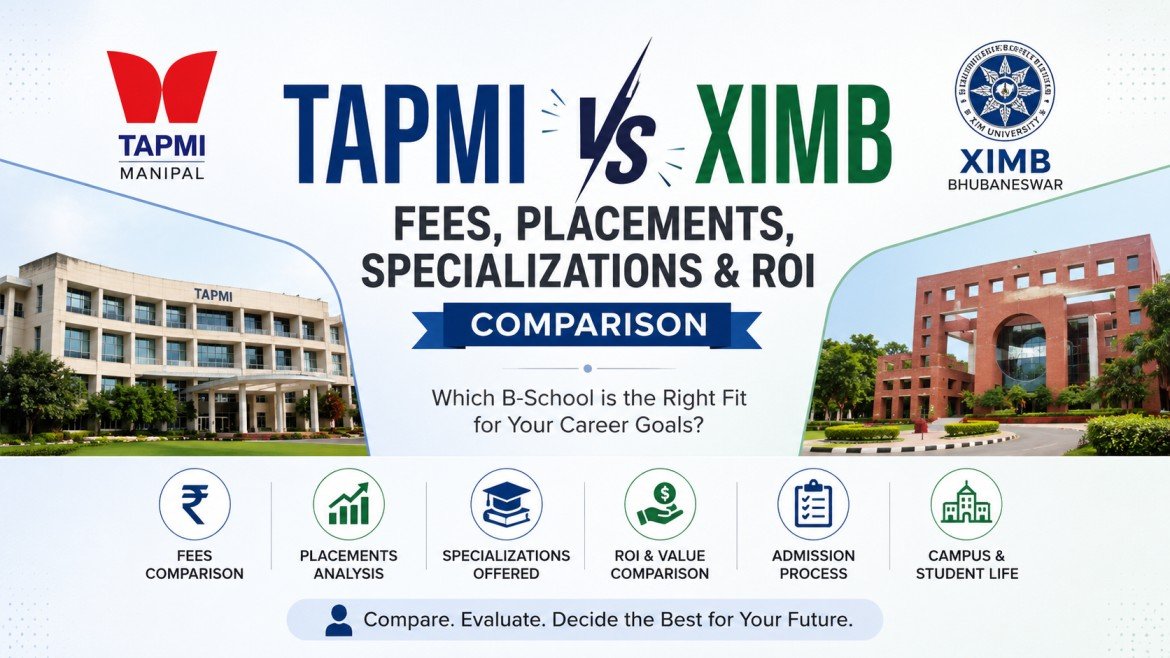
Quick Summary
- TAPMI offers lower tuition and diverse specializations, while XIMB provides a strong MBA-BM experience. Compare placement outcomes, total costs, career goals and financial priorities before choosing.
Meta Title: TAPMI vs XIMB: Fees, Placements, Specializations and ROI Comparison
Meta Description: Compare TAPMI vs XIMB on MBA fees, placements, specializations, admission process and ROI to decide which B-school is the better fit for your career goals.
TAPMI vs XIMB: Fees, Placements, Specializations and ROI Comparison
Choosing between TAPMI Manipal and XIMB Bhubaneswar can be difficult because both institutions are well-known options for students targeting management careers. The TAPMI vs XIMB decision becomes especially important when you compare not only brand reputation but also total fees, placement outcomes, program structure, specializations, location, peer group and long-term return on investment.
TAPMI, or T. A. Pai Management Institute in Manipal, offers multiple MBA programmes across areas such as general management, banking and financial services, HRM, international business, marketing, AI and data science. XIMB, formally associated with Xavier Institute of Management under XIM University, is particularly recognised for its MBA-Business Management programme.
For students making the TAPMI vs XIMB decision in 2026, the most practical question is not simply which institute is "better." The better institute depends on your preferred specialization, budget, target industry and career objectives.
TAPMI vs XIMB at a Glance
| Factor | TAPMI Manipal | XIMB / XIM University |
|---|---|---|
| Main programme | MBA and specialized MBA programmes | MBA-Business Management |
| Location | Manipal, Karnataka | Bhubaneswar, Odisha |
| 2026 tuition | ₹9.75 lakh per year for listed MBA programmes | MBA-BM course fee ₹11.5 lakh per year |
| Approximate course tuition | ₹19.5 lakh over two years | ₹23 lakh over two years |
| Other programme charges | Separate university/hostel-related charges may apply | Development fund, materials, IT and other charges apply |
| Placement data | Official 2025 report available | Latest placement information should be checked programme-wise |
| Specialization range | Broad | MBA-BM is the flagship business management programme |
| Admission tests | CAT, XAT, GMAT and programme-specific criteria as applicable | CAT, XAT, GMAT or XGMT for MBA-BM |
| Best suited for | Students wanting programme choice | Students focused on a traditional MBA-BM experience |
The 2026 fee figures above should be read carefully because total expenditure can change after including accommodation, food, refundable deposits and other institutional charges. TAPMI's official admissions information lists ₹9.75 lakh annual tuition for its Indian-domicile MBA programmes, while XIM University's 2026 MBA-BM fee structure includes ₹11.5 lakh course fee per year plus additional institutional charges.
TAPMI vs XIMB: Which College Has the Stronger Overall Profile?
The TAPMI vs XIMB comparison is close because the institutions appeal to slightly different student priorities.
TAPMI has the advantage of offering a wider portfolio of MBA programmes. A student interested in banking and financial services, human resources, international business, marketing or AI and data science can select a programme more closely aligned with a specific career direction.
XIMB's MBA-BM, on the other hand, appeals to students seeking a broad business management education. For many applicants, the Xavier brand, alumni network and established MBA-BM identity are important considerations.
Therefore, the TAPMI vs XIMB decision should begin with a simple question: Do you already know your preferred specialization?
If the answer is yes, TAPMI's programme variety may be particularly attractive. If you prefer a broad MBA-BM route and want to choose your specialization and career direction through the wider management curriculum, XIMB may be more suitable.
TAPMI vs XIMB Fees Comparison
Fees are one of the most important parts of the TAPMI vs XIMB comparison.
TAPMI Fees
For the 2026 admission cycle, TAPMI lists annual tuition of ₹9.75 lakh for Indian-domicile students across programmes including:
- MBA
- MBA-BKFS
- MBA-HRM
- MBA-International Business
- MBA-Marketing
- MBA-Technology Management
- MBA-AI & Data Science
Based on the published annual tuition, the two-year tuition component is approximately ₹19.5 lakh before considering other applicable expenses. TAPMI also indicates that hostel and mess charges are updated separately.
XIMB MBA-BM Fees
XIM University's published 2026 fee structure lists the following for MBA-Business Management:
- First-year course fee: ₹11.5 lakh
- Second-year course fee: ₹11.5 lakh
- Development fund: ₹1 lakh
- Course materials: ₹40,000 per year
- IT expenses: ₹20,000 per year
- University alumni activities fee: ₹10,000
- Career advisory services: ₹50,000
- Refundable deposit: ₹20,000
These figures mean that the actual programme expenditure is higher than the ₹23 lakh headline course-fee figure once mandatory institutional charges are included. Students should also separately budget for residence and personal living expenses.
Which Is More Affordable: TAPMI or XIMB?
On the published 2026 tuition figures, TAPMI has a lower headline tuition level than XIMB MBA-BM.
However, a proper TAPMI vs XIMB cost comparison should include:
- Tuition fees
- Development and institutional charges
- Hostel fees
- Food and mess expenses
- Travel
- Laptop and academic requirements
- Summer internship relocation expenses
- Opportunity cost of leaving employment
- Education-loan interest
Students should therefore avoid choosing an MBA institute only by comparing the tuition fee shown in advertisements.
TAPMI vs XIMB Placements
Placements are often the deciding factor in the TAPMI vs XIMB debate.
TAPMI Placement Performance
TAPMI has published detailed placement information for its 2025 graduating batches. For the MBA-General programme, the official 2025 placement report states:
- 100% placement for interested students
- 340 students placed
- Average CTC: ₹13.99 lakh per annum
- Highest CTC: ₹32.77 lakh per annum
- Average CTC for the top 50: ₹18.19 lakh per annum
- Average CTC for the top 100: ₹16.74 lakh per annum
- 89 participating companies
- 58 PPOs
The report also provides sector-level information. IT and analytics, consulting, BFSI and other industries contributed to the placement outcomes.
XIMB Placement Perspective
When comparing TAPMI vs XIMB placements, students should always ensure that they compare equivalent programmes and equivalent placement years.
XIM University has published information confirming that the MBA-BM and MBA-HRM batch of 2025–27 achieved 100% summer placements. Summer placements should not be confused with final placements because internship outcomes and final job outcomes represent different stages of the MBA journey.
This distinction is important. A responsible TAPMI vs XIMB placements comparison should compare:
- Final placement with final placement
- Summer placement with summer placement
- Average CTC with average CTC
- Median salary where officially available
- Batch size
- Number of students participating in placements
- Percentage of students placed
- Role quality and recruiter profile
TAPMI vs XIMB: Placement Quality Matters More Than One Salary Number
Students often compare MBA colleges by asking which institute has the higher average package. That approach is incomplete.
For the TAPMI vs XIMB decision, also examine the types of jobs offered.
Questions worth asking include:
- Are the roles in consulting, finance, sales, marketing, analytics or operations?
- What percentage of students enter each sector?
- How many companies are repeat recruiters?
- How many students receive PPOs?
- What are the median salary and salary distribution, if officially disclosed?
- Are high packages concentrated among only a small number of students?
- Does the institute have strong recruiter relationships in your target function?
A student who wants a finance career may value different recruiters from a student targeting FMCG sales or management consulting.
TAPMI vs XIMB Specializations
One of the clearest differences in the TAPMI vs XIMB comparison is programme structure.
TAPMI Specializations and MBA Options
TAPMI's 2026 admissions information lists several MBA programmes, including:
- MBA
- MBA-Banking and Financial Services
- MBA-Human Resource Management
- MBA-International Business
- MBA-Marketing
- MBA-Technology Management
- MBA-Artificial Intelligence and Data Science
The MBA-Technology Management programme is based at TAPMI Bengaluru, while MBA-AI and Data Science combines management learning with technology and data-focused instruction.
This programme diversity gives TAPMI an advantage for students who have already identified a career direction.
XIMB MBA-BM
XIMB's flagship MBA-Business Management programme is designed as a two-year management programme. The 2026 admissions information states that candidates are expected to have a bachelor's degree with at least 55% aggregate marks, subject to the stated conditions and eligibility requirements.
For students who want a broad management education rather than selecting a narrowly branded programme at the application stage, the MBA-BM format can be appealing.
TAPMI vs XIMB ROI Comparison
Return on investment is more complicated than subtracting total fees from the average placement package.
A practical MBA ROI calculation should consider:
ROI = Career value gained + expected earnings growth + professional network + role quality − total financial and opportunity cost
For the TAPMI vs XIMB ROI comparison, students should consider three scenarios.
Scenario One: Student with No Work Experience
For a fresher, the MBA may provide the first major corporate opportunity. In this case, placement quality, job function and long-term career growth may matter more than immediate salary.
Scenario Two: Student With Two to Four Years of Experience
A working professional should compare the post-MBA role with their existing career trajectory. The opportunity cost of leaving a job can be substantial.
Scenario Three: Student Taking a Large Education Loan
For a loan-funded MBA, calculate:
- Total course cost
- Living cost
- Interest during the study period
- EMI after graduation
- Expected post-MBA take-home salary
In this situation, a ₹2–3 lakh difference in published tuition may become much larger after interest and other expenses.
TAPMI vs XIMB: Which Has Better ROI?
TAPMI may offer a stronger immediate cost advantage based on published 2026 tuition figures. XIMB may justify its higher programme cost for students who place greater value on its MBA-BM identity, network and career opportunities.
There is no universal winner in the TAPMI vs XIMB ROI debate.
The better ROI is the programme that gives you the strongest realistic probability of entering your desired career path without creating an unsustainable financial burden.
TAPMI vs XIMB Admission Process
TAPMI Admission
TAPMI's official admissions information confirms that the institution has an active MBA admission cycle for 2026 and lists multiple MBA programmes. Applicants should use only the official TAPMI admissions portal and verify programme-specific eligibility and test-score requirements before applying.
XIMB MBA-BM Admission
For the 2026 cycle, XIM University's MBA-BM information states that candidates may apply using:
- XAT
- CAT
- GMAT within the specified eligible period
- XGMT
The selection process considers test performance and subsequent selection stages, along with academic background and relevant work experience. The published 2026 eligibility requirement includes a minimum 55% aggregate in a recognized bachelor's degree.
TAPMI vs XIMB Campus Location and Student Experience
TAPMI is located in Manipal, Karnataka, a well-known university town with a large student population and a strong academic environment.
XIMB is associated with XIM University in Bhubaneswar, Odisha. Students should consider location beyond the campus itself.
Think about:
- Distance from home
- Cost of travel
- Climate
- Access to internships
- Alumni activity in nearby cities
- Industry exposure
- Personal comfort with the region
Neither Manipal nor Bhubaneswar is automatically better for every student. Campus fit matters because an MBA is an intensive two-year experience.
TAPMI vs XIMB for Finance
Students targeting finance should examine:
- BFSI recruiter presence
- Banking and financial services curriculum
- Finance electives
- Roles offered during summer internships
- PPO conversion
- Alumni working in finance
TAPMI has a dedicated MBA-Banking and Financial Services programme, which may be attractive to students who are already committed to the BFSI sector. However, applicants should compare the curriculum and placement roles carefully before assuming that a programme name automatically guarantees a particular job function.
TAPMI vs XIMB for Marketing
TAPMI offers a dedicated MBA-Marketing programme. This can appeal to students interested in:
- Brand management
- Sales
- FMCG
- Consumer business
- Digital marketing
- Retail
- Category management
For XIMB applicants, the broader MBA-BM structure may appeal to students who want flexibility before committing fully to one management function.
The better choice depends on whether you prefer specialization from the beginning or broader management exposure.
TAPMI vs XIMB for Consulting
Consulting-focused applicants should not rely only on an institute's overall placement percentage.
Study:
- Consulting recruiters
- Job roles
- Number of students entering consulting
- Summer internship opportunities
- Academic profile of the batch
- Alumni presence in consulting firms
The TAPMI vs XIMB decision for consulting should therefore be based on the latest official placement data available at the time of your admission decision.
TAPMI vs XIMB for Freshers
Freshers should focus on:
- Curriculum support
- Internship preparation
- Placement training
- Batch size
- Alumni accessibility
- Career services
- Industry projects
TAPMI may be attractive because students can choose programmes aligned with specific interests. XIMB may appeal to students seeking a broad MBA-BM experience and an established management-school environment.
TAPMI vs XIMB for Experienced Professionals
Candidates with work experience should ask a more demanding question:
Will the MBA help me move into a better role, function, industry or salary trajectory?
Before selecting TAPMI or XIMB, compare:
- Your current salary
- Expected opportunity cost
- Post-MBA roles
- Career-switch probability
- Alumni outcomes
- Loan repayment capacity
For an experienced candidate, an MBA should ideally create a meaningful career transition rather than only provide a new qualification.
TAPMI vs XIMB: Brand and Alumni Network
Brand value is difficult to measure using a single number.
An MBA brand creates value through:
- Alumni access
- Recruiter familiarity
- Faculty reputation
- Corporate relationships
- Geographic presence
- Peer network
Both institutions have established identities in Indian management education. Instead of asking which brand is universally superior, students should examine where graduates from the specific programme are working.
LinkedIn alumni searches can be particularly useful for identifying:
- Common employers
- Job functions
- Career progression
- Geographic distribution
This is often more useful than relying entirely on college-ranking discussions.
TAPMI vs XIMB: Scholarships and Financial Support
TAPMI's 2026 admissions information includes the Dr. Ramdas M. Pai Scholarships for the 2026–28 batch, with eligible students potentially receiving up to a 100% tuition-fee waiver under selected scholarship categories.
XIM University also publishes programme-specific fee information and scholarship-related policies. Students should read the exact eligibility criteria rather than assuming that a scholarship applies automatically to all applicants.
A scholarship can significantly change the TAPMI vs XIMB ROI calculation.
What Should You Check Before Paying the Admission Fee?
Before making a final TAPMI vs XIMB decision, download the latest official documents and verify:
- Total tuition
- Mandatory additional fees
- Hostel charges
- Refundable deposits
- Scholarship conditions
- Placement report year
- Number of students in the batch
- Placement participation criteria
- Median and average salary, where available
- Recruiter list
- Programme location
- Admission withdrawal and refund rules
This final verification is important because MBA fees and admissions policies can change between application cycles.
TAPMI vs XIMB: Pros and Cons
TAPMI Advantages
- Multiple specialized MBA programmes
- Published 2026 tuition information
- Official placement reports for recent graduating batches
- Options across finance, HR, marketing, international business and technology-related fields
- Scholarship opportunities for eligible candidates
TAPMI Considerations
- Students must choose the programme carefully
- Total cost extends beyond headline tuition
- Placement outcomes can vary by programme
- Specialized programme names should be matched with actual career goals
XIMB Advantages
- Established MBA-BM programme
- Broad business management focus
- Multiple accepted admission tests for the published 2026 cycle
- Strong management-school identity
- Active industry and summer-placement ecosystem
XIMB Considerations
- Higher published MBA-BM course fee than TAPMI's listed annual tuition
- Additional institutional charges should be included in the total cost
- Students should verify the latest final-placement figures before making the final admission decision
- ROI depends heavily on individual role and career outcome
TAPMI vs XIMB: Who Should Choose TAPMI?
Choose TAPMI if:
- You want a dedicated programme in a specific management area.
- You are interested in banking, HR, marketing, international business or AI and data science.
- You want to evaluate a lower published tuition level compared with XIMB MBA-BM.
- You prefer the Manipal academic environment.
- You find the programme curriculum closely aligned with your target career.
TAPMI vs XIMB: Who Should Choose XIMB?
Choose XIMB if:
- You want a broad MBA-Business Management programme.
- You value the XIM University and Xavier Institute of Management ecosystem.
- You prefer the Bhubaneswar location.
- You are comfortable with the published fee structure.
- Your career goals align with the MBA-BM programme and its recruiter ecosystem.
The Final Verdict on TAPMI vs XIMB
The TAPMI vs XIMB comparison does not have a single answer for every MBA applicant.
TAPMI is particularly attractive for students who want programme variety and a clearly defined specialization. Its 2026 published tuition is lower than the MBA-BM course fee listed by XIM University, although students must calculate the complete cost of attendance rather than comparing tuition alone.
XIMB is a strong option for students who want a broad MBA-Business Management experience and value the Xavier management ecosystem.
If fees and ROI are your biggest priorities, calculate the complete two-year cost and compare it against realistic—not best-case—career outcomes. If specialization is your biggest priority, TAPMI's wider programme portfolio deserves close attention. If you prefer a broad MBA-BM identity, XIMB may be the better fit.
The best decision is the one that matches your career target, financial capacity and preferred learning environment.
Frequently Asked Questions
Is TAPMI better than XIMB?
Neither is universally better. TAPMI may be more suitable for students seeking specialized MBA programmes, while XIMB may be preferred by students looking for a broad MBA-Business Management experience.
Which is cheaper, TAPMI or XIMB?
Based on published 2026 course fees, TAPMI lists ₹9.75 lakh annual tuition for its listed MBA programmes, while XIM University's MBA-BM course fee is ₹11.5 lakh per year before additional charges.
Does TAPMI have good placements?
TAPMI's official 2025 MBA-General placement report recorded 100% placement for interested students, with an average CTC of ₹13.99 lakh and a highest CTC of ₹32.77 lakh.
Which is better for finance, TAPMI or XIMB?
TAPMI may have an advantage for students who specifically want a banking and financial services-focused programme. However, students should compare current recruiter roles and programme outcomes before making a decision.
Which entrance exams are accepted by XIMB MBA-BM?
For the published 2026 cycle, XIM University listed XAT, CAT, GMAT and XGMT as accepted admission-test routes for MBA-BM.
Is TAPMI worth the fees?
TAPMI's value depends on the programme selected, total financial cost and career outcome. Students should compare the full cost with realistic post-MBA salary and career-growth expectations.
Is XIMB worth the fees?
XIMB can be worthwhile for students whose career goals align with the MBA-BM programme and who are comfortable with the total programme and living costs.
What should I choose between TAPMI and XIMB?
Compare your specialization preference, total budget, placement goals, location preference and expected career path. Avoid choosing only on the basis of one placement-package number.
Sources
Official admissions, fee and placement information should be checked directly through TAPMI Admissions, TAPMI Placement Reports, XIM University MBA-BM Admissions and XIM University 2026 Fee Structure before making a final admission decision.
This article follows the requested publication-ready format and topic brief.
Search Keywords
tapmi vs ximb, TAPMI vs XIMB placements, TAPMI vs XIMB fees, TAPMI vs XIMB ROI, TAPMI Manipal vs XIMB Bhubaneswar, XIMB vs TAPMI MBA, TAPMI MBA fees, XIMB MBA fees, TAPMI placement package, XIMB placement package, TAPMI average package, XIMB average package, TAPMI highest package, XIMB highest package, TAPMI MBA placement 2025, XIMB MBA placement 2026, TAPMI MBA ROI, XIMB MBA ROI, TAPMI Manipal fees 2026, XIMB fees 2026, TAPMI MBA admission, XIMB MBA admission, TAPMI eligibility, XIMB eligibility, TAPMI CAT cutoff, XIMB CAT cutoff, TAPMI XAT cutoff, XIMB XAT cutoff, TAPMI MBA specializations, XIMB MBA specializations, TAPMI marketing MBA, TAPMI finance MBA, TAPMI MBA BKFS, TAPMI MBA HRM, TAPMI MBA international business, TAPMI MBA AI and data science, XIMB MBA BM, XIMB business management, TAPMI vs XIMB for finance, TAPMI vs XIMB for marketing, TAPMI vs XIMB for consulting, TAPMI vs XIMB for freshers, TAPMI vs XIMB for experienced candidates, TAPMI campus life, XIMB campus life, TAPMI Manipal campus, XIMB Bhubaneswar campus, best MBA college TAPMI or XIMB, is TAPMI better than XIMB, is XIMB better than TAPMI, TAPMI review, XIMB review, TAPMI MBA review, XIMB MBA review, TAPMI placements fees ROI, XIMB placements fees ROI, TAPMI course fee, XIMB course fee, TAPMI hostel fees, XIMB hostel fees, TAPMI scholarship, XIMB scholarship, TAPMI MBA salary, XIMB MBA salary, TAPMI recruiter list, XIMB recruiter list, TAPMI summer placements, XIMB summer placements, TAPMI PPO, XIMB PPO, TAPMI alumni network, XIMB alumni network, TAPMI MBA batch size, XIMB MBA batch size, TAPMI MBA programme, XIMB flagship MBA, TAPMI banking and financial services, XIMB business management programme, MBA colleges comparison India, best private MBA colleges India, top MBA colleges for CAT, top MBA colleges for XAT, MBA ROI India, MBA placement comparison, MBA fees comparison India, TAPMI admission process 2026, XIMB admission process 2026, TAPMI MBA 2026, XIMB MBA 2026, TAPMI or XIMB which is better, TAPMI vs XIMB salary comparison, TAPMI vs XIMB placement comparison, TAPMI vs XIMB fee comparison, TAPMI vs XIMB specialization comparison, TAPMI vs XIMB brand value, TAPMI vs XIMB alumni network, TAPMI vs XIMB career opportunities, TAPMI vs XIMB campus comparison, TAPMI vs XIMB cutoff comparison, TAPMI vs XIMB admission comparison, TAPMI vs XIMB MBA comparison, TAPMI vs XIMB final placements, TAPMI vs XIMB average CTC, TAPMI vs XIMB highest CTC, TAPMI vs XIMB total cost, TAPMI vs XIMB education loan, TAPMI vs XIMB scholarship comparison, TAPMI vs XIMB 2026
Long-Tail & Short-Tail Searches
Which is better TAPMI or XIMB for MBA, TAPMI vs XIMB which college should I choose, TAPMI vs XIMB placements comparison 2026, TAPMI vs XIMB fees and ROI comparison, is TAPMI worth joining for MBA, is XIMB worth joining for MBA, which college has better placements TAPMI or XIMB, which college has lower fees TAPMI or XIMB, TAPMI vs XIMB for finance career, TAPMI vs XIMB for marketing career, TAPMI vs XIMB for consulting jobs, TAPMI vs XIMB for BFSI jobs, TAPMI vs XIMB for freshers, TAPMI vs XIMB after work experience, how much is TAPMI MBA total fee, how much is XIMB MBA total fee, what is the average package at TAPMI, what is the latest placement package at XIMB, does TAPMI accept CAT score, does XIMB accept CAT score, does TAPMI accept XAT score, does XIMB accept XAT score, what is the ROI of TAPMI MBA, what is the ROI of XIMB MBA, which MBA specialization is best at TAPMI, what is MBA-BM at XIMB, where is TAPMI located, where is XIMB located, should I take a loan for TAPMI MBA, should I take a loan for XIMB MBA, TAPMI vs XIMB salary after MBA, TAPMI vs XIMB recruiter comparison, TAPMI vs XIMB alumni comparison, TAPMI vs XIMB brand comparison, TAPMI vs XIMB campus life comparison, TAPMI vs XIMB student review comparison, which has better finance placements TAPMI or XIMB, which has better marketing opportunities TAPMI or XIMB, which has better consulting opportunities TAPMI or XIMB, how to choose between TAPMI and XIMB, TAPMI MBA career opportunities after graduation, XIMB MBA career opportunities after graduation, TAPMI vs XIMB complete comparison, TAPMI vs XIMB MBA decision, best MBA college between TAPMI and XIMB, TAPMI Manipal MBA worth it, XIMB Bhubaneswar MBA worth it, TAPMI or XIMB for long-term career growth, TAPMI vs XIMB education loan repayment, TAPMI vs XIMB placement report comparison, TAPMI vs XIMB total MBA cost, TAPMI vs XIMB scholarships and financial aid, TAPMI vs XIMB admission requirements, TAPMI vs XIMB for CAT aspirants, TAPMI vs XIMB for XAT aspirants, which MBA college offers better value for money TAPMI or XIMB.
Key Takeaways
TAPMI offers multiple specialized MBA programmes across finance, marketing, HR, international business and technology.
XIMB's MBA-BM programme is suitable for students seeking a broad business management education.
TAPMI has a lower published tuition cost compared with XIMB's MBA-BM fee structure.
ROI should be calculated using total expenses, education-loan costs and realistic career outcomes.
Placement quality and job roles matter more than comparing only the highest salary package.
TAPMI may be a stronger option for students with clearly defined specialization preferences.
XIMB may appeal to students who prefer a traditional and broad MBA-Business Management experience.
Students should compare the latest official placement reports before making their final decision.
Scholarships can significantly improve the financial value of either MBA programme.
The final TAPMI vs XIMB decision should depend on career goals, specialization, budget, location and long-term professional growth.
Ask a question
Still confused? Leave your question and our team will help you.