
Quick Summary
- TAPMI IPM combines undergraduate and postgraduate management education, accepting IPMAT, JIPMAT, JEE Main, SAT, CLAT, and MET, with academic screening, interviews, micro-presentation, and merit-based selection.
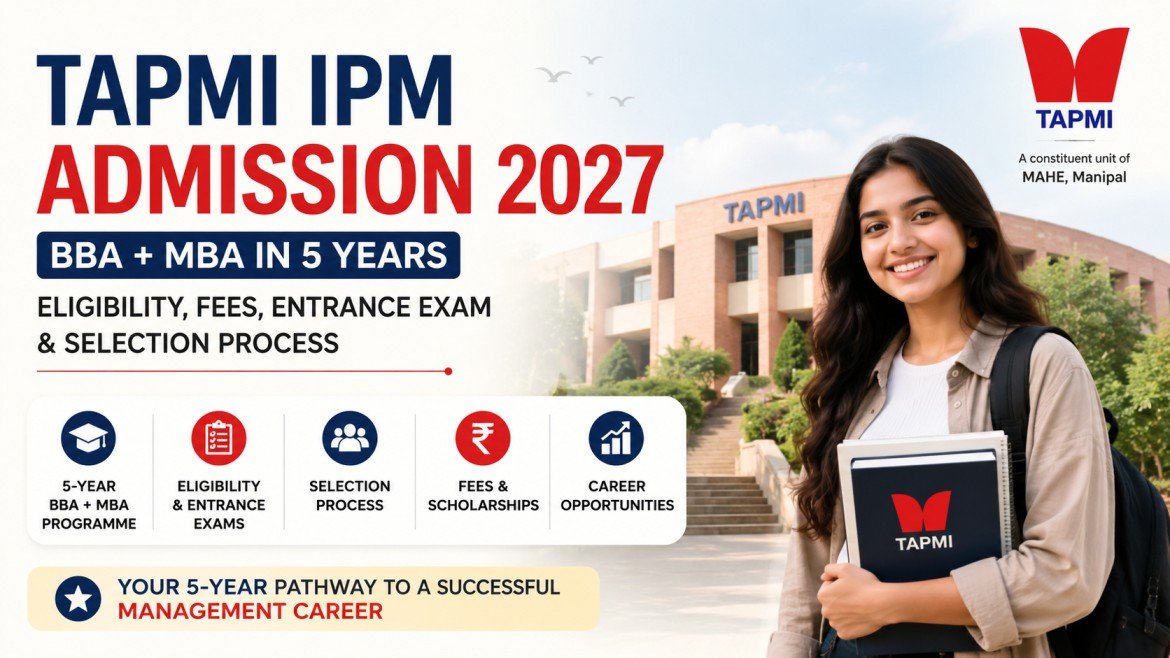
If you are looking for a five-year management programme that combines undergraduate and postgraduate education, TAPMI IPM admission 2027 is an option worth evaluating. The Integrated Programme in Management (IPM) at T A Pai Management Institute (TAPMI), Manipal is designed as a five-year BBA + MBA pathway. Students complete the undergraduate stage first and then progress into the MBA stage, subject to the programme's academic and progression requirements.
TAPMI introduced its Integrated Programme in Management in 2023. The programme is built around multidisciplinary learning, combining management with areas such as humanities, social sciences, analytics, psychology, sustainability and public policy. TAPMI describes the programme as a five-year dual-degree route, with an option to exit after three years with a BBA.
For students planning TAPMI IPM admission 2027, one important point needs to be kept in mind: the institute's detailed 2027 admission schedule and final fee structure may not yet be available. The latest officially published undergraduate admission information currently available is for the 2026 cycle. Therefore, 2026 figures should be treated as the latest verified reference point rather than automatically assuming they will remain unchanged for 2027.
The latest official information shows that TAPMI accepts several entrance examinations for IPM, including IPMAT, JIPMAT, JEE Main, SAT, CLAT and MET. Shortlisting considers academic performance, and shortlisted candidates are required to participate in an online interview and micro-presentation.
This article explains TAPMI IPM admission 2027, including eligibility, entrance exams, fees, admission process, selection criteria, scholarships, curriculum, placement considerations, career opportunities and the practical questions students should consider before applying.
TAPMI IPM Admission 2027: Quick Overview
| Particular | Details |
|---|---|
| Institute | T A Pai Management Institute (TAPMI), Manipal |
| Programme | Integrated Programme in Management (IPM) |
| Duration | 5 years |
| Degree structure | BBA + MBA |
| Undergraduate stage | First 3 years |
| Postgraduate stage | Final 2 years |
| Exit option | BBA after 3 years, subject to programme requirements |
| Minimum Class 12 aggregate | 60% based on latest published criteria |
| Class 10 requirement | 60% based on TAPMI's undergraduate admissions page |
| English | Compulsory subject in Class 12 |
| Accepted entrance tests | IPMAT, JIPMAT, JEE Main, SAT, CLAT, MET |
| Selection components | Academic profile, entrance test, interview, micro-presentation and extracurricular achievements |
| Latest verified total IPM fee | ₹29.05 lakh for the 2026-27 batch, including the refundable caution deposit |
| Campus | TAPMI Manipal |
| 2027 dates | To be confirmed by TAPMI |
The eligibility and fee figures in this table are based on TAPMI's currently published undergraduate/IPM information. The 2027 admission cycle should be checked against the official notification once released.
What Is TAPMI IPM?
The TAPMI Integrated Programme in Management is a five-year integrated management programme offered at TAPMI, Manipal. Instead of completing a separate undergraduate degree followed by a separate MBA admission process, students enter a structured five-year programme that combines BBA-level education with MBA-level management education.
According to TAPMI, the first three years culminate in a Bachelor of Business Administration, while the final two years lead to a Master of Business Administration. The curriculum begins with foundational disciplines and gradually moves towards management subjects, research and advanced electives.
The programme is particularly relevant for students who already know that they want to build a career in business, management, consulting, finance, marketing, entrepreneurship, analytics or related fields.
The five-year structure can also provide continuity. A student does not have to complete a conventional three-year undergraduate programme and then separately prepare for MBA entrance examinations after graduation.
However, students should not interpret the integrated structure as a guarantee of automatic progression into every stage without conditions. Academic performance and the institute's applicable progression rules remain important.
How Does the TAPMI BBA + MBA Structure Work?
The most distinctive feature of the programme is its integrated BBA + MBA design.
During the initial years, students build a broad academic foundation. This stage can expose students to management fundamentals as well as disciplines outside conventional business education.
TAPMI states that the programme includes areas such as:
- Management
- Psychology
- Sociology
- Sustainability
- Analytics
- Public policy
- Humanities
- Social sciences
- Technology
- Ethics
- Experiential learning
The programme also incorporates project-based courses, simulations, workshops and real-world applications. TAPMI describes social and industry internships as part of the learning experience.
The later part of the programme moves towards advanced management education.
This structure can be useful for students who want to develop business knowledge without treating management as an isolated subject. For example, a future marketing professional may benefit from understanding consumer psychology, while someone interested in analytics may need management knowledge alongside quantitative skills.
Is TAPMI IPM the Same as IIM IPM?
No.
This is an important distinction for students researching TAPMI IPM admission 2027.
The word "IPM" refers to Integrated Programme in Management, but several institutions offer programmes with that name. TAPMI's IPM is a programme offered by TAPMI under the Manipal Academy of Higher Education ecosystem. It should not be confused with the IPM programmes offered by IIM Indore, IIM Rohtak, IIM Jammu, IIM Bodh Gaya or other institutes.
TAPMI does, however, accept IPMAT scores as one of the entrance-test routes for its IPM admission process. The official TAPMI admission page lists IPMAT conducted by IIM Indore among the accepted examinations.
Therefore, a student preparing for IPMAT can potentially use that examination score for TAPMI as well, subject to the applicable admission cycle's rules.
TAPMI IPM Eligibility Criteria
The TAPMI IPM eligibility requirements are an important part of the application process.
Based on the latest official TAPMI information, candidates need to satisfy the academic requirements and appear in an accepted entrance examination.
Class 12 Eligibility
TAPMI's currently published IPM criteria require candidates to have passed the Higher Secondary Certificate, or 10+2/equivalent examination, from a recognized board with at least 60% aggregate marks.
The currently published eligibility information refers to candidates who passed in 2023, 2024 or 2025 or were appearing in 2026. These years belong to the 2026 admission cycle and should not automatically be treated as the 2027 eligibility window.
For TAPMI IPM admission 2027, students should therefore wait for the 2027 notification to confirm the exact qualifying examination years.
Class 10 Requirement
TAPMI's undergraduate admissions page currently states a minimum of 60% in Class 10 as well as 60% in Class 12.
This is worth checking carefully because the IPM-specific page and the broader undergraduate admissions page present eligibility information in slightly different contexts. Candidates should rely on the final 2027 admission notification for the exact eligibility conditions applicable to their batch.
English Requirement
English must be a compulsory subject in the HSC/10+2 examination according to TAPMI's currently published IPM criteria.
Entrance Examination Requirement
Meeting the academic criteria alone is not enough.
Candidates must also have appeared in one of the entrance tests accepted by TAPMI for IPM. The currently listed examinations are:
- IPMAT conducted by IIM Indore
- JIPMAT
- JEE Main
- SAT
- CLAT
- Manipal Entrance Test (MET)
TAPMI notes that these entrance scores are used for shortlisting, while the examination-conducting bodies have no role in TAPMI's final selection process.
TAPMI IPM Entrance Exam
One of the advantages of the TAPMI admission route is that students are not restricted to a single management entrance examination.
The TAPMI IPM entrance exam requirement can be fulfilled through one of several accepted tests.
| Entrance Test | Accepted for TAPMI IPM? |
|---|---|
| IPMAT | Yes |
| JIPMAT | Yes |
| JEE Main | Yes |
| SAT | Yes |
| CLAT | Yes |
| MET | Yes |
This gives students flexibility.
For example, a student already preparing seriously for IPMAT may use the same examination score for TAPMI. A student preparing for engineering entrances may potentially use JEE Main. A student targeting law entrances may have CLAT as another route.
However, students should distinguish between being eligible to apply and being competitive for selection. TAPMI's published criteria do not provide a single universal numerical "cutoff" for every accepted examination.
TAPMI IPM Cutoff: Is There a Fixed Cutoff?
The term TAPMI IPM cutoff is frequently searched by applicants, but it should be interpreted carefully.
TAPMI's official IPM admission information states that candidates are shortlisted using a minimum aggregate score of 60% in both Class 10 and Class 12, followed by an online interview and micro-presentation for shortlisted candidates. Final selection considers multiple factors rather than only one entrance-exam number.
TAPMI does not currently publish a simple official statement saying that, for example, "every applicant must score exactly X percentile in IPMAT" for IPM.
Therefore, websites that publish a specific unofficial TAPMI IPM cutoff should not automatically be treated as authoritative.
A safer approach is to separate three concepts:
Eligibility threshold: the minimum academic requirements needed to apply.
Shortlisting: the institute's process for deciding which eligible applicants proceed to the interview/micro-presentation stage.
Final selection: the overall assessment used to make admission decisions.
These are not necessarily the same thing.
TAPMI IPM Admission Process
The TAPMI IPM admission process involves multiple stages.
The latest official process can be broadly understood as follows.
Online Application
Candidates submit the application online through TAPMI/Manipal's official admission system.
TAPMI explicitly states that it does not accept hard-copy applications for this programme. Applications are submitted online.
The official application system is hosted through the Manipal admission ecosystem.
Academic Screening
The academic profile is an important part of the process.
TAPMI's currently published IPM criteria specify a minimum aggregate of 60% in both Class 10 and Class 12 for shortlisting.
Students should therefore avoid treating entrance-test preparation as the only part of their profile.
Entrance-Test Score
The entrance test forms another component of the application.
The accepted routes currently include IPMAT, JIPMAT, JEE Main, SAT, CLAT and MET.
Interview and Micro-Presentation
Shortlisted candidates are informed through their registered email address and are required to participate in an online interview and micro-presentation.
TAPMI states that the interview and micro-presentation together take approximately 20–25 minutes.
This means that students should prepare for more than mathematical or aptitude questions.
A candidate may need to explain:
- Why management?
- Why an integrated BBA + MBA programme?
- Why TAPMI?
- What are their interests?
- What have they learned outside school?
- Which business or social issue interests them?
- What activities have they participated in?
- What career direction do they currently see for themselves?
Final Selection
According to TAPMI, final selection is based on:
- Class 10 and Class 12 academic profile
- English proficiency
- Entrance-test performance
- Personal interview
- Micro-presentation
- Extracurricular achievements
This makes the admission process broader than simply obtaining a qualifying entrance score.
TAPMI IPM Micro-Presentation
The micro-presentation is an important part of the selection process because it tests how effectively a student can organize and communicate an idea.
A good micro-presentation is not necessarily about using complicated vocabulary.
The stronger approach is usually to:
- Understand the topic.
- Decide the central message.
- Organize two or three supporting points.
- Give a relevant example.
- Finish with a clear conclusion.
Students should practice speaking within a limited time while maintaining clarity.
For TAPMI IPM admission 2027, candidates should also be prepared for topics involving business, technology, society, education, sustainability, entrepreneurship and current affairs.
TAPMI IPM Interview Preparation
The personal interview can be approached differently from a conventional entrance examination.
The interview panel may be interested in understanding the candidate rather than simply checking whether the candidate can solve aptitude questions.
Students should be comfortable discussing:
- Academic background
- School subjects
- Hobbies
- Extracurricular activities
- Leadership experiences
- Achievements
- Current affairs
- Business interests
- Career goals
- Why management
- Why an integrated programme
- Why TAPMI
A student who says that they want to pursue management should also be able to explain what interests them about management.
For example, saying "I want to become a successful businessman" is less informative than explaining a specific interest in entrepreneurship, consumer behaviour, technology-driven businesses, finance or strategy.
TAPMI IPM Fees
The TAPMI IPM fees are one of the most important factors for applicants and parents.
The latest official fee information for the 2026-27 batch lists the total IPM fee at ₹29,05,000, including a refundable caution deposit of ₹40,000.
The published programme structure shows the following annual course-fee figures:
| Year | Course Fee | Other/Deposit Information |
|---|---|---|
| Year 1 | ₹5,53,000 | ₹40,000 refundable caution deposit |
| Year 2 | ₹5,53,000 | — |
| Year 3 | ₹5,53,000 | — |
| Year 4 | ₹6,03,000 | — |
| Year 5 | ₹6,03,000 | — |
| Total | ₹28,65,000 course fee | ₹40,000 refundable caution deposit |
| Total including caution deposit | ₹29,05,000 | Refundable deposit included |
The official Manipal fee document for the 2026-27 batch confirms a five-year duration, five annual installments, ₹40,000 refundable caution deposit and total batch fees of ₹29.05 lakh.
Will TAPMI IPM Fees Increase for 2027?
This cannot be confirmed until TAPMI publishes the applicable 2027 fee schedule.
Students researching TAPMI IPM fees for 2027 should therefore use ₹29.05 lakh as the latest verified 2026-27 reference, not as a guaranteed 2027 price.
There can also be expenses beyond the headline programme fee, such as personal living expenses, travel, books, laptops and other student-related costs. Students should review the final fee document carefully before making a financial decision.
TAPMI IPM Application Fee
For the latest published IPM admission cycle, TAPMI lists a non-refundable application fee of ₹800.
Candidates who appear for TAPMI MET may have an additional ₹1,200 fee associated with the MET route. Bank or payment-gateway processing charges may also apply.
The 2027 application fee should be confirmed when the next application form opens.
TAPMI IPM Scholarships
Financial assistance can materially change the cost of a five-year programme, so students should examine scholarship policies separately from the basic admission information.
TAPMI's scholarship documentation for its MBA programmes contains a specific provision for IPM students. It states that scholarship eligibility for IPM is determined based on academic performance at the end of the third year, and scholarships are awarded to students who continue into the TAPMI MBA programme and rank highest in the applicable merit list based on their overall CGPA for the first three years, subject to the stated conditions.
This is particularly important because it means students should not assume that a scholarship at the time of initial IPM admission automatically covers all five years.
The applicable scholarship policy for the 2027 cohort should be checked when TAPMI releases it.
Does TAPMI Offer 100% Scholarships for IPM?
Students should be cautious with generic statements about "100% scholarships."
TAPMI's currently published MBA scholarship information mentions scholarship categories that can provide substantial tuition-fee waivers for MBA students. However, the specific treatment of IPM students is governed by the applicable scholarship policy, including academic performance after the first three years.
Therefore, applicants should not calculate their five-year IPM cost assuming that a full scholarship will definitely be available.
TAPMI IPM Curriculum
The curriculum is one of the distinguishing aspects of the programme.
TAPMI describes the IPM curriculum as multidisciplinary and progressively structured. Students begin with foundational disciplines and move towards core management subjects, research and advanced electives.
The programme's academic exposure includes areas such as:
- Management
- Humanities
- Social sciences
- Psychology
- Sociology
- Analytics
- Sustainability
- Public policy
- Technology
- Ethics
This design can be useful because management decisions rarely exist in isolation.
For example, marketing involves understanding human behaviour. Business analytics requires quantitative reasoning and technology. Corporate leadership requires communication and ethical judgment.
Experiential Learning at TAPMI IPM
TAPMI states that experiential learning is integrated into the IPM programme through project-based courses, simulations, workshops and practical applications.
This matters because management education is not only about memorizing frameworks.
Students can benefit from learning how to:
- Analyze a business problem
- Present a recommendation
- Work in teams
- Interpret data
- Conduct research
- Communicate with stakeholders
- Understand organizational behaviour
- Apply theoretical concepts to practical situations
The programme also includes social and industry internship components according to TAPMI's published IPM information.
International Exposure
TAPMI's undergraduate programme information highlights international university collaborations, including opportunities connected with institutions such as the University of Southampton.
International exposure can be valuable for students interested in global business, cross-cultural management and international academic experiences.
However, students should distinguish between a university tie-up and a guaranteed international semester or exchange. The exact opportunity available to a particular IPM batch depends on the applicable programme structure, partner arrangements and eligibility requirements.
TAPMI IPM Placements
Placement information requires careful interpretation.
The TAPMI IPM placement question is difficult to answer using conventional MBA placement numbers because the IPM is a relatively newer programme. TAPMI states that it launched IPM in 2023.
Therefore, older TAPMI MBA placement figures should not simply be labelled as IPM placement figures.
TAPMI separately publishes placement information and placement/internship reports. The current placement page includes employer information for MBA batches, while its reports page provides placement and internship reports for its postgraduate programmes.
For example, TAPMI's published MBA placement records for 2024-25 include employers such as JP Morgan Chase & Co., MakeMyTrip, Optiv and Himalaya. These records demonstrate the broader corporate exposure of TAPMI's management ecosystem, but they should not be interpreted as a dedicated IPM placement report.
This distinction is essential when comparing programmes.
Can TAPMI IPM Students Get Corporate Jobs?
The programme is designed to prepare students for management and business careers.
Potential career areas include:
- Consulting
- Marketing
- Finance
- Business analytics
- Human resources
- Product management
- Operations
- Sales
- Strategy
- Entrepreneurship
- Family business
- Research
- Further studies
TAPMI's undergraduate programme description specifically identifies corporate careers, entrepreneurship, family business, research and further studies as possible career tracks.
However, career outcomes depend on the student's academic record, skills, internships, specialization, communication abilities, market conditions and placement opportunities.
No college should be evaluated solely by the highest salary package reported for a different programme or year.
TAPMI IPM Career Opportunities
A five-year BBA + MBA pathway can be particularly useful for students who want to develop management skills early.
A student interested in finance may build quantitative and financial knowledge.
A student interested in marketing can combine management concepts with consumer behaviour and communication.
A student interested in analytics can develop business knowledge alongside analytical skills.
An aspiring entrepreneur can use the programme to understand finance, strategy, operations, marketing and organizational behaviour.
The value of the programme therefore depends heavily on how students use the five years.
TAPMI IPM vs Traditional BBA + MBA
One of the most practical questions for applicants is whether an integrated programme is better than completing a BBA separately and applying for an MBA later.
There is no universal answer.
| Factor | TAPMI IPM | Separate BBA + MBA |
|---|---|---|
| Structure | Integrated five-year pathway | Two separate admissions |
| Undergraduate degree | BBA | Usually BBA/BCom/other UG degree |
| MBA admission after UG | Integrated pathway | Separate MBA entrance/application |
| Flexibility | More structured | Generally more flexible |
| Early management focus | High | Depends on UG college |
| Opportunity to change institution | Lower during integrated pathway | Higher |
| Entrance preparation later | Potentially reduced need for separate MBA admission | Usually required for top MBA programmes |
| Academic continuity | High | Depends on institutions |
| Career exploration | Built into longer programme | Can vary considerably |
The biggest advantage of an integrated programme is continuity.
The biggest potential disadvantage is that a student commits to one institutional pathway at an early age.
Students who are uncertain about management may prefer a broader undergraduate route that keeps more options open.
Who Should Consider TAPMI IPM?
TAPMI IPM admission 2027 can be suitable for a student who:
- Is confident about pursuing management.
- Wants a BBA + MBA pathway.
- Is comfortable committing to a five-year programme.
- Meets the academic eligibility criteria.
- Is willing to prepare for an accepted entrance test.
- Wants multidisciplinary management education.
- Is interested in internships and experiential learning.
- Wants exposure to business and management from an early stage.
- Values continuity between undergraduate and postgraduate education.
Who May Want to Consider Other Options?
The programme may not be ideal for everyone.
A student may want to reconsider if:
- They are uncertain about pursuing management.
- They want maximum flexibility to change fields after Class 12.
- The five-year cost is beyond their comfortable budget.
- They want a traditional undergraduate experience first.
- They strongly prefer an institution where undergraduate and postgraduate programmes are separately evaluated.
- They are primarily interested in a technical field rather than business.
The decision should be based on academic goals, finances, career plans and personal preferences rather than the popularity of the IPM format.
TAPMI IPM Admission 2027: How Students Should Prepare
Although the final 2027 dates are not yet confirmed in the currently available official material, students can begin preparing early.
The first priority should be identifying which entrance examination is most appropriate.
If You Are Preparing for IPMAT
Focus on:
- Quantitative ability
- Verbal ability
- Reading comprehension
- Logical reasoning where applicable
- Speed and accuracy
- Mock-test practice
If You Are Preparing for JIPMAT
Focus on the examination pattern and syllabus specified for the applicable admission cycle.
If You Are Preparing for JEE Main
Students can potentially use a corresponding JEE Main score as an accepted route for TAPMI IPM, according to the current TAPMI criteria.
If You Are Preparing for SAT
Students using SAT should check the score validity and submission rules applicable to the TAPMI admission cycle.
If You Are Preparing for CLAT
CLAT can also be used as one of the currently accepted entrance routes.
If You Prefer MET
TAPMI also accepts the Manipal Entrance Test for IPM. The latest published MET 2026 syllabus document describes a 120-minute examination with 100 questions across Numeracy, Conceptual, General English, General Awareness and Reading Comprehension, with a maximum of 400 marks.
The MET pattern for the 2027 cycle should be confirmed from the applicable official notification.
TAPMI MET for IPM
The TAPMI IPM entrance exam route through MET can be useful for students who want an examination directly connected with the Manipal admission ecosystem.
For MET 2026, the official syllabus document lists:
- 30 Numeracy questions
- 20 Conceptual questions
- 20 General English questions
- 20 General Awareness questions
- 10 Reading Comprehension questions
The same document states that the test duration is 120 minutes, with +4 for a correct answer and -1 for an incorrect answer.
Because the 2027 examination could be revised, applicants should use the 2027 official syllabus once released instead of relying permanently on the 2026 pattern.
TAPMI IPM Admission Dates
For the latest published cycle, TAPMI listed two application phases.
| Phase | Application Deadline | Interview Schedule |
|---|---|---|
| Phase 1 | 23 March 2026 | 16–23 April 2026 |
| Phase 2 | 2 May 2026 | 11–19 May 2026 |
TAPMI explicitly noted that these dates were tentative and could change.
These dates should not be presented as the TAPMI IPM admission 2027 schedule.
For the 2027 admission cycle, students should watch the official TAPMI undergraduate admissions page for:
- Application opening
- Application deadlines
- Interview dates
- Admission offers
- Fee-payment deadlines
- Programme commencement
Is There Management Quota at TAPMI IPM?
TAPMI's official IPM admission information states that there is no management quota for admissions at TAPMI.
This is useful information for applicants because admission should be pursued through the institute's official process rather than through individuals claiming to provide a "management quota seat."
Students should also be careful with unofficial websites and agents.
TAPMI's broader admissions page warns applicants about unauthorized websites claiming to be official application portals and advises candidates to verify the website URL before making payments.
How to Apply for TAPMI IPM Admission 2027
Once the 2027 application window opens, students should use the official TAPMI/Manipal application channel.
The broad process is:
- Check the official eligibility criteria.
- Select an accepted entrance-test route.
- Complete the online application.
- Upload the required information/documents.
- Pay the application fee.
- Submit the application.
- Monitor the registered email address.
- Attend the interview and micro-presentation if shortlisted.
- Follow the admission offer and fee-payment instructions.
TAPMI's official registration system is hosted through the Manipal application portal.
Documents Students Should Keep Ready
The exact document list for 2027 should be confirmed from the application portal, but students should generally be prepared with academic and identification records such as:
- Class 10 marksheet
- Class 12 marksheet or qualifying examination details
- Entrance-test score information
- Valid identification document
- Passport-size photograph
- Signature
- Category-related documents, if applicable
- Extracurricular achievement documents, where relevant
Do not upload documents based solely on an old checklist if TAPMI publishes a revised requirement for 2027.
How to Improve Your TAPMI IPM Profile
Because TAPMI's selection process considers more than one factor, applicants should build a balanced profile.
Strong academics should remain the foundation.
Alongside academics, students can develop:
Communication: Practice explaining ideas clearly.
Reading: Follow business, technology, economics, education and social issues.
Quantitative ability: Build comfort with basic mathematics and data interpretation.
Leadership: Participate in clubs, competitions, projects or school activities.
Extracurricular involvement: Genuine achievements can contribute to the overall profile.
Awareness: Be able to discuss important developments without simply memorizing headlines.
Self-awareness: Know why you want to study management.
TAPMI IPM and NEP 2020
TAPMI describes its IPM programme as being aligned with the vision of the National Education Policy 2020.
The programme's multidisciplinary design reflects this approach by combining management with humanities, social sciences, analytics, technology, ethics and experiential learning.
For students, this means the curriculum is not designed purely around traditional business subjects.
That broader academic approach can help students understand business decisions in social, technological and ethical contexts.
TAPMI IPM Campus and Institution
T A Pai Management Institute was established in 1981 and is part of the Manipal Academy of Higher Education ecosystem.
TAPMI states that it is accredited by AACSB and AMBA and recognized by bodies including AICTE and AIU.
The IPM programme is based at TAPMI Manipal.
Students should distinguish the Manipal IPM from TAPMI's separate BBA (Hons.) offering at Bengaluru. TAPMI's programme pages list IPM and BBA (Hons.) as separate undergraduate programmes.
TAPMI IPM vs TAPMI BBA (Hons.)
Both programmes are undergraduate-entry management programmes, but their structures are different.
The IPM is a five-year BBA + MBA pathway, whereas the BBA (Hons.) is a four-year undergraduate programme with its own structure and exit provisions.
Students who already want an MBA-oriented management pathway may prefer IPM.
Students who want to complete an undergraduate management degree first and preserve more flexibility for a future postgraduate decision may consider BBA (Hons.).
TAPMI IPM Fees vs BBA Fees
The two programmes should not be compared only on annual cost.
The latest published figures show that the IPM 2026-27 batch has a total programme fee of ₹29.05 lakh including the refundable caution deposit. TAPMI's Bengaluru BBA (Hons.) fee listed on its undergraduate admissions page totals ₹16.26 lakh including its ₹10,000 refundable caution deposit.
The IPM costs more in total partly because it covers five years and includes the postgraduate stage.
Therefore, a fair comparison should consider the qualification obtained, programme duration, campus, curriculum, career goals and the opportunity cost of each route.
TAPMI IPM: Advantages
The programme offers several potential advantages.
Integrated BBA + MBA Pathway
Students can pursue undergraduate and postgraduate management education through one integrated structure.
Multiple Entrance Routes
TAPMI accepts several examinations, including IPMAT, JIPMAT, JEE Main, SAT, CLAT and MET under the currently published criteria.
Multidisciplinary Education
The programme extends beyond conventional management subjects.
Experiential Learning
Projects, simulations, workshops and internships are incorporated into the programme design.
Early Exposure to Management
Students begin their management education immediately after Class 12 rather than waiting until graduation.
Exit Option
The programme provides an option to exit after three years with a BBA, subject to the applicable programme requirements.
TAPMI IPM: Things to Consider
The programme also has considerations that should not be ignored.
Five-Year Commitment
Students are making a long-term educational commitment immediately after Class 12.
High Total Cost
The latest verified total for the 2026-27 batch is ₹29.05 lakh including the refundable caution deposit.
Newer IPM Programme
TAPMI launched its IPM in 2023, so applicants should be careful when interpreting placement statistics from the institute's older MBA programmes.
2027 Details Can Change
Fees, dates, accepted examination rules and other admission requirements can be revised.
Is TAPMI IPM Worth It?
Whether TAPMI IPM admission 2027 is worth pursuing depends on what the student wants from an undergraduate management programme.
For a student who is already committed to management and wants an integrated BBA + MBA structure, TAPMI offers a clearly defined five-year pathway.
The multidisciplinary curriculum, experiential learning approach and exposure to management from an early stage can be attractive.
The main question is not simply whether TAPMI IPM is "good."
The better question is whether it is the right fit for the individual student.
A student should compare TAPMI IPM against:
- IIM IPM programmes
- Other integrated management programmes
- Strong BBA programmes
- Liberal arts/business programmes
- BCom or economics programmes followed by an MBA
- Other private management institutes
The comparison should include total cost, entrance requirements, academic flexibility, campus, programme maturity, placements, internships and the student's long-term goals.
What Salary Can TAPMI IPM Graduates Expect?
It would be misleading to give a specific TAPMI IPM placement salary as a guaranteed figure without a dedicated, verified IPM placement report for the relevant graduating cohort.
TAPMI's publicly available placement information includes placement records for its MBA programmes, but those figures should not be represented as the salary outcome of the newer IPM programme.
For prospective IPM students, the better approach is to evaluate the roles and companies accessible through TAPMI's broader ecosystem while waiting for dedicated IPM outcome data from the graduating batches.
How TAPMI IPM Can Support Entrepreneurship
An integrated management education can also be useful for students who do not want a conventional corporate career.
Entrepreneurs need to understand:
- Customers
- Finance
- Marketing
- Operations
- Strategy
- Technology
- Human resources
- Business models
- Risk
- Communication
The multidisciplinary approach of TAPMI's IPM can provide exposure to several of these areas.
However, entrepreneurship cannot be guaranteed by a degree. Students who want to build companies should use the programme to create projects, test ideas, develop networks and gain practical experience.
TAPMI IPM for Commerce Students
Commerce students can be a natural fit for management programmes because they may already have exposure to accounting, economics and business studies.
However, a commerce background is not the only route.
Students from science, humanities and other academic backgrounds can also pursue management if they meet the eligibility requirements and perform well in the accepted entrance route.
The important consideration is whether the student can adapt to quantitative, analytical and business-oriented coursework.
TAPMI IPM for Science Students
Science students may bring strong quantitative and analytical skills to the programme.
They may need to strengthen areas such as:
- Business terminology
- Economics
- Communication
- Current affairs
- Marketing
- Organizational behaviour
A science background should not be considered a disadvantage by itself.
TAPMI IPM for Humanities Students
Humanities students may bring strengths in communication, social sciences, history, political science, psychology or related disciplines.
These skills can be valuable in management because business decisions involve people and institutions.
Students may need additional preparation for quantitative aptitude and business mathematics depending on the entrance test they choose.
TAPMI IPM for Students Without Mathematics
The answer depends on the specific entrance exam and the final 2027 eligibility requirements.
TAPMI's currently published IPM criteria do not state that Mathematics must be a compulsory Class 12 subject. Instead, they specify 60% aggregate and English as a compulsory subject, alongside an accepted entrance test.
However, the entrance examination itself may include quantitative content.
Students should therefore distinguish between:
- Mathematics as a Class 12 subject requirement
- Quantitative aptitude in the entrance examination
- Quantitative subjects within the IPM curriculum
These are different requirements.
Frequently Asked Questions
What is TAPMI IPM?
TAPMI IPM is a five-year Integrated Programme in Management at TAPMI Manipal that combines a BBA for the first three years with an MBA for the final two years. Students also have an option to exit after three years with a BBA, subject to programme requirements.
What is the eligibility for TAPMI IPM?
The latest published IPM criteria require 60% aggregate in 10+2/equivalent qualification and English as a compulsory subject. TAPMI's broader undergraduate admissions page also specifies 60% in Class 10. The exact qualifying examination years for 2027 should be confirmed once the 2027 notification is released.
Which entrance exams are accepted for TAPMI IPM?
TAPMI currently lists IPMAT, JIPMAT, JEE Main, SAT, CLAT and MET as accepted entrance-test routes for IPM.
Is IPMAT compulsory for TAPMI IPM?
No. Based on TAPMI's current published criteria, IPMAT is one of several accepted entrance-test routes. JIPMAT, JEE Main, SAT, CLAT and MET are also listed.
What is the TAPMI IPM cutoff?
TAPMI does not currently publish one universal official numerical entrance-test cutoff for all IPM applicants. The institute states a 60% academic threshold for shortlisting and evaluates entrance-test performance along with other selection components.
What are the TAPMI IPM fees?
The latest official fee information for the 2026-27 batch lists ₹29.05 lakh as the total IPM fee including a ₹40,000 refundable caution deposit. The 2027 fee may change.
Is TAPMI IPM a five-year course?
Yes. TAPMI describes IPM as a five-year programme consisting of a BBA followed by an MBA.
Can I exit TAPMI IPM after three years?
TAPMI's undergraduate programme information states that IPM has an option to exit after three years with a BBA, subject to the applicable requirements.
Does TAPMI have a management quota for IPM?
TAPMI's official IPM admission page states that there is no management quota for admissions at TAPMI.
What is the TAPMI IPM application fee?
The latest published IPM application fee is ₹800, with an additional ₹1,200 applicable for candidates appearing for TAPMI MET, subject to the applicable admission-cycle rules.
Does TAPMI IPM offer scholarships?
Scholarship provisions exist within TAPMI, and the published scholarship policy contains specific provisions for IPM students continuing into the MBA stage. The policy states that IPM scholarship eligibility is determined based on academic performance at the end of the third year.
Does TAPMI IPM have placements?
The programme is designed to prepare students for management careers, and TAPMI has an established placement ecosystem. However, because IPM was launched in 2023, students should not automatically use older TAPMI MBA placement figures as dedicated IPM placement statistics.
What companies recruit from TAPMI?
TAPMI's published placement records include employers such as JP Morgan Chase & Co., MakeMyTrip, Optiv, Accenture Consulting, Salesforce, Bajaj Finserv and others across its management programmes. These records are not necessarily IPM-specific.
Is TAPMI IPM better than BBA?
It depends on the student's goals. TAPMI IPM offers a five-year BBA + MBA pathway, while a conventional BBA provides more flexibility to choose a different postgraduate institution later.
Is TAPMI IPM better than IIM IPM?
The two should be compared individually. They are different programmes offered by different institutions, with different admission processes, fees, curriculum structures, campuses and career ecosystems.
When will TAPMI IPM admission 2027 start?
The 2027 schedule should be confirmed through TAPMI's official admission announcement. The latest available official information covers the 2026 cycle, not the 2027 cycle.
Is TAPMI IPM good for commerce students?
Yes, commerce students can consider the programme if they satisfy the eligibility criteria and meet the entrance-test requirements.
Is mathematics compulsory for TAPMI IPM?
The current TAPMI IPM eligibility information does not list Mathematics as a compulsory Class 12 subject; it specifies 60% aggregate and English as a compulsory subject. However, entrance tests may contain quantitative sections, so students should check the specific examination syllabus.
Is TAPMI IPM a BBA or MBA?
It is both in sequence. The first three years lead to a BBA and the final two years lead to an MBA.
Where is TAPMI IPM offered?
The IPM is offered at TAPMI Manipal.
Final Verdict on TAPMI IPM Admission 2027
TAPMI IPM admission 2027 can be an attractive route for students who are confident about building a career in management and want an integrated BBA + MBA education immediately after Class 12.
Its strongest differentiators are the five-year integrated structure, multidisciplinary curriculum, multiple accepted entrance examinations, experiential learning and the opportunity to progress from undergraduate management education into an MBA within the same programme.
At the same time, applicants should evaluate the programme realistically. The latest verified total fee is ₹29.05 lakh for the 2026-27 batch, and 2027 fees may change. The IPM programme itself was launched in 2023, so dedicated IPM placement data should be distinguished from TAPMI's established MBA placement records.
The most sensible approach for a 2027 applicant is to begin entrance-test preparation now, maintain strong Class 10 and Class 12 performance, develop communication and extracurricular credentials, and monitor TAPMI's official admission portal for the release of the 2027 notification.
Students should also avoid relying on unofficial admission agents or websites. TAPMI itself advises applicants to verify the official application portal before submitting information or making payments.
For the most accurate TAPMI IPM admission 2027 information, especially dates, fees, accepted examination rules and scholarship provisions, the final authority should be TAPMI's official admission notification for the 2027 cycle.
Official Sources
TAPMI IPM official programme and admission page
TAPMI Undergraduate Admissions
TAPMI Undergraduate Course Information
TAPMI Placement & Internship Reports
Search Keywords
TAPMI IPM admission 2027, TAPMI IPM 2027, TAPMI Integrated Programme in Management, TAPMI IPM admission, TAPMI IPM eligibility, TAPMI IPM fees, TAPMI IPM entrance exam, TAPMI IPM cutoff, TAPMI IPM admission process, TAPMI BBA MBA, TAPMI IPM placement, TAPMI IPM application form, TAPMI IPM application, TAPMI IPM admission dates, TAPMI IPM eligibility criteria, TAPMI IPM selection process, TAPMI IPM interview, TAPMI IPM micro presentation, TAPMI IPM scholarship, TAPMI IPM scholarship 2027, TAPMI IPM course, TAPMI IPM programme, TAPMI IPM Manipal, TAPMI integrated MBA, TAPMI integrated BBA MBA, TAPMI BBA MBA course, TAPMI BBA MBA fees, TAPMI BBA MBA admission, TAPMI BBA MBA eligibility, TAPMI IPM salary, TAPMI IPM career, TAPMI IPM jobs, TAPMI IPM recruiters, TAPMI IPM companies, TAPMI IPM placements, TAPMI IPM placement package, TAPMI IPM average package, TAPMI IPM highest package, TAPMI IPM internship, TAPMI IPM curriculum, TAPMI IPM syllabus, TAPMI IPM subjects, TAPMI IPM duration, TAPMI IPM five year course, TAPMI IPM three year exit, TAPMI BBA exit option, TAPMI IPMAT, TAPMI IPMAT admission, TAPMI IPMAT cutoff, TAPMI JIPMAT admission, TAPMI JIPMAT cutoff, TAPMI JEE Main admission, TAPMI SAT admission, TAPMI CLAT admission, TAPMI MET admission, TAPMI MET IPM, TAPMI MET syllabus, TAPMI MET exam pattern, TAPMI IPM application fee, TAPMI IPM admission fee, TAPMI IPM total fees, TAPMI IPM annual fees, TAPMI IPM hostel fees, TAPMI IPM Manipal fees, TAPMI IPM 2026 fees, TAPMI IPM 2027 fees, TAPMI IPM admission 2026, TAPMI IPM admission 2027 dates, TAPMI IPM 2027 application date, TAPMI IPM 2027 eligibility, TAPMI IPM 2027 fees, TAPMI IPM 2027 entrance exam, TAPMI IPM 2027 cutoff, TAPMI IPM 2027 selection process, TAPMI IPM 2027 scholarship, TAPMI IPM 2027 placement, TAPMI IPM 2027 application form, TAPMI IPM 2027 syllabus, TAPMI IPM 2027 interview, TAPMI IPM 2027 micro presentation, TAPMI IPM after 12th, TAPMI IPM after Class 12, TAPMI IPM for commerce students, TAPMI IPM for science students, TAPMI IPM for arts students, TAPMI IPM without maths, TAPMI IPM maths requirement, TAPMI IPM English requirement, TAPMI IPM Class 10 eligibility, TAPMI IPM Class 12 eligibility, TAPMI IPM minimum marks, TAPMI IPM 60 percent eligibility, TAPMI IPM entrance test, TAPMI IPM accepted exams, TAPMI IPM admission criteria, TAPMI IPM shortlisting criteria, TAPMI IPM final selection, TAPMI IPM personal interview, TAPMI IPM extracurricular activities, TAPMI IPM academic profile, TAPMI IPM admission notification, TAPMI IPM official website, TAPMI IPM official application, TAPMI IPM Manipal admission, TAPMI integrated management course, TAPMI management programme after 12th, BBA MBA integrated programme India, five year BBA MBA programme, integrated management programme after 12th, integrated MBA colleges India, private IPM colleges India, best IPM colleges India, IPM colleges accepting IPMAT, IPM colleges accepting JIPMAT, IPM colleges accepting JEE Main, IPM colleges accepting SAT, IPM colleges accepting CLAT, IPM colleges accepting MET, BBA MBA integrated course fees, BBA MBA five year course fees, BBA MBA admission after 12th, BBA MBA eligibility after 12th, BBA MBA entrance exam, TAPMI Manipal admission 2027, TAPMI undergraduate admission 2027, TAPMI admissions 2027, TAPMI IPM review, TAPMI IPM worth it, TAPMI IPM vs IIM IPM, TAPMI IPM vs BBA, TAPMI IPM vs BBA MBA, TAPMI IPM vs IIM Indore IPM, TAPMI IPM comparison, TAPMI IPM pros and cons, TAPMI IPM career opportunities, TAPMI IPM corporate jobs, TAPMI IPM entrepreneurship, TAPMI IPM finance, TAPMI IPM marketing, TAPMI IPM analytics, TAPMI IPM consulting, TAPMI IPM business management, TAPMI IPM management career, TAPMI IPM degree, TAPMI IPM BBA degree, TAPMI IPM MBA degree, TAPMI IPM dual degree, TAPMI IPM five year BBA MBA, TAPMI IPM programme structure, TAPMI IPM academic structure, TAPMI IPM internship opportunities, TAPMI IPM international exposure, TAPMI IPM University of Southampton, TAPMI IPM multidisciplinary curriculum, TAPMI IPM experiential learning, TAPMI IPM project based learning, TAPMI IPM student life, TAPMI IPM campus, TAPMI Manipal IPM, TAPMI IPM admission guide, TAPMI IPM application guide, TAPMI IPM preparation, TAPMI IPM preparation strategy, TAPMI IPM interview preparation, TAPMI IPM micro presentation preparation, TAPMI IPM entrance preparation, TAPMI IPM aptitude preparation
Long-Tail & Short-Tail Searches
TAPMI IPM admission 2027 eligibility and fees, TAPMI IPM admission 2027 application date, TAPMI IPM admission 2027 last date, TAPMI IPM 2027 how to apply, TAPMI IPM 2027 which entrance exam to take, TAPMI IPM 2027 accepted entrance exams, TAPMI IPM 2027 minimum marks, TAPMI IPM 2027 Class 12 eligibility, TAPMI IPM 2027 Class 10 eligibility, TAPMI IPM 2027 application fee, TAPMI IPM 2027 total course fees, TAPMI IPM 2027 annual fees, TAPMI IPM 2027 scholarship details, TAPMI IPM 2027 selection criteria, TAPMI IPM 2027 interview process, TAPMI IPM 2027 micro presentation topics, TAPMI IPM 2027 cutoff expectations, does TAPMI have IPM, what is TAPMI integrated programme in management, is TAPMI IPM worth it, is TAPMI IPM better than BBA, is TAPMI IPM better than IIM IPM, can I get TAPMI IPM through IPMAT, can I get TAPMI IPM through JIPMAT, can I get TAPMI IPM through JEE Main, can I get TAPMI IPM through SAT, can I get TAPMI IPM through CLAT, can I get TAPMI IPM through MET, does TAPMI IPM require maths, does TAPMI IPM require English, what is TAPMI IPM cutoff, what is TAPMI IPM total fee, how much does TAPMI IPM cost, how to prepare for TAPMI IPM interview, how to prepare for TAPMI IPM micro presentation, what subjects are taught in TAPMI IPM, how many years is TAPMI IPM, can I exit TAPMI IPM after three years, does TAPMI IPM give BBA degree, does TAPMI IPM give MBA degree, when does TAPMI IPM admission start, when will TAPMI IPM 2027 form release, what documents are required for TAPMI IPM, how does TAPMI IPM selection work, does TAPMI IPM have management quota, does TAPMI IPM provide scholarships, how does TAPMI IPM scholarship work, what is TAPMI IPM placement, does TAPMI IPM have placements, which companies recruit from TAPMI, TAPMI IPM career opportunities after five years, TAPMI IPM for commerce students, TAPMI IPM for science students, TAPMI IPM for humanities students, TAPMI IPM without mathematics, TAPMI IPM vs traditional BBA MBA, TAPMI IPM vs separate BBA and MBA, TAPMI IPM vs IIM Indore IPM, TAPMI IPM fees compared with IIM IPM, TAPMI IPM admission process after Class 12, TAPMI IPM entrance exam after Class 12, best entrance exam for TAPMI IPM, TAPMI IPM MET exam pattern, TAPMI IPM MET syllabus, TAPMI IPM IPMAT route, TAPMI IPM JIPMAT route, TAPMI IPM JEE route, TAPMI IPM SAT route, TAPMI IPM CLAT route, TAPMI IPM application official website, TAPMI IPM official admission portal, TAPMI IPM Manipal admission process, TAPMI IPM BBA MBA integrated degree, TAPMI IPM five year management programme, TAPMI integrated BBA MBA after 12th, five year management course at TAPMI, TAPMI IPM eligibility for CBSE students, TAPMI IPM eligibility for ISC students, TAPMI IPM eligibility for state board students, TAPMI IPM minimum percentage after 12th, TAPMI IPM academic requirements, TAPMI IPM entrance score requirement, TAPMI IPM interview questions, TAPMI IPM interview preparation for students, TAPMI IPM micro presentation preparation tips, TAPMI IPM current affairs preparation, TAPMI IPM management career options, TAPMI IPM entrepreneurship opportunities, TAPMI IPM finance career, TAPMI IPM marketing career, TAPMI IPM business analytics career, TAPMI IPM consulting career, TAPMI IPM internship opportunities, TAPMI IPM international opportunities, TAPMI IPM multidisciplinary education, TAPMI IPM experiential learning, TAPMI IPM curriculum details, TAPMI IPM subjects and syllabus, TAPMI IPM Manipal campus, TAPMI IPM 2027 admission notification, TAPMI IPM 2027 official dates, TAPMI IPM 2027 fees latest update, TAPMI IPM 2027 admission requirements, TAPMI IPM 2027 entrance requirements, TAPMI IPM 2027 interview dates, TAPMI IPM 2027 admission process explained.
Key Takeaways
TAPMI IPM is a five-year integrated BBA + MBA programme.
Students can exit after three years with a BBA, subject to programme requirements.
The latest eligibility criteria require 60% aggregate in Class 12.
TAPMI currently accepts IPMAT, JIPMAT, JEE Main, SAT, CLAT, and MET scores.
The selection process includes academics, entrance-test performance, interview, and micro-presentation.
The latest verified 2026-27 total fee is ₹29.05 lakh, including the refundable caution deposit.
TAPMI does not have a management quota for IPM admissions.
Scholarship eligibility for IPM students is linked to academic performance during the programme.
TAPMI's IPM programme was launched in 2023.
Applicants should wait for the official 2027 notification for final dates, fees, and eligibility rules.
TAPMI IPM provides multidisciplinary learning across management, analytics, psychology, humanities, technology, and social sciences.
Students should distinguish IPM-specific placement data from TAPMI's established MBA placement figures.
Strong academics, entrance-test preparation, communication skills, and extracurricular achievements can strengthen an applicant's profile.
Ask a question
Still confused? Leave your question and our team will help you.