
Quick Summary
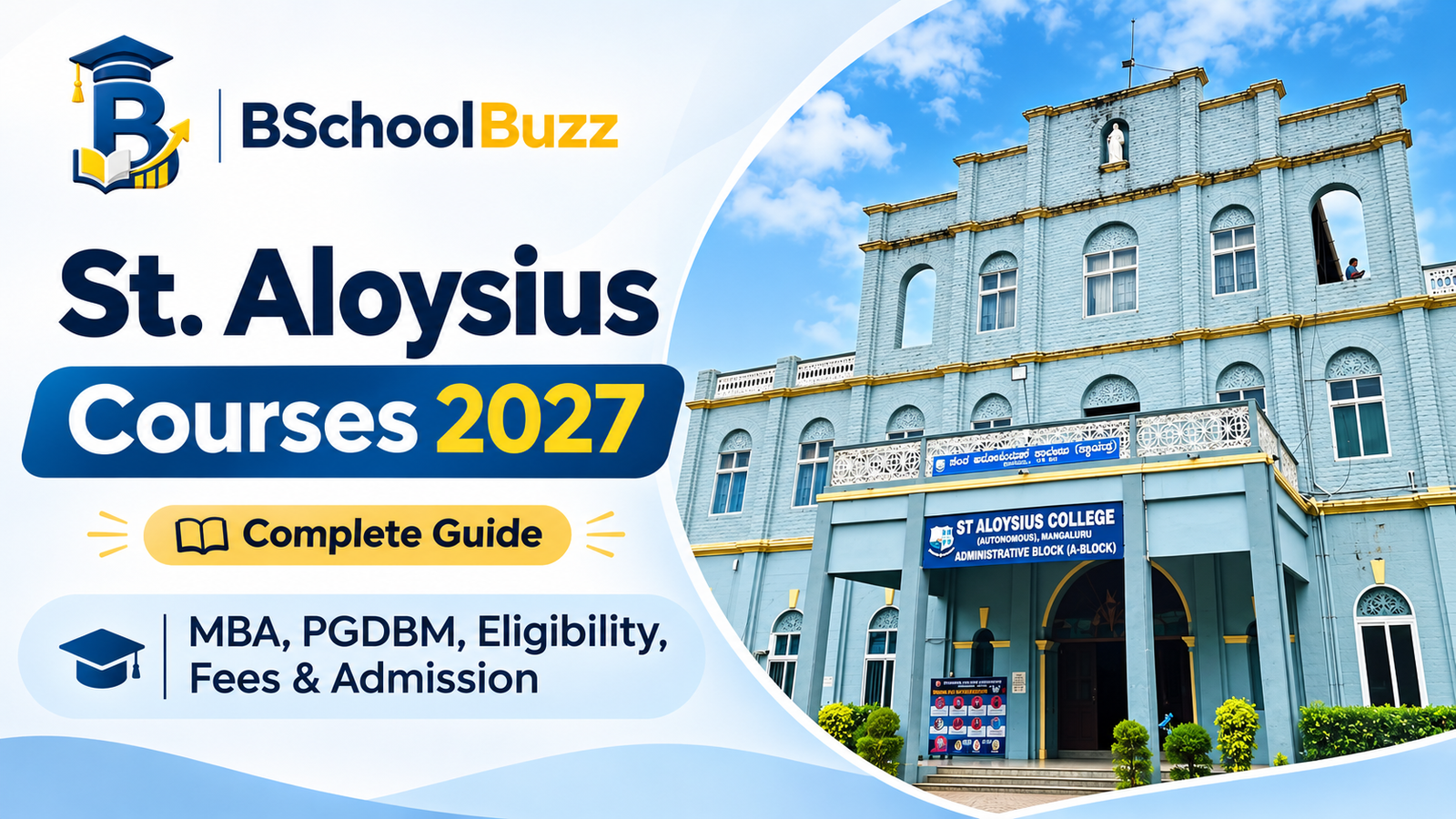
- St. Aloysius (Deemed to be University) is located in Mangaluru, Karnataka.
- The university offers undergraduate, postgraduate, professional and research programmes.
- Major courses include BA, BBA, BCA, B.Com, B.Sc, B.Tech, MBA, MCA, M.Com, M.Sc, MSW and PGDBM.
- The MBA programme is offered through the Aloysius Institute of Management and Information Technology (AIMIT).
- The MBA programme has a duration of two years and four semesters.
- MBA dual specialisations include Finance, Marketing, Human Resource Management, Operations and Business Analytics.
- The university also lists separate MBA programmes in Fintech and Business Analytics.
- MBA Finance focuses on financial management, banking and investment-related knowledge.
- MBA Marketing focuses on sales, branding, advertising and customer behaviour.
- MBA HR focuses on recruitment, employee development and organisational management.
- MBA Operations focuses on logistics, supply chains and operational efficiency.
- MBA Business Analytics focuses on data interpretation and business decision-making.
- MBA Fintech combines financial services with technology, digital payments and emerging financial systems.
- The university also lists PGDBM, or Post Graduate Diploma in Business Management.
- The published fee document identifies PGDBM as a one-year programme.
- An earlier university prospectus specifies a bachelor's degree in any discipline for PGDBM eligibility.
- MBA applicants generally require a recognised bachelor's degree with at least 50% aggregate marks.
- The university lists a 45% marks concession for specified eligible categories, subject to category conditions.
- The AIMIT admission portal lists CAT, XAT, MAT, CMAT and KMAT.
- Students should check programme-specific entrance examination requirements before applying.
- AIMIT provides career support through industry mentorship, interview preparation and resume-writing assistance.
- The university lists recruiters associated with its 2024 and 2025 placement activities.
- MBA and PGDBM fees should be checked separately.
- Applicants should verify the latest 2027–28 programme availability, eligibility, fee schedule and admission instructions through official university portals.
St. Aloysius Courses 2027: MBA/PGDBM Specialisations, Duration, Eligibility and Admission Details
1. Overview of St. Aloysius Courses
St. Aloysius (Deemed to be University), located in Mangaluru, Karnataka, offers a wide range of undergraduate, postgraduate and professional programmes across different academic disciplines. Students can explore courses in management, commerce, science, arts, engineering, computer applications, law, education and social sciences.
The university provides several academic opportunities for students who have completed Class 12 as well as graduates looking to pursue higher education. Among its postgraduate offerings, management programmes are particularly relevant for students interested in business administration, finance, marketing, human resource management, operations and technology-driven financial services.
The Aloysius Institute of Management and Information Technology (AIMIT), located at Beeri, Mangaluru, offers postgraduate management and technology programmes. Its management offerings include MBA with dual specialisation, MBA Fintech and MBA Business Analytics.
Students interested in a shorter postgraduate management qualification can also explore the Post Graduate Diploma in Business Management (PGDBM), which appears in the university's main-campus postgraduate programme listing.
The St. Aloysius academic structure provides opportunities for students with different educational backgrounds. Before selecting a course, applicants should understand the programme's qualification, duration, curriculum, eligibility requirements and career relevance.
2. Complete List of St. Aloysius Courses and Programmes
St. Aloysius offers academic programmes at different levels, allowing students to choose courses according to their educational qualifications and career interests.
Undergraduate Courses
Students who have completed Class 12, PUC or an equivalent recognised qualification can explore the following undergraduate programmes:
BA – Bachelor of Arts
BBA – Bachelor of Business Administration
BCA – Bachelor of Computer Applications
B.Com – Bachelor of Commerce
B.Sc – Bachelor of Science
B.Voc – Bachelor of Vocational Studies
B.Tech – Bachelor of Technology
BA LL.B – Bachelor of Arts and Bachelor of Laws
BBA LL.B – Bachelor of Business Administration and Bachelor of Laws
The university also offers specialised undergraduate combinations in commerce, management, science, technology and vocational education.
Some B.Com options include Logistics Management, Investment Management, International Finance, Accounting and Tax, and Business Analytics.
BBA options include regular business administration, Logistics and Inventory Management, Business Logistics, and Branding and Advertising.
B.Voc programmes include areas such as Retail and Logistics Management, Animation and Multimedia, Software Development, Renewable Energy Management and Sports Management.
Engineering Courses
Students interested in engineering and technology can explore the following B.Tech programmes:
Computer Science and Engineering.
Computer Science and Engineering – Artificial Intelligence and Machine Learning.
Computer Science and Engineering – Artificial Intelligence and Cyber Security.
Electronics and Communication Engineering.
Information Science and Engineering.
These programmes are designed for students interested in technical education, computing, electronics and emerging technologies.
Engineering applicants must satisfy the prescribed Class 12 subject requirements and follow the applicable entrance examination process.
Postgraduate Courses
The university offers postgraduate programmes in several academic areas.
Some of the major options include:
Management and Commerce
MBA.
MBA Fintech.
MBA Business Analytics.
PGDBM.
M.Com.
M.Com Finance and Analytics.
Computer Applications and Technology
MCA.
M.Sc Software Technology.
M.Sc Data Science.
M.Sc Artificial Intelligence and Intelligent Systems.
Science
M.Sc Chemistry.
M.Sc Analytical Chemistry.
M.Sc Physics.
M.Sc Mathematics.
M.Sc Biotechnology.
M.Sc Biochemistry.
M.Sc Food Science and Technology.
M.Sc Food Science, Nutrition and Dietetics.
Arts and Social Sciences
MA English.
MA Business Economics.
MA Media and Communication.
M.Sc Corporate Psychology.
M.Sc Clinical Psychology.
Master of Social Work.
Programme availability, subject combinations and admission requirements should be confirmed through the relevant university admission portal for the 2027–28 academic session.
3. St. Aloysius MBA Programme: Overview
The Master of Business Administration (MBA) is one of the major postgraduate management programmes offered through AIMIT.
The programme is intended for graduates who want to develop professional knowledge in business administration, organisational management, financial decision-making, marketing strategy, human resource management and operations.
The MBA programme follows a two-year academic structure consisting of four semesters.
Students can explore different management specialisations depending on their interests and career objectives.
MBA Programme Details
| Particular | Details |
|---|---|
| Programme | Master of Business Administration |
| Institution | St. Aloysius (Deemed to be University) |
| Management Institute | AIMIT |
| Location | Beeri, Mangaluru |
| Duration | 2 Years |
| Semester Structure | 4 Semesters |
| Qualification | Postgraduate Degree |
| Specialisation Areas | Finance, Marketing, HR, Operations and Business Analytics |
| Additional Programmes | MBA Fintech and MBA Business Analytics |
| Basic Eligibility | Recognised Bachelor's Degree |
An MBA helps students understand how organisations operate, manage resources, develop strategies and make business decisions.
The programme is relevant to graduates interested in corporate careers, business development, management, entrepreneurship and specialised business functions.
4. MBA Specialisations at St. Aloysius
Specialisation is an important consideration when choosing an MBA programme.
It allows students to develop knowledge in a particular management area while learning the broader principles of business administration.
St. Aloysius lists five areas under its MBA dual-specialisation offering:
Finance.
Marketing.
Human Resource Management.
Operations.
Business Analytics.
The university also lists separate specialised MBA programmes in Fintech and Business Analytics.
Each specialisation is relevant to different professional interests and career paths.
MBA in Finance
MBA Finance focuses on financial planning, investment decisions, banking, corporate finance and financial management.
Students interested in financial services, banking, investment analysis and corporate financial planning can consider this specialisation.
Typical areas of finance education include:
Financial Management.
Corporate Finance.
Investment Analysis.
Financial Planning.
Banking and Financial Services.
Risk Management.
Financial Statement Analysis.
Capital Budgeting.
Portfolio Management.
Business Valuation.
Students develop the ability to understand financial statements, evaluate investment opportunities, prepare financial plans and support business decisions.
Possible career opportunities include:
Financial Analyst.
Finance Executive.
Credit Analyst.
Banking Relationship Manager.
Investment Operations Analyst.
Corporate Finance Associate.
Financial Planning Analyst.
Risk Analyst.
This specialisation may be suitable for graduates who enjoy working with financial information, numerical analysis and business planning.
MBA in Marketing
MBA Marketing focuses on understanding customers, developing brands, promoting products and creating business growth strategies.
Marketing professionals help organisations identify target customers, understand market requirements and develop effective sales and promotional activities.
Typical areas of marketing education include:
Marketing Management.
Consumer Behaviour.
Brand Management.
Digital Marketing.
Sales Management.
Market Research.
Advertising and Promotion.
Product Management.
Customer Relationship Management.
Strategic Marketing.
Students develop communication, market research, sales planning and customer engagement skills.
Possible career opportunities include:
Marketing Manager.
Digital Marketing Executive.
Brand Manager.
Business Development Manager.
Sales Manager.
Market Research Analyst.
Product Marketing Executive.
Customer Relationship Manager.
MBA Marketing may suit graduates interested in advertising, branding, communication, business development and customer behaviour.
MBA in Human Resource Management
Human Resource Management focuses on managing employees and supporting organisational development.
HR professionals are involved in recruitment, employee engagement, training, performance management and workplace relations.
Typical areas of study include:
Human Resource Management.
Organisational Behaviour.
Recruitment and Selection.
Training and Development.
Performance Management.
Employee Relations.
Compensation and Benefits.
Labour Laws.
Human Resource Planning.
Leadership and Organisational Development.
Students develop communication, conflict-resolution, recruitment planning and employee-management skills.
Possible career opportunities include:
HR Executive.
HR Business Partner.
Talent Acquisition Specialist.
Recruitment Manager.
Training and Development Specialist.
Employee Relations Executive.
Compensation and Benefits Analyst.
HR Operations Manager.
This specialisation may suit graduates interested in people management, organisational behaviour, recruitment and employee development.
MBA in Operations Management
Operations Management focuses on improving the processes through which organisations manufacture products and deliver services.
It is relevant to industries such as manufacturing, logistics, retail, transportation and supply chain management.
Typical areas of study include:
Operations Management.
Supply Chain Management.
Production Planning.
Quality Management.
Inventory Management.
Logistics Management.
Project Management.
Process Improvement.
Procurement Management.
Operations Strategy.
Students develop planning, coordination, process management and problem-solving abilities.
Possible career opportunities include:
Operations Manager.
Supply Chain Analyst.
Logistics Manager.
Procurement Executive.
Production Planning Manager.
Inventory Control Manager.
Quality Management Executive.
Project Coordinator.
Students interested in logistics, supply chains, production and business operations may consider this specialisation.
MBA in Business Analytics
Business Analytics combines management knowledge with data analysis and technology.
Organisations use business information to understand customer behaviour, monitor performance, identify operational problems and improve decision-making.
St. Aloysius identifies exposure to tools such as Python, R, Microsoft Excel and Tableau in its dedicated Business Analytics programme description.
Relevant learning areas include:
Business Intelligence.
Data Visualisation.
Statistical Analysis.
Predictive Analytics.
Business Reporting.
Data Interpretation.
Analytical Decision-Making.
Performance Measurement.
Students develop analytical thinking, data interpretation and business problem-solving capabilities.
Possible career opportunities include:
Business Analyst.
Business Intelligence Analyst.
Management Analyst.
Business Analytics Consultant.
Marketing Analytics Analyst.
Operations Analyst.
Strategy Analyst.
This specialisation may suit students interested in data, technology, business reporting and evidence-based management.
MBA in Fintech
Fintech stands for Financial Technology. It combines financial services with modern technology to support digital banking, payments and financial innovation.
St. Aloysius lists MBA Fintech as a separate specialised programme through AIMIT.
The university's programme description identifies areas such as:
Blockchain.
Cryptocurrencies.
AI-driven financial systems.
Cybersecurity.
Digital payment innovations.
Students interested in the relationship between financial services and technology can explore this programme.
Possible career areas include digital banking, financial technology operations, payment systems, financial product management and fintech business development.
Potential job roles include:
Fintech Business Analyst.
Digital Banking Executive.
Financial Product Manager.
Payment Operations Manager.
Financial Services Consultant.
Fintech Operations Analyst.
Digital Finance Business Development Executive.
MBA Fintech is a management-oriented programme and should not automatically be treated as a technical computer science degree.
5. MBA Specialisation Comparison
Students can compare management specialisations based on their interests and professional goals.
| Specialisation | Main Focus | Suitable Career Interest |
|---|---|---|
| Finance | Financial planning, banking and investments | Banking and corporate finance |
| Marketing | Branding, advertising and sales | Marketing and business development |
| HR | Recruitment and employee management | Human resources |
| Operations | Logistics and supply chains | Operations and procurement |
| Business Analytics | Data analysis and business intelligence | Business analytics |
| Fintech | Digital finance and financial technology | Digital banking and fintech |
The best specialisation depends on the student's interests, existing skills and preferred career direction.
Students should also examine the actual curriculum, electives, practical projects and industry exposure before choosing a specialisation.
6. St. Aloysius MBA Duration and Semester Structure
The MBA programme follows a two-year academic structure divided into four semesters.
The semester system allows students to build management fundamentals before developing deeper knowledge in their chosen areas.
MBA Duration Details
| Particular | Details |
|---|---|
| Total Duration | 2 Years |
| Total Semesters | 4 |
| Academic Level | Postgraduate |
| Qualification | MBA |
| Campus | AIMIT, Beeri, Mangaluru |
The general progression of management education can be understood as follows:
First Semester – Management Foundations
Students develop an understanding of fundamental business subjects such as accounting, management principles, business economics, organisational behaviour and quantitative methods.
Second Semester – Functional Management Knowledge
Students develop broader knowledge across finance, marketing, human resources and operations.
Third Semester – Specialisation Development
Students progress towards their selected management areas and develop deeper functional understanding.
Fourth Semester – Advanced Application
The final stage generally focuses on advanced management learning and practical academic requirements.
This is a general explanation of MBA progression. Students should refer to the latest official AIMIT syllabus for exact semester-wise subjects, electives, credits, internships and project requirements.
7. St. Aloysius PGDBM Programme
PGDBM stands for Post Graduate Diploma in Business Management.
St. Aloysius lists PGDBM among its postgraduate programme offerings.
It is a management-focused postgraduate diploma for graduates interested in understanding business administration, organisational management and different functional areas of business.
The published university fee document identifies PGDBM as a one-year programme.
PGDBM Programme Details
| Particular | Details |
|---|---|
| Programme Name | Post Graduate Diploma in Business Management |
| Short Name | PGDBM |
| Qualification | Postgraduate Diploma |
| Published Duration | 1 Year |
| Academic Focus | Business Management |
| Basic Qualification | Bachelor's Degree, according to the earlier published prospectus |
PGDBM Curriculum
The university's earlier postgraduate prospectus describes subjects covering different business management areas.
The published subjects include:
First Semester
Organisational Behaviour.
Materials Management and Stores Control.
Accounting and Finance for Managers.
Human Resource Management and Industrial Relations.
Entrepreneurship and Small Business Management.
Second Semester
Retail Management.
Marketing Management.
Indian Business Environment.
Production and Operations Management.
Project Management and Project Study.
These subjects introduce students to the different functions involved in managing a business.
The curriculum listed above comes from an earlier university prospectus and should be verified against the current 2027–28 syllabus.
PGDBM Eligibility
The earlier university prospectus specifies a bachelor's degree in any discipline as the basic qualification for PGDBM.
Students awaiting their final results were also permitted to apply under the conditions stated in that prospectus.
Applicants should confirm the current minimum marks, accepted qualifications and admission conditions with the university before submitting their applications.
What Can Students Learn Through PGDBM?
PGDBM covers important business functions.
Organisational Behaviour helps students understand employee behaviour and workplace relationships.
Accounting and Finance for Managers introduces financial information and its importance in business decisions.
Human Resource Management explains recruitment, employee development and industrial relations.
Marketing Management introduces customer engagement, sales and promotional activities.
Entrepreneurship and Small Business Management help students understand business creation and management.
Production and Operations Management introduces operational planning and resource utilisation.
Project Management develops an understanding of planning and executing business projects.
8. MBA vs PGDBM: Understanding the Difference
MBA and PGDBM are different management qualifications.
Although both programmes focus on business administration, they differ in qualification type, duration and academic structure.
| Comparison Factor | MBA | PGDBM |
|---|---|---|
| Full Form | Master of Business Administration | Post Graduate Diploma in Business Management |
| Qualification | Postgraduate Degree | Postgraduate Diploma |
| Published Duration | 2 Years | 1 Year |
| Academic Structure | 4 Semesters | Earlier prospectus describes 2 semesters |
| Main Focus | Advanced management education | Business management education |
| Specialisation Options | Finance, HR, Marketing, Operations and Business Analytics | Published curriculum covers different management functions |
| Eligibility | Recognised bachelor's degree with prescribed marks | Bachelor's degree in the earlier prospectus |
| Institution | AIMIT | Main-campus PGDBM listing |
Which Is Better: MBA or PGDBM?
The right choice depends on the student's academic and professional objectives.
An MBA may be more appropriate for graduates seeking a master's degree with a longer management programme and specialisation options.
PGDBM may be relevant for graduates looking for a shorter postgraduate diploma in business management.
Before making a decision, compare the qualification awarded, curriculum, duration, academic recognition, practical exposure, career relevance and total programme cost.
Students should also understand that PGDBM, PGDM and MBA are not automatically interchangeable qualifications.
9. St. Aloysius MBA Eligibility Criteria
Candidates applying for the MBA programme must satisfy the academic requirements prescribed by the university.
According to the published AIMIT MBA eligibility information, candidates need a recognised bachelor's degree in any discipline.
MBA Eligibility Requirements
| Eligibility Factor | Requirement |
|---|---|
| Minimum Qualification | Bachelor's Degree |
| Accepted Background | Any discipline |
| General Minimum Marks | 50% aggregate |
| Specified Category Concession | 45%, subject to applicable category rules |
| University | Recognised or equivalent university |
| Entrance Examinations Listed | CAT, XAT, MAT, CMAT and KMAT |
The AIMIT admission page specifies 50% aggregate marks and describes a concession to 45% for SC, ST and Karnataka candidates.
The university's separate eligibility information uses slightly different category wording for the concession.
Applicants should obtain written confirmation of the applicable category conditions and supporting documentation from the admission office.
Can Students from Any Stream Apply?
Yes. The published MBA criteria accept bachelor's degrees from different academic disciplines.
Eligible applicants may include graduates with:
B.Com.
BBA.
BA.
B.Sc.
BCA.
B.Tech.
B.E.
Other recognised bachelor's degrees.
The prescribed minimum marks and admission requirements must still be satisfied.
Is Work Experience Mandatory?
The published MBA eligibility information specifies a bachelor's degree and minimum aggregate marks.
It does not identify mandatory work experience in the displayed eligibility criteria.
Applicants should confirm whether any additional requirements apply to the current admission cycle.
Can Final-Year Students Apply?
Students completing their bachelor's degree should contact the admissions office to confirm whether provisional applications are accepted.
Final admission will depend on submission of the qualifying examination results and fulfilment of the university's eligibility conditions.
10. Eligibility for Other Postgraduate Programmes
Different postgraduate courses have different academic requirements.
Students should check the eligibility criteria for their selected subject rather than assuming that the MBA eligibility conditions apply to all postgraduate programmes.
M.Com Eligibility
Candidates with a three-year B.Com, BBM or BBA degree from a recognised university can explore M.Com and M.Com Finance and Analytics.
The published marks requirements include:
General category: 45%.
SC/ST/Category-I candidates: 40%.
The university specifies that the aggregate is calculated excluding language marks.
MA Business Economics Eligibility
Candidates with qualifications such as BA Economics, B.Sc Economics, B.Sc Mathematics, B.Sc Statistics, B.Com or BBA can explore the programme, subject to the prescribed subject requirements.
The university's published criteria specify the applicable minimum marks or equivalent CGPA.
MA Media and Communication Eligibility
Candidates must hold a recognised bachelor's degree and satisfy the prescribed marks requirements.
The published selection information describes a 50:50 weightage for entrance examination and qualifying examination marks.
MA English Eligibility
Applicants must satisfy the university's English subject-related requirements.
The university recognises certain graduates with English as a major, optional or specified language subject, subject to its published eligibility conditions.
M.Sc Eligibility
M.Sc eligibility depends on the chosen specialisation.
Examples include:
M.Sc Chemistry: Relevant B.Sc degree with Chemistry.
M.Sc Physics: Relevant B.Sc degree with Physics.
M.Sc Mathematics: Relevant B.Sc degree with Mathematics or Statistics.
M.Sc Biotechnology: Relevant life science or science background.
M.Sc Clinical Psychology: Relevant psychology background.
M.Sc Corporate Psychology: Specified backgrounds in psychology, commerce, business administration, HR and other accepted disciplines.
Candidates should check the exact subject combinations and marks requirements.
MCA Eligibility
The MCA programme is offered through AIMIT.
Relevant undergraduate qualifications include BCA, Computer Science Engineering, B.Sc Computer Science and certain other recognised computer-related degrees.
The university also recognises certain B.Sc, B.Com and BBA graduates who have studied Mathematics at Class 12 or graduation level and satisfy the applicable marks requirements.
MSW Eligibility
Applicants with a recognised bachelor's degree can explore MSW, subject to the prescribed marks conditions.
The published eligibility criteria include 45% for general-category candidates and 40% for SC/ST/Category-I candidates.
The programme's selection requirements should be checked separately.
11. Undergraduate Course Eligibility
Students who have completed Class 12, PUC or an equivalent recognised qualification can explore undergraduate programmes.
Undergraduate Eligibility Overview
| Course | Basic Qualification |
|---|---|
| BA | Class 12 / Two-year PUC or equivalent |
| B.Com | Class 12 / Two-year PUC or equivalent |
| BBA | Class 12 / Two-year PUC or equivalent |
| BCA | Class 12 / Equivalent, subject to programme requirements |
| B.Sc | Class 12 with prescribed subject combinations |
| B.Voc | Class 12 / Equivalent |
| B.Tech | Class 12 / PUC with prescribed science subjects |
Science and engineering programmes may require particular subject combinations in Physics, Chemistry, Mathematics and Biology.
BBA applicants generally need to have completed the recognised qualifying examination.
B.Com applicants can explore the different commerce combinations based on their academic interests.
B.Tech applicants must satisfy the prescribed subject and marks requirements and follow the applicable entrance examination procedure.
12. St. Aloysius Admission Process 2027
Students interested in St. Aloysius courses should complete the application process through the relevant official admission portal.
The university provides online registration and application facilities.
Step 1: Select the Programme
Choose the programme according to your academic qualification and career interests.
Examples include MBA Dual Specialisation, MBA Fintech, MBA Business Analytics, PGDBM, MCA and M.Sc programmes.
Step 2: Register Online
Visit the official admission portal and create an applicant account using an active email address and mobile number.
Step 3: Complete the Application Form
Enter personal, educational and contact details accurately.
Select the correct programme and verify the information before proceeding.
Step 4: Upload Required Documents
Upload the academic and identity documents requested by the university.
These may include graduation marks cards, degree certificates, Class 10 and Class 12 marks cards, photographs and other applicable certificates.
Step 5: Pay the Application Fee
Complete the prescribed application fee payment through the authorised payment facility.
Save the payment confirmation and application acknowledgement.
Step 6: Complete Entrance Examination Requirements
MBA candidates should follow the applicable AIMIT entrance examination and score submission requirements.
Step 7: Confirm Admission
Candidates receiving an admission offer should follow the fee payment instructions and complete the required admission formalities.
Step 8: Complete Document Verification
Submit original academic documents and other records requested by the university.
Final admission depends on satisfying the applicable eligibility and verification requirements.
13. MBA Entrance Examinations Accepted
The AIMIT admission portal lists the following management entrance examinations:
| Examination | Full Name |
|---|---|
| CAT | Common Admission Test |
| XAT | Xavier Aptitude Test |
| MAT | Management Aptitude Test |
| CMAT | Common Management Admission Test |
| KMAT | Karnataka Management Aptitude Test |
CAT
CAT is a national-level management entrance examination. Preparation generally covers Quantitative Ability, Data Interpretation, Logical Reasoning, Verbal Ability and Reading Comprehension.
XAT
XAT is another management entrance examination listed by AIMIT. Applicants should follow the examination authority's current pattern and registration instructions.
MAT
MAT assesses management aptitude and related reasoning abilities.
CMAT
CMAT is a national-level management entrance examination. Candidates should refer to the official examination authority for the latest syllabus and examination arrangements.
KMAT
KMAT is relevant to applicants considering participating management institutions in Karnataka.
Candidates should confirm which examination sessions and scores are accepted for their intended admission cycle.
14. Documents Required for MBA Admission
Applicants should prepare their documents before beginning the online application.
Commonly requested documents include:
Class 10 marks card.
Class 12 marks card.
Graduation marks cards.
Degree certificate or provisional certificate, where available.
Recent passport-size photograph.
Valid identity proof.
Entrance examination scorecard, where applicable.
Category certificate, where applicable.
Active email address.
Active mobile number.
Application fee payment confirmation.
The exact checklist depends on the programme and applicant category.
Students should upload readable documents and ensure that the information matches their official academic records.
15. St. Aloysius MBA and PGDBM Fees
Programme fees are an important factor when comparing postgraduate management courses.
Applicants should consider the complete financial commitment rather than looking only at the tuition amount.
MBA Fee Information
The AIMIT admission portal displays different MBA fee figures according to applicant category.
| Applicant Category | Displayed MBA Fee |
|---|---|
| Karnataka | ₹3,11,000 |
| Non-Karnataka | ₹3,16,000 |
| NRI | ₹3,51,000 |
| SAARC | ₹3,30,000 |
| Foreign | ₹3,60,000 |
The displayed fee information does not clearly establish the academic-year applicability or whether the figures represent the complete programme fee or a particular fee period.
Applicants should obtain the official 2027–28 written fee schedule before making a financial commitment.
PGDBM Fees
PGDBM is listed separately from MBA in the university's postgraduate fee documentation.
Applicants should confirm the current PGDBM fee directly with the main-campus admissions office.
Other Expenses to Consider
Students should also plan for:
Examination fees.
Registration charges.
Hostel fees.
Mess charges.
Books and learning materials.
Transportation.
Personal expenses.
Other programme-specific charges.
Not all these costs are necessarily included in tuition.
Before paying admission fees, request clarification about the total programme cost, payment schedule, refund policy and any additional charges.
16. Scholarships and Financial Assistance
Scholarships can help eligible students manage the financial cost of higher education.
St. Aloysius identifies several scholarship categories, including merit-based, need-cum-merit and sports-related assistance.
Vidwath Spoorthi
A merit-based scholarship category intended to recognise academic performance.
Vidya Spoorthi
A need-cum-merit scholarship category that considers financial circumstances alongside academic performance.
Kreeda Spoorthi
A sports scholarship category for eligible students with recognised sports achievements.
SAFAL – St. Aloysius Fellowship for Aspiring Learners
An endowment-based scholarship support category.
Students may also explore applicable government schemes through the National Scholarship Portal and Karnataka State Scholarship Portal.
MBA and PGDBM applicants should confirm whether these scholarships apply to their specific programmes.
Scholarship eligibility, award amounts, documentation and deadlines depend on the applicable scheme.
17. Career Opportunities After St. Aloysius MBA
Career opportunities after an MBA depend on the student's specialisation, academic performance, practical skills and professional experience.
Finance Career Opportunities
Finance graduates can explore banking, corporate finance, investment operations, financial planning and risk management.
Possible roles include Financial Analyst, Credit Analyst and Finance Executive.
Marketing Career Opportunities
Marketing graduates can explore advertising, sales, branding, customer relationship management and digital marketing.
Possible roles include Marketing Executive, Brand Manager and Business Development Manager.
HR Career Opportunities
HR graduates can explore recruitment, employee relations, training and development, and HR operations.
Possible roles include HR Executive, Talent Acquisition Specialist and HR Business Partner.
Operations Career Opportunities
Operations graduates can explore logistics, procurement, production planning, inventory and supply chain management.
Possible roles include Operations Executive, Supply Chain Analyst and Logistics Manager.
Business Analytics Career Opportunities
Business Analytics graduates can explore business intelligence, management reporting, analytical consulting and business strategy.
Possible roles include Business Analyst, Business Intelligence Analyst and Management Analyst.
Fintech Career Opportunities
Fintech graduates can explore digital banking, payment operations, financial technology services and financial product management.
Possible roles include Fintech Business Analyst, Digital Banking Executive and Financial Product Coordinator.
These are potential career pathways, not guaranteed placement outcomes.
18. St. Aloysius MBA Placements and Career Support
Placement support is an important consideration for students evaluating an MBA programme.
AIMIT identifies several career development activities, including:
Industry mentorship.
Interview preparation.
Resume-writing assistance.
Access to job boards.
Internship opportunities.
Technical and soft-skills development.
The university's published placement information identifies recruiters associated with its placement activities during 2024 and 2025.
Examples listed for 2025 include Motul, Jaro Education, EY GDS, Swiggy, HDFC, ICICI, HUL, ANZ, Hitachi, Wipro, DXC Technology, Elsevier, Randstad and BDO Rise.
The 2024 recruiter information also lists companies such as KPMG, MRF, Flipkart and ICICI Prudential.
These are companies identified in university placement information. Their inclusion does not guarantee recruitment of every student.
What Should Students Check About Placements?
Before joining an MBA programme, applicants should request:
The latest completed MBA batch placement report.
Total eligible students.
Number of students placed.
Average salary.
Median salary.
Highest salary.
Number of participating recruiters.
Specialisation-wise placement details.
Internship information.
Actual roles offered to graduates.
Students should examine the reporting year and calculation method before using placement statistics to evaluate return on investment.
19. How to Choose the Right St. Aloysius Course
Choosing a postgraduate course requires an understanding of personal interests, academic background and career objectives.
Students should not select a programme only because it has an attractive name or a popular specialisation.
Identify Your Career Interest
Students interested in banking and investments can explore Finance.
Those interested in advertising, branding and sales can consider Marketing.
Graduates interested in recruitment and employee development can explore HR.
Students interested in logistics and supply chains can consider Operations.
Candidates interested in data-driven business decisions can investigate Business Analytics.
Students interested in digital financial services can explore Fintech.
Compare Programme Qualifications
MBA and PGDBM are different qualifications.
Students seeking a master's degree should evaluate the MBA programme.
Those interested in a shorter business management diploma can investigate PGDBM.
Review the Curriculum
Check the subjects, electives, practical projects, internships, software tools and industry exposure.
The curriculum should support the student's preferred professional direction.
Compare the Complete Cost
Consider tuition, examinations, hostel, food, transportation and other expenses.
Confirm scholarship conditions and refund policies before paying.
Evaluate Career Support
Request current placement information and investigate the actual roles offered to graduates.
Students should also explore alumni experiences and employer expectations.
Confirm the Campus
The MBA is associated with AIMIT at Beeri, Mangaluru, whereas PGDBM is listed among the main-campus postgraduate programmes.
Applicants should verify the exact teaching location before arranging accommodation.
20. Important Points to Verify Before Applying
Before submitting an application for St. Aloysius courses, students should confirm:
Exact programme name.
Academic-year applicability.
Programme duration.
Eligibility and minimum marks.
Category-related concessions.
Entrance examination requirements.
Specialisation availability.
Current syllabus.
Total tuition fees.
Hostel and mess charges.
Scholarship eligibility.
Latest placement information.
Application deadlines.
Refund and cancellation policies.
Campus location.
This is particularly important for MBA Fintech, MBA Business Analytics and PGDBM because each programme has a distinct academic structure.
21. Official St. Aloysius Admission Links
Applicants should use official university resources to obtain the latest admission information.
University Website: https://staloysius.edu.in/
2027–28 Admission Portal: https://apply.staloysius.edu.in/
AIMIT Admission Portal: https://aimitadmissions.staloysius.edu.in/
AIMIT MBA Department: https://aimit.edu.in/department/business-administration
PG Eligibility: https://staloysius.edu.in/pg-eligibility
AIMIT PG Eligibility: https://staloysius.edu.in/aimit-pg-eligibility-programmes
University Prospectus: https://staloysius.edu.in/prospectus
Fee Structure: https://staloysius.edu.in/fee-structure
22. Conclusion
St. Aloysius courses provide opportunities for students interested in undergraduate, postgraduate, professional and management education.
For management aspirants, the two-year MBA programme at AIMIT offers dual-specialisation options in Finance, Marketing, Human Resource Management, Operations and Business Analytics. Students can also explore separately listed MBA programmes in Fintech and Business Analytics.
Graduates looking for a shorter business management qualification can investigate PGDBM, which is listed as a one-year postgraduate diploma in the university's published fee documentation.
The decision between MBA and PGDBM should depend on the qualification required, academic duration, curriculum, eligibility and career objectives.
Before applying for the 2027–28 academic session, students should verify the latest programme availability, eligibility requirements, entrance examinations, fees, campus location and admission deadlines through the official university portals.
A careful comparison of programme structure, practical exposure, career support and financial requirements will help students select a course that aligns with their long-term professional goals.
Key Takeaways
Wide Course Selection: St. Aloysius offers programmes in management, commerce, science, arts, engineering, law and computer applications.
Two-Year MBA: The MBA programme at AIMIT is structured over two years and four semesters.
Dual Specialisation: Students can explore Finance, Marketing, HR, Operations and Business Analytics.
Specialised MBA Options: MBA Fintech and MBA Business Analytics are separately listed programmes.
Finance Career Path: Finance is relevant to students interested in banking, investments and corporate financial management.
Marketing Career Path: Marketing suits students interested in branding, advertising, customer engagement and sales.
HR Career Path: HR is relevant to graduates interested in recruitment, employee relations and organisational development.
Operations Career Path: Operations suits students interested in logistics, supply chain management and business processes.
Business Analytics: Students interested in data-driven management can explore Business Analytics, including exposure to Python, R, Excel and Tableau.
Fintech Opportunities: MBA Fintech introduces financial technology areas such as blockchain, digital payments, AI-driven financial systems and cybersecurity.
One-Year PGDBM: The university lists a one-year Post Graduate Diploma in Business Management.
MBA and PGDBM Are Different: MBA is a postgraduate degree, whereas PGDBM is a postgraduate diploma.
Graduation Eligibility: MBA applicants generally need a recognised bachelor's degree with 50% aggregate marks.
Entrance Examinations: The AIMIT portal lists CAT, XAT, MAT, CMAT and KMAT.
Programme-Specific Eligibility: M.Com, M.Sc, MCA and other postgraduate programmes have separate academic requirements.
Practical Learning: Students should evaluate internships, projects, industry exposure and curriculum before selecting a programme.
Career Support: AIMIT identifies mentorship, interview preparation, resume-writing assistance and job-board access.
Placement Verification: Applicants should request the latest batch-specific placement report rather than relying only on general placement percentages.
Financial Planning: Verify tuition, examination charges, accommodation and other expenses before paying admission fees.
Official Verification: Always check the latest 2027–28 admission portal for programme availability, specialisations, eligibility, duration and fees.
Frequently Asked Questions
What courses are offered at St. Aloysius University?
St. Aloysius offers undergraduate, postgraduate and professional programmes in arts, commerce, science, management, engineering, law and computer applications. Options include BBA, B.Com, BCA, B.Sc, MBA, MCA, M.Com, M.Sc and PGDBM.
Does St. Aloysius offer an MBA programme?
Yes. St. Aloysius offers a two-year MBA programme through its Aloysius Institute of Management and Information Technology (AIMIT) campus in Mangaluru.
What are the MBA specialisations at St. Aloysius?
The MBA dual-specialisation options include Finance, Business Analytics, Operations, Human Resources and Marketing. The university also lists separate MBA programmes in Fintech and Business Analytics.
What is the duration of the St. Aloysius MBA programme?
The MBA programme is two years long and consists of four semesters.
Does St. Aloysius offer PGDM?
The university's current admission listing identifies a Post Graduate Diploma in Business Management (PGDBM), rather than a programme specifically named PGDM. The published fee document identifies PGDBM as a one-year programme.
What is the eligibility for MBA admission at St. Aloysius?
Applicants generally need a recognised bachelor's degree with at least 50% aggregate marks. The university lists a 45% concession for specified eligible categories. Applicants should verify the applicable category conditions with the admissions office.
Which entrance examinations are accepted for St. Aloysius MBA admission?
The AIMIT admission portal lists KMAT, XAT, MAT, CMAT and CAT as accepted entrance examinations. Candidates should confirm the applicable requirements for their admission cycle.
Can students from any undergraduate stream apply for the MBA?
Yes. The published MBA eligibility information accepts a bachelor's degree in any discipline from a recognised or equivalent university, subject to the prescribed minimum marks and admission requirements.
What is the difference between MBA and PGDBM at St. Aloysius?
MBA is a two-year postgraduate degree programme with management specialisations. PGDBM is a one-year postgraduate diploma in business management. They are different qualifications and should not be treated as interchangeable.
Where can students apply for St. Aloysius courses?
Students can explore programmes and apply through the official university admission portal at https://apply.staloysius.edu.in/. MBA applicants can also refer to the dedicated AIMIT admission portal at https://aimitadmissions.staloysius.edu.in/.
Ask a question
Still confused? Leave your question and our team will help you.