
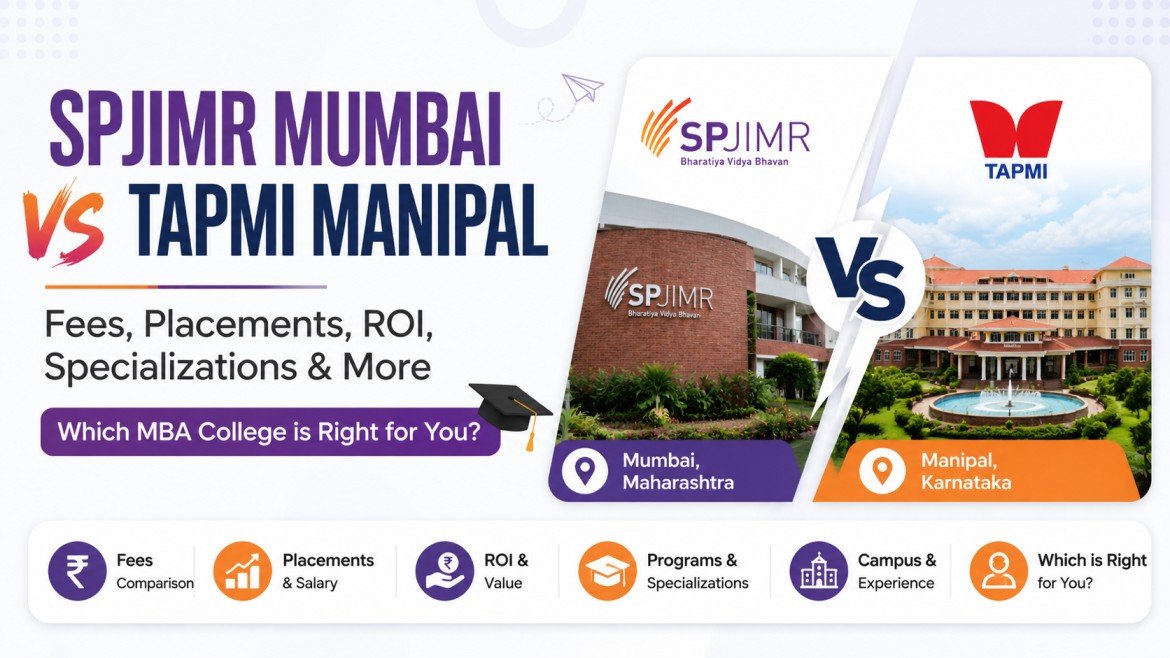
Quick Summary
- SPJIMR offers stronger recent placement outcomes and Mumbai corporate exposure, while TAPMI provides diverse specialised MBA programmes and potentially lower tuition, making career goals and ROI central considerations.
Choosing between SPJIMR Mumbai and TAPMI Manipal can be difficult because both institutions are well-known names in Indian management education. However, the two schools differ significantly in programme structure, fees, placement outcomes, specialization choices, location advantages and the type of student experience they offer.
For students searching for SPJIMR vs TAPMI, the decision usually comes down to four major questions: Which institute offers better placements? Which one provides better return on investment? How different are the programme fees? And which institute is better for a particular specialization?
The short answer is that SPJIMR Mumbai generally operates in a higher placement and salary bracket, while TAPMI Manipal can offer a different combination of specialization choices, campus experience and a lower published tuition cost for several MBA programmes.
The right choice depends heavily on your profile, career goals, financial situation and preferred management specialization.
This detailed SPJIMR vs TAPMI comparison examines the factors that matter most to MBA aspirants, including fees, placements, ROI, programmes, specializations, admissions, learning experience and career opportunities.
SPJIMR Mumbai vs TAPMI Manipal: Quick Comparison
| Comparison Factor | SPJIMR Mumbai | TAPMI Manipal |
|---|---|---|
| Main management programme | PGDM and PGDM (Business Management) | MBA and specialized MBA programmes |
| Programme duration | Two years | Two years |
| Location | Mumbai, Maharashtra | Manipal, Karnataka |
| Published fee information | ₹24.86 lakh for Indian PGDM participants, including tuition and basic hostel/accommodation, subject to revision | ₹9.75 lakh tuition per year for listed Indian-domicile MBA programmes, plus applicable additional charges; hostel and mess information is separately updated |
| Major specializations | Finance, Information Management, Marketing, Operations & Supply Chain | MBA, Banking and Financial Services, HRM, International Business, Marketing, Technology Management and AI & Data Science |
| Latest prominently published SPJIMR Class of 2026 placement outcomes | Average CTC ₹33.75 lakh, median CTC ₹32.85 lakh, highest CTC ₹75 lakh | Programme-specific placement information is published by TAPMI; applicants should compare the relevant programme and batch rather than assume one common figure |
| Placement record | SPJIMR reports 100% final placements for the PGDM and PGDM (BM) Class of 2026 | TAPMI publishes placement details across programmes and batches |
| Best suited for | Students targeting strong corporate placements and Mumbai-based industry exposure | Students seeking a broader portfolio of specialized MBA programmes and the Manipal campus environment |
The figures above should always be interpreted in the context of the relevant batch, programme and placement year. Placement salary figures are not guaranteed salaries for every student.
SPJIMR vs TAPMI: Which College Has Better Brand Value?
Brand value is an important consideration in the SPJIMR vs TAPMI debate, particularly for students planning long-term careers in consulting, finance, marketing, product management, technology or general management.
SPJIMR has a particularly strong reputation among recruiters and management aspirants for its industry orientation, selective admissions process, Mumbai location and placement performance. Its position in India's management education ecosystem is strengthened by long-standing corporate relationships and a learning model that includes classroom education along with immersive and non-classroom experiences.
TAPMI has also developed a strong identity as a management institution and offers a wider range of specialised MBA pathways. For a student whose interests are already focused on areas such as Banking and Financial Services, Human Resources, International Business, Marketing, Technology Management or Artificial Intelligence and Data Science, TAPMI's programme portfolio can be an important advantage.
Therefore, the brand comparison is not simply about which name is more recognised.
The better question is:
Which institution's brand, programme and alumni ecosystem align better with the career you want to build?
For broadly competitive corporate roles and strong placement-driven decision-making, many applicants may place SPJIMR higher in their preference list. For candidates seeking specific programme formats and specialised MBA options, TAPMI deserves detailed consideration.
SPJIMR vs TAPMI Fees: Which MBA Costs More?
The fee difference is one of the most important aspects of the SPJIMR vs TAPMI comparison.
SPJIMR's published PGDM fee page lists a fee of ₹24.86 lakh for Indian participants. The institute states that this includes tuition fees and basic hostel or accommodation, while also noting that the amount is indicative and subject to revision.
TAPMI's official admissions information for the 2026 cycle lists tuition fees of ₹9.75 lakh per year for Indian-domicile students across several listed MBA programmes. Over two academic years, this represents ₹19.50 lakh in tuition before applicable additional charges. TAPMI also lists an alumni lifetime membership fee of ₹20,000 and a refundable caution deposit of ₹40,000. The MBA-BKFS programme has additional training costs at SBI and BSE.
Students should not compare only the headline numbers.
The actual cost of an MBA can include:
Tuition fees
Hostel accommodation
Mess expenses
Refundable deposits
Alumni fees
Academic and technology charges
Travel expenses
International immersion costs, where applicable
Personal living expenses
Opportunity cost from leaving a full-time job
This means that a proper SPJIMR vs TAPMI fees comparison should be based on the complete expected cost of completing the programme rather than tuition alone.
Important Fee Comparison
SPJIMR's published PGDM fee includes basic hostel or accommodation according to the institute's official fee information.
TAPMI's official admissions page separately states that hostel and mess fees will be updated, so applicants should check the latest official payment schedule before calculating the total cost.
For this reason, a student should avoid making a final financial decision based only on an approximate ₹24.86 lakh versus ₹19.50 lakh comparison.
The real question is whether the additional cost is justified by the expected career outcome.
SPJIMR vs TAPMI Placements
For many aspirants, SPJIMR vs TAPMI placements is the deciding factor.
SPJIMR announced 100% final placements for its PGDM and PGDM (BM) Class of 2026. According to the institute's published placement announcement, the class recorded:
Highest CTC: ₹75 lakh
Average CTC: ₹33.75 lakh
Median CTC: ₹32.85 lakh
Batch size: 356 participants
PPOs: 46% of the batch
Top 50% average: ₹39 lakh
Top 25% average: ₹43.75 lakh
Companies participating: 80
New recruiters: 31
These figures place SPJIMR's latest reported placement outcomes at a very strong level among Indian management institutions.
However, students should remember that the published results combine relevant flagship programme outcomes and should not be interpreted as a guaranteed salary for every individual.
TAPMI publishes placement information across different programmes and graduating batches. This is particularly important because TAPMI has multiple MBA formats and specialisations, meaning that placement outcomes can vary by programme.
A student comparing SPJIMR vs TAPMI placements should therefore compare:
The same graduating year where possible
The same type of programme
Average and median compensation separately
Placement percentage
Number and quality of recruiters
Roles offered
Industry distribution
Career growth after the first job
A very high average package is useful information, but it does not tell the complete story. The median package can provide another perspective on how compensation is distributed across a batch.
SPJIMR Placement Performance and What It Means for Students
SPJIMR's Class of 2026 placement announcement shows strong outcomes across multiple metrics.
An average CTC of ₹33.75 lakh and a median CTC of ₹32.85 lakh indicate that the middle of the salary distribution remained relatively strong compared with the overall average.
The institute also reported that 46% of the batch received pre-placement offers. This is significant because PPOs can reflect the value of internships, corporate competitions and sustained employer engagement.
SPJIMR also states that its PGDM placement process has maintained a 100% placement record for more than two decades.
For an aspirant evaluating SPJIMR vs TAPMI ROI, these placement outcomes are central to the calculation.
A higher programme cost can still result in stronger ROI if graduates consistently secure significantly better career opportunities. At the same time, a student should never assume that an institution's average package will automatically become their personal starting salary.
Individual outcomes depend on:
Academic performance
Previous work experience
Specialisation
Interview performance
Internship performance
Market conditions
Recruiter requirements
Career preferences
Communication and analytical skills
TAPMI Placement Opportunities
TAPMI provides placement information across its MBA and specialised programmes, reflecting its multi-programme structure.
This is one reason why students should avoid using a single generic placement figure when evaluating TAPMI.
For example, a candidate pursuing an MBA in Human Resource Management may enter a different recruiter ecosystem from a candidate pursuing MBA Marketing or MBA Banking and Financial Services.
Similarly, a student choosing MBA Technology Management or MBA Artificial Intelligence and Data Science should evaluate placement opportunities in the context of technology-oriented roles.
When researching SPJIMR vs TAPMI placements, students should download or examine the latest programme-specific placement information and ask:
Which companies recruit for my programme?
What roles are offered?
How many students enter each programme?
What are the median and average salary figures?
Are internships aligned with final career roles?
How many PPOs are generated?
Which industries recruit most heavily?
This programme-specific approach provides a more accurate comparison than simply searching for one overall TAPMI placement package.
SPJIMR vs TAPMI ROI: Which Offers Better Return on Investment?
ROI is probably the most important financial question in the SPJIMR vs TAPMI comparison.
Return on investment should not be calculated by dividing one salary figure by one fee figure.
A better MBA ROI calculation considers:
Total programme cost + living cost + lost salary during the programme + education loan interest versus career growth after graduation.
SPJIMR has a higher published programme fee than the base two-year TAPMI tuition figure. However, SPJIMR's latest published Class of 2026 placement outcomes are also substantially strong.
This creates a typical premium MBA decision.
You pay more upfront but may potentially access a stronger placement ecosystem and higher early-career compensation.
TAPMI may offer a lower tuition cost for its listed programmes and a greater variety of specialised MBA options. For students with a clearly defined career path, this combination can make financial sense.
When SPJIMR May Offer Better ROI
SPJIMR may be attractive for ROI-focused students when:
You receive a strong final placement offer.
You want roles in consulting, finance, marketing, operations, technology or general management.
You value Mumbai's corporate ecosystem.
You want access to a highly competitive peer group.
You can finance the programme without excessive financial stress.
Your long-term career objective aligns with SPJIMR's major recruiter base.
When TAPMI May Offer Better ROI
TAPMI may be attractive when:
You want a specialised MBA pathway.
You prefer the Manipal campus environment.
You want to control the total cost of education.
You have a specific interest in HR, Banking and Financial Services, International Business, Marketing or technology-related management.
Your career objective aligns closely with a particular TAPMI programme.
The answer to SPJIMR vs TAPMI ROI is therefore personal.
A student earning a strong role after either institution can achieve a good return. The more useful question is not simply which college has the lower fee, but which programme gives you the strongest probability of reaching your target career.
SPJIMR vs TAPMI Specializations
The specialization comparison is one of the biggest differences between the two institutions.
SPJIMR's PGDM programme lists specialisation options in:
Finance
Information Management
Marketing
Operations & Supply Chain
These areas cover many of the major functional management careers pursued by MBA graduates.
TAPMI offers a wider collection of separately identified MBA programmes, including:
MBA
MBA Banking and Financial Services
MBA Human Resource Management
MBA International Business
MBA Marketing
MBA Technology Management
MBA Artificial Intelligence and Data Science
This creates different decision paths.
At SPJIMR, a student can pursue a broad management programme and then move toward major functional specialisations.
At TAPMI, applicants can select from multiple specialised MBA formats depending on their career interests.
SPJIMR for Finance
SPJIMR may be attractive for students interested in finance because Mumbai remains one of India's most important financial and corporate centres.
Students considering finance should still evaluate the exact roles they want, such as:
Corporate finance
Investment banking
Equity research
Financial analysis
Risk management
Fintech
Consulting
A good MBA specialisation is not enough by itself. The candidate's academic background, internships, certifications and placement preparation also influence the final outcome.
TAPMI for Banking and Financial Services
TAPMI's MBA Banking and Financial Services programme provides a more specialised pathway for candidates who already know they want to build careers in banking or financial services.
The programme has additional training costs at SBI and BSE according to the published admissions information, so students should include those charges in their total cost calculation.
SPJIMR vs TAPMI for Marketing
Both institutions can be relevant for students targeting marketing careers.
SPJIMR offers Marketing as a PGDM specialisation.
TAPMI has a dedicated MBA Marketing programme.
The decision should depend on the type of marketing career you want.
For example:
Brand management
FMCG marketing
Digital marketing
Product marketing
Sales and business development
Consumer research
Advertising and communications
Candidates should compare the latest recruiter list and placement roles for the exact programme before deciding.
TAPMI for Human Resource Management
TAPMI's MBA-HRM programme can be particularly relevant for students who are already committed to an HR career.
Potential career paths include:
Talent acquisition
Learning and development
HR business partnering
Compensation and benefits
Organisation development
Employee relations
People analytics
A specialised HR programme may provide greater focus for candidates who do not want a general MBA route.
SPJIMR vs TAPMI for Technology and Data
Technology-oriented management careers are becoming increasingly important.
SPJIMR offers Information Management as one of its major PGDM specialisation areas.
TAPMI offers MBA Technology Management and MBA Artificial Intelligence and Data Science programmes.
For students with an engineering or technical background, the choice depends on whether they want:
General technology management
Product management
Digital transformation
IT consulting
Business analytics
AI and data-related management roles
A technical student should compare the curriculum carefully instead of selecting a programme only because its title contains AI or technology.
SPJIMR vs TAPMI Curriculum and Learning Experience
SPJIMR describes its PGDM experience as combining classroom learning with immersive experiences, live projects, industry engagement and simulations.
The institute also highlights non-classroom learning, Global Fast Track opportunities and international exchange experiences.
Another important aspect is the residential nature of the programme. SPJIMR states that its PGDM is a two-year full-time residential programme and that students reside on campus.
TAPMI offers a different educational environment centred around the Manipal campus and a portfolio of specialised MBA programmes.
The learning experience can therefore feel very different even though both are two-year management programmes.
Students should consider the type of environment in which they perform best.
Some students prefer a metropolitan business environment with frequent exposure to corporate activity.
Others prefer a residential campus experience with a strong student community and a dedicated academic setting.
Neither approach is automatically better.
The right environment is the one that helps you learn, build relationships and prepare effectively for your career.
SPJIMR Mumbai Location Advantage
Location can have an indirect effect on an MBA experience.
Mumbai offers access to a large corporate ecosystem, including companies across financial services, consulting, consumer businesses, media, technology and other sectors.
For students at SPJIMR, this environment can support:
Corporate interaction
Guest lectures
Industry exposure
Networking opportunities
Live projects
Internship possibilities
The value of location should not be exaggerated. A student's career outcome still depends on their skills and performance.
However, for aspirants who want to study close to a major corporate centre, Mumbai is an important factor in the SPJIMR vs TAPMI decision.
TAPMI Manipal Campus Experience
TAPMI offers a campus-based management education experience in Manipal.
For many students, the campus environment itself is a major reason for considering TAPMI.
A residential academic environment can provide opportunities for:
Student clubs
Case competitions
Peer learning
Faculty interaction
Campus activities
Group projects
Professional networking
Students who want a more traditional full-time campus experience may find this environment attractive.
Before choosing, it is useful to speak with current students and alumni from both institutions because the lived experience of an MBA cannot be understood completely from a brochure.
SPJIMR vs TAPMI Admission Process
Admission competitiveness should also be considered.
SPJIMR's PGDM admissions information for the 2026-28 cycle uses profile and entrance-test-based evaluation. The official information indicates that candidate profiles can be assessed through factors including academic consistency, work experience, versatility and achievements.
SPJIMR's published admissions information also provides qualifying examination requirements and programme-specific criteria.
TAPMI's 2026 prospectus states that applicants must hold a graduate degree from a recognised university with at least 60% marks. Final-year students may apply subject to completing graduation with the required marks.
For the core MBA programme, TAPMI's prospectus lists valid CAT, XAT and GMAT examination routes and specifies eligibility requirements based on applicant profiles.
Admission criteria can change between cycles, so students should always verify the latest official prospectus before applying.
Which Entrance Exam Is Accepted?
For SPJIMR, applicants should consult the current official admissions page for accepted examinations and qualifying score requirements.
The published SPJIMR admissions information for the relevant cycle includes CAT and GMAT requirements.
TAPMI's official prospectus for the 2026 cycle identifies CAT, XAT and GMAT as relevant examinations for the core MBA programme.
Applicants should verify:
Which examination scores are accepted for their chosen programme
Whether the score is valid for the current admission cycle
Sectional requirements
Overall percentile requirements
Work experience criteria
Programme-specific eligibility
A good exam score improves competitiveness, but admissions at management institutions can also consider profile quality, academic history and professional experience.
SPJIMR vs TAPMI for Freshers
Freshers should examine more than placement packages.
The most important questions are:
Does the programme accept candidates with limited work experience?
What roles are commonly offered to freshers?
How competitive is the placement process?
Does your academic background fit the programme?
Are you ready to compete with candidates who have work experience?
SPJIMR is known for a selective admissions approach that considers candidate profiles.
TAPMI's different MBA programmes can also attract candidates from varied academic and professional backgrounds.
A fresher should choose the institution where their profile is genuinely competitive rather than applying based only on a college's popularity.
SPJIMR vs TAPMI for Candidates with Work Experience
Candidates with work experience should analyse whether their experience will help them enter their preferred post-MBA role.
For example, a software engineer may compare:
SPJIMR Information Management
TAPMI MBA Technology Management
TAPMI MBA AI and Data Science
General MBA pathways with technology-focused career opportunities
A banking professional may compare:
SPJIMR Finance
TAPMI MBA Banking and Financial Services
General MBA programmes with finance-related placements
The correct choice depends on whether you want to continue in the same industry, switch functions or make a complete career transition.
SPJIMR vs TAPMI: Batch Size and Peer Group
The quality of the peer group matters because MBA learning extends beyond lectures.
SPJIMR's Class of 2026 placement announcement covered 356 participants across the PGDM and PGDM (BM) placement process.
The PGDM admissions page also provides programme-specific information, including the published PGDM batch size.
TAPMI operates multiple programmes, so applicants should examine the batch size of their exact programme.
A larger batch can provide broader networking opportunities but also means more competition for some roles.
A smaller programme may offer greater specialisation but a more limited peer network.
Neither is automatically better.
The most useful question is whether the peer group and programme structure match your learning and networking preferences.
SPJIMR vs TAPMI: Career Opportunities
Both institutions can lead to strong corporate careers, but the career paths may differ according to programme and specialisation.
Career Paths After SPJIMR
Depending on the specialisation and recruiter opportunities, graduates may pursue careers in:
Consulting
Finance
Marketing
Product management
Information management
Operations
Supply chain
General management
Technology-related business roles
SPJIMR's latest placement announcement specifically mentioned recruiter participation across consulting, FMCG, BFSI, general management, product and technology roles.
Career Paths After TAPMI
TAPMI's programme portfolio creates opportunities across areas such as:
Banking and financial services
Human resources
International business
Marketing
Technology management
AI and data-related management
General management
Students should compare the exact curriculum and placement ecosystem rather than assuming that every programme leads to the same set of opportunities.
SPJIMR vs TAPMI: Scholarship Opportunities
Scholarships can significantly change the ROI calculation.
SPJIMR provides information on fee and scholarship opportunities through its official programme pages.
TAPMI's 2026 admissions information mentions Dr. Ramdas M. Pai Scholarships for the 2026-2028 batch.
Scholarship policies can include merit-based or need-related conditions, and the number of awards may be limited.
Students should check:
Eligibility criteria
Application deadlines
Scholarship amount
Whether the scholarship covers tuition or other expenses
Academic performance requirements
Whether the award continues throughout the programme
A scholarship can change the answer to the SPJIMR vs TAPMI ROI question significantly.
SPJIMR vs TAPMI: Pros and Cons
SPJIMR Mumbai Advantages
Strong latest published placement outcomes.
100% final placement announcement for the PGDM and PGDM (BM) Class of 2026.
Mumbai corporate ecosystem.
Strong opportunities across major management functions.
Residential full-time programme.
Finance, Information Management, Marketing and Operations & Supply Chain specialisations.
High published median and average compensation for the latest reported placement class.
SPJIMR Mumbai Limitations
Higher programme fee.
Highly competitive admissions process.
Strong placement outcomes do not guarantee the same result for every student.
Students should carefully calculate education financing requirements.
TAPMI Manipal Advantages
Broad portfolio of specialised MBA programmes.
Published tuition cost structure that may be lower than SPJIMR's flagship PGDM fee.
Dedicated programmes in HR, Banking and Financial Services, Marketing, International Business and technology-related areas.
Strong campus-based learning environment.
Multiple programme options for candidates with specialised career goals.
TAPMI Manipal Limitations
Placement outcomes should be evaluated programme by programme.
Total cost should include hostel, mess and other charges rather than tuition alone.
Students must choose their programme carefully because a specialised MBA can shape the career direction.
Who Should Choose SPJIMR?
Choose SPJIMR if your priorities include:
Strong latest placement outcomes.
A major corporate location.
Broad functional management careers.
Finance, Marketing, Information Management or Operations & Supply Chain.
A residential programme.
A willingness to invest more upfront for a potentially strong career outcome.
SPJIMR may be especially attractive if you receive admission and can finance the programme responsibly.
Who Should Choose TAPMI?
Choose TAPMI if your priorities include:
A specialised MBA pathway.
Banking and Financial Services.
Human Resource Management.
International Business.
Dedicated Marketing studies.
Technology Management.
Artificial Intelligence and Data Science.
A Manipal campus experience.
A potentially lower published tuition structure than SPJIMR's flagship PGDM.
TAPMI may be the better choice when one of its specialised programmes directly matches your career objective.
Final Verdict: SPJIMR vs TAPMI
There is no universal winner in the SPJIMR vs TAPMI comparison because the right decision depends on the student's priorities.
If your primary focus is the latest reported placement performance, median and average compensation and access to a strong corporate ecosystem, SPJIMR has a compelling advantage based on its published Class of 2026 placement outcomes.
If your primary focus is selecting a specific MBA pathway such as HRM, Banking and Financial Services, International Business, Marketing, Technology Management or AI and Data Science, TAPMI's broader programme portfolio may provide a better fit.
For pure ROI analysis, do not compare fees alone.
Calculate your:
Total education cost
Accommodation and living expenses
Education loan interest
Opportunity cost
Scholarship support
Expected role and salary
Long-term career growth
The best MBA is not necessarily the college with the highest package or the lowest fee. It is the programme that gives you the strongest combination of career fit, financial sustainability, learning opportunities and realistic placement prospects.
For many applicants, the decision can be simplified this way:
Choose SPJIMR when you prioritise strong recent placement outcomes, major corporate exposure and broad high-growth management careers. Choose TAPMI when you want a specialised MBA pathway and a programme structure that closely matches your chosen professional field.
Before making the final decision, compare the latest official admission prospectus, fee schedule and programme-specific placement information for the exact 2026 intake you are considering.
Frequently Asked Questions
Is SPJIMR better than TAPMI?
SPJIMR and TAPMI are strong institutions with different strengths. SPJIMR's latest published Class of 2026 placement outcomes are particularly strong, while TAPMI offers a broader collection of specialised MBA programmes. The better choice depends on your career objective and preferred specialisation.
Which has better placements, SPJIMR or TAPMI?
SPJIMR reported 100% final placements for its PGDM and PGDM (BM) Class of 2026, with an average CTC of ₹33.75 lakh and a median CTC of ₹32.85 lakh. TAPMI placement performance should be compared programme by programme because it offers multiple MBA formats.
What is the SPJIMR fee?
SPJIMR's official PGDM fee page lists ₹24.86 lakh for Indian participants, including tuition and basic hostel or accommodation. The institute notes that the fee is indicative and subject to revision.
What is the TAPMI MBA fee?
TAPMI's official 2026 admissions information lists tuition fees of ₹9.75 lakh per year for several Indian-domicile MBA programmes. Additional charges and accommodation expenses should be checked separately.
Which college has better ROI?
ROI depends on total cost and individual placement outcomes. SPJIMR has a higher published programme cost but also very strong latest published placement outcomes. TAPMI may offer a lower tuition structure and specialised programmes that can be attractive for specific career paths.
Is SPJIMR good for Finance?
SPJIMR offers Finance as a major PGDM specialisation and is located in Mumbai, an important corporate and financial centre. Students should still evaluate current recruiter roles and their individual career goals.
Is TAPMI good for Marketing?
TAPMI offers a dedicated MBA Marketing programme. Students interested in marketing should compare the curriculum, recruiters and placement roles with SPJIMR's Marketing specialisation.
Which is better for a fresher, SPJIMR or TAPMI?
Both can be suitable depending on the applicant's academic profile and programme eligibility. Freshers should focus on profile fit, programme requirements and realistic placement opportunities rather than choosing solely based on average salary figures.
Is SPJIMR more expensive than TAPMI?
Based on the currently published figures used in this comparison, SPJIMR's flagship PGDM fee is higher than TAPMI's two-year base tuition calculation for several listed MBA programmes. However, the total cost comparison should include accommodation, additional charges and other expenses.
Should I choose SPJIMR or TAPMI?
Choose SPJIMR if strong recent placement outcomes, Mumbai corporate exposure and broad management careers are your main priorities. Choose TAPMI if a specialised MBA programme such as HRM, BFS, International Business, Marketing or technology-related management aligns more closely with your career plan.
Conclusion
The SPJIMR vs TAPMI decision should not be treated as a simple comparison of college names.
SPJIMR offers a strong proposition for candidates focused on competitive corporate placements, functional management specialisations and the advantages of studying in Mumbai. Its latest published Class of 2026 placement outcomes make it particularly attractive for aspirants who are comfortable with the programme's higher financial investment.
TAPMI offers a different advantage: a diverse range of specialised MBA programmes that can help students choose a management education path more closely aligned with their intended profession.
Before accepting an offer, compare the exact programme, complete cost, financing requirements, curriculum, recruiter list and latest placement report.
That approach will give you a much more useful answer than simply asking which college is better.
Search Keywords
spjimr vs tapmi, spjimr vs tapmi placements, spjimr vs tapmi fees, spjimr vs tapmi ROI, SPJIMR Mumbai vs TAPMI Manipal, SPJIMR or TAPMI, SPJIMR placement package, TAPMI placement package, SPJIMR average package, TAPMI average package, SPJIMR median package, TAPMI median package, SPJIMR fees, TAPMI fees, SPJIMR PGDM fees, TAPMI MBA fees, SPJIMR ROI, TAPMI ROI, SPJIMR Mumbai placement, TAPMI Manipal placement, SPJIMR MBA equivalent, TAPMI MBA review, SPJIMR PGDM review, SPJIMR finance vs TAPMI finance, SPJIMR marketing vs TAPMI marketing, SPJIMR information management vs TAPMI technology management, SPJIMR operations vs TAPMI MBA, TAPMI HRM vs SPJIMR, TAPMI BFS vs SPJIMR finance, SPJIMR Mumbai MBA, TAPMI Manipal MBA, best MBA college SPJIMR or TAPMI, SPJIMR vs TAPMI 2026, SPJIMR fees 2026, TAPMI fees 2026, SPJIMR placements 2026, TAPMI placements 2026, SPJIMR admission 2026, TAPMI admission 2026, SPJIMR CAT cutoff, TAPMI CAT cutoff, SPJIMR XAT eligibility, TAPMI XAT eligibility, SPJIMR GMAT eligibility, TAPMI GMAT eligibility, SPJIMR specializations, TAPMI specializations, SPJIMR Finance, SPJIMR Marketing, SPJIMR Information Management, SPJIMR Operations and Supply Chain, TAPMI MBA Marketing, TAPMI MBA HRM, TAPMI MBA BFS, TAPMI MBA International Business, TAPMI MBA Technology Management, TAPMI MBA AI and Data Science, SPJIMR campus, TAPMI campus, SPJIMR Mumbai location advantage, TAPMI Manipal campus life, SPJIMR hostel, TAPMI hostel, SPJIMR scholarship, TAPMI scholarship, SPJIMR vs TAPMI for freshers, SPJIMR vs TAPMI for work experience, SPJIMR vs TAPMI for finance, SPJIMR vs TAPMI for marketing, SPJIMR vs TAPMI for consulting, SPJIMR vs TAPMI for technology, SPJIMR vs TAPMI for HR, SPJIMR vs TAPMI for BFSI, SPJIMR vs TAPMI recruiter comparison, SPJIMR PPO, TAPMI PPO, SPJIMR batch size, TAPMI batch size, SPJIMR career opportunities, TAPMI career opportunities, SPJIMR corporate exposure, TAPMI student life, SPJIMR return on investment, TAPMI return on investment, best private MBA college in India, best MBA colleges after CAT, best MBA colleges after XAT, MBA colleges in Mumbai, MBA colleges in Karnataka, top management colleges India, PGDM vs MBA, SPJIMR admission process, TAPMI admission process, SPJIMR interview preparation, TAPMI interview preparation, SPJIMR selection criteria, TAPMI selection criteria, SPJIMR alumni network, TAPMI alumni network, SPJIMR consulting placements, TAPMI marketing placements, SPJIMR finance placements, TAPMI BFS placements, MBA ROI India, high ROI MBA colleges India, SPJIMR vs TAPMI comparison, SPJIMR or TAPMI which is better
Long-Tail & Short-Tail Searches
Which is better SPJIMR Mumbai or TAPMI Manipal, SPJIMR vs TAPMI which college should I choose, SPJIMR vs TAPMI placement comparison 2026, SPJIMR vs TAPMI fees and ROI comparison, Is SPJIMR worth the higher fees compared to TAPMI, Which has better ROI SPJIMR or TAPMI, What is the average package at SPJIMR, What is the latest placement package at SPJIMR, How much does TAPMI MBA cost for two years, Which college is better for finance SPJIMR or TAPMI, Which college is better for marketing SPJIMR or TAPMI, Is TAPMI good for MBA HRM, Is SPJIMR good for Information Management, Which MBA is better for Banking and Financial Services, SPJIMR Finance or TAPMI BFS, Should a fresher choose SPJIMR or TAPMI, Which is better for candidates with work experience, How difficult is SPJIMR admission, How difficult is TAPMI admission, What CAT percentile is required for SPJIMR, What CAT percentile is required for TAPMI, Does SPJIMR accept XAT, Does TAPMI accept XAT, Does SPJIMR accept GMAT, Does TAPMI accept GMAT, Which has better campus life SPJIMR or TAPMI, Is Mumbai better than Manipal for MBA students, Which college has better corporate exposure, What are the best specializations at SPJIMR, What are the MBA specializations offered by TAPMI, SPJIMR placement report 2026, TAPMI placement report 2026, SPJIMR fee structure for PGDM, TAPMI MBA fee structure 2026, How to calculate MBA ROI for SPJIMR, How to calculate MBA ROI for TAPMI, Is SPJIMR residential, Is TAPMI residential, Which college has better recruiters SPJIMR or TAPMI, SPJIMR vs TAPMI for consulting careers, SPJIMR vs TAPMI for product management, SPJIMR vs TAPMI for technology careers, SPJIMR vs TAPMI for finance careers, SPJIMR vs TAPMI for marketing careers, SPJIMR vs TAPMI for HR careers, Which MBA college offers better salary growth, Is TAPMI worth joining in 2026, Is SPJIMR worth joining in 2026, Best MBA choice after CAT and XAT, SPJIMR or TAPMI final decision.
Key Takeaways
SPJIMR stands out for its strong recent placement performance.
TAPMI offers a wider range of specialised MBA programmes.
SPJIMR's programme cost is generally higher than TAPMI's base tuition.
SPJIMR can offer strong ROI through higher placement outcomes.
TAPMI may provide better value for students seeking specialised careers.
Mumbai gives SPJIMR students access to a major corporate ecosystem.
TAPMI's Manipal campus offers a strong residential academic experience.
SPJIMR offers specialisations in Finance, Marketing, Information Management, and Operations & Supply Chain.
TAPMI offers specialised programmes in HRM, BFS, Marketing, International Business, Technology Management, and AI & Data Science.
The final choice should depend on career goals, financial capacity, preferred specialisation, and long-term ROI.
Ask a question
Still confused? Leave your question and our team will help you.