
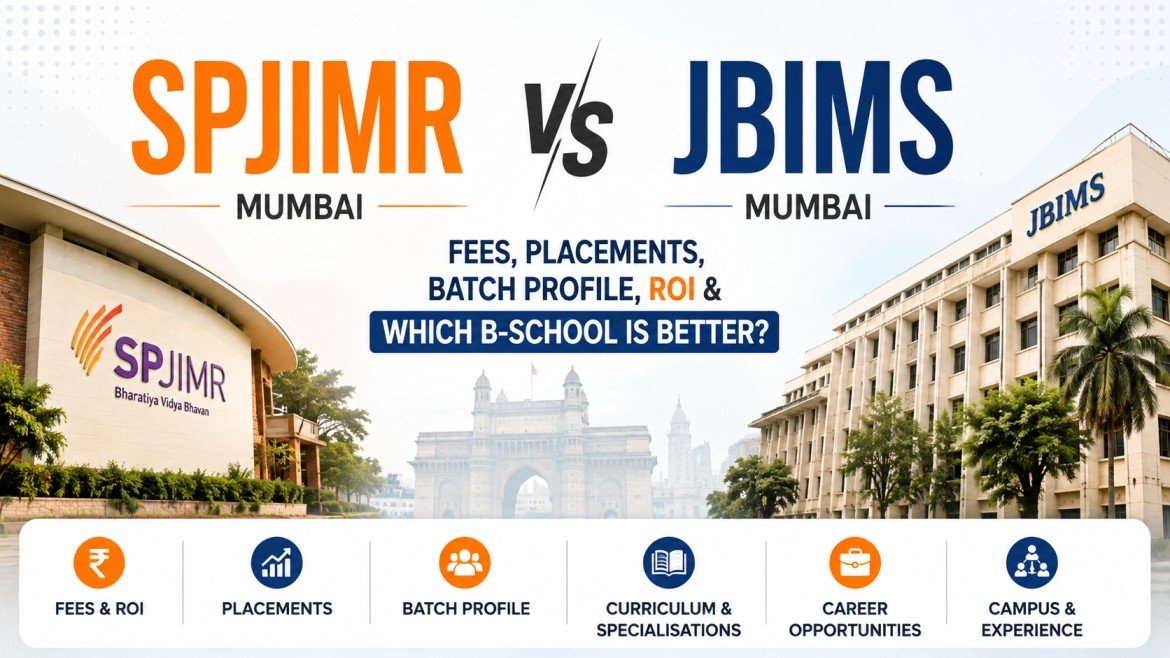
Quick Summary
- SPJIMR offers strong placements and a premium residential experience, while JBIMS stands out for exceptional ROI, low fees and strong finance opportunities, making both attractive for different goals.
Choosing between SPJIMR Mumbai and JBIMS Mumbai is one of the most interesting decisions for an MBA aspirant targeting a top management institute in Mumbai.
Both schools have strong corporate connections, influential alumni, excellent locations and a long history of producing management professionals. Yet they are very different institutions.
SPJIMR, formally S.P. Jain Institute of Management and Research, offers a two-year full-time residential PGDM and PGDM (Business Management), with a strong emphasis on industry exposure, specialisation, leadership development and experiential learning.
JBIMS, or Jamnalal Bajaj Institute of Management Studies, offers the two-year full-time MMS programme and is particularly known for its extremely strong fee-to-placement equation, Mumbai location, finance and consulting ecosystem, and powerful alumni network.
The comparison becomes especially important when you consider fees, placements and ROI together rather than looking only at the highest package.
For the latest available placement outcomes, SPJIMR's 2023–25 PGDM and PGDM (BM) batch reported 100% placement, an average CTC of ₹32 lakh, median CTC of ₹30.50 lakh and a highest international CTC of ₹89 lakh. JBIMS' 2024–26 MMS batch reported a mean CTC of ₹26.67 lakh, median CTC of ₹26.15 lakh and highest CTC of ₹80 lakh, with 70+ recruiters and 93 PPO/PPI offers.
So, which is better?
The answer depends on what you value.
If your priority is maximum ROI and lower tuition cost, JBIMS has an unusually strong case.
If your priority is higher average compensation, residential campus experience, structured specialisation and a broader private-B-school ecosystem, SPJIMR becomes highly attractive.
This article compares SPJIMR vs JBIMS across the areas that matter most to an MBA applicant: fees, placements, batch profile, admissions, curriculum, specialisations, career opportunities, campus experience, alumni network and ROI.
SPJIMR vs JBIMS: Quick Comparison
Before going into the details, here is the comparison in one place.
| Parameter | SPJIMR Mumbai | JBIMS Mumbai |
|---|---|---|
| Full-time flagship programme | PGDM / PGDM (BM) | MMS |
| Duration | 2 years | 2 years |
| Location | Andheri West, Mumbai | Churchgate, Mumbai |
| Programme format | Residential | Full-time |
| Approximate flagship batch size | PGDM: 240 | MMS: 150–160 |
| Latest verified placement batch | 2023–25 | 2024–26 |
| Average / Mean CTC | ₹32 LPA | ₹26.67 LPA |
| Median CTC | ₹30.50 LPA | ₹26.15 LPA |
| Highest CTC | ₹89 LPA international; ₹81 LPA domestic | ₹80 LPA |
| Placement rate | 100% for 2023–25 | Strong placement outcome; latest report lists 70+ recruiters |
| Major sectors | Consulting, FMCG, General Management, BFSI, Technology | BFSI, Investment Banking, Consulting, FMCG, Technology, Conglomerates |
| Entrance exams | CAT / GMAT | MAH MBA CET and other routes under applicable admission rules |
| Hostel | Yes, residential | Mumbai city-campus model |
| ROI | Strong | Exceptional when comparing tuition with compensation |
| Best suited for | Aspirants wanting structured residential B-school experience | Aspirants seeking strong placements at a comparatively low fee |
SPJIMR officially lists its PGDM batch size as 240 and describes the programme as a two-year full-time residential programme. JBIMS officially lists MMS intake at approximately 150–160 students.
The important point is that these numbers are not perfectly like-for-like. SPJIMR's placement figures combine its PGDM and PGDM (BM) placement process, whereas the JBIMS figure above refers specifically to the MMS programme.
What Is the Difference Between SPJIMR and JBIMS?
The simplest way to understand the difference is this:
SPJIMR is a private autonomous business school with a residential, industry-oriented PGDM model, while JBIMS is a University of Mumbai-affiliated management institute with its flagship MMS programme and a particularly attractive cost structure.
SPJIMR's PGDM is designed as a two-year full-time residential programme. The institute offers specialisations in areas including Finance, Information Management, Marketing, and Operations & Supply Chain. It also places significant emphasis on immersive experiences, international exposure, live projects and industry interaction.
JBIMS' MMS is also a two-year programme. The first two semesters provide common management education, after which students choose an area of specialisation such as Finance, Marketing, Operations, Systems or Human Resources.
This creates an important distinction.
At SPJIMR, the overall experience is strongly structured around a residential management-school environment.
At JBIMS, the advantage comes from being located in the middle of Mumbai's financial and corporate ecosystem while maintaining a relatively compact batch.
Neither model is automatically better.
The right choice depends on the student's career goals.
SPJIMR vs JBIMS Fees
Fees are probably the biggest reason this comparison gets complicated.
SPJIMR's official PGDM fee page currently lists the fee for Indian participants at ₹24.86 lakh, including tuition and basic hostel/accommodation. The institute explicitly states that the figure is indicative and subject to revision. Optional Global Fast Track and International Exchange expenses are not included.
JBIMS operates with a dramatically different fee structure.
For the latest official domestic fee figure that could be verified in JBIMS's published admission documentation, the open-category fee for the 2025–26 MMS cycle was listed at approximately ₹4.22 lakh, inclusive of tuition, other fees, library deposit and caution money. Because I could not verify the corresponding 2026–27 domestic fee notice from JBIMS, this figure should be treated as the latest verified reference rather than a confirmed 2026–27 fee.
That difference is enormous.
A student comparing only tuition expenditure could therefore see JBIMS as costing a fraction of SPJIMR.
However, fee comparison needs context.
SPJIMR's fee includes basic residential accommodation, while JBIMS students have a different Mumbai-campus model. Living expenses, accommodation, travel, food and other personal expenses can therefore differ substantially.
Fee comparison
| Cost factor | SPJIMR | JBIMS |
|---|---|---|
| Programme fee | ₹24.86 lakh indicative | Latest officially verified domestic reference: ~₹4.22 lakh |
| Hostel / accommodation | Basic accommodation included | Different campus/living model |
| International exposure | Optional additional cost | Depends on programme opportunities |
| Overall tuition burden | High | Very low compared with SPJIMR |
| Fee advantage | JBIMS | JBIMS |
SPJIMR's official documentation makes clear that its ₹24.86 lakh figure is indicative and includes tuition and basic hostel accommodation.
This is where SPJIMR vs JBIMS ROI becomes particularly interesting.
Why JBIMS Has Such a Strong ROI
Return on investment should not be calculated simply as:
Average salary ÷ tuition fee
That calculation ignores taxes, living expenses, loan interest, variable compensation and the fact that CTC is not the same as take-home salary.
Still, the basic relationship is useful.
JBIMS combines a comparatively low programme fee with a high-paying placement ecosystem.
The latest 2024–26 MMS placement outcome reported a ₹26.67 lakh mean CTC and ₹26.15 lakh median CTC, while the highest CTC reached ₹80 lakh.
That creates an unusually favourable fee-to-compensation relationship.
SPJIMR, meanwhile, has a considerably higher programme cost but also a higher average placement outcome. Its 2023–25 placement results showed an average salary of ₹32 lakh and median salary of ₹30.50 lakh.
Therefore:
JBIMS wins on fee efficiency.
SPJIMR wins on average compensation in the latest directly verified placement figures.
That distinction is important.
SPJIMR vs JBIMS Placements
Placements are where both institutions become extremely competitive.
SPJIMR's official 2025 placement announcement reported 100% placement for its largest-ever batch of 336 PGDM and PGDM (BM) participants.
The placement highlights included:
336 participants
86 participating companies
27 first-time recruiters
162 pre-placement offers
₹32 lakh average salary
₹30.50 lakh median salary
₹81 lakh highest domestic salary
₹89 lakh highest international salary
More than 53% of the batch receiving offers above ₹30 lakh
More than 90% receiving offers above ₹25 lakh
JBIMS' latest 2024–26 MMS placement outcome reported:
70+ total recruiters
21+ new recruiters
₹26.67 lakh mean CTC
₹26.15 lakh median CTC
₹80 lakh highest CTC
93 PPO/PPI offers
The placement numbers show that both schools can lead to excellent management careers.
Placement comparison
| Placement metric | SPJIMR | JBIMS |
|---|---|---|
| Batch considered | 2023–25 | 2024–26 |
| Average / Mean CTC | ₹32 LPA | ₹26.67 LPA |
| Median CTC | ₹30.50 LPA | ₹26.15 LPA |
| Highest CTC | ₹89 LPA international | ₹80 LPA |
| Domestic highest | ₹81 LPA | ₹80 LPA |
| Recruiters | 86 | 70+ |
| PPO/PPI | 162 | 93 |
| Placement rate | 100% reported | Strong placement outcome |
The batches and reporting periods are different, so these numbers should not be interpreted as a perfectly controlled statistical comparison.
Nevertheless, they provide a useful picture.
SPJIMR Placements: What Makes Them Strong?
SPJIMR has a particularly strong presence in consulting, FMCG, general management, BFSI and technology.
Its 2025 placement announcement identified consulting, FMCG, general management, BFSI and technology among the major recruiting sectors.
The placement ecosystem includes major companies across consulting, consumer businesses, financial services and technology.
The high PPO rate is also significant.
SPJIMR reported 162 PPOs for its 2023–25 batch, equivalent to approximately 48% of the batch.
This matters because a strong internship-to-PPO pipeline can reduce uncertainty during final placements.
For a student targeting consulting, marketing, general management or leadership-track roles, this is a major advantage.
JBIMS Placements: What Makes Them Strong?
JBIMS has an especially strong reputation in financial services, investment banking, consulting and large corporate groups.
The institute's latest MMS placement outcome shows that its recruiter network continues to include major firms such as Accenture Strategy & Consulting, BCG, Citi, Deloitte, HDFC Bank, HSBC, ICICI Bank, Infosys, JPMorganChase, KPMG, McKinsey, Morgan Stanley, PwC and Reliance Retail.
This is one of the reasons JBIMS is often considered highly attractive for candidates interested in finance and consulting.
Its location is another major advantage.
The campus is at Churchgate, Mumbai, placing students within one of India's most important business and financial districts.
For networking, corporate events and interaction with Mumbai's financial ecosystem, the location is strategically valuable.
Which Has Better Placements: SPJIMR or JBIMS?
If the comparison is based purely on the latest published average/mean CTC figures:
SPJIMR has the higher average compensation.
SPJIMR reported ₹32 lakh average salary for its 2023–25 placement batch, compared with JBIMS' ₹26.67 lakh mean CTC for the 2024–26 MMS batch.
However, placement quality cannot be reduced to one number.
JBIMS has a much lower fee burden and an extremely strong Mumbai corporate network.
Therefore:
Best average salary: SPJIMR
Best fee-to-placement relationship: JBIMS
Best finance ecosystem: JBIMS has a particularly strong case
Best overall placement scale and structured career services: SPJIMR has a strong advantage
SPJIMR vs JBIMS Batch Profile
Batch profile matters because your classmates become part of your professional network.
SPJIMR's PGDM programme has a relatively diverse profile with engineers, commerce graduates and candidates from other academic backgrounds. Its admission philosophy also considers academic performance, entrance-test scores, work experience, achievements and overall profile.
JBIMS has historically attracted a large proportion of engineering graduates as well.
The 2024–26 MMS batch profile reported approximately 155 students, with engineering students forming about 62% of the batch in the published summer placement profile. The same profile reported an average age of 24 years and approximately 14 months of average work experience.
The latest final-placement reporting for the 2024–26 batch also indicates a predominantly engineering background, with substantial representation from commerce and management.
Batch profile comparison
| Factor | SPJIMR | JBIMS |
|---|---|---|
| Academic diversity | High | Moderate to high |
| Engineering representation | Significant | Very significant |
| Freshers | Present | Significant |
| Work-experience candidates | Strong representation | Strong representation |
| Batch size | PGDM 240; combined placement batch 336 | Around 150–160 MMS |
| Learning environment | Residential cohort | Compact Mumbai cohort |
One important difference is that SPJIMR explicitly considers a candidate's broader profile during selection.
JBIMS's MMS admissions operate through the Maharashtra centralized admission framework and applicable entrance-score requirements.
SPJIMR Admission Process
SPJIMR accepts CAT and GMAT scores for its PGDM programme.
The institute states that applicants need a bachelor's degree with at least 50% marks or an equivalent CGPA. Work experience is not mandatory, and both fresh graduates and candidates with up to five years of work experience can apply.
SPJIMR's selection process is profile-oriented.
That means the entrance score is important, but it is not the only element considered.
Academic consistency, work experience, achievements, versatility and other aspects of the applicant profile can influence the shortlist.
This can be particularly useful for candidates who have a strong overall profile rather than only a high test score.
JBIMS Admission Process
JBIMS's flagship MMS is a two-year full-time programme with an intake of approximately 150–160 students.
The institute states that candidates seeking admission to the MMS programme must qualify through the applicable entrance examination and the centralized admission process. Its course page specifically identifies MAH MBA CET as the route for MMS consideration under the relevant admission process.
The 2026–27 admission documentation published by JBIMS also references scorecards from exams including MH-CET, CAT, CMAT, XAT, ATMA, MAT and GMAT in the documentation requirements, reflecting the applicable admission routes and categories.
Because admission rules can change by category, year and Maharashtra's centralized process, candidates should verify the applicable 2026–27 CAP notification before applying.
CAT vs CET: A Major Difference Between SPJIMR and JBIMS
One of the biggest practical differences is the entrance examination ecosystem.
For SPJIMR PGDM, CAT and GMAT are accepted.
For JBIMS MMS, the admission process is tied to the Maharashtra centralized admission system and MAH MBA CET plays a central role.
This means the two colleges require different preparation strategies.
A CAT aspirant targeting SPJIMR can simultaneously target IIMs, FMS, MDI, IIFT and other CAT-based schools.
A candidate targeting JBIMS through Maharashtra's process needs to pay close attention to MAH MBA CET strategy and the relevant CAP rules.
Therefore, the right exam strategy can depend heavily on your target school list.
Curriculum and Specialisations
SPJIMR's PGDM curriculum covers broad management fundamentals before allowing participants to develop deeper expertise in areas such as:
Finance
Marketing
Information Management
Operations and Supply Chain
The programme also incorporates immersive learning, live projects, industry engagement, simulations, internships and international opportunities.
JBIMS's MMS starts with common management education before students move toward areas including:
Finance
Marketing
Operations
Systems
Human Resources
For a student who already knows the preferred career function, this difference can influence the decision.
For example:
Finance: JBIMS has an exceptionally strong case.
Marketing: SPJIMR has a particularly strong reputation and recruiter ecosystem.
Consulting: Both are highly competitive.
General management: Both offer strong opportunities.
Technology/product roles: SPJIMR's information-management orientation and broad recruiter base can be attractive, although role availability depends on the placement cycle.
SPJIMR vs JBIMS for Finance
Finance is one of the areas where JBIMS is particularly compelling.
Its Mumbai location, alumni network and longstanding relationships with financial institutions contribute to a strong finance ecosystem.
Recent JBIMS placement information highlights recruitment from investment banking, BFSI, wealth management, credit, consulting and related financial-services areas.
SPJIMR also has strong finance placements and a broader set of management career paths.
If you want investment banking, corporate finance, financial services or finance-heavy consulting, both schools deserve serious consideration.
However, if the decision is specifically:
"Which Mumbai school should I strongly consider for finance while minimizing tuition cost?"
JBIMS becomes exceptionally attractive.
SPJIMR vs JBIMS for Consulting
Consulting is another area where the two schools compete strongly.
SPJIMR's latest placement cycle had consulting among its largest recruiting sectors, with companies such as Accenture Strategy, BCG, Deloitte, EY Parthenon, KPMG and PwC represented in its recruiter ecosystem.
JBIMS also attracts major consulting firms including BCG, Accenture Strategy & Consulting, Deloitte, EY, KPMG, McKinsey and PwC.
The distinction therefore becomes less about whether consulting exists and more about:
Your individual profile
Academic record
Interview performance
Previous work experience
Internship performance
Role availability in the specific placement year
For consulting, both are excellent options.
SPJIMR vs JBIMS for Marketing
SPJIMR has a particularly strong marketing and FMCG ecosystem.
The 2025 placement cycle included major consumer companies among recruiters, and FMCG was one of the institute's prominent recruiting sectors.
Candidates interested in brand management, sales and marketing, consumer strategy and general-management roles should therefore evaluate SPJIMR seriously.
JBIMS also has strong marketing placements, but SPJIMR's curriculum and recruiter mix can make it particularly appealing for candidates specifically targeting consumer-facing roles.
Campus and Student Life
Campus experience is another area where the two schools are very different.
SPJIMR's PGDM is explicitly residential.
The institute states that the PGDM is a two-year, full-time residential programme and participants are required to reside on campus.
This creates a traditional B-school environment.
Students spend significant time together, participate in academic activities, clubs, competitions, projects and industry interactions, and build relationships through a shared residential experience.
JBIMS is located in Churchgate.
Its advantage is not the traditional residential-campus experience but its location in Mumbai's business ecosystem.
That can be valuable for students who enjoy being in the city and want easy access to the professional environment surrounding South Mumbai.
So:
Residential campus experience → SPJIMR
Central Mumbai corporate location → JBIMS
Alumni Network: SPJIMR vs JBIMS
Alumni strength is difficult to quantify because network value depends on industry, geography and individual engagement.
JBIMS has a particularly strong legacy in Indian corporate leadership and is widely associated with its "CEO Factory" identity.
Its alumni network includes senior professionals across financial services, consulting, conglomerates, consumer businesses and entrepreneurship.
SPJIMR also has a large and influential alumni community across consulting, finance, FMCG, technology, general management and entrepreneurship.
The important distinction is not simply the number of alumni.
Ask:
Where are the alumni working in the career I want?
If you are targeting finance and investment banking, investigate the finance-heavy alumni network.
If you want consulting, examine consulting alumni.
If you want FMCG or marketing, compare the consumer-business network.
The alumni advantage becomes much more valuable when it aligns with your intended career.
Is SPJIMR Worth the Higher Fees?
This is one of the most important questions in the entire comparison.
SPJIMR's current indicative Indian participant fee is ₹24.86 lakh including tuition and basic hostel accommodation.
Its latest reported average salary was ₹32 lakh, with a ₹30.50 lakh median.
That is a strong placement outcome.
But the student should still consider the financing structure.
If you need a large education loan, the effective cost of SPJIMR can be significantly higher after adding interest.
At the same time, SPJIMR may offer greater access to certain career tracks, which could justify the higher investment for some candidates.
Therefore, the question is not:
"Is SPJIMR expensive?"
It is.
The better question is:
"Will the additional investment produce enough career value for my target role to justify the difference?"
For a candidate targeting consulting, marketing, general management or other high-paying corporate roles, the answer may be yes.
For a candidate who has a confirmed JBIMS seat and is primarily evaluating ROI, the calculation becomes much harder for SPJIMR to win.
Is JBIMS Better Than SPJIMR for ROI?
If ROI means salary relative to programme fee, JBIMS has one of the strongest cases among Indian B-schools.
Its latest publicly verifiable domestic fee reference is around ₹4.22 lakh for the 2025–26 cycle, while its 2024–26 MMS batch reported a mean CTC of ₹26.67 lakh.
Even without making an overly simplistic salary-to-fee calculation, the gap is obvious.
JBIMS therefore has a major financial advantage.
The student also needs to account for:
Accommodation
Food
Transport
Personal expenses
Education loan interest
Taxes
Actual fixed salary
Variable pay
But even after considering these factors, the low tuition remains a major advantage.
SPJIMR vs JBIMS: ROI Comparison
| Factor | SPJIMR | JBIMS |
|---|---|---|
| Programme cost | High | Very low relative to placements |
| Average compensation | Higher | Slightly lower |
| Median compensation | Higher | Slightly lower |
| Loan requirement | Potentially high | Much lower |
| Accommodation | Included in basic fee | Separate living consideration |
| Financial risk | Higher | Lower |
| Salary upside | Excellent | Excellent |
| Fee-to-salary ROI | Strong | Exceptional |
If your goal is minimizing financial risk, JBIMS is difficult to beat.
If your goal is maximizing access to a premium residential management education with a higher average salary outcome, SPJIMR deserves the premium.
A More Realistic ROI Calculation
Suppose a student pays a large programme fee through an education loan.
The actual return is affected by:
Total investment = programme fees + living expenses + loan interest + opportunity cost
while:
Career return = fixed compensation + variable compensation + long-term career progression
This is why two students can make completely different decisions even after seeing the same placement numbers.
A student with family funding may value campus experience and brand exposure more heavily.
A student taking a large loan may prioritize fee efficiency.
A student with a strong finance background may value JBIMS's Mumbai network.
A candidate interested in marketing or general management may prefer SPJIMR.
ROI is therefore personal.
Which Is Better for Freshers?
Both institutes can be attractive to fresh graduates.
SPJIMR explicitly states that work experience is not mandatory for PGDM admission. Fresh graduates can apply.
JBIMS also has a meaningful fresher population. The 2024–26 batch profile reported approximately 42% freshers in the published summer-placement profile.
Therefore, a fresher should not reject either school simply because they do not have full-time work experience.
However, profile quality matters.
A fresher with:
Strong academics
Good entrance score
Relevant internships
Leadership experience
Competitions
Extracurricular achievements
Strong communication
can be competitive at both schools.
Which Is Better for Candidates With Work Experience?
Work experience can be valuable at both schools, but the ideal choice depends on the career objective.
SPJIMR's selection process explicitly considers relevant work experience and broader profile factors.
JBIMS also has a meaningful mix of experienced candidates. Its 2024–26 MMS profile reported an average work experience of approximately 14 months.
Candidates with two to three years of experience should therefore look beyond the admission process and consider whether the MBA/MMS will create a meaningful career transition.
For example:
A software engineer moving into consulting may value the consulting ecosystem.
A finance professional moving toward investment banking may value JBIMS's finance network.
A marketing professional seeking brand-management opportunities may find SPJIMR particularly attractive.
Which Has Better Brand Value?
Both brands are highly respected.
SPJIMR is a major private management institute with international accreditation and a strong national reputation.
The institute highlights its Triple Crown accreditation from AACSB, AMBA and EQUIS.
JBIMS has a long-standing legacy under the University of Mumbai and is one of India's best-known management institutions.
In practical hiring terms, both are recognized by major employers.
The brand difference is therefore much smaller than the difference in programme economics.
You should not select a school only because one has a more attractive ranking headline.
Look at:
Recruiters
Roles
Median salary
Batch size
Alumni
Fee
Loan requirement
Career fit
These factors are more useful than a single ranking.
SPJIMR vs JBIMS: Pros and Cons
SPJIMR Advantages
Strong average placement compensation
100% placement reported for the 2023–25 batch
Strong consulting ecosystem
Excellent FMCG and marketing opportunities
Strong general-management opportunities
Residential programme
International exposure
Structured career services
Strong academic and corporate ecosystem
Multiple specialisation options
SPJIMR Disadvantages
High programme fee
Potentially substantial education loan burden
Higher total cost than JBIMS
Residential format may not suit everyone
Premium must be justified through career outcomes
JBIMS Advantages
Exceptionally low programme fee relative to placement outcomes
Excellent ROI
Strong Mumbai location
Strong finance and investment-banking ecosystem
Strong consulting placements
Powerful alumni network
Compact batch
Strong corporate recruiter base
High placement compensation relative to tuition
JBIMS Disadvantages
Admission is extremely competitive
MAH MBA CET route requires a different preparation strategy
Less traditional residential-campus experience
Average CTC is lower than SPJIMR's latest reported figure
Candidates may need to manage accommodation separately
2026–27 domestic fee should be verified against the final official fee notice before payment
SPJIMR vs JBIMS for International Opportunities
SPJIMR offers structured international exposure through initiatives such as its Global Fast Track and International Exchange opportunities.
Its latest placement report also recorded an international highest salary of ₹89 lakh.
That does not mean that every student will receive an international job.
International opportunities depend on:
Recruiter demand
Visa policies
Candidate profile
Role
Location
Work experience
Economic conditions
JBIMS also has internationally relevant corporate outcomes, particularly through multinational firms and global financial institutions.
For a student specifically targeting international mobility, however, SPJIMR's structured global-exposure opportunities can be a useful advantage.
Which Is Better for MBA Aspirants From Engineering Backgrounds?
Engineering graduates make up a significant portion of both schools' cohorts.
JBIMS's recent batch profile shows engineering as the dominant academic background, while SPJIMR also attracts a substantial engineering population.
For engineers, the decision should therefore be driven by the desired career transition.
If you want:
Consulting: both
Product / technology management: SPJIMR can be attractive
Finance: JBIMS deserves serious consideration
Marketing: SPJIMR can be particularly attractive
General management: both
Maximum ROI: JBIMS
Which Is Better for a Student Taking an Education Loan?
This is where the decision can become straightforward.
If the student has to finance almost the entire programme through debt, the lower-cost option becomes significantly more attractive.
JBIMS's fee advantage reduces:
Principal borrowed
Interest burden
Monthly EMI
Financial pressure after graduation
Break-even period
SPJIMR's higher average salary can compensate for some of the difference, but the student must evaluate their expected career path rather than assuming the average salary applies equally to every graduate.
For a loan-dependent student, JBIMS generally has the stronger financial-risk profile.
Which Is Better if Money Is Not a Major Constraint?
If the programme fee is manageable without creating significant financial stress, the comparison changes.
You can place greater weight on:
Residential experience
Curriculum
International exposure
Specialisation
Corporate projects
Consulting ecosystem
Marketing ecosystem
Career services
Alumni network
Personal learning style
Under these circumstances, SPJIMR's premium may make more sense.
SPJIMR vs JBIMS: Career-Wise Decision
Choose SPJIMR if you want:
Consulting
Marketing
FMCG
General management
Technology-management roles
A residential B-school experience
Structured experiential learning
International exposure
A higher average compensation outcome
Choose JBIMS if you want:
Finance
Investment banking
BFSI
Consulting
Strong Mumbai corporate exposure
A compact cohort
Lower financial burden
Exceptional fee-to-placement ROI
SPJIMR vs JBIMS: Who Should Choose What?
The following framework can make the decision easier.
| Student profile | Better fit |
|---|---|
| Wants maximum ROI | JBIMS |
| Wants lowest tuition | JBIMS |
| Wants finance | JBIMS |
| Wants investment banking | JBIMS |
| Wants consulting | Both |
| Wants marketing/FMCG | SPJIMR |
| Wants residential B-school experience | SPJIMR |
| Wants international exposure | SPJIMR |
| Has a large education loan | JBIMS |
| Wants higher latest average CTC | SPJIMR |
| Wants compact Mumbai corporate ecosystem | JBIMS |
| Wants broader experiential learning environment | SPJIMR |
SPJIMR vs JBIMS: The Placement Number You Should Actually Look At
Students often focus on the highest package.
That is usually the wrong number.
A ₹80 lakh or ₹89 lakh highest CTC is impressive, but it does not tell you what the average student receives.
Median salary is more useful because it gives a better indication of the middle of the placement distribution.
SPJIMR reported:
Average: ₹32 LPA
Median: ₹30.50 LPA
JBIMS reported:
Mean: ₹26.67 LPA
Median: ₹26.15 LPA
The gap between average and median is relatively modest for both schools, which provides a more useful perspective than simply comparing the highest packages.
Why Highest Package Should Not Decide Your College
Suppose College A has a highest package of ₹1 crore and College B has a highest package of ₹80 lakh.
It does not automatically mean College A is better.
The highest salary may represent:
One student
One international role
A highly specialized function
A role with unusually high variable pay
A rare recruitment outcome
Instead, compare:
Median salary
Average salary
Placement rate
Recruiter quality
Number of recruiters
Role distribution
Sector distribution
PPO rate
Batch size
Fees
This gives a much more realistic picture.
How to Compare SPJIMR and JBIMS Beyond Placements
A serious MBA decision should use a weighted scorecard.
You can assign your own importance to each factor.
For example:
| Factor | Suggested weight |
|---|---|
| Career outcome | 25% |
| ROI | 20% |
| Fees / loan burden | 15% |
| Brand and alumni | 15% |
| Career specialization | 10% |
| Campus experience | 5% |
| Location | 5% |
| International exposure | 5% |
Then score each school from 1 to 10.
This prevents one impressive number from dominating the decision.
For a finance-focused student, you might increase the weight of finance placements.
For a marketing aspirant, you might increase the weight of FMCG and brand-management recruitment.
For a student using a large loan, you might increase the fee/ROI weighting.
Frequently Asked Questions
Is SPJIMR better than JBIMS?
Neither is universally better. SPJIMR offers a higher latest reported average salary and a strong residential management-school experience, while JBIMS offers exceptionally strong ROI because of its much lower programme fee and high placement outcomes.
Which has better placements, SPJIMR or JBIMS?
Based on the latest verified figures, SPJIMR reported an average salary of ₹32 LPA for its 2023–25 PGDM/PGDM (BM) batch, while JBIMS reported a mean CTC of ₹26.67 LPA for its 2024–26 MMS batch.
Which has better ROI, SPJIMR or JBIMS?
JBIMS has the stronger fee-to-placement ROI because its domestic MMS fee is dramatically lower than SPJIMR's programme fee. The latest officially verified JBIMS domestic fee reference available is from the 2025–26 cycle, so candidates should verify the final 2026–27 fee before admission.
What is the SPJIMR PGDM fee?
SPJIMR currently lists ₹24.86 lakh for Indian participants, including tuition and basic hostel accommodation. The institute describes this amount as indicative and subject to revision.
What is the JBIMS MMS fee?
The latest official domestic fee figure I could verify is approximately ₹4.22 lakh for the 2025–26 open-category MMS cycle. The corresponding 2026–27 domestic fee should be checked against JBIMS's final official admission/fee notice.
What is the average package at SPJIMR?
SPJIMR reported an average annual salary of ₹32 lakh for the 2023–25 PGDM and PGDM (BM) placement batch.
What is the average package at JBIMS?
JBIMS reported a mean CTC of ₹26.67 lakh and median CTC of ₹26.15 lakh for its 2024–26 MMS final placement cycle.
What is the highest package at SPJIMR?
For the 2023–25 placement batch, SPJIMR reported ₹81 lakh as the highest domestic salary and ₹89 lakh as the highest international salary.
What is the highest package at JBIMS?
JBIMS reported a highest CTC of ₹80 lakh for its 2024–26 MMS batch.
Is SPJIMR good for freshers?
Yes. SPJIMR states that work experience is not mandatory for PGDM admission, so fresh graduates can apply.
Is JBIMS good for freshers?
Yes. JBIMS has a substantial fresher population. The 2024–26 batch profile reported approximately 42% freshers.
Which is better for finance, SPJIMR or JBIMS?
JBIMS has a particularly strong finance ecosystem because of its Mumbai location, alumni network and recruiter base. SPJIMR also has strong finance opportunities. For a candidate primarily targeting investment banking or financial services while prioritizing ROI, JBIMS is especially compelling.
Which is better for consulting?
Both are excellent choices. SPJIMR and JBIMS attract leading consulting firms. Your individual profile, interview performance, internship and role preferences will have a major impact on the final outcome.
Which is better for marketing?
SPJIMR has a particularly strong case for marketing and FMCG because these sectors are prominent in its placement ecosystem.
Does SPJIMR accept CAT?
Yes. SPJIMR's PGDM accepts CAT and GMAT scores.
Does JBIMS accept CAT?
JBIMS's MMS admissions operate through the applicable centralized admission process. The institute's 2026–27 documentation references multiple entrance-score documents, while its MMS course page identifies MAH MBA CET as the relevant entrance examination route for MMS consideration. Candidates should follow the current DTE/CAP notification for their category.
Is SPJIMR residential?
Yes. SPJIMR's PGDM is a two-year full-time residential programme.
Which has a better campus experience?
This depends on preference. SPJIMR offers a traditional residential B-school environment, while JBIMS offers a central Mumbai location with proximity to the city's corporate and financial ecosystem.
Is JBIMS worth choosing over SPJIMR?
If you have confirmed admission to both and are primarily concerned about ROI and financial risk, JBIMS can be the better financial decision. If you value SPJIMR's residential environment, curriculum, international exposure and stronger latest average salary outcome, SPJIMR can justify its higher cost.
Is SPJIMR worth the higher fees?
For candidates targeting high-value careers and who can comfortably manage the programme cost, SPJIMR can be worth the premium. However, students taking a large education loan should compare the actual loan burden against their expected career outcome rather than relying solely on average CTC.
Final Verdict: SPJIMR vs JBIMS
There is no single winner for every MBA aspirant.
SPJIMR wins on average compensation, residential experience, structured experiential learning, international exposure and a broad corporate ecosystem.
JBIMS wins on tuition economics, fee-to-placement ROI, Mumbai location and its exceptionally strong finance and corporate network.
The latest verified numbers make the difference clear.
SPJIMR reported ₹32 lakh average salary and ₹30.50 lakh median salary for its 2023–25 PGDM/PGDM (BM) placement batch, with 100% placement reported and a ₹89 lakh international highest salary.
JBIMS reported ₹26.67 lakh mean CTC and ₹26.15 lakh median CTC for its 2024–26 MMS batch, with a ₹80 lakh highest CTC and 93 PPO/PPI offers.
But the fee equation changes the decision dramatically.
SPJIMR currently lists an indicative Indian PGDM fee of ₹24.86 lakh including basic hostel accommodation, whereas the latest officially verified domestic JBIMS fee reference available is approximately ₹4.22 lakh for the 2025–26 MMS cycle.
That makes JBIMS an outstanding ROI choice.
So the practical verdict is:
Choose JBIMS if your first priority is ROI, low fees, finance, investment banking or minimizing education-loan pressure.
Choose SPJIMR if your priority is a premium residential B-school experience, higher average compensation, consulting, marketing, FMCG, general management and structured experiential/global exposure.
If you have both offers, do not make the decision based on the highest package alone.
Compare your total cost, expected loan, target career, median salary, recruiter mix, role quality, alumni network and personal career goals.
For many students, JBIMS will be the smarter financial choice.
For others, particularly those targeting specific high-value career paths and who can comfortably absorb the higher fee, SPJIMR can be the stronger overall educational investment.
The best college is therefore not simply the one with the bigger package.
It is the one that gives your profile, career goal and financial situation the strongest combination of opportunity and return.
Sources and official references
SPJIMR official PGDM fee information: SPJIMR PGDM Fees & Scholarships
SPJIMR official placement information: SPJIMR PGDM Placements
SPJIMR 2025 placement announcement: SPJIMR 2023–25 Placement Results
SPJIMR admissions: SPJIMR PGDM Admissions
JBIMS official placement reports: JBIMS Placement Reports
JBIMS official MMS programme information: JBIMS MMS Programme
JBIMS 2026–27 admission updates: JBIMS 2026–27 Admissions
Maharashtra 2026–27 technical-course admission brochure: Maharashtra 2026–27 Admission Brochure
Search Keywords
spjimr vs jbims, SPJIMR vs JBIMS Mumbai, SPJIMR vs JBIMS placements, SPJIMR vs JBIMS fees, SPJIMR vs JBIMS ROI, SPJIMR JBIMS comparison, SPJIMR Mumbai vs JBIMS Mumbai, SP Jain vs JBIMS, SP Jain Mumbai vs JBIMS, SPJIMR fees, JBIMS fees, SPJIMR placements, JBIMS placements, SPJIMR average package, JBIMS average package, SPJIMR highest package, JBIMS highest package, SPJIMR median salary, JBIMS median salary, SPJIMR ROI, JBIMS ROI, SPJIMR MBA fees, JBIMS MMS fees, SPJIMR PGDM fees, JBIMS MMS placement, SPJIMR PGDM placement, SPJIMR admission, JBIMS admission, SPJIMR CAT, JBIMS CET, SPJIMR CAT cutoff, JBIMS CET cutoff, SPJIMR eligibility, JBIMS eligibility, SPJIMR batch profile, JBIMS batch profile, SPJIMR average salary, JBIMS mean CTC, SPJIMR median CTC, JBIMS median CTC, SPJIMR recruiters, JBIMS recruiters, SPJIMR consulting placements, JBIMS consulting placements, SPJIMR finance placements, JBIMS finance placements, SPJIMR marketing placements, JBIMS marketing placements, SPJIMR FMCG placements, JBIMS investment banking, SPJIMR investment banking, JBIMS finance, SPJIMR consulting, JBIMS consulting, SPJIMR marketing, JBIMS marketing, SPJIMR general management, JBIMS general management, SPJIMR residential programme, JBIMS campus, SPJIMR campus, JBIMS Mumbai, SPJIMR Mumbai, SP Jain Institute of Management and Research, Jamnalal Bajaj Institute of Management Studies, SPJIMR PGDM, JBIMS MMS, SPJIMR PGDM BM, SPJIMR PGDM Business Management, JBIMS Master of Management Studies, SPJIMR vs JBIMS which is better, JBIMS vs SPJIMR which is better, SPJIMR or JBIMS, JBIMS or SPJIMR, should I choose SPJIMR or JBIMS, SPJIMR better than JBIMS, JBIMS better than SPJIMR, SPJIMR ROI vs JBIMS ROI, SPJIMR fees vs JBIMS fees, SPJIMR placements vs JBIMS placements, SPJIMR package vs JBIMS package, SPJIMR salary vs JBIMS salary, SPJIMR college comparison, JBIMS college comparison, best MBA college Mumbai, best B school Mumbai, top MBA colleges Mumbai, top B schools Mumbai, MBA colleges with best ROI Mumbai, MBA colleges low fees high placement Mumbai, best ROI MBA colleges India, best MBA for finance Mumbai, best MBA for consulting Mumbai, best MBA for marketing Mumbai, MBA finance JBIMS, MBA consulting SPJIMR, MBA marketing SPJIMR, MBA investment banking JBIMS, SPJIMR 2026, JBIMS 2026, SPJIMR admission 2026, JBIMS admission 2026, SPJIMR placements 2026, JBIMS placements 2026, SPJIMR fees 2026, JBIMS fees 2026, SPJIMR vs JBIMS 2026, SPJIMR MBA comparison 2026, JBIMS MMS comparison 2026, SPJIMR PGDM 2026, JBIMS MMS 2026, SPJIMR batch 2026, JBIMS batch 2026, SPJIMR career opportunities, JBIMS career opportunities, SPJIMR alumni, JBIMS alumni, SPJIMR corporate recruiters, JBIMS corporate recruiters, SPJIMR education loan ROI, JBIMS education loan ROI, SPJIMR return on investment, JBIMS return on investment, SPJIMR placement rate, JBIMS placement rate, SPJIMR PPO, JBIMS PPO, SPJIMR pre placement offers, JBIMS pre placement offers, SPJIMR salary packages, JBIMS salary packages, SPJIMR fee structure, JBIMS fee structure, SPJIMR admission criteria, JBIMS admission criteria, SPJIMR entrance exam, JBIMS entrance exam, CAT colleges Mumbai, CET colleges Mumbai, SPJIMR vs JBIMS for freshers, SPJIMR vs JBIMS for engineers, SPJIMR vs JBIMS for finance, SPJIMR vs JBIMS for consulting, SPJIMR vs JBIMS for marketing
Long-Tail & Short-Tail Searches
spjimr vs jbims which is better, is SPJIMR better than JBIMS, is JBIMS better than SPJIMR, SPJIMR vs JBIMS fees and placements, SPJIMR vs JBIMS ROI comparison, SPJIMR vs JBIMS salary comparison, SPJIMR vs JBIMS placement comparison, SPJIMR vs JBIMS fee difference, SPJIMR vs JBIMS for finance careers, SPJIMR vs JBIMS for consulting careers, SPJIMR vs JBIMS for marketing careers, SPJIMR vs JBIMS for freshers, SPJIMR vs JBIMS for engineers, SPJIMR vs JBIMS for finance students, SPJIMR vs JBIMS for CAT aspirants, SPJIMR vs JBIMS for CET aspirants, should I choose JBIMS or SPJIMR, which has better ROI SPJIMR or JBIMS, which has better placements SPJIMR or JBIMS, which has lower fees SPJIMR or JBIMS, which has better salary SPJIMR or JBIMS, which has better finance placements SPJIMR or JBIMS, which has better consulting placements SPJIMR or JBIMS, which has better marketing placements SPJIMR or JBIMS, SPJIMR fee worth it compared with JBIMS, is JBIMS worth choosing over SPJIMR, is SPJIMR worth the higher fee, JBIMS ROI after MMS, SPJIMR ROI after PGDM, SPJIMR average package compared with JBIMS, JBIMS average package compared with SPJIMR, SPJIMR median package compared with JBIMS, JBIMS median package compared with SPJIMR, SPJIMR placement report compared with JBIMS, JBIMS placement report compared with SPJIMR, SPJIMR fees including hostel, JBIMS MMS total fees, SPJIMR education loan burden, JBIMS education loan burden, best Mumbai MBA college for ROI, best Mumbai B school for finance, best Mumbai B school for consulting, best Mumbai B school for marketing, SPJIMR vs JBIMS admission process, SPJIMR CAT admission vs JBIMS CET admission, SPJIMR PGDM vs JBIMS MMS, SPJIMR PGDM or JBIMS MMS, SPJIMR residential campus vs JBIMS Mumbai campus, SPJIMR international exposure vs JBIMS, SPJIMR alumni vs JBIMS alumni, SPJIMR recruiters vs JBIMS recruiters, SPJIMR placement rate vs JBIMS placement rate, SPJIMR highest package vs JBIMS highest package, SPJIMR median salary vs JBIMS median salary, SPJIMR average salary vs JBIMS average salary, SPJIMR consulting recruiters, JBIMS consulting recruiters, SPJIMR finance recruiters, JBIMS finance recruiters, SPJIMR FMCG recruiters, JBIMS investment banking recruiters, SPJIMR marketing career, JBIMS finance career, SPJIMR general management career, JBIMS consulting career, SPJIMR 2026 admission fees, JBIMS 2026 admission fees, SPJIMR 2026 placement comparison, JBIMS 2026 placement comparison, SPJIMR 2026 batch profile, JBIMS 2026 batch profile, SPJIMR vs JBIMS latest comparison, latest SPJIMR vs JBIMS placement data, latest SPJIMR vs JBIMS fees, latest JBIMS MMS placement, latest SPJIMR PGDM placement, SPJIMR vs JBIMS return on investment for MBA.
Key Takeaways
SPJIMR has a strong placement record, with 2026 data showing an average package around ₹33.6 lakh for PGDM.
JBIMS is particularly attractive for students prioritising ROI and lower education costs.
SPJIMR offers a residential two-year PGDM experience with strong industry exposure.
JBIMS has a powerful Mumbai location and a strong reputation in finance and consulting.
SPJIMR is particularly attractive for consulting, marketing, FMCG and general-management careers.
JBIMS is especially compelling for finance, investment banking and candidates seeking lower financial risk.
The better choice depends on career goals, fees, expected salary and personal financial situation.
Placement averages should be considered alongside median salary, recruiter quality and role profiles.
Students taking a large education loan may find JBIMS's lower-cost model particularly attractive.
Candidates prioritising broader campus experience and structured experiential learning may prefer SPJIMR.

Ask a question
Still confused? Leave your question and our team will help you.