
Quick Summary
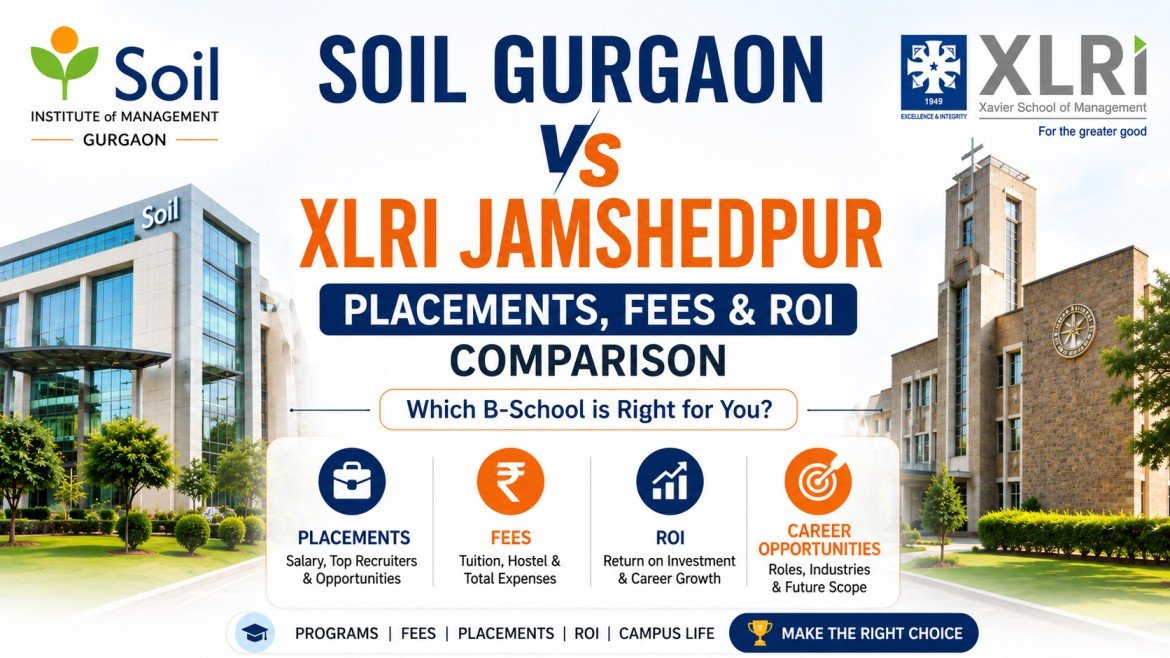
- XLRI offers stronger brand recognition and higher placement outcomes, while SOIL provides programme flexibility, experiential learning and Gurgaon exposure. The better choice depends on career stage, budget and goals.
Choosing between SOIL Gurgaon and XLRI Jamshedpur is not a simple comparison of two management institutes. The right choice depends heavily on your career stage, budget, preferred program format, target industry and expectations from placements.
In the SOIL vs XLRI comparison, one of the biggest differences is that students are often comparing different types of management programmes. SOIL offers one-year programmes for experienced professionals as well as a two-year PGDM designed largely for freshers and early-career candidates. XLRI Jamshedpur, meanwhile, is widely known for its two-year flagship PGDM programmes in Business Management and Human Resource Management, along with programmes for experienced professionals.
This means that SOIL vs XLRI should not be treated as a simple college ranking battle. A fresher comparing SOIL's two-year PGDM with XLRI BM may reach a different conclusion from a professional with several years of work experience comparing SOIL PGPM with XLRI's management programmes.
The latest publicly available information as of 2026 also needs to be interpreted carefully. XLRI has published final placement highlights for 2026, while SOIL's official website provides programme-specific placement information and, for its two-year PGDM, an interim placement report for the 2025–26 cycle. Therefore, students should compare the figures according to programme and placement cycle rather than assuming every number represents the same batch or year.
Quick Comparison: SOIL Gurgaon vs XLRI Jamshedpur
| Factor | SOIL Gurgaon / Manesar | XLRI Jamshedpur |
|---|---|---|
| Major programme formats | One-year PGPM, PGPM-HR and two-year PGDM | Two-year PGDM BM and HRM, plus programmes for experienced professionals |
| Suitable for | Freshers, early-career candidates and experienced professionals depending on programme | Highly competitive management aspirants and experienced professionals, depending on programme |
| 2026/available placement information | Programme-specific official placement reports available; latest PGDM interim report available for March 2026 | Official final placement highlights for 2026 available |
| Latest SOIL PGDM placement figure available | ₹11.5 LPA overall average in the March 2026 interim report | — |
| Latest SOIL PGDM highest figure available | ₹24 LPA in the March 2026 interim report | — |
| Latest XLRI 2026 average salary | — | ₹31.40 LPA |
| Latest XLRI 2026 median salary | — | ₹29 LPA |
| XLRI 2026 highest domestic offer | — | ₹59 LPA |
| XLRI 2026 highest international offer | — | ₹1.10 crore |
| Programme fees | Vary significantly by programme | Approximately ₹15.25 lakh per year for BM/HRM in the 2026 admission information, with hostel and mess extra |
| Learning approach | Leadership, experiential learning and business/design-oriented learning depending on programme | Strong traditional management education with specialisation and broad corporate exposure |
| Location advantage | Gurgaon/Delhi NCR ecosystem | Jamshedpur residential campus environment |
| Brand positioning | Specialised private management institution | One of India's most established management institutions |
The comparison above is useful as a starting point, but the most important decision comes from comparing the exact programme you are eligible for.
SOIL's official programme pages and XLRI's 2026 admission and placement information provide the basis for these figures.
SOIL Gurgaon vs XLRI: Which Comparison Is Actually Relevant?
The phrase SOIL vs XLRI can represent several different comparisons.
For a fresher, the relevant comparison may be:
- SOIL two-year PGDM vs XLRI PGDM Business Management.
- SOIL two-year PGDM vs XLRI PGDM Human Resource Management, depending on career interest.
For an experienced professional, the comparison may instead involve:
- SOIL one-year PGPM vs an XLRI programme designed for experienced candidates.
- SOIL PGPM-HR vs an HR-focused XLRI option.
This distinction matters because programme duration, candidate profile and placement outcomes can differ significantly.
A student should therefore avoid asking only, "Which college is better?" A more useful question is:
Which programme offers the better combination of career fit, cost, placement opportunity and ROI for my current profile?
That is the most practical way to approach the SOIL vs XLRI decision.
About SOIL Gurgaon
SOIL Institute of Management offers multiple management programmes designed for different career stages.
Its official website currently highlights:
- A one-year PGPM for management professionals.
- A one-year PGPM-HR programme.
- A two-year PGDM programme located in Manesar, New Gurgaon.
The two-year PGDM is designed around business education combined with design thinking and liberal arts. SOIL describes a significant part of the curriculum as experiential and industry immersive. Its official PGDM information also lists Finance, Marketing, Human Resources and Analytics among the programme's specialisation areas.
SOIL's location is another important consideration. Students studying in the Gurgaon and Manesar region have access to the broader Delhi NCR corporate ecosystem, which can be particularly relevant for industry interaction, networking and career exploration.
However, the programme you choose matters more than the institute name alone. A one-year PGPM candidate and a two-year PGDM candidate should not expect identical career outcomes.
About XLRI Jamshedpur
XLRI Jamshedpur offers several management programmes, with its flagship two-year programmes including:
- PGDM Business Management.
- PGDM Human Resource Management.
The 2026 admission prospectus describes these as two-year full-time postgraduate programmes designed for careers in industry and services.
The Business Management programme covers major management disciplines and allows students to pursue areas such as finance, marketing, information systems, operations, economics and strategic management.
The Human Resource Management programme focuses more deeply on HR concepts and practices while also exposing students to broader management disciplines.
In the SOIL vs XLRI comparison, XLRI's flagship programmes generally appeal to students looking for a highly competitive, residential, academically intensive management experience with strong corporate placement outcomes.
SOIL vs XLRI: Programme Structure
SOIL Programme Options
SOIL's programme portfolio gives applicants flexibility depending on their experience level.
The two-year PGDM is primarily relevant for fresh graduates and candidates in the early stages of their careers. SOIL's admission information specifies that the programme accepts candidates with valid scores from recognised management entrance examinations, subject to programme eligibility requirements.
The official programme information for the 2026 cycle stated that freshers and candidates with less than three years of work experience as of the specified eligibility date could apply.
The one-year PGPM, on the other hand, is designed for candidates with professional experience. Its batch profile and placement outcomes should therefore be evaluated differently from the two-year PGDM.
XLRI Programme Structure
XLRI's flagship BM and HRM programmes run for two years and are organised across multiple academic terms.
The BM programme provides a broad management foundation followed by electives and concentration opportunities.
The HRM programme provides specialised exposure to areas connected with people management, staffing, labour relations, employee effectiveness, compensation, organisation development and the future of work.
For candidates specifically interested in HR careers, XLRI's HRM programme occupies a very different position from a general management programme.
SOIL vs XLRI Fees
Fees are one of the most important parts of the SOIL vs XLRI decision.
Students should always check the official programme page because fees can change between admission cycles and different programmes have different structures.
SOIL Fees
SOIL's current official PGDM FAQ lists a fee of ₹17.20 lakh for the two-year PGDM batch 2027–29. This is useful for understanding the current published fee structure, but applicants for another batch should confirm the fee applicable to their own admission cycle.
For SOIL's one-year PGPM, the official fee page currently lists a total of ₹15,33,226, including applicable components and GST, while noting that accommodation and certain other expenses are not included. The page currently references the May 2027 programme commencement, so applicants must verify the applicable fee for their own intake.
SOIL PGPM-HR has a separate published fee structure, demonstrating why comparing only a single "SOIL fee" against another college can be misleading.
XLRI Fees
XLRI's official 2026 admission information states that fees for the flagship PGDM BM and HRM programmes were approximately ₹15.25 lakh per annum, with mess and hostel expenses charged separately. The institute also reserves the right to revise fees.
For a two-year programme, students should therefore estimate the total academic cost across both years and then separately budget for:
- Hostel.
- Mess.
- Personal expenses.
- Travel.
- Laptop and academic requirements.
- Opportunity cost where applicable.
Fee Comparison: SOIL vs XLRI
| Cost Consideration | SOIL | XLRI Jamshedpur |
|---|---|---|
| Two-year programme cost | Depends on programme and batch | Approx. ₹15.25 lakh per annum for BM/HRM in 2026 information |
| One-year programme options | Available | Programme options vary by category |
| Hostel | Programme and campus dependent | Hostel expenses separate for flagship BM/HRM information |
| Best comparison approach | Compare exact SOIL programme | Compare exact XLRI programme |
| Overall financial decision | Consider salary outcome and career stage | Consider total two-year investment and placement potential |
A lower fee does not automatically mean better ROI, and a higher fee does not automatically mean worse ROI.
The actual ROI calculation depends on:
Total education cost + living cost + lost salary during study + expected post-programme compensation + career progression.
SOIL vs XLRI Placements
Placements are usually the biggest reason students search for SOIL vs XLRI placements.
However, this comparison requires careful interpretation because the programmes and batches are different.
XLRI Jamshedpur Placements
XLRI's official placement report highlights for the 2026 final placement season reported:
- Average salary: ₹31.40 LPA.
- Median salary: ₹29 LPA.
- Average salary for the top 10th percentile: ₹49.2 LPA.
- Average salary for the top 25th percentile: ₹44.18 LPA.
- Highest domestic offer: ₹59 LPA.
- Highest international offer: ₹1.10 crore.
These figures demonstrate the level of compensation reported in XLRI's 2026 placement outcomes.
However, applicants should remember that placement packages are not guaranteed salaries for every student. Individual outcomes depend on the programme, prior profile, academic performance, work experience, interview performance, market conditions and available roles.
SOIL PGDM Placements
SOIL's official two-year PGDM page reports placement outcomes for the 2023–25 batch, including:
- Highest CTC: ₹20.7 LPA.
- Average CTC: ₹11.17 LPA.
- Median CTC: ₹10.9 LPA.
- Top 50% CTC: ₹12.97 LPA.
More recent 2025–26 information is available through SOIL's interim placement report published as of March 2026.
That report stated that close to 80% of students had been placed two months before graduation, with:
- Highest salary: ₹24 LPA.
- Top 25% average salary: ₹14.5 LPA.
- Top 50% average salary: ₹13.4 LPA.
- Overall average salary: ₹11.5 LPA.
Because this was an interim report rather than a final placement report, students should not treat it as a final completed placement result.
SOIL PGPM Placements
For SOIL's one-year PGPM Class of 2025, the official placement report stated:
- Highest CTC: ₹21.8 LPA.
- Average CTC: ₹12.3 LPA.
- Top 50% CTC: ₹15.4 LPA.
- Top 25% CTC: ₹18.8 LPA.
- 95% of students opted for placements according to the report.
This is an important example of why SOIL vs XLRI placements must be compared programme by programme.
SOIL vs XLRI Placement Comparison
| Placement Metric | SOIL PGDM | SOIL PGPM | XLRI Jamshedpur |
|---|---|---|---|
| Latest publicly available figure discussed here | 2025–26 interim | Class of 2025 | Final placements 2026 |
| Average salary | ₹11.5 LPA interim | ₹12.3 LPA | ₹31.40 LPA |
| Highest salary | ₹24 LPA interim | ₹21.8 LPA | ₹59 LPA domestic |
| Median salary | Latest 2023–25 official final figure ₹10.9 LPA | Not highlighted in the cited summary | ₹29 LPA |
| Top 25% | ₹14.5 LPA interim average | ₹18.8 LPA | ₹44.18 LPA average |
| Placement status | Interim report | Final class report | Final placement highlights |
The figures above represent different programmes and reporting periods, so they should not be interpreted as a perfectly like-for-like statistical comparison.
Which Institute Has Better Placements?
If the question is based strictly on the latest reported salary figures for the flagship placement outcomes discussed above, XLRI Jamshedpur has significantly higher reported compensation levels.
For students whose primary objective is access to higher-paying corporate roles and who are competitive enough to secure admission, XLRI has a clear advantage in the placement figures currently available.
However, that does not mean SOIL is the wrong choice for every candidate.
SOIL may be a more practical option for students who:
- Are specifically attracted to its experiential learning approach.
- Prefer the Gurgaon/Delhi NCR ecosystem.
- Fit the profile of a particular SOIL programme.
- Have different entrance exam performance levels.
- Want a one-year programme rather than a two-year programme.
- Have financial or opportunity-cost considerations.
The right SOIL vs XLRI placement decision depends on whether you are comparing comparable programmes and whether you are realistically eligible for both.
SOIL vs XLRI ROI
ROI is more complicated than dividing average salary by programme fees.
A meaningful management education ROI calculation should include:
- Tuition and academic fees.
- Hostel and food.
- Personal and travel expenses.
- Loan interest.
- Lost salary while studying.
- Duration of the programme.
- Probability of achieving your target role.
- Long-term career growth.
- Alumni network value.
- Career switching opportunities.
XLRI ROI
XLRI's reported 2026 placement outcomes create a strong ROI proposition for successful students, especially when compared with the salary figures reported after graduation.
However, students should still calculate the total two-year cost rather than considering only annual tuition.
A candidate who finances the programme through a loan should estimate EMI obligations and realistic post-tax income.
SOIL ROI
SOIL's ROI varies considerably by programme.
A professional joining the one-year PGPM may evaluate ROI differently because the programme duration is shorter and the opportunity cost of being out of the workforce can be lower than a two-year programme.
A fresher entering the two-year PGDM may focus more on career entry opportunities, skill development and long-term salary progression.
The SOIL vs XLRI ROI comparison therefore has no single answer.
For a candidate admitted to both comparable flagship programmes and able to finance the education, XLRI's current placement outcomes suggest a stronger salary-based ROI.
For a candidate choosing between programmes with different durations and eligibility requirements, the better ROI may depend on career stage rather than brand alone.
SOIL vs XLRI for Freshers
For a fresher, the comparison requires particular attention.
SOIL's two-year PGDM is designed for freshers and candidates with limited work experience. Its official admission information has stated that candidates with less than three years of experience can be eligible, subject to the specific admission cycle requirements.
XLRI's two-year BM and HRM programmes also accept eligible bachelor's degree holders and candidates completing their qualifying examination within the relevant deadline specified in the 2026 admission information.
For freshers, XLRI may be the stronger option if:
- You have the required entrance exam performance.
- You receive admission.
- You can manage the financial investment.
- You want a highly competitive management environment.
- Your career goals align with XLRI's corporate opportunities.
SOIL may be a strong alternative if:
- You prefer its curriculum approach.
- You are interested in the Delhi NCR ecosystem.
- You value experiential and industry-based learning.
- You are looking at programme fit rather than brand comparison alone.
SOIL vs XLRI for Experienced Professionals
The comparison changes significantly for experienced candidates.
SOIL's one-year PGPM is specifically structured for professionals and reports a batch profile with an average age of 26.5 years and average work experience of 44.6 months on its official programme page.
XLRI also offers programmes for experienced professionals, including an 18-month full-time general management programme with work-experience requirements.
The official XLRI information for the 2026 cycle described eligibility requirements for its General Management programme and published an approximate programme fee of ₹25.9 lakh for the 2026–27 academic year, excluding certain living expenses.
For experienced professionals, the decision should focus on:
- Current salary.
- Work experience.
- Desired career transition.
- Time away from employment.
- Desired specialisation.
- Expected post-programme salary.
- Network and industry access.
A one-year programme can sometimes offer better opportunity-cost economics than a two-year programme, even when the absolute placement package is lower.
SOIL vs XLRI: Location and Corporate Exposure
SOIL and the Delhi NCR Advantage
SOIL's Gurgaon and Manesar presence places students within the broader Delhi NCR region.
This can be valuable for:
- Corporate interaction.
- Industry projects.
- Networking.
- Guest sessions.
- Career exploration.
- Access to a large corporate ecosystem.
For students who want to build their professional network in NCR, location may be an important factor.
XLRI's Jamshedpur Campus Experience
XLRI offers a different environment through its established residential campus culture.
For many students, the value of a residential management programme includes:
- Intensive peer learning.
- Campus organisations.
- Faculty interaction.
- Alumni connections.
- Structured management education.
- A strong cohort experience.
Students should therefore consider whether they prefer being embedded in a corporate metropolitan ecosystem or experiencing a traditional residential management campus.
SOIL vs XLRI: Curriculum and Learning Experience
SOIL differentiates itself through an emphasis on experiential learning, leadership and, in the two-year PGDM, the integration of business, design thinking and liberal arts.
XLRI's flagship programmes offer a structured management curriculum with significant depth across business disciplines and opportunities to pursue electives and concentrations.
The better fit depends on how you prefer to learn.
Choose a programme with stronger experiential and design-oriented elements if you:
- Prefer applied learning.
- Want frequent industry exposure.
- Value interdisciplinary business education.
Choose a programme with deeper traditional management specialisation if you:
- Want broad management foundations.
- Want strong academic depth.
- Have a clear interest in areas such as business management or human resources.
SOIL vs XLRI: Brand Value
Brand value matters, but students should understand what they are buying when they invest in a management programme.
A strong business school brand can influence:
- Initial recruiter access.
- Alumni network opportunities.
- Career credibility.
- Networking.
- Geographic mobility.
- Long-term professional recognition.
In a direct SOIL vs XLRI brand comparison, XLRI has a longer-established national and international management education identity.
SOIL, however, has developed a differentiated positioning around leadership and experiential learning.
Students should not choose a college only because of a brand name. The better question is whether the brand will help them reach their specific career objective.
SOIL vs XLRI Admission Difficulty
Admission difficulty is another major difference.
XLRI's flagship programmes are associated with highly competitive admissions, particularly through XAT for Indian candidates.
The official 2026 admission overview stated that Indian candidates could appear for XAT 2026, while certain international candidate categories could apply through GMAT or XAT, subject to programme requirements.
SOIL accepts multiple management entrance examinations for relevant programmes. Its published PGDM eligibility information has listed examinations such as CAT, XAT, GMAT, CMAT, MAT, NMAT, SNAP and ATMA, subject to the programme's stated admission conditions.
This makes the admission strategy different.
A student should not decide based only on the possibility of admission. Instead, create a realistic college list containing:
- Dream colleges.
- Target colleges.
- Safe options.
SOIL and XLRI may occupy different positions in that list depending on your academic profile and entrance score.
SOIL vs XLRI: Specialisations
XLRI's flagship programmes have clear programme identities.
The BM programme is appropriate for candidates seeking broad management education and later functional concentration.
The HRM programme is especially relevant for candidates who want careers in:
- Human resources.
- Talent management.
- Organisation development.
- Compensation.
- Employee relations.
- People strategy.
SOIL's programme offerings provide specialisation opportunities depending on the programme. Its PGDM FAQ lists Finance, Marketing, Human Resources and Analytics as specialisation areas.
The best choice depends on whether you already know your preferred career path.
Who Should Choose SOIL?
SOIL may be a suitable choice for students who:
- Prefer Gurgaon or the Delhi NCR ecosystem.
- Want an experiential learning model.
- Are interested in business design and interdisciplinary management education.
- Fit the eligibility requirements of the relevant programme.
- Want a one-year management programme after gaining work experience.
- Want a programme that matches their budget and career stage.
SOIL is particularly worth evaluating when the candidate's profile and programme choice align well with the institution's design.
Who Should Choose XLRI Jamshedpur?
XLRI Jamshedpur may be the stronger choice for students who:
- Achieve a competitive admission profile.
- Want a highly established management school brand.
- Seek strong corporate placement outcomes.
- Prefer a residential campus experience.
- Want the BM or HRM specialisation.
- Are prepared for a demanding academic and competitive environment.
- Can justify the total cost through expected career outcomes.
For candidates admitted to both comparable programmes, XLRI will often be the preferred choice based on its current placement outcomes and established brand strength.
The Biggest Mistake in the SOIL vs XLRI Comparison
The biggest mistake is comparing only average salary.
A management programme is a career investment, not simply a salary auction.
Suppose one candidate receives admission to a one-year programme and another receives admission to a two-year programme. Even if the two-year programme produces a higher average package, the one-year programme may have lower opportunity cost.
Similarly, a student receiving a high placement package but taking a large education loan may have a different financial experience from someone graduating with a lower package and lower debt.
Before deciding, calculate:
Total programme cost – existing career value + expected career improvement.
You should also consider what happens five years after graduation, not only during the first placement season.
How to Calculate Your Personal ROI
Create a simple comparison using these questions:
What will you spend?
Add:
- Tuition.
- GST and academic charges where applicable.
- Hostel.
- Food.
- Travel.
- Laptop and study expenses.
- Loan interest.
What salary are you giving up?
If you are employed, calculate the income you will lose while studying.
What is your realistic expected post-programme outcome?
Do not assume that you will automatically receive the highest package.
Use realistic scenarios:
- Conservative.
- Expected.
- Optimistic.
How long will loan repayment take?
Estimate your monthly EMI based on the amount borrowed and likely interest rate.
Will the programme help you reach your target role?
This may be more important than the first salary package.
A career switch from an unsuitable industry into a high-growth role can sometimes create more value than a modest difference in starting salary.
SOIL vs XLRI: Final Verdict
If you are fortunate enough to receive admission to XLRI Jamshedpur's flagship programmes and the programme matches your career goals, XLRI generally has the stronger overall advantage in brand recognition and currently reported placement outcomes.
The official 2026 placement highlights show an average salary of ₹31.40 LPA and a median salary of ₹29 LPA, placing XLRI's reported outcomes at a substantially higher level than the currently available placement figures discussed for SOIL programmes.
However, SOIL vs XLRI is not a one-size-fits-all decision.
SOIL can make sense for candidates whose priorities include:
- A particular one-year programme.
- Gurgaon and Delhi NCR access.
- Experiential learning.
- Business design-oriented education.
- A programme suited to their work experience level.
- Different financial or opportunity-cost considerations.
The best choice is therefore:
Choose XLRI when you are admitted to the right flagship programme, can manage the investment and want maximum exposure to its established brand and corporate placement ecosystem.
Choose SOIL when its specific programme fits your career stage, learning preference, location preference and financial plan better.
Do not select either institution based only on a single placement number. Compare the exact programme, exact fee applicable to your batch, total cost, candidate eligibility and your personal career objective before making the final decision.
Frequently Asked Questions
Is XLRI better than SOIL Gurgaon?
For overall brand strength and the latest reported placement outcomes discussed in this article, XLRI Jamshedpur has a stronger position. However, the best choice depends on the specific programme and the candidate's career stage.
Which has better placements, SOIL or XLRI?
Based on the official figures currently available, XLRI's 2026 final placement highlights are significantly higher than the SOIL placement figures discussed here. However, the programmes and reporting cycles are not identical, so students should compare like-for-like programmes.
What is the average package at XLRI in 2026?
XLRI's official 2026 final placement highlights report an average salary of ₹31.40 LPA and a median salary of ₹29 LPA.
What is the latest placement information for SOIL PGDM?
SOIL's interim report for the 2025–26 PGDM placement cycle, published as of March 2026, reported an overall average salary of ₹11.5 LPA and a highest salary of ₹24 LPA. Because the report was interim, applicants should check for the final report when available.
What is the fee for XLRI BM and HRM?
XLRI's 2026 admission information listed an approximate fee of ₹15.25 lakh per annum for BM and HRM, with hostel and mess expenses charged separately.
Is SOIL good for freshers?
SOIL's two-year PGDM is designed for freshers and early-career candidates. Applicants should check the current admission eligibility for their intake because experience requirements can vary by programme and cycle.
Is SOIL better for experienced professionals?
SOIL's one-year PGPM can be particularly relevant for professionals with work experience because programme duration and opportunity cost may be important factors.
Should I choose SOIL or XLRI for ROI?
If you receive admission to XLRI's flagship programme and can manage the total financial investment, its current placement outcomes indicate strong salary-based ROI potential. SOIL may offer a more suitable ROI for candidates choosing a shorter programme or prioritising lower opportunity cost.
Sources
SOIL official programme, fee, admission and placement information: SOIL Institute of Management
XLRI official academic and admission information: XLRI Jamshedpur
Search Keywords
soil vs xlri, SOIL Gurgaon vs XLRI Jamshedpur, SOIL vs XLRI placements, SOIL vs XLRI fees, SOIL vs XLRI ROI, XLRI vs SOIL MBA, SOIL Gurgaon review, XLRI Jamshedpur review, SOIL PGDM vs XLRI BM, SOIL PGPM vs XLRI, XLRI average package, SOIL average package, XLRI placement 2026, SOIL placement 2026, SOIL PGDM placement, SOIL PGPM placement, XLRI BM placement, XLRI HRM placement, XLRI fees 2026, SOIL fees 2026, SOIL PGDM fees, SOIL PGPM fees, XLRI Jamshedpur fees, XLRI MBA ROI, SOIL MBA ROI, best MBA college SOIL or XLRI, SOIL Gurgaon MBA, XLRI Jamshedpur MBA, SOIL vs XLRI for freshers, SOIL vs XLRI for experienced professionals, SOIL vs XLRI salary comparison, SOIL highest package, XLRI highest package, SOIL median package, XLRI median package, SOIL Gurgaon placement review, XLRI placement review, XLRI BM vs SOIL PGDM, XLRI HRM vs SOIL HR, SOIL business design, XLRI business management, XLRI human resource management, best B school for placements, best MBA college in India, private MBA college comparison, MBA college fees comparison, MBA college ROI India, SOIL admission 2026, XLRI admission 2026, XAT colleges comparison, CAT colleges comparison, SOIL eligibility, XLRI eligibility, SOIL Gurgaon location advantage, XLRI Jamshedpur campus, SOIL campus review, XLRI campus review, SOIL recruiter list, XLRI recruiter list, SOIL placement report, XLRI placement report, SOIL PGDM average CTC, SOIL PGPM average CTC, XLRI average CTC 2026, XLRI median salary 2026, SOIL highest CTC 2026, management college salary comparison, MBA placement packages India, one year MBA vs two year MBA, SOIL one year PGPM, XLRI two year PGDM, MBA for freshers, MBA for working professionals, best MBA for career switch, MBA loan ROI, MBA salary after graduation, SOIL Gurgaon pros and cons, XLRI Jamshedpur pros and cons, SOIL vs XLRI ranking, SOIL vs XLRI brand value, XLRI alumni network, SOIL alumni network, SOIL vs XLRI curriculum, SOIL vs XLRI specialisations, SOIL finance specialization, SOIL marketing specialization, SOIL analytics specialization, SOIL HR specialization, XLRI BM specialization, XLRI HRM specialization, MBA fees and placements comparison, MBA colleges in Gurgaon, MBA colleges in Jamshedpur, management colleges in Delhi NCR, top B schools for HR, top B schools for business management, SOIL placement outcome, XLRI placement outcome, SOIL 2026 admission, XLRI XAT 2026 admission, SOIL interview process, XLRI interview process, best MBA ROI after XAT, best management college for salary, SOIL vs XLRI which is better, should I join SOIL or XLRI, SOIL vs XLRI career opportunities, SOIL vs XLRI corporate exposure, SOIL vs XLRI alumni value, SOIL vs XLRI total cost, SOIL vs XLRI hostel expenses, SOIL vs XLRI return on investment, MBA college comparison 2026, management education comparison India
Long-Tail & Short-Tail Searches
SOIL vs XLRI which is better, should I choose SOIL Gurgaon or XLRI Jamshedpur, is XLRI better than SOIL for placements, SOIL Gurgaon vs XLRI fees comparison, SOIL vs XLRI ROI calculation, what is the average package at XLRI Jamshedpur in 2026, what is the latest SOIL PGDM average package, is SOIL good for MBA in Gurgaon, is XLRI worth the fees, which college has better ROI SOIL or XLRI, SOIL PGDM vs XLRI Business Management, SOIL PGPM vs XLRI for working professionals, SOIL vs XLRI for fresh graduates, SOIL vs XLRI for HR careers, XLRI HRM vs SOIL PGPM HR, how much does XLRI Jamshedpur cost for two years, what is the total fee of SOIL PGDM, which MBA college has better placements SOIL or XLRI, should I take an education loan for XLRI, is SOIL worth joining for placement, XLRI Jamshedpur average salary after MBA, SOIL Gurgaon highest placement package, how are placements at SOIL Gurgaon, how are placements at XLRI Jamshedpur, best MBA college for career switch SOIL or XLRI, one year MBA versus two year MBA ROI, which college is better for Gurgaon corporate exposure, does location matter for MBA placements, XLRI Jamshedpur residential campus review, SOIL Manesar campus review, what exams are accepted by SOIL, does XLRI accept XAT, how difficult is admission to XLRI, how difficult is admission to SOIL, which college has better alumni network, SOIL vs XLRI brand comparison, SOIL vs XLRI for marketing career, SOIL vs XLRI for finance career, SOIL vs XLRI for analytics career, SOIL vs XLRI for human resources, which MBA gives higher salary after graduation, how to compare MBA college ROI, what factors should I consider before choosing an MBA college, is XLRI worth joining in 2026, is SOIL worth joining in 2026, best B school for experienced professionals, best MBA programme for freshers in India, SOIL Gurgaon PGDM review and placements, XLRI BM review and placements, XLRI HRM review and placements, MBA colleges with best salary outcomes, SOIL versus XLRI placement package comparison, SOIL vs XLRI fees and placements, which management college should I join after XAT, what is better for career growth SOIL or XLRI.
Key Takeaways
XLRI Jamshedpur leads in brand value and reported placement outcomes.
SOIL offers one-year and two-year programmes for different career stages.
SOIL's Gurgaon location provides access to the Delhi NCR corporate ecosystem.
XLRI is generally more suitable for highly competitive management aspirants.
SOIL can be a practical choice for programme flexibility and experiential learning.
Fees should be compared according to the exact programme and admission batch.
Placement figures should never be compared without considering programme differences.
XLRI's reported 2026 placement outcomes are substantially higher than SOIL's latest available figures.
ROI depends on total fees, living expenses, opportunity cost and career progression.
Freshers should compare SOIL PGDM with XLRI's flagship two-year programmes carefully.
Experienced professionals may find SOIL's one-year PGPM relevant for faster career progression.
The final decision should depend on career goals, budget, eligibility and programme fit.
Ask a question
Still confused? Leave your question and our team will help you.