
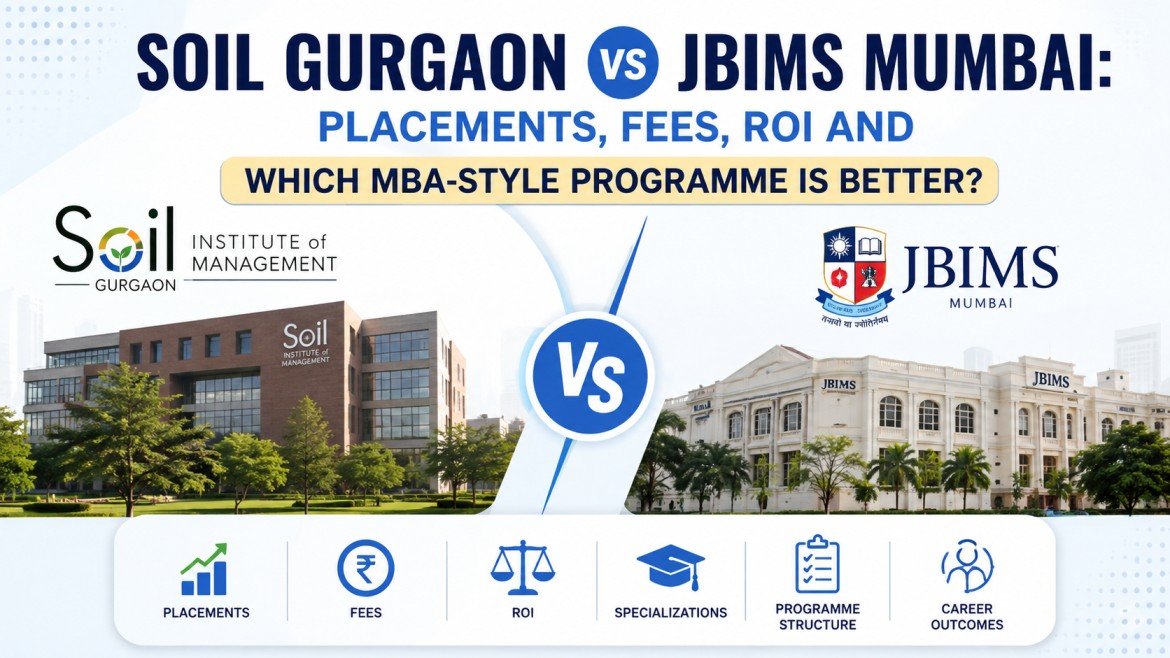
Quick Summary
- JBIMS offers stronger reported placement outcomes and a traditional two-year MMS experience, while SOIL provides an accelerated one-year programme, making the choice dependent on experience, costs and career objectives.
Choosing between SOIL Gurgaon vs JBIMS Mumbai is not a straightforward comparison because the two institutions serve somewhat different student profiles and operate with different programme structures. SOIL Institute of Management is particularly known for its one-year PGPM and other management programmes, while JBIMS offers its flagship two-year full-time MMS programme and has a long-established position in Mumbai's management education ecosystem.
For students comparing SOIL vs JBIMS, the biggest questions usually revolve around placements, fees, ROI, specializations, programme duration, eligibility and career outcomes. A candidate with several years of work experience may evaluate the one-year format at SOIL very differently from a fresher targeting the two-year MMS at JBIMS.
The latest officially available information also needs to be interpreted carefully. As of the information available for the 2026 decision cycle, some placement data represents completed batches while some programme and fee pages are already displaying future admission cycles. Students should therefore verify the exact fee schedule and admission rules applicable to their own offer or admission year before paying any amount. SOIL's current official PGPM pages, for example, display programme and placement information separately from future commencement information.
SOIL Gurgaon vs JBIMS Mumbai at a Glance
| Comparison Point | SOIL Gurgaon | JBIMS Mumbai |
|---|---|---|
| Main programme considered | One-year PGPM | Two-year full-time MMS |
| Programme duration | 12 months | 24 months |
| Location | Gurgaon/Gurugram region | Churchgate, Mumbai |
| Typical target profile | Professionals with prior work experience | Management aspirants entering through the prescribed admission process |
| Work experience requirement for SOIL PGPM | Minimum 2 years for the official PGPM eligibility criteria | No comparable minimum work-experience requirement is stated for the full-time MMS programme |
| SOIL PGPM specializations | Finance, Marketing and Analytics | Finance, Marketing, Operations & Supply Chain, HR, Systems & Digital Business |
| SOIL latest reported PGPM average CTC | ₹12.3 LPA for the Class of 2025 | JBIMS reports vary by placement batch and report |
| JBIMS latest clearly identified completed batch figure | — | ₹26.48 LPA mean CTC for the 2023–25 final placement report |
| SOIL reported PGPM highest CTC | ₹21.8 LPA for the Class of 2025 | ₹55.60 LPA for the 2023–25 final placement report |
| SOIL official PGPM fee page total currently displayed | ₹15.33 lakh including the listed GST components and refundable caution deposit | Students should verify the applicable official 2026–27 fee notice |
| Programme format | Accelerated one-year management programme | Traditional two-year full-time MMS degree |
The comparison immediately shows why SOIL vs JBIMS cannot be decided using salary figures alone. Programme duration, student profile, opportunity cost and career stage can substantially change the ROI calculation.
Table of Contents
- SOIL Gurgaon vs JBIMS Mumbai: Understanding the Basic Difference
- Programme Structure and Duration
- SOIL vs JBIMS Fees
- Specializations
- Placements and Career Outcomes
- ROI Comparison
- Admission and Eligibility
- Campus Location and Industry Exposure
- Who Should Choose SOIL?
- Who Should Choose JBIMS?
- Final Verdict
- Frequently Asked Questions
SOIL Gurgaon vs JBIMS Mumbai: Understanding the Basic Difference
The first thing students should understand is that SOIL vs JBIMS is partly a comparison between two different management education models.
SOIL's one-year PGPM is designed as an accelerated programme. The official eligibility criteria require a completed bachelor's degree, specified academic performance requirements, at least two years of prior work experience and an accepted entrance examination score or the institution's alternative testing route where applicable. This means the programme is naturally more relevant to professionals who already have experience and want to make a relatively fast career transition.
JBIMS, on the other hand, offers a two-year full-time MMS programme structured across four semesters. Its programme includes a summer internship and allows students to specialize after completing the common foundation stages. The official course information describes areas including Finance, Marketing, Operations and Supply Chain Management, Human Resources and Systems and Digital Business.
Therefore, before comparing placements, fees and ROI, a student should ask:
Am I an experienced professional looking for an accelerated career transition, or am I looking for a traditional two-year full-time management programme with a summer internship and broader campus experience?
That answer can be more important than a simple ranking-style comparison.
Programme Duration: One Year vs Two Years
SOIL Gurgaon
The flagship PGPM programme considered in this SOIL vs JBIMS comparison is structured as a 12-month full-time programme. The accelerated format can be attractive because students spend less time away from the workforce.
For professionals with existing work experience, the shorter duration can reduce the career interruption associated with pursuing a full-time management programme. However, the intensity of a one-year programme should also be considered. Students need to absorb academic learning, projects, career preparation and networking within a compressed timeline.
SOIL's current programme pages describe the PGPM as a one-year programme in Gurgaon and highlight experiential learning and leadership development.
JBIMS Mumbai
JBIMS' flagship full-time MMS is a two-year programme divided into four semesters. The programme includes an 8–12 week summer internship between the first and second academic years.
This longer structure gives students more time to explore subjects, complete internships, participate in student activities and develop deeper specialization knowledge.
Which duration is better?
Neither model is automatically better.
Choose the SOIL-style accelerated route if:
- You already have meaningful work experience.
- You want to return to the job market quickly.
- A one-year career break makes more sense for your situation.
- You want a management programme focused on professional transition.
Choose the JBIMS-style two-year route if:
- You want a conventional full-time management education.
- You value a summer internship.
- You are earlier in your career.
- You want more time for specialization and campus recruitment preparation.
SOIL vs JBIMS Fees: What Students Should Compare
Fees are one of the most important parts of the SOIL vs JBIMS decision, but tuition should never be viewed in isolation.
The total financial cost of management education may include:
- Tuition and academic charges
- Taxes where applicable
- Accommodation
- Food
- Books and course material
- Travel
- Personal expenses
- Lost salary during the programme
- Interest on an education loan
SOIL Gurgaon PGPM Fees
SOIL's current official PGPM fee page lists the following structure:
| Fee Component | Amount Listed |
|---|---|
| Tuition and Academic Fee | ₹8,12,000 |
| GST on tuition component | ₹1,46,160 |
| Programme Fee | ₹4,56,921 |
| GST on programme component | ₹82,245 |
| Alumni Association Membership Fee | ₹5,000 |
| GST on membership fee | ₹900 |
| Refundable Caution Deposit | ₹30,000 |
| Total Listed | ₹15,33,226 |
The official page also states that accommodation, books, course materials and certain other expenses may be separate. Students should therefore calculate the full cost of attendance rather than treating the published programme total as the complete cost of living and studying.
JBIMS Mumbai Fees
For JBIMS, students should verify the exact fee applicable to the relevant admission cycle directly through the official institute and Maharashtra admission documentation before making a final financial decision.
Fee structures can differ by admission category, academic cycle and applicable institutional rules. The safest approach is to use the official admission and fee information applicable specifically to the 2026–27 cycle or the cycle in which the candidate receives admission.
A comparison article should not present an unverified historical fee figure as a current 2026 fee.
SOIL vs JBIMS Fees: Why Lower Tuition Does Not Always Mean Better ROI
Suppose two students pay different tuition amounts but experience different career outcomes.
The student with the lower fee may still have lower ROI if:
- The salary increase is limited.
- The career transition does not match the student's goals.
- The programme requires a longer opportunity cost.
- Location and personal expenses are high.
Similarly, a higher-fee programme may justify its cost for some candidates if the student achieves a significant career transition.
For this reason, the correct SOIL vs JBIMS fees comparison should consider:
Total programme cost + living cost + lost salary + financing cost + expected career outcome.
Specializations: SOIL vs JBIMS
Specialization choice can strongly influence a student's decision.
SOIL PGPM Specializations
SOIL's official PGPM FAQs list three specialization areas:
- Finance
- Marketing
- Analytics
The official information states that students select their specialization from Term 2, while the first term is common for PGPM students.
These areas can be suitable for professionals targeting business functions connected with financial decision-making, market-facing roles or analytics-driven management.
JBIMS MMS Specializations
JBIMS lists a broader range of second-year specialization options for its MMS programme:
- Finance
- Marketing
- Operations and Supply Chain Management
- Human Resources
- Systems and Digital Business
The programme's official curriculum also demonstrates how specialization subjects become more focused in later semesters.
Which institute has more specialization variety?
On the basis of the official programme information reviewed for this comparison, JBIMS offers a broader set of flagship MMS specialization categories, while SOIL's one-year PGPM currently lists Finance, Marketing and Analytics.
However, students should not choose a programme merely because it has more specializations. The relevant question is whether the institution offers the specialization most closely aligned with the student's intended career.
SOIL vs JBIMS Placements
Placements are often the first thing students search when comparing SOIL vs JBIMS, but placement statistics must be compared carefully.
A salary figure can represent:
- Mean CTC
- Average CTC
- Median CTC
- Highest CTC
- Top percentage of the batch
These figures are not interchangeable.
SOIL Gurgaon PGPM Placements
SOIL's official placement report for the Class of 2025 reports:
- Highest CTC: ₹21.8 LPA
- Average CTC: ₹12.3 LPA
- Top 50% CTC: ₹15.4 LPA
- Top 25% CTC: ₹18.8 LPA
- Around 60 companies participating
The report also states that 95% of the batch opted for placements and reports placement outcomes for those who opted, while the remaining students included individuals pursuing entrepreneurship or company sponsorship/sabbatical routes.
The official programme page describes the 2024–25 placement cycle and lists the same ₹21.8 LPA highest and ₹12.3 LPA average CTC figures.
JBIMS Mumbai Placements
JBIMS' official Final Placement Report for the Batch of 2023–25 reports:
- Mean CTC: ₹26.48 LPA
- Median CTC: ₹26.15 LPA
- Highest CTC: ₹55.60 LPA
- Top 10% CTC: ₹39.73 LPA
- Top 30% CTC: ₹34.07 LPA
- 65+ total recruiters
- 13+ new recruiters
- 94 PPOs/PPO-related offers as reported in the placement document
The report also provides sector-level placement information, with BFSI and investment banking representing a significant share of reported outcomes.
JBIMS' official placement reports page also lists newer 2024–26 unified final placement report resources, so applicants should check the current official report directly when making a final admission decision.
Why Direct Placement Comparison Requires Context
At first glance, JBIMS' completed 2023–25 placement figures are substantially higher than the SOIL PGPM Class of 2025 figures cited above.
However, students should avoid making an overly simplistic conclusion.
The programmes differ in:
- Duration
- Student profile
- Work-experience requirements
- Programme format
- Batch composition
- Career stage
- Industry opportunities
- Specialization structure
A professional with four or five years of experience may evaluate a one-year programme based on career acceleration and reduced time away from employment.
A student with little or no full-time experience may evaluate a two-year programme based on the opportunity to build a management foundation, complete an internship and participate in a longer campus recruitment process.
SOIL vs JBIMS ROI: Which Offers Better Value?
ROI is probably the most useful way to compare SOIL vs JBIMS, but it should not be reduced to:
Average salary ÷ tuition fee
A realistic management education ROI calculation includes several variables.
Direct Financial Cost
Calculate:
- Programme fees
- Taxes
- Accommodation
- Food
- Books
- Travel
- Loan interest
Opportunity Cost
This is particularly important for experienced professionals.
If a person earns ₹10 lakh annually and leaves employment for two years, the lost salary can be significant.
A one-year programme may reduce this opportunity cost.
Career Progression
Students should ask:
- Will I move into a higher-paying function?
- Can I change industries?
- Will I gain management responsibilities?
- Will the programme help me access a stronger professional network?
- Is my current career likely to benefit from a management qualification?
Salary Increment Rather Than Starting Salary Alone
A candidate already earning ₹12 lakh per year should evaluate the programme differently from a fresher earning no salary.
The best ROI question is therefore:
How much will my career and earning potential improve relative to my current position and total investment?
A Simple SOIL vs JBIMS ROI Framework
| Factor | SOIL Gurgaon | JBIMS Mumbai |
|---|---|---|
| Programme duration | Shorter | Longer |
| Opportunity cost for experienced professionals | Potentially lower due to one-year format | Potentially higher due to two-year duration |
| Summer internship | Depends on programme structure | Built into the two-year MMS structure |
| Latest cited placement data in this article | ₹12.3 LPA average CTC for Class of 2025 | ₹26.48 LPA mean CTC for Batch 2023–25 |
| Best evaluated for | Experienced professionals seeking acceleration | Aspirants seeking a traditional high-intensity two-year management programme |
| Specialization range | More focused | Broader |
| Financial decision | Consider total programme and living cost | Verify applicable current fee structure and calculate two-year opportunity cost |
SOIL vs JBIMS: Admission and Eligibility
SOIL PGPM Eligibility
According to SOIL's current official admissions information for its one-year PGPM, candidates are expected to meet requirements including:
- A completed bachelor's degree
- At least 50% in graduation
- More than 60% in Class 10 and Class 12 as stated on the official page
- At least two years of prior work experience
- A valid accepted management entrance examination score or the SOIL testing route where applicable
The official page currently lists accepted examination pathways and the institutional assessment process. Applicants should confirm the exact examinations and score-year validity applicable to their intended admission cycle because these details can change.
JBIMS MMS Admission
JBIMS states that admissions to the MMS programme are conducted through the applicable common admission process under Maharashtra's prescribed procedures.
The institute's official FAQ states that candidates may appear for MAH-MBA CET and that CAT and CMAT pathways are also considered according to the applicable admission process. Candidates should always follow the official admission notification for their specific cycle.
SOIL vs JBIMS: Campus Location and Industry Environment
SOIL Gurgaon
Gurgaon provides proximity to a large corporate ecosystem across technology, consulting, professional services, financial services, manufacturing and other sectors.
For working professionals, this location can be particularly relevant when evaluating:
- Corporate networking
- Guest sessions
- Career transitions
- Industry exposure
- Access to the broader Delhi-NCR employment market
JBIMS Mumbai
JBIMS is located in Mumbai, one of India's most significant business and financial centres.
Its location can be particularly attractive to candidates interested in areas such as:
- Finance
- Banking
- Investment-related careers
- Consulting
- Corporate strategy
- FMCG
- Technology and digital business
JBIMS' official placement report for the 2023–25 batch shows BFSI and investment banking as the largest reported sector category in that report.
SOIL vs JBIMS for Finance
For students focused on finance, the decision depends heavily on career stage.
SOIL's PGPM includes Finance as a specialization. This may appeal to experienced professionals seeking an accelerated transition into management-oriented roles.
JBIMS offers a deeper two-year specialization structure in Finance. Its official curriculum includes subjects such as corporate valuation, financial modelling, derivatives and risk management, investment banking and alternative investment funds, portfolio management and other finance-related areas.
For a candidate targeting highly competitive finance roles and wanting a longer academic and recruitment cycle, JBIMS may have a stronger fit.
For an experienced professional seeking to complete a management programme within one year, SOIL may be the more suitable format.
SOIL vs JBIMS for Marketing
Both institutions offer marketing-oriented management education.
SOIL lists Marketing as one of its PGPM specialization options.
JBIMS' Marketing specialization includes subjects covering areas such as consumer behaviour, sales management, product management, brand management, digital marketing, marketing analytics and other marketing disciplines.
Students should compare the programme based on the role they want after graduation.
For example:
- Brand management
- Product management
- Sales
- Digital marketing
- Consumer marketing
- Business development
The best choice depends on the candidate's background and target function.
SOIL vs JBIMS for Analytics and Digital Careers
SOIL's PGPM officially lists Analytics as one of its specialization options. The programme also highlights exposure to Data Visualization using Power BI on its programme page.
JBIMS offers Systems and Digital Business as one of its MMS specialization areas. The curriculum includes subjects related to digital business, enterprise systems, analytics, data warehousing, business intelligence and emerging technologies.
Students targeting analytics should therefore go beyond the specialization name and review:
- Specific courses
- Projects
- Recruiter roles
- Required technical skills
- Alumni outcomes
- Career-switch feasibility
Who Should Choose SOIL Gurgaon?
SOIL can be a strong option for candidates who:
- Have at least the required prior work experience for the PGPM.
- Want to complete a full-time management programme within one year.
- Want to minimize time away from the workforce.
- Are targeting Finance, Marketing or Analytics.
- Value a career-transition-oriented programme.
- Want to build their career in the Delhi-NCR corporate ecosystem.
The one-year format is particularly important. For the right professional profile, saving a year of opportunity cost can materially change the overall ROI.
Who Should Choose JBIMS Mumbai?
JBIMS may be more suitable for candidates who:
- Want a traditional two-year full-time MMS programme.
- Want a structured summer internship.
- Prefer a broader range of management specializations.
- Are targeting Finance, Marketing, Operations, HR or Digital Business.
- Want exposure to Mumbai's corporate and financial ecosystem.
- Are seeking a programme with historically strong placement outcomes.
The programme's two-year structure also gives students more time to explore career paths and build relationships before final placements.
SOIL vs JBIMS: Which Is Better for Freshers?
For a fresher, the answer depends partly on eligibility.
SOIL's one-year PGPM official eligibility information requires at least two years of prior work experience. Therefore, a typical fresher may not be eligible for that programme.
JBIMS' full-time MMS programme can therefore be structurally more relevant for candidates entering management education earlier in their careers, subject to meeting the applicable entrance and admission requirements.
SOIL vs JBIMS: Which Is Better for Working Professionals?
For an experienced working professional, the comparison becomes more interesting.
A one-year programme can provide advantages such as:
- Shorter career interruption
- Faster return to employment
- Reduced opportunity cost
- Concentrated learning
However, students should examine whether their target role actually requires a career switch that the programme can support.
JBIMS' full-time MMS provides a longer campus experience and internship cycle, but the two-year duration may represent a larger opportunity cost for professionals already earning a significant salary.
Therefore, SOIL vs JBIMS for working professionals is primarily a career-stage decision rather than simply a placement comparison.
Does JBIMS Have Better Placements Than SOIL?
Based on the specific completed placement reports cited in this article, JBIMS' 2023–25 batch reported higher mean, median and highest CTC figures than SOIL's PGPM Class of 2025.
However, these are not identical programmes or identical student populations.
The most responsible interpretation is:
JBIMS shows substantially stronger reported salary figures in the cited completed placement data, while SOIL's one-year programme may still offer a compelling ROI for experienced professionals because of its shorter duration and different career-transition model.
Students should not assume that every candidate will achieve the published average or highest salary.
Does SOIL Offer Better ROI Because It Is One Year?
Not automatically.
A one-year programme can improve ROI because the student spends less time away from work. But the final result depends on:
- Programme cost
- Existing salary
- Post-programme salary
- Career transition
- Loan cost
- Living expenses
For someone already earning well, a shorter programme may be financially attractive.
For someone entering management education without substantial work experience, a longer programme with a strong internship and placement ecosystem may offer a different type of value.
How to Make the Final SOIL vs JBIMS Decision
Before accepting an offer, create a personal comparison sheet.
Include:
Your current profile
- Graduation background
- Work experience
- Current salary
- Career goals
- Preferred industry
Total cost
- Tuition
- Taxes
- Accommodation
- Food
- Travel
- Loan interest
Opportunity cost
Calculate how much income you may give up while studying.
Career target
Write down the exact roles you want after graduation.
Examples:
- Product Manager
- Marketing Manager
- Consultant
- Financial Analyst
- Investment Banking professional
- Operations Manager
- HR Manager
- Business Analyst
Placement evidence
Review:
- Latest official placement report
- Recruiter list
- Role distribution
- Median or average compensation
- Batch size
- Sector distribution
Alumni conversations
Speak with recent alumni where possible.
Ask practical questions:
- What was your profile before joining?
- What role did you get after graduation?
- Did the programme help you achieve your expected career transition?
- What was the total cost?
- What surprised you about placements?
This kind of first-hand research can be more useful than simply comparing highest CTC figures.
Final Verdict: SOIL Gurgaon vs JBIMS Mumbai
The answer to SOIL vs JBIMS depends on who you are as a candidate.
JBIMS Mumbai may be the stronger choice for many candidates seeking a traditional two-year full-time management programme with broader specialization options and stronger salary figures in the latest completed official placement report cited here.
SOIL Gurgaon may be the more practical choice for eligible professionals with prior work experience who want an accelerated one-year management programme and want to reduce the opportunity cost of leaving the workforce for two years.
In a direct comparison of placements, fees and ROI, JBIMS has the advantage in the completed placement figures discussed in this article. SOIL's strongest argument is not simply that it is cheaper or more expensive—it is the value of completing an intensive management programme in one year for the right experienced professional.
The best decision is therefore:
Choose JBIMS if you want a traditional two-year MMS experience, broader specialization options and a strong Mumbai-based management ecosystem. Choose SOIL if you are an eligible working professional seeking a faster management programme and a shorter break from your career.
Before paying fees, verify the exact admission-cycle fee structure, eligibility rules and newest placement report directly through the official institution sources because these details can change between batches.
Frequently Asked Questions
Is SOIL Gurgaon better than JBIMS Mumbai?
There is no universal winner. JBIMS may suit candidates seeking a two-year full-time MMS with broader specialization options and strong reported placement outcomes. SOIL may suit experienced professionals who want an accelerated one-year management programme.
Which has better placements, SOIL or JBIMS?
Based on the completed official reports cited here, JBIMS' 2023–25 batch reported a ₹26.48 LPA mean CTC and ₹55.60 LPA highest CTC, while SOIL's PGPM Class of 2025 reported a ₹12.3 LPA average CTC and ₹21.8 LPA highest CTC. The programmes and student profiles are different, so these figures should be interpreted in context.
What are the SOIL PGPM specializations?
SOIL's official PGPM FAQs list Finance, Marketing and Analytics.
What are the JBIMS MMS specializations?
JBIMS lists Finance, Marketing, Operations and Supply Chain Management, Human Resources and Systems and Digital Business.
Is SOIL PGPM suitable for freshers?
The current official PGPM eligibility information requires a minimum of two years of prior work experience, so typical freshers should check other programmes or confirm their eligibility directly with the institute.
Is JBIMS a two-year programme?
The flagship full-time MMS programme is a two-year programme divided into four semesters and includes a summer internship component.
What is the SOIL PGPM fee?
The current official fee page lists a total of ₹15,33,226 including the listed GST components and refundable caution deposit. Certain accommodation and other expenses may be additional. Students should verify the fee applicable to their specific admission cycle.
Which is better for ROI, SOIL or JBIMS?
ROI depends on tuition, opportunity cost, existing salary and career outcomes. JBIMS shows stronger placement figures in the completed report cited here, while SOIL's one-year format can reduce opportunity cost for experienced professionals.
Should I choose a one-year or two-year management programme?
Choose based on your work experience, financial position and career goal. A one-year programme is often more relevant to experienced professionals, while a two-year programme can provide a longer academic experience and internship opportunity.
Where can I verify the latest information?
Always check the official programme, admissions, fee and placement pages of the relevant institution before making a final decision. SOIL Institute of Management and JBIMS Official Website provide official starting points.
Search Keywords
soil vs jbims, soil vs jbims placements, soil vs jbims fees, soil vs jbims ROI, SOIL Gurgaon vs JBIMS Mumbai, SOIL Gurgaon placements, JBIMS Mumbai placements, SOIL PGPM fees, JBIMS MMS fees, SOIL PGPM placement, JBIMS MMS placement, SOIL vs JBIMS which is better, SOIL or JBIMS, SOIL Gurgaon MBA, JBIMS Mumbai MMS, SOIL Gurgaon PGPM, JBIMS placement average package, SOIL placement average package, SOIL highest package, JBIMS highest package, SOIL ROI, JBIMS ROI, SOIL Gurgaon review, JBIMS Mumbai review, SOIL PGPM review, JBIMS MMS review, SOIL vs JBIMS comparison, SOIL fees and placements, JBIMS fees and placements, SOIL specializations, JBIMS specializations, SOIL PGPM Finance, SOIL PGPM Marketing, SOIL PGPM Analytics, JBIMS Finance specialization, JBIMS Marketing specialization, JBIMS Operations specialization, JBIMS HR specialization, JBIMS Systems specialization, SOIL one year MBA, JBIMS two year MMS, one year MBA vs two year MBA, SOIL Gurgaon admission, JBIMS Mumbai admission, SOIL eligibility, JBIMS eligibility, SOIL work experience requirement, JBIMS MAH MBA CET, JBIMS CAT admission, JBIMS CMAT admission, SOIL CAT admission, SOIL XAT admission, SOIL NMAT admission, SOIL SAT test, SOIL PGPM salary, JBIMS MMS salary, SOIL Gurgaon average CTC, JBIMS Mumbai average CTC, SOIL Gurgaon highest CTC, JBIMS Mumbai highest CTC, best MBA college for ROI, best management college for working professionals, best one year MBA for experienced professionals, best two year management programme Mumbai, Gurgaon management colleges, Mumbai management colleges, SOIL vs JBIMS for finance, SOIL vs JBIMS for marketing, SOIL vs JBIMS for analytics, SOIL vs JBIMS for consulting, SOIL vs JBIMS for freshers, SOIL vs JBIMS for working professionals, SOIL vs JBIMS placement comparison, SOIL vs JBIMS salary comparison, SOIL vs JBIMS course duration, SOIL vs JBIMS admission process, SOIL vs JBIMS campus life, SOIL vs JBIMS recruiters, SOIL recruiter list, JBIMS recruiter list, SOIL career growth, JBIMS career growth, SOIL alumni network, JBIMS alumni network, SOIL Gurgaon management programme, JBIMS flagship MMS, SOIL PGPM batch profile, JBIMS MMS batch profile, management college ROI India, private management school vs public management school, MBA career transition India, MBA for experienced professionals India, management education Mumbai, management education Gurgaon, JBIMS Mumbai ROI, SOIL Gurgaon ROI, SOIL Gurgaon 2026, JBIMS Mumbai 2026, SOIL admission 2026, JBIMS admission 2026, SOIL fees 2026, JBIMS fees 2026, SOIL placements 2026, JBIMS placements 2026, best MBA alternative India, best MMS programme India, SOIL Gurgaon vs top B schools, JBIMS vs private MBA college, management course after work experience, best business school for finance Mumbai, best business school for analytics Gurgaon
Long-Tail & Short-Tail Searches
is SOIL Gurgaon better than JBIMS Mumbai, which is better SOIL or JBIMS for placements, SOIL vs JBIMS which college has better ROI, SOIL Gurgaon PGPM fee and placement details, JBIMS MMS fee and placement comparison, should I choose SOIL or JBIMS after work experience, is SOIL PGPM worth the fees, is JBIMS worth the fees, what is the average package at SOIL Gurgaon, what is the average package at JBIMS Mumbai, which college has better finance placements SOIL or JBIMS, which is better for marketing SOIL or JBIMS, which is better for experienced professionals SOIL or JBIMS, which is better for freshers SOIL or JBIMS, how does SOIL one year PGPM compare with JBIMS MMS, why choose a one year MBA over a two year MBA, how to calculate MBA ROI before joining, what is the total cost of SOIL PGPM, what is the latest SOIL placement package, what is the latest JBIMS placement package, which specializations are available at SOIL, which specializations are available at JBIMS, where is SOIL Gurgaon located, where is JBIMS Mumbai located, how to apply to SOIL PGPM, how to get admission in JBIMS MMS, what exams are accepted by SOIL, what exams are accepted by JBIMS, is work experience required for SOIL PGPM, when should working professionals pursue a one year MBA, which MBA programme offers better career transition, SOIL Gurgaon vs JBIMS Mumbai for finance career, SOIL Gurgaon vs JBIMS Mumbai for marketing career, SOIL Gurgaon vs JBIMS Mumbai for analytics career, SOIL Gurgaon vs JBIMS Mumbai for salary growth, SOIL vs JBIMS opportunity cost comparison, SOIL vs JBIMS programme duration comparison, SOIL vs JBIMS specialization comparison, SOIL vs JBIMS recruiter comparison, SOIL vs JBIMS alumni comparison, SOIL vs JBIMS campus comparison, best management college in Mumbai for finance, best management college in Gurgaon for working professionals, how to choose between one year and two year MBA, is JBIMS good for finance, is SOIL good for career switch, which programme has better placement opportunities, which MBA programme gives faster ROI, how much salary increase can an MBA provide, should I leave my job for a two year MBA, is a one year PGPM better for career growth, SOIL vs JBIMS final verdict, SOIL or JBIMS for long term career growth, best choice between SOIL and JBIMS in 2026.
Key Takeaways
JBIMS reports significantly higher placement figures in the completed placement data compared with SOIL's one-year PGPM.
SOIL's one-year PGPM can reduce opportunity costs for experienced professionals returning quickly to the workforce.
JBIMS offers a broader range of specialization options, including Finance, Marketing, Operations, HR and Digital Business.
SOIL PGPM focuses on Finance, Marketing and Analytics for its specialization options.
SOIL's current official PGPM fee structure is listed at ₹15.33 lakh, excluding certain additional living expenses.
JBIMS may suit candidates seeking a traditional two-year management programme with a summer internship and extended campusexperience.
SOIL is better aligned with eligible professionals seeking an accelerated management education format.
ROI should include tuition, living expenses, loan costs, lost salary and expected post-programme career growth.
Students should compare their career stage and target role instead of relying only on average salary packages.
The final choice between SOIL vs JBIMS depends on whether faster career acceleration or a longer traditional management experience better fits the candidate.
Ask a question
Still confused? Leave your question and our team will help you.