
Quick Summary
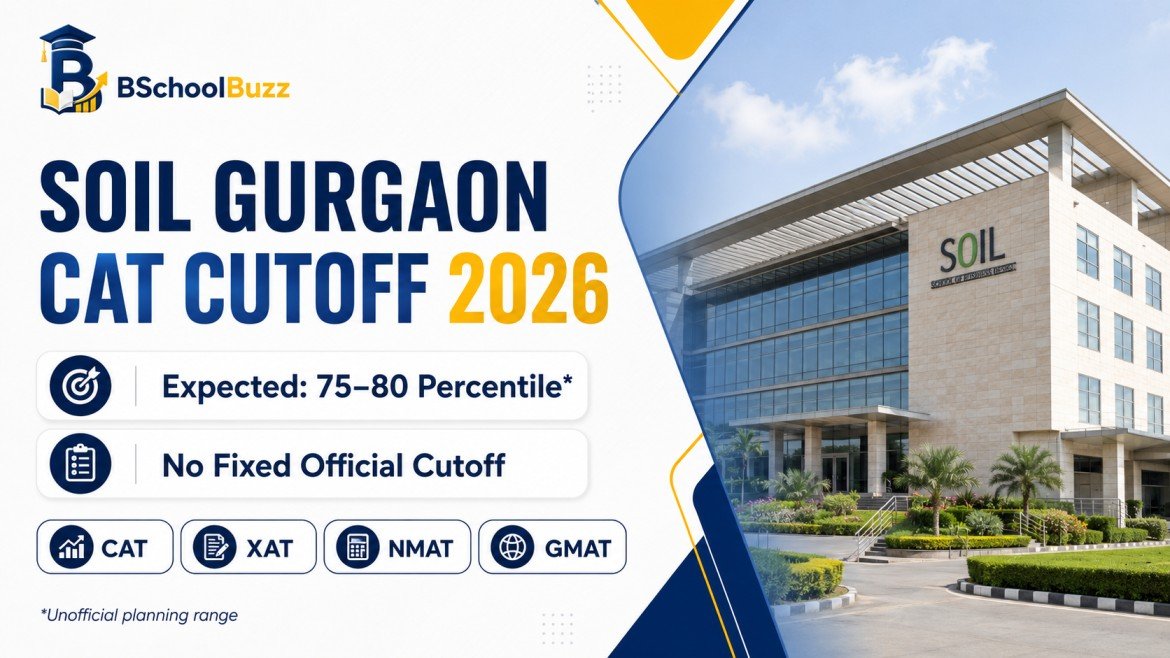
- SOIL does not publish a fixed overall or sectional CAT cutoff for its PGDM. However, 75–80 percentile is a useful unofficial target, with 80+ offering a stronger position. Selection is holistic: entrance scores carry 35% and GE/PI 40%. The PGDM 2027–29 fee is ₹17.20 lakh, while the Class of 2025 reported ₹11.17 LPA average and ₹20.7 LPA highest CTC.
The most accurate answer to the SOIL Gurgaon CAT cutoff question is different from the number repeated on many college portals. SOIL does not publish a fixed minimum overall CAT percentile for applying to its two-year PGDM, and it does not prescribe sectional cutoffs. The institute’s current admission policy is profile-based. For the PGDM batch beginning in 2027, CAT 2026 is accepted, the entrance-test score carries 35% of the published selection weight, and the Group Exercise and Personal Interview together carry 40%.
That does not make the CAT score unimportant. It means there is no single official percentile that guarantees a shortlist or automatically rejects every applicant below it. Independent education portals commonly place the practical SOIL Gurgaon CAT cutoff expectation around 75–80 percentile, with some using 80 percentile as a planning benchmark. That range can help candidates set a target, but it must be labelled correctly: it is an unofficial estimate, not an institute-announced qualifying cutoff.
This distinction matters in 2026. A student with 72 percentile and a strong academic record, persuasive application, meaningful achievements and excellent GE/PI performance may present a more competitive overall profile than someone with 82 percentile but a weak interview and little clarity about the programme. No percentile, including 80 or above, should be treated as a guaranteed conversion.
Quick answer: SOIL has officially stated that its PGDM has no fixed minimum overall or sectional CAT cutoff. For planning purposes, 75–80 percentile is a reasonable unofficial target range drawn from past trends and current third-party estimates. Aim for 80+ if possible, but build the rest of the profile because CAT accounts for 35% and GE/PI for 40% of the published selection framework.
Information in this article was verified on 12 August 2026. SOIL’s website was displaying admissions for the PGDM 2027–29 batch and the PGPM/PGPM-HR 2027–28 batches on that date. Dates, fees and admission rules can change, so applicants should recheck the linked official pages before paying an application or registration fee.
Table of Contents
SOIL Gurgaon CAT Cutoff at a Glance
| Admission question | Verified position for the current cycle |
|---|---|
| Official minimum CAT percentile for PGDM | No fixed minimum percentile published by SOIL |
| Practical target used for planning | About 75–80 percentile, unofficial and not guaranteed |
| Safer target for a stronger exam component | 80+ percentile, while recognising that selection remains profile-based |
| Sectional CAT cutoff | No sectional cutoff, according to SOIL’s PGDM FAQ |
| CAT score accepted for PGDM 2027–29 | CAT 2026 |
| Entrance-test weight in PGDM selection | 35% |
| Academics | 15% |
| Extra-curricular record | 5% |
| Work experience | 5%; freshers are also eligible |
| Group Exercise and Personal Interview | 40% combined |
| Other accepted tests for PGDM | XAT, GMAT, CMAT, MAT, NMAT, SNAP and ATMA, subject to current conditions |
| PGDM application fee shown by SOIL | ₹2,000 |
| PGDM location | Manesar, New Gurgaon |
| PGDM duration | 24 months, full-time |
The table provides the short answer, but applicants should understand what each line means. A “no fixed cutoff” policy is not the same as “the score does not matter.” SOIL assigns more than one-third of the PGDM selection weight to the entrance test. A higher CAT percentile therefore strengthens the application, especially if academics or work experience are ordinary. The absence of a published floor simply means the institute evaluates the total profile rather than applying a publicly disclosed pass/fail threshold at one percentile.
What Is the Official SOIL Gurgaon CAT Cutoff?
For the two-year PGDM, the official position is unambiguous. The SOIL PGDM FAQ states that there is no fixed minimum percentile or score requirement in CAT, GMAT, XAT or CMAT for applying. The same page states that there are no sectional cutoffs for CAT, GMAT, XAT, CMAT or NMAT. It explains that admission is based on the overall academic record, work experience where applicable, entrance-test performance, Group Exercise and Personal Interview.
This official statement should take priority over numbers displayed by aggregators. A third-party website may describe 75, 80 or another percentile as the “SOIL cutoff,” but that label can imply a precision the institute itself does not claim. The better interpretation is:
SOIL requires a valid aptitude-test score for its AICTE-approved PGDM.
The institute considers the exam score in a weighted, holistic selection process.
It does not publish a universal minimum CAT percentile for applying.
It does not publish a CAT sectional threshold.
A score that was competitive in one cycle may not produce the same outcome in another.
The official policy applies most directly to the PGDM offered at the Manesar campus. The one-year PGPM and PGPM-HR follow separate eligibility and admission routes at the Sector 44 Gurgaon campus. They accept CAT and other scores, and candidates without a recognised score may be directed to the SOIL Aptitude Test under the programme rules. Students should therefore avoid combining PGDM and PGPM requirements into one cutoff table.
Minimum eligibility is not the same as a competitive score
Three different ideas are often called “cutoff” in admission content:
| Term | What it actually means |
| Application eligibility | The conditions required to submit a valid application, such as a bachelor’s degree and an accepted test score |
| Shortlist threshold | A score or profile level used to invite candidates to later rounds; SOIL does not publish a fixed CAT percentile for this |
| Competitive conversion range | The score range that may improve the probability of final admission, but cannot guarantee it |
At SOIL, the application eligibility conditions are published. The selection weights are also published for the PGDM. What is not published is a single CAT percentile that functions as an official shortlist cutoff. This is why responsible cutoff guidance must use terms such as “estimated,” “indicative” or “planning range” when discussing 75–80 percentile.
Why Do Websites Report 75 or 80 Percentile?
The 75–80 range appears because education portals try to convert historical admission patterns, student reports and market positioning into a simple number. For example, Shiksha has displayed an indicative 75 percentile figure for an earlier cycle, while Careers360 has used 80 percentile as an expected SOIL CAT cutoff. These are useful signals of the general competitiveness of the applicant pool, but the sources themselves do not override SOIL’s current official statement.
There are several reasons estimates differ:
Portals may refer to different programmes, campuses or admission years.
Some show an application benchmark while others attempt to estimate the score of admitted students.
Older pages may continue to rank after the institute has changed its published policy.
A range based on self-reported student outcomes is not the same as an official cutoff document.
Profile-based selection produces admits across a band rather than at one clean boundary.
The applicant pool, seat availability and score distribution change each year.
The safest editorial conclusion for SOIL Gurgaon CAT cutoff 2026 is therefore not “the cutoff is exactly 80.” It is: no fixed official cutoff; 75–80 is an unofficial planning range; 80+ is a sensible target if a candidate wants the entrance-test component to support the profile more strongly.
How to read the 75–80 estimate
Treat the estimate as a decision aid, not an admission promise.
| CAT percentile | Practical interpretation, not an official rule |
| Below 65 | A difficult position for CAT-led shortlisting; an exceptional profile and excellent GE/PI would need to do substantial work |
| 65–69.99 | Possible to apply under the no-fixed-cutoff policy, but the test component is likely to be a weakness |
| 70–74.99 | Borderline relative to common external estimates; profile quality becomes especially important |
| 75–79.99 | Within the commonly cited unofficial planning band; still no guarantee of a call or conversion |
| 80–84.99 | A stronger planning zone for SOIL, provided eligibility and profile quality are satisfactory |
| 85–89.99 | A good CAT component for this target; attention should shift to application depth and GEPI execution |
| 90+ | A strong score, but admission can still be lost through a weak application, poor fit or weak interview |
These bands are analytical guidance, not a substitute for the admission committee’s decision. SOIL has not published this table, and it should never be represented as an official category-wise or programme-wise cutoff.
What CAT Percentile Should You Target?
Candidates should aim above the minimum level they think they need. For most applicants specifically targeting the SOIL PGDM through CAT 2026, 80 percentile or higher is a practical target. It sits above the lower end of widely quoted estimates and gives the test component more strength. An 85+ target creates additional comfort, especially for a candidate with inconsistent academics, limited extra-curricular evidence or a very common profile.
A target must also reflect opportunity cost. If SOIL is one college in a broader application list containing schools that typically require higher percentiles, the candidate should prepare for the highest realistic target in that list rather than stopping at 80. CAT preparation designed for 90+ percentile will serve a SOIL application better than a strategy designed to barely enter an estimated range.
A profile-adjusted target
| Profile situation | Sensible CAT target for planning | Why |
| Consistent academics, strong achievements, clear programme fit | 75–80+ | Other components may support the profile, though a higher score remains helpful |
| Average academics and limited work experience | 80–85+ | A stronger test score can improve the academic evidence in the application |
| Weak graduation marks but eligible | 85+ | CAT cannot erase past marks, but it can demonstrate current aptitude |
| Fresher with good campus leadership or projects | 80+ | Achievements can help, but exam and GE/PI still carry most of the published weight |
| Candidate with meaningful full-time experience | 75–80+ | Relevance and impact matter; work experience itself carries only 5% in the PGDM framework |
| Candidate relying mainly on CAT score | 85–90+ | A high score helps but cannot compensate for an unconvincing interview or poor fit by itself |
The ranges are deliberately broad. SOIL has not released a conversion calculator linking CAT percentile to admission probability. Any website that claims an exact chance without access to the complete applicant pool and admission model is estimating.
Why 80 percentile should not become a stopping point
CAT percentiles are relative. An 80 percentile result means the candidate performed better than roughly 80% of test takers, not that the candidate scored 80% marks. The raw score needed for a percentile changes with paper difficulty, slot normalisation and the performance distribution. Preparing to a raw-mark threshold too early can create false confidence.
The better goal is to build accuracy and question selection across all three sections. Even though SOIL says it has no sectional cutoff, an extremely uneven score can still raise questions about readiness. A candidate with a healthy balance in VARC, DILR and QA has more credible evidence of all-round aptitude and is less vulnerable if other colleges on the application list do impose sectional cutoffs.
SOIL Programmes and Campuses
“SOIL Gurgaon” is used loosely online, but the institute currently presents three full-time postgraduate management programmes. They differ in duration, target applicant, location, regulatory status and admission route. Choosing the right programme is more important than searching for one shared cutoff.
| Programme | Duration | Current commencement displayed on 12 August 2026 | Location | Intended profile | CAT role |
| PGDM | 24 months | June 2027 | Manesar, New Gurgaon | Freshers and applicants with less than three years of full-time experience | CAT 2026 accepted; recognised test score mandatory |
| PGPM | 12 months | May 2027 | Sector 44, Gurgaon | Professionals with at least two years of prior work experience | CAT 2025/26 accepted; SOIL SAT route available under current rules |
| PGPM-HR | 12 months | May 2027 | Sector 44, Gurgaon | Freshers and experienced candidates seeking HR careers | CAT 2025/26 accepted; SOIL SAT route available under current rules |
The SOIL media kit describes the institute as operating two campuses in Gurgaon and New Gurgaon. The two-year PGDM integrates business, design thinking and liberal arts and is presented as AICTE-approved. The one-year PGPM and PGPM-HR are institutional postgraduate programmes with their own academic and admission structures. Students comparing credentials should read the award, approval and equivalence language in the current brochure instead of assuming every programme is an MBA degree.
Which programme does the cutoff discussion mainly concern?
Most “SOIL Gurgaon CAT cutoff” searches concern the two-year PGDM because:
a national-level aptitude test score is mandatory for the AICTE-approved PGDM;
the programme publishes a numerical selection-weight framework;
it is designed for freshers and early-career candidates, the group most likely to search college cutoffs; and
college-comparison portals usually place PGDM courses in CAT cutoff databases.
For PGPM and PGPM-HR, a valid CAT score can satisfy the aptitude-score route, but SOIL also publishes a SOIL Aptitude Test option for candidates who have not submitted another recognised entrance score. The one-year programmes use profile-based evaluation and GEPI. Quoting the PGDM’s unofficial 75–80 planning range as a mandatory PGPM cutoff would therefore be inaccurate.
PGDM Eligibility and Accepted Exams
For the PGDM 2027–29 intake displayed in August 2026, the official PGDM admission page lists the following requirements:
A bachelor’s degree in any discipline from a UGC/AIU-recognised university, with at least 50% aggregate and a minimum three years of study after 10+2.
Final-year students appearing in 2027 may apply subject to the institute’s documentary requirements and deadline.
A valid score in an accepted aptitude test.
Freshers and applicants with less than three years of work experience are eligible.
The admission page lists CAT, XAT, GMAT, CMAT, MAT, NMAT, SNAP and ATMA among the accepted tests. It also says that multiple scores may be submitted and the best valid score will be considered. A current footnote says NMAT and SNAP scores are considered only when accompanied by another AICTE-approved test score. Candidates relying on NMAT or SNAP should verify that condition immediately before applying because accepted-test combinations can change.
The PGDM FAQ gives cycle-specific score validity: CAT-based applicants for the current 2027–29 admission cycle must use CAT 2026, while XAT- and CMAT-based applicants must use XAT 2027 or CMAT 2027. It states that GMAT scores taken on or after 1 January 2022 are considered. The final rule visible in the application portal or offer communication should be treated as controlling.
Graduation marks for reserved categories
The general PGDM admission page displays 50% in graduation. The official FAQ further states that candidates with 45% for SC/ST and 50% for General are eligible in accordance with the institute’s stated AICTE approach. Applicants should upload the correct category and degree documentation and confirm whether any current AICTE relaxation applies to their exact category.
Eligibility permits consideration; it does not establish competitiveness. A candidate with the minimum graduation percentage still needs to present an acceptable test score and perform well across the remaining selection components.
Work-experience rule
Freshers are welcome in the PGDM. Candidates with less than 36 months of full-time experience by the date specified for the intake are also eligible. The FAQ says internships and part-time roles are not counted as work experience, while full-time entrepreneurial or family-business work may be considered when valid supporting documents are available.
That distinction affects how applicants should complete the form. An internship can strengthen a fresher’s narrative and demonstrate skills, but it should not be misreported as full-time work experience. A family-business role should be backed by documentation such as appointment evidence, compensation or financial records, role descriptions and proof of business operations as requested by the institute.
How SOIL Selects PGDM Candidates
The published PGDM selection framework is more useful than an unofficial cutoff because it shows where an applicant can actually improve.
| Selection component | Published weight | What the component signals |
| Entrance-test score | 35% | Quantitative, verbal, analytical and test-taking aptitude |
| Academics | 15% | Consistency and ability to manage formal learning |
| Extra-curricular record | 5% | Initiative, teamwork, sustained interests and achievement beyond coursework |
| Work experience | 5% | Exposure to responsibility, execution and professional learning; freshers remain eligible |
| Group Exercise and Personal Interview | 40% | Communication, collaboration, leadership, motivation, problem solving and programme fit |
The official selection page makes two points especially important for cutoff-focused candidates. First, the entrance test is mandatory and carries a substantial 35%. Second, GE/PI carries an even larger combined 40%. Together these components account for three-quarters of the published evaluation.
What the weights mean in practice
Suppose two candidates apply:
Candidate A has a higher CAT percentile but gives generic interview answers, interrupts teammates in the Group Exercise and cannot explain why SOIL’s curriculum fits the intended career.
Candidate B has a moderately lower CAT percentile, consistent academics, evidence of initiative, a thoughtful application and a strong, collaborative GE/PI performance.
The published weights explain why Candidate B can remain competitive. They do not prove that Candidate B will be admitted; SOIL does not publish the exact conversion of every sub-score. They show why a cutoff-only prediction is incomplete.
The framework also prevents a common mistake: assuming work experience dominates PGDM admission. It carries 5% in the published table, the same as extra-curriculars. Relevant impact can still enrich the application and interview, but the formal weight means an experienced candidate cannot neglect CAT or GEPI.
What “profile-based” does and does not mean
Profile-based selection means the admission committee considers multiple dimensions. It does not mean:
CAT is optional for the PGDM;
very low exam performance has no consequence;
an attractive résumé guarantees an interview call;
the process is the same for PGDM, PGPM and PGPM-HR; or
applicants can leave score or document fields incomplete.
It means the CAT result is one weighted input in a broader decision. A candidate should maximise every controllable component rather than search for the lowest score that might survive.
Admission Chances at Different CAT Percentiles
No public dataset links each CAT percentile to SOIL calls and conversions. The following analysis therefore uses the official no-fixed-cutoff policy, the published selection weights and the commonly cited 75–80 external estimate. It is guidance, not a predictor.
Can I get SOIL with 60 percentile in CAT?
An application may not be technically barred by a published CAT floor because SOIL says it has no fixed minimum. Competitively, however, 60 percentile is well below the most frequently cited planning range. The entrance-test component would likely be a weakness. The applicant would need compelling evidence elsewhere and exceptional GE/PI execution, and should maintain realistic backup choices.
A 60-percentile candidate should also consider whether another accepted test offers a genuine chance to improve. SOIL says it can consider the best valid score when multiple accepted scores are submitted. Taking XAT, CMAT, MAT or another permitted exam can create a second route, subject to the current intake’s validity rules.
Can I get SOIL with 70 percentile in CAT?
Seventy percentile sits close to, but usually below, the 75–80 unofficial range. It is not an automatic rejection under the published policy. A strong profile can justify applying, particularly if the candidate has good academic consistency, distinctive achievements and clear programme fit. The candidate should not treat the score as comfortable, and GEPI preparation becomes critical.
The application should provide evidence rather than adjectives. “I am a leader” is weak. “I coordinated a six-member team, redesigned the event workflow and increased registrations from 180 to 310” is more persuasive. Concrete impact can make the profile easier to evaluate.
Is 75 percentile enough for SOIL Gurgaon?
Seventy-five percentile is the lower end of the range often reported by college portals. It can be a plausible score for consideration, but “enough” is too strong because the institute does not publish a guaranteed threshold. At this level, a good application and GEPI may determine whether the candidate advances and converts.
Applicants at 75 percentile should audit the rest of the profile:
Are graduation marks safely above eligibility?
Is there evidence of initiative or achievement?
Can the candidate explain why the PGDM’s business-design approach is relevant?
Is the career goal specific and realistic?
Are academic gaps or employment gaps explained without defensiveness?
Has the candidate practised collaborative problem solving for the Design Thinking Workshop?
Is 80 percentile good for SOIL Gurgaon?
An 80 percentile CAT result is a sensible score for a SOIL PGDM application and sits at the upper end of common external estimates. It should strengthen the entrance-test component, but it is not an official cutoff and does not guarantee a shortlist or admission. The candidate still needs to clear eligibility, submit a complete application and perform effectively in GE/PI.
At 80 percentile, the highest-return activity is usually not worrying about whether 80.1 is materially different from 79.8. It is improving the application narrative, revising academics and current affairs, researching the programme, and rehearsing concise interview answers.
What about 85 or 90 percentile?
At 85+ percentile, the CAT score is likely to be a positive component for this target. At 90+, it becomes an even stronger academic signal. The risk shifts toward complacency. High-percentile candidates are still assessed on communication, collaboration, motivation and fit. An applicant who treats SOIL as a casual backup and cannot articulate a sincere reason for joining may underperform in the interview.
The candidate should also compare offers carefully. A stronger CAT result may open additional colleges, but the decision should consider curriculum, programme duration, location, fees, placement distribution, role fit and personal constraints rather than brand lists alone.
Sectional and Category-Wise Cutoff Policy
SOIL’s current PGDM FAQ says there are no sectional cutoffs for CAT, GMAT, XAT, CMAT or NMAT. Therefore, a claim that SOIL requires a fixed 30 percentile in each CAT section conflicts with the current official page and should not be presented as verified 2026 policy.
This does not make sectional performance irrelevant. A very low QA score may lead to questions for a finance- or analytics-oriented candidate. Weak VARC can affect performance in the written application, Group Exercise and interview. Balanced preparation remains wise, especially because other colleges may impose sectional thresholds.
Does SOIL publish separate CAT cutoffs for General, OBC, SC, ST or EWS?
The current official SOIL pages do not publish a category-wise CAT percentile table for the PGDM. Some third-party databases show identical historical estimates across categories, but those tables are not a current institute notification. Applicants should not assume either a relaxation or a common cutoff unless SOIL publishes it for the relevant cycle.
The PGDM FAQ says there is no separate reservation quota and that candidates are evaluated on merit and overall profile, while also referring to AICTE eligibility norms. These are distinct matters:
Graduation eligibility relaxation concerns the minimum degree marks needed to apply.
Reservation policy concerns seat allocation.
CAT cutoff relaxation concerns exam thresholds.
One statement cannot be used to infer the others. Because SOIL has no fixed published CAT cutoff, there is no official category-wise CAT cutoff table to reproduce.
Application and GEPI Process
The PGDM admission journey begins with the online form. The official page lists academic details, extra-curricular activities, valid aptitude scores and supporting documents among the required inputs. It displays an application fee of ₹2,000 and warns that SOIL does not endorse coupon or discount schemes.
After submission, the institute conducts profile shortlisting. Candidates who move ahead attend GEPI, consisting of a Group Exercise and Personal Interview. The official page describes the Group Exercise as a Design Thinking Workshop and says final decisions are generally shared within four weeks of GEPI. Selected candidates confirm their seat by paying the required registration fee within the stated deadline.
Admission flow
| Stage | What happens | Candidate priority |
| Application | Submit academics, achievements, experience, scores and documents; pay the fee | Accuracy, completeness and evidence |
| Profile shortlisting | SOIL reviews the overall profile | Clear strengths and credible programme fit |
| Group Exercise | Team-based Design Thinking activity | Listening, empathy, structure, collaboration and practical ideas |
| Personal Interview | Faculty and industry panel explores background, goals and fit | Honest, specific and well-researched answers |
| Final decision | Offer, possible second interview or regret communication | Follow instructions and deadlines carefully |
| Registration | Pay the stipulated amount and complete documentation | Verify refund terms and total cost before committing |
Documents to prepare
The final portal checklist controls, but candidates can prepare these commonly required records in advance:
Class 10 and 12 marksheets and certificates
Semester-wise and consolidated graduation marksheets
Degree or provisional certificate, where available
Final-year status certificate if applicable
CAT or other accepted exam scorecard when released
Government photo identification
Recent photograph and signature in the specified format
Category or disability certificate if the application requests it
Employment letters, salary evidence and relieving letters for full-time work experience
Proof of entrepreneurial or family-business work where claimed
Certificates supporting major awards, positions and extra-curricular achievements
Every number in the form should match the underlying document. Rounding marks, converting CGPA without the university formula or inflating work-experience months can create avoidable problems.
How to Prepare for the Design Thinking Workshop
The Group Exercise is not simply a traditional group discussion. SOIL describes a hands-on Design Thinking Workshop in which teams work on a real-world challenge. The official page uses the Stanford d.school sequence: empathise, define, ideate, prototype and test. The activity is intended to reveal creativity, collaboration, communication and leadership under time pressure.
The published description mentions teams of approximately eight to ten participants and a workshop sequence that moves from understanding the challenge to generating and presenting a prototype. Exact timings may change, but the underlying behaviours are clear.
What evaluators are likely to observe
Whether the candidate listens before proposing a solution
Whether the candidate identifies the affected user or stakeholder
Whether ideas address the actual problem rather than a superficial symptom
Whether the candidate can organise ambiguity into a workable structure
Whether the candidate helps the team progress
Whether disagreement is handled respectfully
Whether the proposed solution is feasible enough to test
Whether the candidate communicates the reasoning clearly
Whether leadership is shared rather than imposed
A practical approach during the exercise
Begin by clarifying the user. If the challenge concerns urban water use, for example, the relevant users may include households, municipal bodies, businesses and low-income communities. Ask which group the team will prioritise and why. This prevents an unfocused list of solutions.
Define the problem in one sentence. A strong definition is specific enough to guide ideas but broad enough to permit creativity. “Residents waste water” is accusatory and vague. “How might we help apartment residents see and reduce avoidable daily consumption without making the process expensive or punitive?” is more actionable.
During ideation, generate alternatives before defending one. Build on teammates’ ideas and group similar proposals. When the team must choose, use simple criteria such as user value, feasibility, cost and implementation speed. This makes the decision transparent.
The prototype need not be technically sophisticated. It can be a sketch, process flow, role-play or service mock-up. What matters is whether it allows the team to test assumptions and explain how the user experience changes.
Behaviours that hurt performance
Speaking first on every point without listening
Repeating an idea to gain airtime
Dismissing a teammate rather than questioning the assumption
Converting the exercise into a speech competition
Offering a technology solution without defining the user problem
Ignoring cost, adoption or implementation constraints
Taking sole credit for a group outcome
Staying silent until the presentation
Good group performance is visible contribution plus visible collaboration. A candidate can lead by summarising, inviting a quieter participant, identifying a missing stakeholder, resolving a disagreement or keeping the team aligned with time.
How to Prepare for the Personal Interview
SOIL describes the PGDM interview as a 30–45 minute conversation with a panel of faculty and industry experts. The panel may review academics and experience, explore career aspirations, and assess capacities such as learning, thinking, relating and motivating. The exact questions will vary, but most will test whether the story in the application survives a thoughtful conversation.
Questions every applicant should be ready to answer
Tell us about yourself without repeating the résumé line by line.
Why do you want a management qualification now?
Why SOIL and why the two-year PGDM?
What have you understood about business design, design thinking and liberal arts?
Which specialisation interests you, and what evidence supports that interest?
What role or function do you want after graduation?
Which achievement best shows initiative?
Describe a failure, conflict or ethical dilemma and what changed afterward.
Explain a weak semester, gap year or job change.
What did you learn from CAT preparation?
Which business or social development have you followed recently?
What will you contribute to the cohort?
The strongest answers contain a claim, evidence and reflection. Consider “I work well in teams.” It is a claim without proof. A better answer identifies a real team, explains the conflict or constraint, describes the action and reflects on the result. Reflection distinguishes an experience from a rehearsed achievement story.
How to answer “Why SOIL?”
Avoid a string of website phrases. Select two or three aspects that genuinely connect to the candidate’s history and goals. An applicant interested in product management might connect the curriculum’s design-thinking emphasis with a project in which user research changed a product decision. A candidate interested in HR might explain why human-centred problem solving and organisational behaviour are relevant to people strategy.
A credible answer can cover:
the integration of management fundamentals with design thinking and liberal arts;
the experiential component and industry projects;
one of the four PGDM specialisations—Finance, Marketing, Human Resources or Analytics;
the candidate’s preference for a two-year learning path;
the Gurgaon/Manesar corporate ecosystem; and
how these features support a specific post-PGDM direction.
Do not claim that the college guarantees a particular company, role or salary. Placement outcomes are cohort-level historical data, not individual entitlements.
Handling a low CAT percentile
If the panel asks about a score below the commonly quoted SOIL Gurgaon CAT cutoff range, acknowledge it plainly. Do not argue that the score is irrelevant because the process is holistic. A useful response has three parts:
Accept the result without blaming the paper, slot or circumstances excessively.
Identify what the preparation revealed about strengths and weaknesses.
Present other evidence of readiness, such as academic improvement, analytical work, projects or a stronger score in another accepted test.
The objective is not to excuse the number. It is to show self-awareness and current capability.
Academic and current-affairs preparation
Freshers should revise the subjects they claim to enjoy, especially fundamental concepts from their degree. Experienced candidates should understand their employer’s business model, customers, competitors, industry economics and their own measurable contribution. All applicants should follow major economic and business developments and be able to form a balanced view rather than recite headlines.
Candidates interested in Finance should be comfortable with basic accounting, interest rates, inflation and financial statements. Marketing candidates should understand segmentation, positioning, customer acquisition and a recent campaign. Analytics candidates should be able to discuss data quality, interpretation and at least one analytical tool or project. HR candidates should prepare on talent, performance, culture, labour developments and the effect of AI on work.
Building a Strong Application Beyond CAT
The application is the first structured evidence the admission committee sees. In a profile-based process, careless writing can weaken even a good score. The form should present a coherent record rather than a collection of flattering statements.
Academic record
List results exactly as instructed. If performance improved over time, make the trend visible. If one period was weak, provide concise context only when the form permits. Context should explain, not demand sympathy. The most convincing recovery evidence is later performance: improved marks, a difficult certification, quantitative coursework or a project that required disciplined learning.
Extra-curricular activities
The PGDM selection table assigns 5% to extra-curriculars. Quality matters more than listing every school activity. Prioritise sustained involvement, responsibility, achievement and impact. Useful evidence includes:
elected or selected positions with clear responsibilities;
sports or arts participation at a meaningful level;
social-impact work with verifiable outcomes;
entrepreneurship or a side project that reached real users;
organising a college or community initiative;
competitions, publications or recognised certifications; and
contribution to clubs, societies or professional communities.
Quantify without exaggeration. “Managed sponsorship outreach for a festival and closed ₹1.8 lakh from seven partners” gives the reader more information than “excellent sponsorship head.”
Work experience
Describe outcomes, not only duties. A job title rarely reveals scope. State the problem, action and result. Good metrics can include time saved, revenue supported, cost reduced, errors prevented, customers served, turnaround improved or people trained. If the work is confidential, use ranges or percentages that remain truthful.
Candidates changing function should explain the bridge. An engineer seeking marketing may point to customer discovery, product launches or market analysis. A recruiter seeking analytics may show how data improved sourcing or retention decisions. The goal is a believable transition, not a sudden declaration.
Statement of purpose and career goals
A strong statement answers four connected questions:
What experiences shaped the candidate’s interest?
What capability gap prevents the next step?
Why does this programme address that gap?
What realistic role or problem area will the candidate pursue afterward?
Avoid goals that are both grand and vague, such as “become a global leader and transform society.” Ambition becomes credible when paired with a near-term function, sector or problem. The long-term direction can remain flexible.
Strategy for Freshers
SOIL’s PGDM explicitly welcomes freshers. Lack of full-time experience is not a defect to hide, but freshers must replace job-based evidence with other proof of readiness.
Strong fresher evidence can come from:
internships described honestly as internships;
live projects with a company, NGO or campus unit;
student leadership with measurable responsibility;
research, case competitions or entrepreneurship;
academic projects that used real data or user research;
consistent performance in demanding courses; and
serious participation in sport, arts or social work.
Freshers should prepare especially well for “Why management now?” A weak answer says that an MBA will provide a good package. A stronger answer explains how a specific experience revealed an interest in a business function and why structured training is needed before entering it. The candidate can still care about employability, but the academic and career logic should come first.
Fresher profile example
Imagine a commerce student with 78% in Class 10, 82% in Class 12, 74% in graduation and 78 CAT percentile. The profile is not defined only by the CAT number. A three-month internship in consumer research, leadership of a campus entrepreneurship cell and a well-articulated interest in marketing can strengthen it. The candidate should show what was learned, not simply name the activities.
Conversely, a fresher with 88 CAT percentile but no evidence of exploration should not fabricate experience. Honest reflection on coursework, a substantial academic project or self-initiated learning is better than inflated claims that collapse under questioning.
Strategy for Candidates with Work Experience
The PGDM is limited to early-career applicants under the current rule, while the one-year PGPM requires at least two years of work experience. Candidates near this boundary should compare programme fit carefully.
An experienced PGDM applicant should communicate progression. Even within 18 or 24 months, the person may have taken ownership, improved a process, served a difficult client, supported a product or mentored a new colleague. The form and interview should show learning velocity and impact.
Candidates with two or more years should ask:
Do I need a two-year programme with a summer internship and broader campus experience?
Would a one-year PGPM create a better time-cost trade-off?
Does my current role require a function change that benefits from an internship?
Am I eligible for both programmes under the exact work-experience cut-off date?
Which curriculum and placement profile align with my goal?
The CAT cutoff cannot answer those questions. A programme that admits the candidate is not automatically the programme that best serves the candidate.
Work-experience documentation
Keep joining letters, experience letters, payslips and relieving documents organised. If employment is current, the institute may ask for evidence through a stated date. For family-business or entrepreneurial work, prepare documents that establish both the enterprise and the candidate’s full-time role. Never convert an unpaid internship, freelance assignment or part-time activity into full-time employment merely to add months.
Accepted Exams Other Than CAT
CAT is one route to SOIL, not the only one. The current PGDM page lists XAT, GMAT, CMAT, MAT, NMAT, SNAP and ATMA alongside CAT, with conditions for NMAT and SNAP. The institute says it will consider the best valid score when more than one is submitted.
| Exam | Current PGDM status | Important caution |
| CAT | Accepted; CAT 2026 for PGDM 2027–29 | No fixed official overall or sectional cutoff published by SOIL |
| XAT | Accepted; XAT 2027 for the current intake | Use the correct cycle’s score |
| GMAT | Accepted | Official FAQ displays a validity start date; verify before applying |
| CMAT | Accepted; CMAT 2027 for the current intake | Check the portal deadline and score availability |
| MAT | Listed as accepted | Confirm accepted session and validity |
| NMAT | Listed with a condition | Current page says it must accompany another AICTE-approved test score |
| SNAP | Listed with a condition | Current page says it must accompany another AICTE-approved test score |
| ATMA | Listed as accepted | Confirm the valid test session for the intake |
Third-party sites often publish expected cutoffs such as XAT 75, NMAT 210 or MAT 90. SOIL’s current official PGDM FAQ, however, says it has no fixed minimum percentile or score requirement in the named exams and evaluates the overall profile. External numbers can be used as rough targets only when labelled unofficial.
Should you take another exam after a low CAT score?
Taking another test can be sensible when:
the candidate can meaningfully improve with a different format or later date;
the exam expands the overall college list;
the score will arrive before SOIL’s relevant application deadline; and
the test is accepted for the exact intake under current rules.
It is less useful when it distracts from applications and interview preparation without a realistic improvement plan. A candidate should map all target-college deadlines before registering for multiple exams.
CAT 2026 Dates Relevant to SOIL Applicants
As of 12 August 2026, CAT 2026 registration was open on the official CAT website. The official schedule identified IIM Indore as the conducting institute and placed the exam on 29 November 2026. The registration window ran from 3 August to 15 September 2026.
| CAT 2026 event | Officially announced date available on 12 August 2026 |
| Registration opened | 3 August 2026 at 10:00 AM IST |
| Registration closes | 15 September 2026 at 5:00 PM IST |
| Admit card availability begins | 4 November 2026 |
| CAT 2026 exam | 29 November 2026 |
| Result | Expected by the first week of January 2027 under the official schedule |
Applicants should confirm the live schedule because examination authorities can revise operational details. The CAT registration fee and document specifications should be taken directly from the official CAT portal, not copied from an old article.
A SOIL application timeline around CAT 2026
August–September 2026: Complete CAT registration early, check photograph and signature specifications, and build a college tracker. Start collecting academic and identity documents.
September–November 2026: Prepare across VARC, DILR and QA. Research SOIL’s programmes without allowing college applications to disrupt the final preparation cycle.
Late November–December 2026: Take CAT, review the response sheet only when officially released, and continue preparing for XAT or other planned tests. Draft application content from verified achievements.
After CAT result: Enter the score accurately, compare it with the unofficial 75–80 planning range without treating that range as a rule, and submit within SOIL’s cycle deadline. If the form allows submission before the result, follow the portal instructions for updating the score later.
Before GEPI: Revise academics and work, prepare programme-specific answers, practise Design Thinking exercises and conduct mock interviews.
SOIL’s admission page was showing multiple cycles with dates “to be declared” when checked on 12 August 2026. Candidates should monitor the official admission page rather than rely on a previously reported last date.
How CAT Percentile Works
CAT percentile is a relative position, not the percentage of correct answers. If a candidate receives 80 percentile, the result indicates performance better than approximately 80% of the test-taking population after the examination’s scoring and normalisation process. It does not mean 80 marks out of 100.
Raw-score-to-percentile relationships vary each year. Paper difficulty, slot-level adjustment, candidate performance and the final answer key affect the conversion. This is why an article about SOIL Gurgaon CAT cutoff should not promise that a fixed raw score will produce 75 or 80 percentile before CAT 2026 is conducted.
Use mock percentiles carefully
Mock-test percentiles depend on the quality and size of the test-taking pool. A coaching-platform percentile may be useful for trend tracking, but it is not the official CAT percentile. Candidates should monitor:
net score and accuracy by section;
attempted versus unattempted questions;
time spent on wrong answers;
set and question selection;
errors caused by concepts, calculation, reading or pressure; and
performance across several mocks rather than one result.
An aspirant targeting 80+ for SOIL should ideally create a buffer in mocks. Exam-day uncertainty, slot variation and pressure can reduce performance. A 90-percentile preparation standard provides more resilience than training to touch 80 exactly.
CAT Preparation Strategy for a SOIL Target
A student should not prepare a special “SOIL-level” CAT syllabus. CAT is the same exam regardless of the accepting college. The preparation plan should improve aptitude broadly and preserve options across a wider B-school list.
VARC
Build a daily reading habit across economics, science, society and business, but connect reading with questions. Practise identifying the author’s purpose, paragraph function, inference and tone. Review why an attractive option is wrong. In verbal-ability questions, prioritise logical flow over keywords.
For candidates worried about interview communication, VARC work offers a second benefit: clearer reading often improves the ability to understand a question before responding.
DILR
DILR rewards selection as much as solving. Build a library of set types—arrangements, scheduling, networks, games, tables and mixed data—but avoid memorising templates mechanically. In each mock, identify which clues unlocked the set and which signals suggested it should be left.
Practise presenting a DILR solution aloud in simple steps. That discipline can help during SOIL’s Group Exercise, where teams must make reasoning understandable.
QA
Strengthen arithmetic and algebra before chasing rare problems. Maintain an error log separated into conceptual errors, calculation mistakes and selection mistakes. Re-solve wrong questions after a delay. The aim is not maximum attempts; it is the highest reliable net score under time pressure.
Even though SOIL publishes no QA sectional cutoff, candidates interested in Finance or Analytics should seek credible quantitative performance because the interview may test the consistency between stated goals and aptitude evidence.
Weekly rhythm
A workable cycle includes concept study, timed sectional practice, one or more full mocks depending on the stage, and serious analysis. Mock analysis should often take longer than the mock itself. Track whether accuracy declines because of fatigue, rushed reading or poor selection.
Do not spend the final weeks repeatedly searching “Is 78 percentile enough for SOIL?” The answer will remain uncertain because the selection is holistic. Spend that time improving the score and preparing the application evidence.
Fees, Scholarships and Total Cost
Cutoff research should lead to an affordability check before application. The current SOIL PGDM fee page displays ₹17.20 lakh for the 2027–29 batch, plus a refundable security deposit of ₹30,000. The page breaks the fee across two academic years and states that hostel or PG accommodation is extra. Optional immersion travel, visa, insurance and related expenses may also be additional.
| PGDM 2027–29 fee component | First academic year | Second academic year | Total |
| Tuition fee | ₹5,35,000 | ₹4,50,000 | ₹9,85,000 |
| Programme fee | ₹3,90,000 | ₹2,80,000 | ₹6,70,000 |
| Student activity charges | ₹47,000 | — | ₹47,000 |
| Personal accidental benefit policy | ₹5,000 | — | ₹5,000 |
| Knowledge resources | ₹3,000 | — | ₹3,000 |
| Alumni subscription | — | ₹10,000 | ₹10,000 |
| Published total | ₹9,80,000 | ₹7,40,000 | ₹17,20,000 |
| Refundable security deposit | ₹30,000 extra |
The table reflects the fee page available on the verification date, not the fee for every batch. Before paying, candidates should download the current offer terms and identify:
refundable and non-refundable components;
payment dates and late-payment rules;
accommodation and food costs;
laptop, books and personal expenses;
optional immersion costs;
loan interest and processing charges; and
the refund policy if the student withdraws.
One-year programme fees
For comparison, the current PGPM fee page displayed a total of ₹15,33,226, including GST and a refundable caution deposit of ₹30,000. The PGPM-HR page displayed ₹14,50,000, also including a refundable ₹30,000 security deposit. These figures belong to different programmes with different duration and target profiles. They should not be used as the PGDM fee.
Scholarships
The PGDM fee page lists need-based, merit-based, Dr Verghese Kurien, Defence Personnel and Unique Achievement scholarships. The published need-based criterion refers to gross annual family income below ₹8 lakh in the previous financial year. The Dr Verghese Kurien scholarship is described for wards of farmers with annual income below ₹5 lakh. Merit evaluation considers academics and entrance-exam performance, while the Unique Achievement category recognises areas such as sport, fine arts and social work.
Scholarship availability, amount and conditions can change. An applicant should not deduct an assumed scholarship from the cost until a written award is received. Apply with complete evidence and ask when the award is credited, whether it affects instalments, and what conditions must be maintained.
Estimating the Real Cost of Attendance
Published tuition is only part of the investment. A two-year full-time programme may involve accommodation, food, transport, devices, clothing, travel, health costs and foregone salary. A realistic budget is more useful than a simple fee-to-average-CTC ratio.
| Cost category | How to estimate it |
| Institute fee | Use the exact batch fee and payment schedule |
| Refundable deposit | Include in cash-flow needs even though it may be returned later |
| Accommodation | Obtain current PG/hostel quotes near the Manesar campus |
| Food and utilities | Estimate monthly spending for the full academic period |
| Laptop and software | Include only if an upgrade is required |
| Travel | Count home travel, local transport and interview/internship movement |
| Immersion | Confirm whether optional and which expenses are excluded |
| Loan cost | Model interest during study and repayment, not just principal |
| Opportunity cost | For experienced candidates, include lost take-home salary |
A student borrowing the full amount should calculate an indicative EMI across several interest rates and tenures. Salary packages are quoted as annual CTC, not monthly in-hand income. The repayment plan should use a conservative expected take-home salary, not the highest package in a placement report.
Placements and Return-on-Investment Context
The latest fully identified official PGDM placement report available during verification was for the Class of 2025. It reported:
highest CTC of ₹20.7 LPA;
average CTC of ₹11.17 LPA;
median CTC of ₹10.9 LPA;
top 25% average CTC of ₹14.27 LPA;
top 50% average CTC of ₹12.97 LPA; and
130+ companies in the report’s previous-year trend table.
The official PGDM placement page also states that 93% of the batch opted for placements and that 98% of those participants were placed. It separately notes categories among the 7% who did not opt, such as company sponsorship, ineligibility and entrepreneurship. Applicants should preserve these denominators when quoting placement rates.
PGDM placement trend
| Metric | 2024–25 | 2023–24 | 2022–23 | 2021–22 |
| Average CTC | ₹11.17 LPA | ₹10.75 LPA | ₹10.3 LPA | ₹9.7 LPA |
| Top 25% average CTC | ₹14.27 LPA | ₹13.90 LPA | ₹13.5 LPA | ₹12.2 LPA |
| Top 50% average CTC | ₹12.97 LPA | ₹12.2 LPA | ₹11.8 LPA | ₹11.3 LPA |
| Median CTC | ₹10.9 LPA | ₹10.5 LPA | ₹10 LPA | ₹9.8 LPA |
This is historical cohort information, not a forecast for a student entering in 2027 and graduating in 2029. Economic conditions, cohort size, student profiles, job markets and company participation can all change.
Why median matters
The average can be pulled upward by higher offers. The median describes the middle of the distribution and can be more useful for a typical-outcome discussion. For the Class of 2025, the official average was ₹11.17 LPA and the median ₹10.9 LPA, a relatively close pairing that offers more context than the highest package alone.
Candidates should ask for the complete placement report and examine:
the number of eligible and participating students;
role and function distribution;
fixed versus variable compensation where disclosed;
location of roles;
repeat versus new recruiters;
internship conversion; and
how results differ by specialisation and prior profile.
PGPM and PGPM-HR placements are separate
The Class of 2025 PGPM report shows a highest CTC of ₹21.8 LPA and average CTC of ₹12.3 LPA. The PGPM-HR report shows ₹20 LPA highest and ₹11.2 LPA average. Those outcomes should not be blended into the PGDM statistics. The programmes serve different cohorts and have different fee, duration and work-experience profiles.
Is SOIL Gurgaon Worth It?
There is no universal answer. SOIL may be a reasonable fit for an applicant who values experiential learning, design thinking, a Gurgaon-region location and a profile-based selection process. It may be less suitable for someone seeking a low-cost public institution, a traditional residential campus model, a programme with a different regulatory award, or a recruiter mix concentrated in a specific niche not evident in the placement report.
Evaluate the decision across five dimensions.
Academic fit
The PGDM integrates conventional management subjects with design thinking and liberal arts. The curriculum page describes six terms and more than 1,000 hours of core curriculum plus extensive beyond-classroom learning. Applicants should review actual courses, faculty and assessment methods. The words “experiential” and “design thinking” should be connected to how the candidate learns.
Career fit
SOIL lists specialisations in Finance, Marketing, Human Resources and Analytics. Compare the curriculum and placement roles with the intended function. A generic desire to “enter corporate” is insufficient for a high-cost decision.
Financial fit
Model total cost and loan repayment conservatively. Do not compare the ₹17.20 lakh academic fee directly with a ₹20.7 lakh highest CTC. CTC is annual employer cost, the highest figure represents one end of a distribution, and the programme cost includes expenses beyond tuition.
Cohort fit
The official PGDM batch profile for the Class of 2025 reported an average age of 22.5 years, average work experience of 15.4 months, representation from 24 states and 46% women. A mixed fresher and early-career cohort may suit candidates who value diversity of experience. Visit or attend a webinar to test whether classroom culture matches expectations.
Alternative-offer fit
The correct comparison is between real offers, not imagined brand tiers. Use the same framework for each option: total cost, curriculum, role distribution, location, cohort, approval, duration and personal constraints. A college with a higher reported average may still be a worse choice if its roles do not match the candidate’s goal or its debt burden is unmanageable.
Comparing SOIL with Other CAT-Accepting Colleges
A cutoff-only comparison encourages poor decisions. Two institutes with a similar expected CAT range can have very different programmes. Build a comparison table only after confirming current information for each school.
| Comparison factor | Question to ask |
| Official cutoff policy | Is the percentile an institute-published threshold or a third-party estimate? |
| Programme credential | Is it a university MBA, AICTE-approved PGDM or an institutional certificate? |
| Intake and cohort | How large is the batch, and what is its experience mix? |
| Total cost | What is payable beyond tuition? |
| Placement denominator | Does the placement rate refer to the whole batch, eligible students or participants? |
| Salary distribution | What are the median, average and top-quartile figures? |
| Role quality | Which functions, sectors and locations are represented? |
| Curriculum | Does it offer depth in the target function? |
| Internship | What support and outcomes are documented? |
| Location | How does the campus location affect living cost and employer access? |
When comparing SOIL with institutes in the 70–85 CAT percentile discussion, recheck every current admission page. Do not assume last year’s cutoffs, fees or accepted exams remain valid in 2026.
Common Mistakes in SOIL Cutoff Research
Treating an estimate as an official cutoff
The most common error is writing “SOIL CAT cutoff is 80 percentile” without qualification. SOIL’s own PGDM FAQ says there is no fixed minimum. The accurate wording is that 75–80 is a commonly cited unofficial range and 80+ is a practical target, while final selection remains profile-based.
Mixing the three programmes
PGDM, PGPM and PGPM-HR are not interchangeable labels. They differ in duration, location, work-experience eligibility, accepted-score route, fees and placement reports. An article that attaches the PGPM average salary to the PGDM fee or applies PGDM test requirements to PGPM-HR misleads readers.
Calling the Manesar campus central Gurgaon
The two-year PGDM is offered at the School of Business Design campus in Manesar, New Gurgaon. The one-year programmes are listed at Sector 44, Gurgaon. Accommodation, commute and campus expectations should be based on the correct address.
Assuming no cutoff means easy admission
No published cutoff does not imply automatic shortlisting. The institute still weighs the entrance test at 35% and evaluates the application, academics, achievements and GEPI. A profile-based process can be selective without a public percentile floor.
Assuming 80 percentile guarantees conversion
The published 40% GE/PI weight makes that assumption particularly risky. An 80 or 90 percentile candidate can underperform in later rounds. A lower-scoring candidate can present a stronger overall profile. Only an offer letter confirms admission.
Ignoring accepted-exam conditions
The current page applies conditions to NMAT and SNAP and specifies the score year for CAT, XAT and CMAT. A valid score for another university or an earlier intake may not be valid for this one.
Using the highest package as the expected salary
The highest CTC is not the typical outcome. Use the median, average, cohort participation and role distribution. Remember that CTC differs from in-hand pay and that future outcomes are not guaranteed by the previous batch’s report.
Quoting fees without the batch year
SOIL’s fee pages can be updated for a new intake. Always attach the batch label to the PGDM fee and check additional costs. A page accessed in 2026 may display the fee for a class starting in 2027.
Keyword stuffing the exact cutoff phrase
Repeating “SOIL Gurgaon CAT Cutoff” in every paragraph makes the content less trustworthy and harder to read. Search engines and students benefit more from a clear explanation of the official policy, estimated range, selection weights and programme differences than from artificial repetition.
Application Readiness Checklist
Use this checklist before submitting the SOIL PGDM application:
Confirm that the selected programme is PGDM, PGPM or PGPM-HR.
Verify the programme’s campus, duration, commencement and eligibility.
Check the accepted exam and score-year rule for the intake.
Do not rely on a fixed CAT percentile because SOIL has not published one for PGDM.
Use 75–80 only as an unofficial planning range.
Enter marks exactly as they appear or convert them only by the university’s prescribed formula.
Keep degree, marksheet, identity and score documents ready.
Calculate full-time work experience only under the portal’s rules.
Separate internships and part-time activities from full-time employment.
Select achievements that can be documented and explained.
Quantify impact without exaggeration.
Write a specific reason for pursuing management education now.
Connect SOIL’s curriculum with a realistic career goal.
Proofread every long-form response for clarity and consistency.
Pay only through the official portal and ignore unauthorised discount claims.
Save the application, payment receipt and submitted responses.
Read the current refund policy before paying registration or instalment amounts.
Build a total-cost and loan-repayment estimate.
Prepare for a collaborative Design Thinking Workshop, not only a conventional group discussion.
Revise academics, work, current affairs and programme details before the interview.
Frequently Asked Questions
What is the SOIL Gurgaon CAT cutoff for 2026?
SOIL does not publish a fixed minimum CAT percentile for applying to the two-year PGDM, and it says there are no CAT sectional cutoffs. External sources commonly place the expected range around 75–80 percentile. Treat that as an unofficial planning range, not an admission rule.
Is 75 percentile enough for SOIL Gurgaon?
Seventy-five percentile is within the lower end of the range often quoted by third-party portals. It may be sufficient for a competitive application when supported by a good overall profile and GEPI performance, but it does not guarantee a call or admission.
Is 80 percentile good for SOIL?
An 80 percentile CAT result is a practical target for the PGDM and sits near the upper end of common external estimates. SOIL’s selection remains holistic, so academics, extra-curriculars, work experience and GE/PI still matter.
Can I apply to SOIL with 70 percentile in CAT?
Yes, the current official policy does not disclose a fixed minimum percentile that prevents an application at 70. Competitively, 70 is below many external estimates, so the candidate should present a strong profile, prepare thoroughly for GEPI and retain suitable backup options.
Can I get SOIL with 60 percentile?
There is no official published floor, but 60 percentile is significantly below the commonly cited planning range. Admission would be difficult, and the exam component would likely weaken the profile. A stronger score in another accepted test may improve the application if submitted under current rules.
Does SOIL have a sectional CAT cutoff?
No. SOIL’s current PGDM FAQ explicitly says it does not have sectional cutoffs for CAT, GMAT, XAT, CMAT or NMAT.
Does SOIL publish category-wise CAT cutoffs?
The current official pages do not provide a General, OBC, SC, ST, EWS or PwD CAT percentile table for the PGDM. Do not treat third-party category tables as current official policy.
Which CAT score is accepted for the PGDM 2027–29 batch?
SOIL’s PGDM FAQ says only CAT 2026 is accepted for candidates applying through CAT to the 2027–29 intake.
What percentage of the PGDM selection depends on the entrance exam?
The published selection framework assigns 35% to the entrance-test score. Academics carry 15%, extra-curriculars 5%, work experience 5%, and GE/PI 40%.
Can a high CAT score compensate for weak academics?
A high score can strengthen 35% of the published framework and demonstrate current aptitude, but academics still carry 15%. It cannot erase the record or guarantee conversion. The applicant should provide truthful context and stronger recent evidence where available.
Can a low CAT score be compensated by GEPI?
GE/PI carries 40%, so excellent performance can materially strengthen the profile. However, the entrance test still carries 35%. It is safer to maximise both rather than assume one will fully cancel the other.
Is work experience mandatory for SOIL PGDM?
No. Freshers are eligible. The current rule also permits applicants with less than three years of work experience, subject to the intake’s cut-off date.
Is work experience mandatory for SOIL PGPM?
Yes. The current PGPM eligibility page requires at least two years of prior work experience. The one-year PGPM-HR separately allows freshers and experienced applicants under its current criteria.
Does SOIL accept XAT?
Yes. XAT is accepted. For the PGDM 2027–29 cycle, the FAQ identifies XAT 2027 as the applicable score. Candidates should verify the portal before submission.
Does SOIL accept NMAT?
NMAT is listed, but the current PGDM page says NMAT must be accompanied by another AICTE-approved all-India test score. The best eligible score may be considered. This condition should be rechecked for the exact cycle.
Does SOIL accept MAT and CMAT?
Yes, both are listed for PGDM admission. The current FAQ identifies CMAT 2027 for the 2027–29 intake. Confirm which MAT session and validity window the application portal accepts.
Can I submit more than one entrance-test score?
Yes. SOIL says applicants may submit multiple accepted scores and the best valid score will be considered, subject to current exam conditions.
Is there direct admission without an entrance test?
For the AICTE-approved PGDM, a recognised aptitude-test score is mandatory under the current rules. The one-year PGPM and PGPM-HR publish a SOIL Aptitude Test route for applicants who have not submitted another recognised score. That alternative should not be confused with direct PGDM admission.
What is the SOIL PGDM application fee?
The official PGDM admission page displayed an application fee of ₹2,000 when verified on 12 August 2026. Check the live portal before payment.
What happens in SOIL GEPI?
GEPI combines a Group Exercise and Personal Interview. For PGDM, the Group Exercise is presented as a Design Thinking Workshop in which teams understand a real problem, generate ideas and develop a prototype or presentation. The interview explores academics, experience, goals and programme fit.
How long is the SOIL personal interview?
The PGDM admission page describes a 30–45 minute panel interview. Actual duration can vary by candidate and cycle.
When are SOIL admission results announced?
The current admission page says final decisions are generally communicated within four weeks of GEPI. Applicants should follow the timeline in their own invitation and portal.
What is the fee for SOIL PGDM?
The official fee page displayed ₹17.20 lakh for the PGDM 2027–29 batch, plus a refundable ₹30,000 security deposit. Accommodation and certain optional or personal expenses are extra.
What was the SOIL PGDM average package?
The official Class of 2025 PGDM report listed an average CTC of ₹11.17 LPA and a median of ₹10.9 LPA. These are historical cohort outcomes, not guaranteed salaries for future students.
What was the highest PGDM package?
The Class of 2025 PGDM placement report listed ₹20.7 LPA as the highest CTC. It should not be treated as the expected outcome for an individual student.
Is SOIL PGDM AICTE approved?
SOIL presents the two-year PGDM as AICTE-approved. Applicants should review the current approval letter linked from the official website for the relevant academic year.
Where is the SOIL PGDM campus?
The PGDM campus is listed at Plot No. 23, Sector 2, Phase 1, Manesar, Gurgaon, Haryana. The one-year programmes are listed at Plot 76, Sector 44, Gurgaon.
What specialisations does the PGDM offer?
The current official FAQ lists Finance, Marketing, Human Resources and Analytics.
Should I apply if my CAT percentile is below 75?
Apply if the programme fits, the cost is acceptable and the rest of the profile offers credible strength, while keeping expectations realistic. The lack of a fixed official cutoff permits holistic consideration, but a score below 75 is beneath common external estimates and should be balanced with backup applications.
What should I target in CAT 2026 for SOIL?
Aim for at least 80+ as a practical target, and higher if SOIL is part of a broader list of more selective colleges. Preparing for 85–90+ creates a buffer and expands options. The target is strategic guidance, not an official cutoff.
Conclusion
The correct way to understand the SOIL Gurgaon CAT cutoff is to separate official policy from market estimates. Officially, SOIL’s two-year PGDM has no fixed minimum overall CAT percentile and no sectional cutoff. Unofficially, 75–80 percentile is the range most often used for planning, with 80+ providing a more comfortable exam position. Neither number guarantees selection.
The published weights explain why. CAT or another entrance test contributes 35%, while GE/PI contributes 40%. Academics, achievements and experience make up the remainder. A serious candidate should therefore pursue the highest CAT score possible, submit evidence rather than claims, and prepare for the Design Thinking Workshop and interview with the same discipline used for the exam.
Before applying, confirm the programme. The PGDM is a 24-month AICTE-approved programme at Manesar for freshers and early-career applicants. PGPM and PGPM-HR are one-year programmes at the Sector 44 campus with different eligibility and score routes. Check the exact intake, accepted exam year, current fee, refund terms and placement report before committing funds.
For CAT 2026 applicants, the immediate practical step is simple: register within the official CAT window, prepare above the estimated range, and build the non-test components early. The final admission decision will depend on the complete profile, not one search-result number.
Sources
Search Keywords
SOIL Gurgaon CAT cutoff, SOIL CAT cutoff, SOIL Gurgaon cutoff, SOIL Institute of Management cutoff, SOIL cutoff 2026, SOIL Gurgaon CAT cutoff 2026, SOIL PGDM cutoff, SOIL MBA cutoff, SOIL CAT percentile, SOIL Gurgaon expected cutoff, SOIL Gurgaon official cutoff, SOIL Gurgaon admission 2026, SOIL PGDM admission 2027, SOIL Gurgaon eligibility, SOIL PGDM eligibility, SOIL Gurgaon selection criteria, SOIL PGDM selection process, SOIL Gurgaon CAT score, CAT score for SOIL Gurgaon, percentile required for SOIL, minimum CAT percentile for SOIL, SOIL Gurgaon 75 percentile, SOIL Gurgaon 80 percentile, can I get SOIL at 70 percentile, can I get SOIL at 75 percentile, is 80 percentile good for SOIL, SOIL Gurgaon sectional cutoff, SOIL category wise cutoff, SOIL General category cutoff, SOIL OBC cutoff, SOIL SC cutoff, SOIL ST cutoff, SOIL EWS cutoff, SOIL CAT cutoff for PGDM, SOIL PGPM CAT cutoff, SOIL PGPM HR cutoff, SOIL accepted exams, does SOIL accept CAT, does SOIL accept XAT, does SOIL accept NMAT, does SOIL accept CMAT, does SOIL accept MAT, SOIL GMAT cutoff, SOIL XAT cutoff, SOIL NMAT cutoff, SOIL CMAT cutoff, SOIL MAT cutoff, SOIL ATMA admission, SOIL SNAP admission, SOIL exam score weightage, SOIL GEPI weightage, SOIL interview process, SOIL group exercise, SOIL Design Thinking Workshop, SOIL personal interview questions, SOIL GEPI preparation, SOIL application form, SOIL application fee, SOIL application last date, SOIL admission dates, SOIL admission cycles, SOIL 2027 admissions, SOIL PGDM 2027-29, SOIL CAT 2026 accepted, SOIL XAT 2027 accepted, SOIL graduation percentage, SOIL work experience eligibility, SOIL freshers eligibility, SOIL PGDM for freshers, SOIL PGPM work experience, SOIL Gurgaon courses, SOIL PGDM programme, SOIL PGPM programme, SOIL PGPM HR programme, SOIL Gurgaon campus, SOIL Manesar campus, School of Business Design Manesar, SOIL Sector 44 campus, SOIL PGDM fees, SOIL Gurgaon fees, SOIL fee structure 2027, SOIL PGDM total fees, SOIL Gurgaon hostel fees, SOIL accommodation cost, SOIL scholarship, SOIL merit scholarship, SOIL need based scholarship, SOIL education loan, SOIL PGDM placements, SOIL Gurgaon placements, SOIL average package, SOIL highest package, SOIL median package, SOIL placement report 2025, SOIL PGDM average CTC, SOIL Gurgaon ROI, is SOIL Gurgaon worth it, SOIL college review, SOIL PGDM review, SOIL AICTE approval, SOIL PGDM specialisations, SOIL Finance specialisation, SOIL Marketing specialisation, SOIL HR specialisation, SOIL Analytics specialisation, SOIL curriculum, SOIL design thinking PGDM, SOIL liberal arts PGDM, colleges accepting 75 percentile CAT, colleges accepting 80 percentile CAT, MBA colleges in Gurgaon accepting CAT, PGDM colleges in Gurgaon, CAT colleges with profile based admission, profile based MBA colleges, no sectional cutoff MBA colleges, SOIL admission chances, SOIL cutoff trends, SOIL previous year cutoff, SOIL CAT marks vs percentile, CAT percentile needed for SOIL, CAT 2026 registration, CAT 2026 exam date, CAT 2026 result date, CAT 2026 colleges, SOIL application documents, SOIL interview preparation, SOIL SOP tips, SOIL direct admission, SOIL entrance exam requirement, SOIL Aptitude Test, SOIL SAT test, SOIL programme comparison, SOIL PGDM vs PGPM, SOIL PGPM vs PGPM HR, SOIL Gurgaon placement percentage, SOIL placement companies, SOIL fee vs package, SOIL loan EMI, SOIL total cost of attendance, SOIL admissions official website, SOIL Gurgaon cutoff official policy
Long-Tail & Short-Tail Searches
what is the CAT cutoff for SOIL Gurgaon, what percentile is required for SOIL Institute of Management, does SOIL have a fixed CAT cutoff, does SOIL have sectional cutoffs in CAT, can I apply to SOIL with 60 percentile, can I convert SOIL at 70 percentile, is 75 CAT percentile enough for SOIL PGDM, is 80 CAT percentile safe for SOIL Gurgaon, what are my chances at SOIL with 85 percentile, does 90 percentile guarantee SOIL admission, how does SOIL shortlist PGDM candidates, how much weight does CAT carry at SOIL, how much weight does GEPI carry at SOIL, what happens in SOIL Design Thinking Workshop, how to prepare for SOIL Group Exercise, how to prepare for SOIL personal interview, what questions are asked in SOIL interview, how to write SOIL statement of purpose, how to improve SOIL admission profile, can freshers join SOIL PGDM, how much work experience is allowed for SOIL PGDM, which SOIL programme is best for experienced candidates, what is the difference between SOIL PGDM and PGPM, where is the SOIL PGDM campus located, is SOIL PGDM in Gurgaon or Manesar, which CAT year is accepted for SOIL 2027 admission, which XAT score is valid for SOIL PGDM, can I submit CAT and XAT scores to SOIL, does SOIL consider the best entrance score, can I get SOIL through NMAT only, is an entrance test mandatory for SOIL PGDM, can I join SOIL without CAT, what is SOIL Aptitude Test, how much is the SOIL PGDM application fee, when will SOIL applications close, what documents are required for SOIL admission, what is the total fee for SOIL PGDM 2027-29, are accommodation charges included in SOIL fees, what scholarships are available at SOIL, how to finance SOIL PGDM fees, what is the latest SOIL PGDM average package, what is the median salary at SOIL Gurgaon, how many SOIL students were placed, is SOIL placement report reliable, is SOIL Gurgaon good for marketing, is SOIL good for finance, is SOIL good for HR, is SOIL good for analytics, is SOIL Gurgaon worth the fees, what is the ROI of SOIL PGDM, should I choose SOIL with 80 percentile, which colleges can I compare with SOIL Gurgaon, what is profile based admission at SOIL, why do websites show different SOIL cutoffs, is 75 to 80 percentile an official SOIL cutoff, where can I check the official SOIL admission criteria, how should a fresher prepare for SOIL GEPI, how should an experienced candidate choose PGDM or PGPM, when is CAT 2026 for SOIL admission
Key Takeaways
SOIL does not publish a fixed overall or sectional CAT cutoff for PGDM.
A CAT percentile of 75–80 is an unofficial target range, while 80+ is considered safer.
Entrance-exam scores carry 35% weight, while GE/PI performance carries 40%.
CAT 2026 scores are accepted for admission to the PGDM 2027–29 batch.
Freshers and candidates with less than three years of work experience can apply.
The PGDM 2027–29 fee is ₹17.20 lakh, excluding the refundable ₹30,000 security deposit.
The Class of 2025 recorded ₹11.17 LPA average, ₹10.9 LPA median and ₹20.7 LPA highest CTC.
The two-year PGDM is offered at SOIL’s Manesar, New Gurgaon campus.
Ask a question
Still confused? Leave your question and our team will help you.