
Quick Summary
- SOIL Gurgaon stands out for its industry-oriented management education, with the institute focusing on experiential learning, leadership development and strong corporate exposure. The blog covers important SOIL Gurgaon statistics including programme fees, batch profile, placement performance, average and highest salary figures, recruiters, course options and admission-related data to help aspirants assess the institute’s overall academic and career value.
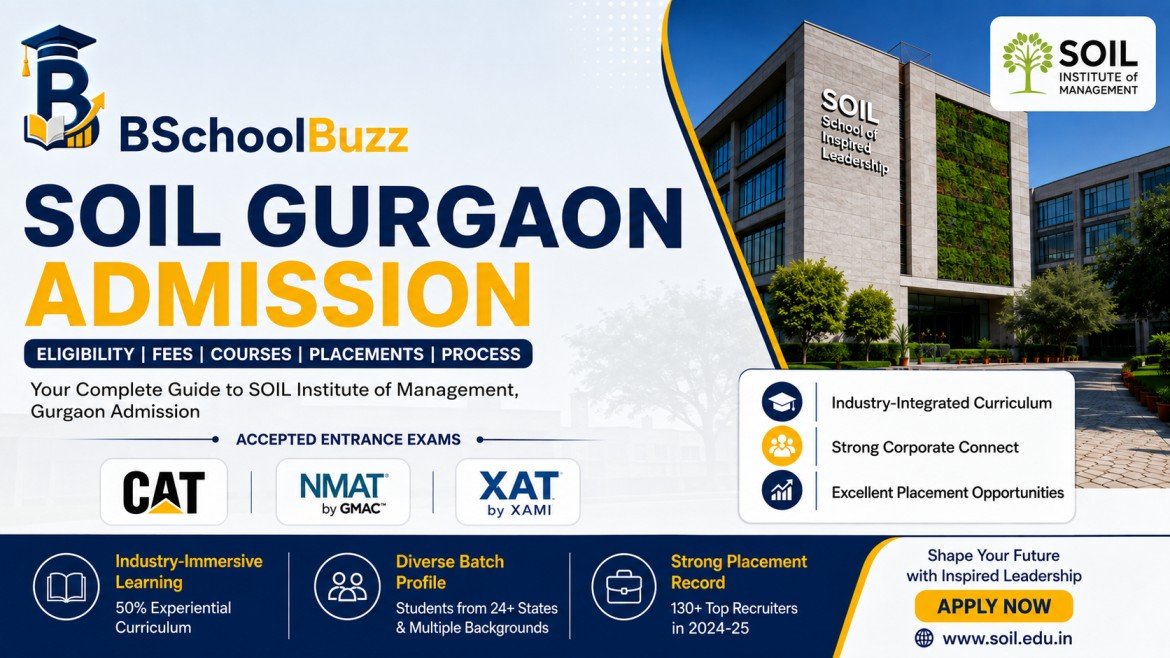
SOIL Gurgaon Admission is a popular option among MBA aspirants looking for a management programme that combines conventional business education with design thinking, experiential learning and leadership development. SOIL Institute of Management, also known as the School of Inspired Leadership, offers multiple management programmes, with the two-year PGDM being particularly relevant for fresh graduates and candidates with limited work experience, while the one-year PGPM is designed for professionals with prior work experience.
For students researching SOIL Gurgaon Admission 2026, there is one important point to understand at the outset: the 2026–28 PGDM admission cycle has already moved into the academic phase. SOIL's official information states that the PGDM Batch 2026–28 orientation started on June 5, 2026. The institute's current website is now displaying admissions for the subsequent 2027–29 PGDM cycle.
That makes the 2026 admission information useful mainly for students who want to understand the recently completed admission cycle, compare SOIL with other B-schools, or prepare for the next intake. It is also important because many websites continue to mix old fee structures, placement figures and admission rules from different years.
This article separates the available information by admission cycle wherever necessary. It covers eligibility, accepted entrance examinations, application fees, selection process, Design Thinking Workshop, Personal Interview, programme structure, fees, scholarships, placements, campus, career opportunities, return on investment and the difference between SOIL's PGDM and PGPM.
For the latest official admission information, students should always cross-check the institute's own admissions page before submitting an application or paying any fee. SOIL official website
SOIL Gurgaon Admission at a Glance
SOIL's programmes are structured differently, so the first step is identifying which programme matches your academic and professional profile.
| Particular | Two-Year PGDM | One-Year PGPM |
|---|---|---|
| Programme duration | 24 months | 12 months |
| Location | Manesar, New Gurgaon | Gurgaon |
| Format | Full-time | Full-time |
| Primary audience | Freshers and candidates with limited work experience | Experienced professionals |
| Minimum graduation requirement | 50% aggregate | 50% aggregate |
| Work experience | Freshers eligible; less than 3 years | Minimum 2 years required |
| Entrance exams | CAT, XAT, GMAT, MAT, CMAT, NMAT, SNAP/ATMA depending on cycle | CAT, XAT, NMAT, GMAT and/or SOIL SAT depending on cycle |
| Selection | Profile + exam score + GE/PI | Profile + exam score/SAT + GE/PI |
| Application fee | ₹2,000 for PGDM | Varies by admission cycle |
| Academic focus | Business, Design Thinking and Liberal Arts | Management and leadership for experienced professionals |
The two programmes should not be treated as interchangeable. The PGDM is a two-year programme designed substantially around students at the beginning of their management careers. SOIL itself states that freshers and candidates with less than three years of work experience are eligible for the PGDM.
The PGPM, on the other hand, is a one-year programme for candidates who already have professional experience. The current PGPM eligibility page requires a bachelor's degree with at least 50%, more than 60% in Class 10 and Class 12, a minimum of two years of prior work experience, and an accepted aptitude test score or the SOIL Aptitude Test.
What Is SOIL Institute of Management?
SOIL Institute of Management is a management education institution based in Gurgaon, Haryana. Its academic positioning is built around leadership, design thinking, innovation, business fundamentals and experiential learning.
The two-year PGDM is presented by SOIL as a programme integrating Business, Design Thinking and Liberal Arts. The institute describes it as an AICTE-approved programme and states that approximately half of the curriculum is experiential and industry immersive.
This positioning is relevant when evaluating SOIL because the institution does not follow exactly the same academic philosophy as a conventional two-year PGDM that focuses predominantly on classroom-based functional specialisations.
Students are exposed to areas such as:
Business fundamentals
Marketing
Finance
Strategy
Business analytics
Digital transformation
Design thinking
Innovation
Leadership
Problem solving
Communication
Industry projects
Experiential learning
Career preparation
SOIL also highlights courses related to Big Data and Artificial Intelligence, Business Analytics and Digital Transformation & Strategy.
The institute's approach can therefore appeal to students who want a management programme that combines analytical business skills with creativity and problem solving.
SOIL Gurgaon Admission 2026: Current Status
Students searching specifically for SOIL Gurgaon Admission 2026 need to distinguish between the 2026–28 admission cycle and the admissions that are currently open.
For the 2026–28 PGDM batch, SOIL's official School of Business Design admissions page stated that applications were open for the batch and provided eligibility and selection information for candidates appearing in 2026.
The institute's current website, however, indicates that the PGDM Batch 2026–28 orientation began on June 5, 2026. Since the current date is August 2026, the 2026–28 batch has already commenced.
An SOIL eligibility page associated with the 2026 cycle also displayed January 18, 2026 as an application deadline.
Therefore, a student reading this in August 2026 should not assume that the 2026–28 PGDM application is still open.
The institute's current admission page is now displaying the 2027–29 PGDM cycle.
This distinction matters because education portals often retain older admission pages even after a batch has started.
What does this mean for students?
If you were specifically looking for the 2026–28 intake, the regular admission window has already passed and the batch has started.
If you are planning to apply to SOIL after the 2026–28 cycle, you should use the current 2027–29 admission information rather than relying on older 2026 dates.
SOIL Gurgaon Courses
SOIL currently offers three major full-time management pathways:
Two-Year PGDM
The Post Graduate Diploma in Management is a 24-month full-time programme located at the Manesar, New Gurgaon campus. SOIL positions this programme for freshers and candidates with limited professional experience.
One-Year PGPM
The Post Graduate Program in Management is a 12-month full-time programme located in Gurgaon. It is intended for professionals with prior work experience and focuses more heavily on leadership and career acceleration.
PGPM-HR
SOIL also offers a one-year Post Graduate Program in Management – Human Resources. It is designed for candidates interested specifically in human resources and people management.
Because eligibility, fees and work-experience requirements differ, students should select the programme based on their profile rather than choosing simply on the basis of the programme name.
SOIL Gurgaon Admission Eligibility
Eligibility is one of the most important parts of the admission process.
For the two-year PGDM, SOIL's 2026 admissions information required candidates to have a bachelor's degree with at least 50% aggregate marks in any discipline from a recognised university. The degree needed to comprise at least three years of education after the 10+2 stage.
The current admission page continues to specify a minimum 50% bachelor's degree requirement for the two-year PGDM.
Academic qualification
A candidate generally needs:
A bachelor's degree in any discipline
At least 50% aggregate marks
A degree from a recognised university
At least three years of undergraduate education after 10+2
The programme is not restricted to a particular undergraduate stream.
That means students from backgrounds such as:
Engineering
Commerce
Arts
Science
Management
Economics
Computer applications
Humanities
can be considered, provided they satisfy the formal eligibility conditions.
Can final-year students apply?
Yes.
For the 2026–28 cycle, final-year bachelor's students appearing in 2026 were permitted to apply provided they could submit a certificate from their institution confirming the required 50% marks. The final marksheet and degree certificate were required by October 1, 2026.
The current admission cycle similarly provides an opportunity for final-year candidates, although the applicable year and submission deadline change with the batch.
Students should therefore read the deadline for their specific admission cycle instead of assuming that the 2026 deadline applies to the next batch.
Work Experience Requirement for SOIL PGDM
One of the advantages of the SOIL PGDM is that freshers are eligible.
For the 2026–28 admission cycle, the institute stated that freshers and candidates with less than three years of work experience could apply.
This makes the programme relevant for students who have completed graduation and want to move directly into management education.
Work experience can still strengthen an applicant's profile, particularly when the candidate can demonstrate:
Responsibility
Leadership
Professional achievements
Team management
Business exposure
Problem solving
Entrepreneurship
Client interaction
Internships or substantial projects
However, candidates should not assume that work experience is mandatory for the two-year programme.
SOIL's own batch information shows a strong fresher presence. Its published Class of 2025 profile reported 68% freshers, with students coming from multiple academic and professional backgrounds.
Which Entrance Exams Does SOIL Accept?
The entrance examination requirement is somewhat broader than at many B-schools.
For the 2026–28 PGDM admission cycle, SOIL's official admissions page listed:
CAT
XAT
GMAT
MAT
CMAT
NMAT
The institute also stated that applicants could submit multiple examination scores and that the best score could be considered.
The current admission page additionally lists SNAP and ATMA among accepted tests, with specific conditions for NMAT and SNAP.
This means applicants should always check the exam list for their intended intake.
Does SOIL have a CAT cutoff?
SOIL does not publish a fixed minimum CAT percentile for applying to the PGDM.
Its FAQ states that there is no fixed minimum percentile or score requirement for CAT, GMAT, XAT or CMAT for applying. Instead, the selection process is profile based and considers academic performance, work experience, examination score and performance in the Group Exercise and Personal Interview.
This is an important distinction.
A student should not interpret "no fixed cutoff" as "the exam score does not matter."
The exam score still forms part of the evaluation.
The current SOIL selection framework assigns 35% weight to examination scores, while academics account for 15%, extracurriculars 5%, work experience 5%, and GE/PI performance 40%.
Therefore, a good score can strengthen an application, but the final decision is not based solely on the percentile.
SOIL Gurgaon Admission Selection Process
The SOIL admission process is more profile-oriented than a purely examination-driven model.
The major stages are:
Online application → profile shortlisting → Group Exercise/Design Thinking Workshop → Personal Interview → final decision → registration
The institute's current PGDM admissions page describes a holistic selection framework.
Online Application
Candidates begin by completing the application form.
The application requires information related to:
Academic background
Entrance examination scores
Extracurricular achievements
Work experience, if applicable
Supporting documents
Statement of Purpose
Application fee
For the 2026–28 cycle, the application fee was ₹2,000 and was stated to be non-refundable.
The institute has also cautioned applicants against unauthorised coupon or discount schemes and says the application fee should be paid in full.
Statement of Purpose for SOIL Admission
The Statement of Purpose is an important part of the application because SOIL's admission philosophy extends beyond examination performance.
A good SOP should explain:
Why you want to pursue management education
Why you are interested in SOIL
Your academic journey
Your professional or extracurricular experiences
Problems you have solved
Leadership experiences
Career goals
Why the programme fits your plans
What you can contribute to the student community
A weak SOP generally repeats the resume.
A stronger SOP tells a coherent story.
For example, instead of writing:
"I am hardworking, passionate and a good leader."
A candidate should explain a specific experience in which they had to lead a team, solve a problem or take responsibility.
The admissions team can then see evidence rather than adjectives.
SOIL Design Thinking Workshop
One of the most distinctive parts of the admission process is the Design Thinking Workshop.
SOIL uses a hands-on group exercise rather than relying exclusively on a conventional group discussion.
For the current process, the institute describes the exercise as a 60–75 minute activity in which candidates work in teams to solve a real-world problem using design-thinking principles.
The broader workshop follows the design-thinking sequence:
Empathize → Define → Ideate → Prototype → Test
Candidates may be asked to understand a problem, identify the underlying issue, develop ideas and then present or test a solution.
The exercise is designed to observe qualities such as:
Collaboration
Creativity
Empathy
Communication
Problem solving
Leadership
Decision making
Ability to work under time pressure
Ability to listen to other viewpoints
This is different from preparing for a conventional GD in which candidates mainly debate a topic.
How should you prepare?
You do not need to memorise hundreds of design-thinking definitions.
Instead, practise:
Case-based problem solving
Brainstorming
Team discussions
Business cases
Consumer problems
Social problems
Product improvement exercises
Structured communication
During the workshop, avoid trying to dominate the group.
A candidate who listens carefully, builds on another person's idea and moves the team toward a practical solution can demonstrate leadership without speaking continuously.
SOIL Personal Interview
The Personal Interview follows the Group Exercise or Design Thinking Workshop.
The current SOIL process describes a 30–45 minute interview with faculty and industry experts. The interview examines areas such as academic background, work experience, career aspirations, motivation and the candidate's ability to learn, think, relate and motivate.
Questions can potentially cover:
Academics
Tell us about your graduation.
Why did you choose your undergraduate course?
Which subject did you enjoy most?
What did you learn outside your curriculum?
Career
Why MBA/PGDM?
Why now?
What role do you want after graduation?
Which industry interests you?
Why management rather than a technical career?
Profile
Tell us about yourself.
What are your strengths?
What is one weakness you are working on?
Tell us about a leadership experience.
Describe a failure and what you learned.
SOIL-specific questions
Why SOIL?
Why a two-year PGDM?
What attracts you to design thinking?
How would you contribute to the SOIL community?
What do you understand about experiential learning?
Current affairs and business
Candidates should also remain familiar with major developments in:
Indian economy
Startups
Artificial intelligence
Digital businesses
Finance
Marketing
Technology
Global business
Major corporate developments
The strongest answers usually connect the candidate's experience with their career direction.
SOIL Admission Selection Weightage
SOIL's current PGDM selection framework provides a useful indication of how the institute evaluates applicants.
| Component | Weightage |
|---|---|
| Entrance exam score | 35% |
| Academics | 15% |
| Extracurricular activities | 5% |
| Work experience | 5% |
| GE/PI performance | 40% |
This framework shows that the admission decision is not based solely on CAT or another entrance test. GE/PI carries the largest individual component at 40%.
This can be particularly relevant for candidates whose examination score is decent but not exceptional.
However, it also means that candidates should not treat the interview and group exercise as formalities.
SOIL Gurgaon Admission Fees
Fee information requires particular caution because SOIL publishes different fee structures for different admission batches.
For the current 2027–29 PGDM batch, the official fee page lists a total academic fee of ₹17.20 lakh, plus a refundable security deposit of ₹30,000. The published components include ₹9.85 lakh in tuition fees, ₹6.70 lakh in programme fees, ₹47,000 in student activity charges, ₹5,000 for the personal accidental benefit policy, ₹3,000 for knowledge resources and ₹10,000 for alumni subscription.
However, this is the 2027–29 fee structure, not the 2026–28 fee structure.
The official School of Business Design admissions page confirms that a separate fee structure existed for the 2026–28 batch, but the accessible text version of that page does not expose the individual numerical amounts.
Therefore, it would be inaccurate to present the 2027–29 ₹17.20 lakh figure as the 2026–28 fee.
What should 2026 applicants do?
Students researching the 2026–28 batch should rely on their original offer letter or the fee schedule supplied by SOIL for that admission cycle.
Students applying for a future intake should use the fee applicable to that intake.
This is especially important because B-school fees can change between admission cycles.
What Does the Current SOIL PGDM Fee Include?
The current official fee structure for the 2027–29 batch breaks the academic cost into several components:
| Fee component | Current published 2027–29 amount |
|---|---|
| Tuition Fee | ₹9.85 lakh |
| Programme Fees | ₹6.70 lakh |
| Student Activity Charges | ₹47,000 |
| Personal Accidental Benefit Policy | ₹5,000 |
| Knowledge Resources | ₹3,000 |
| Alumni Subscription | ₹10,000 |
| Total academic fee | ₹17.20 lakh |
| Refundable security deposit | ₹30,000 |
These figures are specifically for the 2027–29 batch and should not be substituted for the 2026–28 fee.
The fee page indicates that the programme fee covers a range of academic and associated activities.
Students should separately budget for expenses that may not be included in the academic fee, such as:
Accommodation
Food
Personal expenses
Travel
Laptop
Optional international immersion expenses
Other living expenses
SOIL's admissions information states that accommodation is arranged separately and that students can contact the institute for nearby residential options.
SOIL Gurgaon Admission Application Fee
For the two-year PGDM, the application fee for the 2026–28 cycle was ₹2,000.
The official admissions page clearly stated that the fee was non-refundable.
The application fee is relatively small compared with the total cost of a management programme, but candidates should still verify the exact fee displayed on the official application portal before making payment.
SOIL Scholarships
SOIL offers scholarship options for eligible students.
Its PGDM information lists categories including:
Need-based scholarship
Merit-based scholarship
Unique Achievement Scholarship
Dr. Verghese Kurien Scholarship
Defence Personnel Scholarship
Scholarship eligibility and amounts can vary by admission cycle.
Students should not assume that receiving an admission offer automatically guarantees a scholarship.
Scholarship decisions generally depend on the specific criteria applicable to the candidate and the programme.
Need-based financial support
Need-based support can be particularly relevant for students for whom the total programme cost represents a significant financial commitment.
Applicants should check:
Eligibility
Family-income criteria, where applicable
Required documents
Application deadline
Scholarship amount
Whether the scholarship is adjusted against fees or paid later
Conditions attached to the award
For the PGPM, SOIL's published scholarship information includes a need-based category and states that scholarship amounts and conditions are determined by the scholarship committee.
Education Loans for SOIL
Students who require financing can explore education loans.
SOIL's FAQ lists relationships with several education-loan providers, including Bank of Baroda, Axis Bank, Credila Financial, Yes Bank and IDFC First Bank, among others.
Students should compare the complete cost of borrowing rather than selecting a loan purely based on the approved amount.
Important factors include:
Interest rate
Moratorium period
Processing fee
Collateral requirements
Repayment period
Interest during study period
Whether interest is capitalised
Prepayment terms
Insurance requirements
A ₹15–18 lakh management education investment can produce a very different financial outcome depending on the interest rate and repayment structure.
SOIL PGDM Curriculum
The PGDM is positioned around a combination of business education and design thinking.
SOIL describes the programme as integrating:
Business
Design Thinking
Liberal Arts
The institute also states that 50% of the curriculum is experiential and industry immersive.
The philosophy is designed to move students beyond simply learning theories.
A management student needs to understand not only what a business framework says, but also how to apply it to a real situation.
For example, a marketing student may need to understand:
Consumer behaviour
Segmentation
Positioning
Digital marketing
Brand strategy
Customer journeys
Data
But real business problems may not fit neatly into one textbook framework.
Design thinking can help students examine the customer's actual problem, understand user behaviour, generate alternatives and test potential solutions.
Design Thinking at SOIL
Design thinking is one of the strongest differentiators in SOIL's positioning.
The institute describes design thinking as a mindset for creative problem solving rather than simply a standalone subject.
Students can learn to:
Understand the user
Define the real problem
Challenge assumptions
Generate multiple solutions
Build prototypes
Test ideas
Learn from feedback
Improve the solution
This approach is particularly relevant in careers involving:
Product management
Consulting
Marketing
Strategy
Entrepreneurship
Innovation
Business development
Customer experience
It can also be useful in traditional functions because managers regularly need to solve ambiguous problems.
Experiential Learning at SOIL
SOIL places considerable emphasis on learning through experiences.
The institute's PGDM page states that approximately half of the curriculum is experiential and industry immersive.
Experiential learning can include:
Live projects
Industry interaction
Case studies
Simulations
Internships
Workshops
Business challenges
Industry visits
Design exercises
The benefit is that students can connect classroom concepts with business situations.
However, students should also remember that the quality of their learning depends heavily on their own participation.
A student who simply attends classes will not get the same value from an experiential programme as someone who actively participates in projects, competitions, clubs, internships and industry interactions.
Summer Internship at SOIL
Summer internship is an important part of the two-year PGDM.
SOIL's FAQ describes the summer internship as a mandatory component in which students work on a real-time project in a company. It states that the internship lasts two months and that the placement process takes place during the second year.
For a management student, the internship is valuable for three reasons.
First, it provides exposure to actual organisational work.
Second, it can help the student decide whether a particular function is suitable.
Third, a good internship can strengthen the final-placement profile.
Students should therefore not look at the internship merely as a two-month requirement.
It can be used to develop:
Functional skills
Professional communication
Excel/analytics ability
Presentation skills
Industry knowledge
Networking
Problem-solving ability
SOIL Gurgaon Placements
Placements are one of the most important factors when evaluating SOIL.
The latest completed PGDM placement data published by SOIL is for the Class of 2025.
According to the institute's official placement report:
Highest CTC: ₹20.7 LPA
Average CTC: ₹11.17 LPA
Median CTC: ₹10.9 LPA
Top 50% CTC: ₹12.97 LPA
Top 25% CTC: ₹14.27 LPA
130+ companies participated
93% of students opted for placements
Among those opting for placements, 98% got placed at an average CTC of ₹11.33 LPA
These figures should be described as Class of 2025 placement data, not as guaranteed salaries for students entering a future batch.
The latest placement report available on SOIL's site also identifies an interim placement report for 2025–26, while the final published report for the completed cycle is 2024–25/Class of 2025.
SOIL Placement Salary Trend
SOIL's published placement report provides a historical trend:
| Placement year | Average salary | Median salary | Top 25% CTC |
|---|---|---|---|
| 2024–25 | ₹11.17 LPA | ₹10.90 LPA | ₹14.27 LPA |
| 2023–24 | ₹10.75 LPA | ₹10.50 LPA | ₹13.90 LPA |
| 2022–23 | ₹10.30 LPA | ₹10.00 LPA | ₹13.50 LPA |
| 2021–22 | ₹9.70 LPA | ₹9.80 LPA | ₹12.20 LPA |
The same report shows the number of companies participating rising to more than 130 in the 2024–25 cycle, compared with 84 in 2023–24.
The trend indicates improvement in the reported average salary over these years, although past placement performance should never be interpreted as a guarantee of future compensation.
Highest Package at SOIL
The latest completed PGDM placement report reports a highest CTC of ₹20.7 LPA.
The highest package is useful as a headline number, but it should not be the primary metric used to evaluate the programme.
For a student deciding whether to spend several lakh rupees on management education, the following numbers are more informative:
Average CTC
Median CTC
Top 25% average
Top 50% average
Placement percentage
Number of recruiting companies
Nature of roles
Internship conversion
Batch size
Total cost of education
The median salary of ₹10.9 LPA is especially useful because it indicates the midpoint of the reported salary distribution more directly than the highest package.
SOIL Placement Companies
SOIL's published placement material identifies recruiters and alumni associated with companies such as:
BlackRock
S&P Global
Infosys
Accenture
Aditya Birla
KPMG
Nestlé
Mahindra & Mahindra
McKinsey & Company
BCG
Bain & Company
Noise
MRM
Recruiter participation can change from year to year.
Students should therefore avoid interpreting a company's presence in one placement report as a guarantee that the same company will recruit from every future batch.
SOIL Placement Roles
Management graduates can pursue roles across several functions.
Potential areas include:
Marketing
Brand management
Digital marketing
Growth marketing
Performance marketing
Category management
Sales and marketing
Consumer insights
Finance
Financial analysis
Corporate finance
Banking
Investment-related roles
Business finance
Risk
FP&A
Consulting and Strategy
Business consulting
Strategy
Management consulting
Business transformation
Research and analytics
Analytics
Business analytics
Data-driven decision making
Business intelligence
Consulting analytics
Product analytics
Human Resources
HR business partnering
Talent acquisition
Learning and development
Employee experience
People analytics
Product and Technology
Product management
Product operations
Digital transformation
Technology consulting
The actual roles available depend on recruiter demand, market conditions, student profiles and performance.
SOIL Gurgaon Batch Profile
SOIL's published PGDM Class of 2025 profile provides insight into the type of students who join the programme.
The reported average age was 22.5 years, average work experience was 15.4 months, 24 states were represented and 46% of the batch was female.
The profile also showed:
68% freshers
8% marketing and branding background
4% finance
2% human resources
5% software development
25% information technology industry
18% e-commerce and retail
7% BFSI
11% education
This suggests that the classroom environment is not limited to engineering graduates.
Students from management, commerce, science, arts and other academic backgrounds can form part of the cohort.
Academic Diversity at SOIL
The PGDM batch profile shows students from different graduation streams.
The published profile lists:
Arts: 12%
Commerce: 29%
Engineering: 19%
Management: 25%
Science: 15%
This diversity can improve classroom discussions because business problems are rarely solved from a single academic perspective.
An engineer may approach a problem through systems thinking.
A commerce student may focus on financial implications.
A marketing graduate may focus on consumer behaviour.
An arts student may bring a different perspective on communication and human behaviour.
The value of this diversity depends on how actively students participate in classroom and project work.
SOIL Campus and Location
The two-year PGDM is located at Manesar, New Gurgaon, Haryana.
SOIL's official contact information lists the PGDM campus at Plot No. 23, Sector 02, Phase 01, Manesar, Gurgaon, Haryana – 122050.
This location is relevant for students because Gurgaon and the wider Delhi-NCR region have a substantial concentration of companies across:
Technology
Consulting
BFSI
E-commerce
Consumer goods
Automotive
Startups
Media
Healthcare
Professional services
The location can support industry interaction, although students should distinguish corporate proximity from actual placement outcomes.
Life at SOIL
SOIL's approach is designed around more than classroom lectures.
The institute highlights:
Student clubs
Cultural activities
Wellness activities
Indoor sports
Digital library resources
Smart classrooms
Design labs
Industry interactions
Its FAQ states that students have access to a digital library containing academic journals, case studies, business reports and e-books, while classrooms are smart-enabled.
The institute also describes recreational and extracurricular facilities intended to support holistic development.
International Exposure at SOIL
SOIL offers international immersion opportunities as part of its broader learning philosophy.
The institute describes a Global Immersion Experience designed to provide students with international exposure.
However, students should understand the financial structure carefully.
International immersion expenses can involve additional costs depending on the destination and format.
SOIL's admissions information states that optional trip charges are separate and can vary depending on the location and value-added experiences. Students are also responsible for applicable visa fees and medical insurance premiums.
Therefore, international exposure should be treated as an additional learning opportunity rather than automatically assuming it is fully included in the academic fee.
SOIL PGDM vs SOIL PGPM
One of the most common sources of confusion is the difference between the two programmes.
| Factor | PGDM | PGPM |
|---|---|---|
| Duration | 2 years | 1 year |
| Target profile | Freshers/limited experience | Experienced professionals |
| Work experience | Less than 3 years | Minimum 2 years |
| Location | Manesar, Gurgaon | Gurgaon |
| Primary objective | Management education and career entry | Career acceleration |
| Internship | Relevant to two-year structure | Different one-year format |
| Programme intensity | Two-year academic experience | Compressed one-year experience |
The PGDM is more suitable for a graduate who wants a full two-year management education.
The PGPM is more suitable for an experienced professional who wants to accelerate or change their career without spending two years away from work.
The current PGPM admissions page requires at least two years of prior work experience.
SOIL PGPM Fees
The official PGPM fee page currently provides a detailed fee structure.
The published total is ₹15,33,226, including GST, consisting of:
Tuition and academic fee: ₹8,12,000
GST on tuition/academic fee: ₹1,46,160
Programme fee: ₹4,56,921
GST on programme fee: ₹82,245
Alumni association membership: ₹5,000
GST: ₹900
Refundable caution deposit: ₹30,000
The institute specifically states that accommodation, books, course materials, the Sidhbari trip and other expenses during the stay are excluded from the published fee.
Again, these figures relate to the published PGPM fee structure and should not be confused with the two-year PGDM fee.
SOIL PGPM Eligibility
The one-year PGPM has a more experienced candidate profile.
SOIL's current admissions page states that candidates need:
A completed bachelor's degree
At least 50% in graduation
More than 60% in Class 10
More than 60% in Class 12
At least two years of prior work experience
A valid accepted entrance examination score
Accepted tests include CAT, NMAT and XAT, while candidates without one of the recognised scores may take the SOIL Aptitude Test.
This makes the PGPM fundamentally different from the PGDM.
SOIL Aptitude Test
SOIL also has its own aptitude assessment for eligible applicants who do not have a recognised entrance score.
The SOIL Aptitude Test is described as a 60-minute assessment covering areas such as:
Aptitude
Data interpretation
Verbal ability
Critical thinking
The test is particularly relevant to the PGPM process according to the current admissions information.
Candidates should verify whether the test is applicable to their programme and admission cycle before assuming that it can replace any particular entrance examination.
Is SOIL Gurgaon Good for Freshers?
For fresh graduates, the two-year PGDM is the more relevant programme.
SOIL's own published batch data indicates that a substantial majority of the PGDM cohort consists of freshers.
The institute also explicitly states that its PGDM offers placement opportunities for freshers and that more than 65% of the PGDM batch consists of freshers according to its programme information.
However, "good for freshers" should not be interpreted as "guaranteed high salary for every fresher."
The final outcome depends on:
Academic performance
Internship
Communication
Skills
Interview preparation
Functional knowledge
Projects
Student initiative
Market conditions
Recruiter requirements
Is SOIL Gurgaon Worth It?
Whether SOIL is worth the investment depends on what you want from an MBA.
It can make sense for students who value:
Gurgaon/NCR location
Experiential learning
Design thinking
Leadership development
A relatively diverse cohort
Access to multiple entrance exams
A profile-based selection process
Career preparation
A two-year PGDM for freshers
It requires more careful consideration for students who are primarily looking for:
A highly established legacy B-school brand
Very high consulting placements
Investment banking-focused recruitment
Extremely high average packages
A very low total education cost
The right question is therefore not simply "Is SOIL good?"
The better question is:
Does SOIL provide enough value for your specific career target at the total cost you will incur?
SOIL ROI: How Should Students Calculate It?
Return on investment should not be calculated using the highest salary.
Suppose a student spends ₹17 lakh or more on academic fees and additional money on living expenses.
If the student receives a ₹20.7 LPA offer, it would be tempting to conclude that the investment is highly profitable.
But the highest package represents the top end of the distribution.
The latest completed PGDM placement report reports:
Average CTC: ₹11.17 LPA
Median CTC: ₹10.9 LPA
Top 25%: ₹14.27 LPA
Highest: ₹20.7 LPA
For a realistic ROI analysis, the median and average are more useful starting points.
Students should also account for:
Tuition
Programme fees
Accommodation
Food
Travel
Laptop
Personal expenses
Loan interest
Opportunity cost of two years
A candidate financing the entire education through a loan will have a different ROI from someone paying through family savings.
Example SOIL ROI Calculation
Consider a hypothetical student whose total education and living investment reaches ₹20 lakh.
If the student eventually receives an ₹11.17 LPA CTC, it does not mean that ₹11.17 lakh arrives in their bank account.
CTC can include:
Fixed salary
Variable pay
Employer contributions
Benefits
Bonuses
The student's take-home salary will be lower than the CTC.
Therefore, students should never calculate the payback period simply as:
Total fees ÷ CTC
A better analysis considers estimated take-home income, taxes, loan repayment and living expenses.
This is particularly important when evaluating an expensive two-year management programme.
SOIL vs Other Gurgaon B-Schools
Students often compare SOIL with other management institutes in Delhi-NCR.
A useful comparison should include:
| Factor | What to compare |
|---|---|
| Admission | Entrance exams and selection |
| Fees | Complete two-year cost |
| Placement | Average and median CTC |
| Highest CTC | Top-end outcome |
| Recruiters | Relevant companies |
| Roles | Marketing, finance, consulting, analytics etc. |
| Batch size | Competition for placements |
| Curriculum | Traditional vs experiential |
| Location | Corporate access |
| Alumni | Career network |
| ROI | Cost versus realistic salary |
A candidate should not choose a college merely because its highest package is higher.
Similarly, a lower fee does not automatically mean better ROI.
The career goal matters.
For example, someone targeting marketing may value recruiter mix and brand-building roles more than someone targeting finance.
SOIL for Marketing Careers
SOIL can be considered by students interested in marketing and growth-oriented careers.
The curriculum includes business and experiential components, while SOIL's published batch profile includes students with marketing and branding backgrounds.
Potential career paths include:
Brand management
Digital marketing
Growth
Sales
Category management
Consumer insights
Marketing analytics
Business development
Students targeting marketing should build practical skills alongside the PGDM:
Excel
PowerPoint
Google Analytics
Performance marketing
SEO
Consumer research
Market research
Presentation
Storytelling
Data interpretation
The degree provides the platform; the student's skill development determines how effectively that platform is used.
SOIL for Finance Careers
Students interested in finance should evaluate the recruiter mix and role profile carefully.
Potential finance-related career paths after management education can include:
Corporate finance
Financial planning
Business finance
Banking
Risk
Financial analysis
Investment-related support roles
However, candidates specifically targeting investment banking, private equity or highly selective front-office finance roles should compare SOIL with schools that have stronger historical recruitment pipelines in those functions.
A college can have a finance curriculum without being a major investment-banking recruiting campus.
That distinction matters.
SOIL for Consulting
SOIL's placement information includes alumni associated with consulting firms such as BCG, Bain and McKinsey.
However, individual alumni success should not be interpreted as evidence that every student can expect a consulting offer.
Consulting recruitment is competitive and typically depends on:
Academic record
Problem-solving
Case interview ability
Communication
Structured thinking
Business knowledge
Internship
Overall profile
Students targeting consulting should start case preparation early.
SOIL for Entrepreneurship
SOIL's emphasis on design thinking, innovation and leadership can be relevant to aspiring entrepreneurs.
The programme is designed around identifying customer problems, developing solutions and thinking beyond conventional management approaches.
For an entrepreneur, the value of a management programme can come from:
Peer network
Mentors
Industry exposure
Business knowledge
Customer discovery
Financial understanding
Marketing
Leadership
Access to potential co-founders
However, an MBA is not mandatory for entrepreneurship.
A student should join SOIL for entrepreneurship only if the overall learning and network value justifies the cost.
Documents Required for SOIL Admission
Applicants should keep common admission documents ready.
These can include:
Class 10 marksheet
Class 12 marksheet
Graduation marksheets
Graduation degree/provisional certificate
Entrance exam scorecard
Identity proof
Passport-size photograph
Work-experience documents, if applicable
Internship or achievement documents where relevant
Extracurricular certificates
Statement of Purpose
Other documents requested by the institute
The exact document list can change by admission cycle.
Candidates should follow the instructions on the official application portal.
How to Prepare for SOIL Admission
Preparation should begin before the application is submitted.
Build a strong academic narrative
Be prepared to explain your academic choices.
If your academic performance has been inconsistent, do not try to hide it.
Instead, explain what changed and what you learned.
Prepare your career story
You should be able to answer:
Why management?
Why now?
Why SOIL?
Why this career?
These four answers should connect logically.
Prepare for the Design Thinking Workshop
Practise group problem solving rather than only conventional GD topics.
Prepare for the PI
Know your resume completely.
Anything written on your application can become an interview question.
Read business news
Follow major business developments.
Know SOIL
Understand:
Programme
Curriculum
Design thinking
Career opportunities
Location
Placement data
Fees
Student profile
A candidate who says "I want to join because SOIL is a good college" is giving a weak answer.
A stronger answer connects the programme with a specific career goal.
Common Mistakes Students Make During SOIL Admission
Treating CAT score as the only factor
SOIL follows a holistic selection model.
Ignoring the SOP
The SOP can help the admissions team understand your motivation.
Preparing only for a traditional GD
SOIL's Design Thinking Workshop is different from a conventional debate.
Giving generic PI answers
"Leadership" and "innovation" are not enough unless supported by examples.
Not researching the programme
Students should know why they want SOIL rather than simply applying to multiple colleges.
Looking only at the highest package
The median and average are more useful for evaluating realistic outcomes.
Ignoring total cost
Tuition is not the entire MBA investment.
Assuming no cutoff means easy admission
No published fixed cutoff does not mean automatic admission.
Confusing PGDM and PGPM
The programmes target different candidate profiles.
Does SOIL Have Reservation?
SOIL's published PGDM FAQ states that the institute follows AICTE-approved guidelines and does not have a separate reservation quota for SC/ST/OBC or EWS candidates. It states that candidates are evaluated fairly based on merit and overall profile.
Candidates should always verify the current admission policy because regulatory requirements can change.
Is There a Management Quota at SOIL?
Students should be cautious about third parties promising guaranteed admission or special quota seats.
The application process should be completed through the official SOIL application channels.
The institute's admissions pages explicitly direct candidates toward its online application system and warn against unauthorised application-fee coupon schemes.
If someone claims that they can guarantee admission based only on payment, candidates should verify the claim directly with the institute before transferring money.
SOIL Admission and Career Development
SOIL's Career Management Services team supports students during the placement journey.
The institute states that its career team works with employers ranging from Fortune 500 companies to startups and provides career preparation and employer connections.
Career preparation can include:
Resume building
Interview preparation
Group discussions
Career workshops
Mock interviews
Industry interactions
Alumni networking
Placement preparation
Students should still understand that placement support is not the same as a guaranteed placement.
The final outcome depends on student performance and recruiter selection.
SOIL Placement Data: What the Numbers Actually Mean
The reported 2024–25 average CTC of ₹11.17 LPA is a useful benchmark, but there are several ways a student can misunderstand it.
First, CTC is not the same as take-home salary.
Second, average does not describe every student.
Third, the highest salary is not representative of the typical student.
Fourth, placement statistics apply to a particular graduating cohort.
Fifth, the job market can change between admission and graduation.
For example, a student entering in 2026 may graduate in 2028. Economic conditions, recruiter demand, technology changes and hiring patterns in 2028 cannot be known with certainty in 2026.
Therefore, placement figures should be treated as historical evidence rather than a promise.
What Makes SOIL Different?
SOIL's most distinct positioning comes from the combination of:
Business + Design Thinking + Liberal Arts + Experiential Learning + Leadership
The institute explicitly describes the PGDM as India's first PGDM integrating these three academic components.
This can be attractive for students who do not want a purely conventional management curriculum.
The approach is particularly relevant to careers where ambiguity and problem-solving are important.
However, students who prefer a highly traditional curriculum with strong emphasis on a particular specialisation should compare course structures carefully.
SOIL Gurgaon Admission: Advantages
Some of the strongest reasons students consider the programme include:
Freshers are eligible.
The minimum graduation requirement is 50%.
Multiple entrance exams are accepted.
No fixed CAT percentile is published for PGDM application.
Selection considers the overall profile.
Design thinking is integrated into the programme.
Experiential learning is emphasised.
Gurgaon/NCR provides corporate exposure.
The batch includes students from diverse academic backgrounds.
Placement data shows an average CTC above ₹11 lakh for the latest completed PGDM placement cycle.
The programme has an established placement and career development structure.
Scholarship categories are available.
SOIL Gurgaon Admission: Limitations to Consider
A realistic decision also requires understanding the challenges.
Cost
The programme is a significant financial investment.
Brand positioning
SOIL is not positioned in the same category as India's most selective legacy institutions such as IIM Ahmedabad, IIM Bangalore, IIM Calcutta, FMS Delhi or XLRI.
Placement variation
Not every student receives the highest package.
ROI depends on profile
Students with stronger skills and interview performance can have better outcomes.
Additional living expenses
Accommodation and personal costs can materially increase total spending.
Future uncertainty
Placement outcomes for a future graduating batch cannot be guaranteed from historical data.
Who Should Consider SOIL Gurgaon?
SOIL can be worth considering if you are:
A fresher looking for a two-year management programme
A graduate with less than three years of work experience
Interested in experiential learning
Interested in design thinking
Comfortable with a profile-based admission process
Interested in Gurgaon/NCR
Looking for a programme with a strong leadership orientation
Interested in marketing, strategy, analytics, consulting or entrepreneurship
Willing to invest in a private management programme
Comfortable evaluating ROI beyond just college brand
Who Should Compare Other Options First?
You should compare other schools carefully if:
You have a very high CAT percentile
You have strong calls from higher-ranked B-schools
Your primary target is elite investment banking
Your primary goal is MBB consulting
Your budget is highly constrained
You are uncomfortable with the total cost
You are choosing solely because of the highest package
You want a very large residential university campus
You want a programme with a much stronger legacy alumni network
SOIL can be a useful option, but the best college is always relative to the alternatives available to the student.
SOIL Gurgaon Admission: Final Decision Checklist
Before accepting an offer, compare the following:
Your entrance exam percentile
Other college calls
SOIL programme fit
Total fee
Accommodation cost
Loan amount
Expected monthly EMI
Median CTC
Average CTC
Relevant recruiter list
Target job function
Batch profile
Curriculum
Internship opportunities
Career support
Alumni network
Location
Personal career goals
Do not make the decision only from an advertisement claiming a high package.
Frequently Asked Questions
What is SOIL Gurgaon Admission?
SOIL Gurgaon Admission refers to the admission process for management programmes offered by SOIL Institute of Management in the Gurgaon/Manesar region, including the two-year PGDM and one-year PGPM.
Is SOIL Gurgaon Admission open for 2026?
The two-year PGDM 2026–28 batch has already commenced. SOIL's official information states that orientation for the PGDM Batch 2026–28 started on June 5, 2026. The institute's current website is now showing admissions for the subsequent 2027–29 PGDM batch.
What is the eligibility for SOIL PGDM?
Candidates need a bachelor's degree with at least 50% aggregate marks from a recognised university. Freshers and candidates with less than three years of work experience are eligible.
Can freshers apply to SOIL?
Yes. Freshers are eligible for the two-year PGDM. SOIL's published batch profile also shows a substantial majority of freshers in the PGDM cohort.
Does SOIL accept CAT?
Yes. CAT is one of the entrance examinations accepted for the PGDM.
Does SOIL have a CAT cutoff?
SOIL states that it does not have a fixed minimum CAT percentile requirement for applying to the PGDM. Selection is profile based.
Which exams are accepted by SOIL?
The accepted examination list includes CAT, XAT, GMAT, MAT, CMAT and NMAT for the 2026 cycle, with additional tests such as SNAP and ATMA appearing in the current admission framework. Candidates should check the exact list applicable to their intake.
What is the SOIL application fee?
The PGDM application fee for the 2026–28 cycle was ₹2,000 and was stated to be non-refundable.
What is the SOIL PGDM fee?
The exact 2026–28 fee should be checked against the fee schedule issued for that batch. The current official website publishes ₹17.20 lakh as the academic fee for the 2027–29 PGDM batch, plus a ₹30,000 refundable security deposit. This is not the 2026–28 fee.
What is the SOIL PGDM average package?
The latest completed PGDM placement report published by SOIL reports an average CTC of ₹11.17 LPA for the Class of 2025.
What is the highest package at SOIL?
The latest completed PGDM placement report reports a highest CTC of ₹20.7 LPA.
What is the median package at SOIL?
The reported median CTC for the 2024–25 PGDM placement cycle was ₹10.9 LPA.
Does SOIL provide placements?
SOIL provides career development and placement support through its Career Management Services team. Placement statistics are published for completed batches.
Is SOIL good for MBA freshers?
The two-year PGDM is specifically designed to accommodate freshers and candidates with limited work experience. Whether it is the best option depends on the candidate's alternatives, budget and career goals.
Is SOIL an MBA or PGDM?
The two-year programme is a Post Graduate Diploma in Management. Students often use the terms MBA and PGDM interchangeably in searches, but the formal programme title is PGDM.
Is SOIL PGDM AICTE approved?
SOIL states that its two-year PGDM is AICTE approved.
Where is the SOIL PGDM campus?
The PGDM campus is in Manesar, New Gurgaon, Haryana. SOIL lists the campus at Plot No. 23, Sector 02, Phase 01, Manesar, Gurgaon.
What is the difference between SOIL PGDM and PGPM?
The PGDM is a two-year programme for freshers and candidates with limited experience, while PGPM is a one-year programme requiring prior professional experience.
How much work experience is required for SOIL PGPM?
The current PGPM eligibility criteria require at least two years of prior work experience.
Does SOIL have scholarships?
Yes. SOIL lists need-based, merit-based, unique achievement, Dr. Verghese Kurien and defence personnel scholarship categories for the PGDM.
Does SOIL provide education loans?
SOIL lists several education-loan providers, including Bank of Baroda, Axis Bank, Credila Financial, Yes Bank and IDFC First Bank.
What is the SOIL Design Thinking Workshop?
It is a hands-on group exercise used during the PGDM admission process. Candidates work together to solve real-world problems using design-thinking principles.
How long is the SOIL Personal Interview?
The current PGDM admissions information describes the Personal Interview as approximately 30–45 minutes.
Does SOIL consider extracurricular activities?
Yes. Extracurricular activities form part of the holistic selection process. The current published selection framework assigns 5% weightage to extracurriculars.
Does work experience improve chances at SOIL?
Work experience can strengthen a profile, but it is not mandatory for the two-year PGDM. The current selection framework assigns 5% weightage to work experience.
Is SOIL worth the fees?
That depends on the student's alternatives and career goals. The latest completed PGDM placement report reports ₹11.17 LPA average CTC and ₹10.9 LPA median CTC, while the programme requires a significant financial investment.
Should I choose SOIL if I have a very high CAT percentile?
Not automatically. Students with strong CAT scores should compare all available calls, especially from institutions with stronger brand positioning or recruiter alignment for their target career.
Is SOIL good for marketing?
It can be relevant for marketing aspirants because the programme combines business education, experiential learning and problem-solving. Students should also compare the actual marketing roles and recruiters available in the latest placement cycle.
Does SOIL offer international exposure?
SOIL offers a Global Immersion Experience as part of its international exposure initiatives. Additional costs may apply depending on the programme and destination.
Conclusion
SOIL Gurgaon Admission should be evaluated as a complete management education decision rather than simply as an entrance-exam or placement decision.
For the two-year PGDM, the institute offers a profile-oriented admission process in which examination scores, academics, extracurricular activities, work experience and GE/PI performance all contribute to the selection decision. The programme is particularly suitable for freshers and candidates with limited work experience.
The institute's strongest academic differentiator is its combination of business education, design thinking, liberal arts and experiential learning. Its latest completed PGDM placement report shows an average CTC of ₹11.17 LPA, median CTC of ₹10.9 LPA and highest CTC of ₹20.7 LPA for the Class of 2025.
At the same time, students should look beyond headline placement figures. The total cost of education, accommodation, loan interest, alternative college offers and the type of career a student wants after graduation should all be part of the decision.
For students researching the 2026–28 PGDM specifically, the most important update is that the batch has already started, with orientation beginning on June 5, 2026. The current SOIL website has moved to the 2027–29 admission cycle.
The practical next step is therefore to check the current official admission cycle, verify the latest fee structure and compare SOIL's programme, placements and total cost against the other B-schools available to you before paying an application or admission fee.
Search Keywords
SOIL Gurgaon Admission, SOIL Gurgaon Admission 2026, SOIL admission, SOIL Gurgaon, SOIL Institute of Management admission, SOIL Institute Gurgaon admission, SOIL PGDM admission, SOIL PGDM admission 2026, SOIL PGDM 2026, SOIL PGDM 2026-28, SOIL Gurgaon PGDM, SOIL Gurgaon MBA admission, SOIL MBA admission, SOIL Gurgaon courses, SOIL Gurgaon fees, SOIL PGDM fees, SOIL PGDM fees 2026, SOIL Gurgaon fee structure, SOIL fee structure, SOIL admission process, SOIL selection process, SOIL eligibility, SOIL Gurgaon eligibility, SOIL PGDM eligibility, SOIL admission eligibility, SOIL CAT admission, SOIL CAT cutoff, SOIL CAT percentile, SOIL XAT admission, SOIL XAT cutoff, SOIL GMAT admission, SOIL CMAT admission, SOIL MAT admission, SOIL NMAT admission, SOIL SNAP admission, SOIL ATMA admission, SOIL entrance exam, SOIL entrance exams, SOIL admission criteria, SOIL application form, SOIL application fee, SOIL application fee 2026, SOIL admission dates, SOIL admission deadline, SOIL Gurgaon admission dates, SOIL PGDM application, SOIL PGDM application form, SOIL PGDM application fee, SOIL PGDM selection criteria, SOIL PGDM selection process, SOIL GEPI, SOIL personal interview, SOIL PI, SOIL group exercise, SOIL design thinking workshop, SOIL design thinking admission, SOIL SOP, SOIL statement of purpose, SOIL interview questions, SOIL admission interview, SOIL interview preparation, SOIL Gurgaon interview, SOIL admission preparation, SOIL PGDM preparation, SOIL placement, SOIL Gurgaon placement, SOIL PGDM placement, SOIL placement 2025, SOIL placement report, SOIL average package, SOIL average salary, SOIL highest package, SOIL median salary, SOIL salary package, SOIL recruiters, SOIL placement companies, SOIL career opportunities, SOIL career development, SOIL internships, SOIL summer internship, SOIL PGDM internship, SOIL ROI, SOIL Gurgaon ROI, SOIL PGDM ROI, SOIL fees and placements, SOIL fees vs placements, SOIL PGDM worth it, is SOIL worth it, SOIL Gurgaon review, SOIL PGDM review, SOIL Institute review, SOIL Gurgaon college review, SOIL college review, SOIL Gurgaon courses and fees, SOIL PGDM courses, SOIL PGPM admission, SOIL PGPM eligibility, SOIL PGPM fees, SOIL PGPM placement, SOIL PGPM vs PGDM, SOIL PGDM vs PGPM, SOIL two year PGDM, SOIL one year PGPM, SOIL freshers admission, SOIL MBA for freshers, SOIL freshers PGDM, SOIL work experience requirement, SOIL graduation eligibility, SOIL 50 percent eligibility, SOIL final year admission, SOIL scholarship, SOIL PGDM scholarship, SOIL merit scholarship, SOIL need based scholarship, SOIL defence scholarship, SOIL education loan, SOIL hostel, SOIL accommodation, SOIL campus, SOIL Manesar campus, SOIL Gurgaon campus, SOIL Manesar Gurgaon, SOIL location, SOIL facilities, SOIL library, SOIL student life, SOIL campus life, SOIL batch profile, SOIL student profile, SOIL academic profile, SOIL curriculum, SOIL PGDM curriculum, SOIL design thinking, SOIL experiential learning, SOIL liberal arts PGDM, SOIL business design, SOIL leadership programme, SOIL leadership development, SOIL entrepreneurship, SOIL marketing placements, SOIL finance placements, SOIL consulting placements, SOIL analytics placements, SOIL product management, SOIL digital marketing, SOIL business analytics, SOIL artificial intelligence, SOIL international immersion, SOIL global immersion, SOIL recruiters 2025, SOIL placement statistics, SOIL placement salary, SOIL CTC, SOIL average CTC, SOIL highest CTC, SOIL top 25 percent salary, SOIL top 50 percent salary, SOIL placement percentage, SOIL companies, SOIL B School, Gurgaon B School admission, Gurgaon MBA colleges, Gurgaon PGDM colleges, best PGDM colleges Gurgaon, MBA colleges Gurgaon accepting CAT, PGDM colleges Gurgaon accepting CAT, MBA colleges Delhi NCR, PGDM colleges Delhi NCR, management colleges Gurgaon, SOIL admission for engineers, SOIL admission for commerce students, SOIL admission for arts students, SOIL admission for science students, SOIL admission for BBA students, SOIL admission for BCom students, SOIL admission for BTech students, SOIL admission for graduates, SOIL admission without CAT cutoff, SOIL no CAT cutoff, SOIL profile based admission, SOIL holistic admission, SOIL CAT percentile required, SOIL minimum CAT percentile, SOIL CAT score required, SOIL admission without high CAT percentile, SOIL PGDM entrance requirements, SOIL application requirements, SOIL documents required, SOIL admission documents, SOIL PGDM documents, SOIL admission SOP, SOIL design workshop questions, SOIL GE questions, SOIL PI questions, SOIL admission tips, SOIL PGDM admission tips, SOIL admission strategy, SOIL application strategy, SOIL interview tips, SOIL GD preparation, SOIL design thinking preparation, SOIL admission result, SOIL admission offer, SOIL registration fee, SOIL admission confirmation, SOIL admission status, SOIL 2026 admission status, SOIL 2026-28 admission, SOIL 2026-28 PGDM, SOIL batch 2026-28, SOIL orientation 2026, SOIL admission 2027, SOIL PGDM 2027, SOIL PGDM 2027-29, SOIL Gurgaon 2027 admission
Long-Tail & Short-Tail Searches
SOIL Gurgaon admission eligibility, SOIL Gurgaon admission process, SOIL Gurgaon admission 2026 details, how to get admission in SOIL Gurgaon, how to apply for SOIL Gurgaon, how to apply for SOIL PGDM, what is SOIL Gurgaon admission process, what percentile is required for SOIL Gurgaon, does SOIL Gurgaon accept CAT, does SOIL accept XAT score, does SOIL accept CMAT score, does SOIL accept MAT score, does SOIL accept NMAT score, is there a CAT cutoff for SOIL Gurgaon, SOIL Gurgaon admission without CAT, SOIL Gurgaon PGDM eligibility for freshers, SOIL Gurgaon PGDM eligibility for working professionals, SOIL Gurgaon admission for final year students, SOIL Gurgaon PGDM application fee, SOIL Gurgaon PGDM fees for two years, SOIL Gurgaon PGDM total cost, SOIL Gurgaon placement average salary, SOIL Gurgaon PGDM average package, SOIL Gurgaon PGDM highest package, SOIL Gurgaon median package, SOIL Gurgaon placement percentage, SOIL Gurgaon placement companies, SOIL Gurgaon placement report 2025, SOIL Gurgaon PGDM placement report, SOIL Gurgaon ROI analysis, is SOIL Gurgaon worth joining, is SOIL Gurgaon worth the fees, should I join SOIL Gurgaon, SOIL Gurgaon vs other MBA colleges, SOIL Gurgaon vs IMI Delhi, SOIL Gurgaon vs FORE School, SOIL Gurgaon vs BIMTECH, SOIL Gurgaon vs LBSIM, SOIL Gurgaon vs Jaipuria, SOIL Gurgaon vs IMT Ghaziabad, SOIL PGDM vs MBA, SOIL PGDM vs PGPM, SOIL PGDM for freshers, SOIL PGPM for experienced professionals, SOIL Gurgaon admission for 2 years work experience, SOIL PGPM admission for working professionals, SOIL PGPM admission requirements, SOIL PGPM entrance exam requirements, SOIL PGPM salary after graduation, SOIL PGPM fees including GST, SOIL PGDM scholarship eligibility, how to get scholarship at SOIL, SOIL need based scholarship eligibility, SOIL merit scholarship criteria, SOIL education loan options, SOIL hostel cost, SOIL accommodation cost, SOIL Manesar campus location, SOIL Gurgaon campus life, SOIL student life review, SOIL PGDM curriculum details, SOIL design thinking curriculum, SOIL experiential learning programme, SOIL international immersion programme, SOIL summer internship details, SOIL internship placement process, SOIL admission SOP sample, how to write SOIL SOP, SOIL personal interview preparation, SOIL PI questions and answers, SOIL design thinking workshop preparation, SOIL group exercise preparation, SOIL GEPI preparation, SOIL interview questions for freshers, SOIL interview questions for engineers, SOIL interview questions for BBA students, SOIL interview questions for BCom students, SOIL admission tips for CAT aspirants, SOIL admission chances with 70 percentile, SOIL admission chances with 80 percentile, SOIL admission chances with 90 percentile, SOIL admission chances with 95 percentile, SOIL profile based MBA admission, SOIL holistic selection process, SOIL admission selection weightage, SOIL CAT weightage in admission, SOIL PI weightage in admission, SOIL academics weightage, SOIL work experience weightage, SOIL extracurricular weightage, SOIL admission dates for PGDM, SOIL admission deadline for PGDM, SOIL admission status 2026, SOIL 2026 PGDM admission closed, SOIL 2026-28 batch start date, SOIL 2026 orientation date, SOIL current admission cycle, SOIL latest admission process, SOIL latest PGDM fee, SOIL latest placement report, SOIL latest average CTC, SOIL latest median CTC, SOIL latest highest CTC, SOIL Gurgaon management admission, SOIL School of Business Design admission, School of Business Design Gurgaon admission, School of Inspired Leadership admission, SOIL Gurgaon MBA college review, SOIL Gurgaon business school review, SOIL Gurgaon career opportunities, SOIL Gurgaon marketing career, SOIL Gurgaon finance career, SOIL Gurgaon consulting career, SOIL Gurgaon analytics career, SOIL Gurgaon entrepreneurship programme, SOIL Gurgaon business design programme, SOIL Gurgaon leadership programme, SOIL Gurgaon admission for non engineers, SOIL Gurgaon admission for commerce graduates, SOIL Gurgaon admission for arts graduates, SOIL Gurgaon admission for science graduates, SOIL Gurgaon admission for BBA graduates, SOIL Gurgaon admission for BTech graduates, SOIL Gurgaon admission for candidates with no work experience, SOIL Gurgaon admission for candidates with one year experience, SOIL Gurgaon admission for candidates with two years experience, SOIL Gurgaon admission for candidates with three years experience, SOIL Gurgaon PGDM career outcomes, SOIL Gurgaon placement ROI, SOIL Gurgaon fee versus salary, SOIL Gurgaon total MBA investment, SOIL Gurgaon education loan EMI, SOIL Gurgaon average CTC versus fees, SOIL Gurgaon median CTC versus fees, SOIL Gurgaon admission decision guide, SOIL Gurgaon college selection guide, SOIL Gurgaon MBA decision, SOIL Gurgaon PGDM decision, SOIL Gurgaon admission checklist, SOIL Gurgaon application documents, SOIL Gurgaon admission requirements, SOIL Gurgaon admission timeline, SOIL Gurgaon admission procedure for CAT students, SOIL Gurgaon admission procedure for XAT students, SOIL Gurgaon admission procedure for CMAT students, SOIL Gurgaon admission procedure for MAT students, SOIL Gurgaon admission procedure for GMAT students, SOIL Gurgaon admission procedure for NMAT students, SOIL Gurgaon PGDM selection criteria 2026, SOIL Gurgaon PGDM selection criteria 2027, SOIL Gurgaon PGDM fee structure 2026, SOIL Gurgaon PGDM fee structure 2027, SOIL Gurgaon PGDM placement 2026, SOIL Gurgaon PGDM placement 2025, SOIL Gurgaon admission latest update, SOIL Gurgaon admission current status, SOIL Gurgaon admission open or closed, SOIL Gurgaon admission application link, SOIL Gurgaon official admission website
Key Takeaways
SOIL Gurgaon offers full-time management programmes including PGDM, PGPM and PGPM-HR.
The 2025 PGDM batch recorded an average CTC of ₹11.17 LPA and the highest CTC of ₹20.7 LPA.
PGDM students in the top 25% of the 2025 batch achieved an average CTC of ₹14.27 LPA.
The 2025 PGPM batch recorded an average CTC of ₹12.3 LPA and the highest CTC of ₹21.8 LPA.
PGPM’s top 25% of students achieved a CTC of ₹18.8 LPA in the 2025 placement cycle.
PGPM-HR recorded an average CTC of ₹11.2 LPA and the highest CTC of ₹20 LPA for the 2025 batch.
The 2025 PGDM placement process saw 93% of students opting for placements, with 98% of those students placed.
PGPM placements involved 60 companies in the 2024–25 cycle, compared with 64 companies the previous year.
SOIL’s flagship PGPM is a 12-month full-time programme based in Gurugram, with 50% of the curriculum focused on experiential immersion.
The latest published PGPM fee structure totals approximately ₹15.33 lakh, excluding accommodation and certain additional expenses.
SOIL Gurgaon combines management education with experiential learning, industry exposure, mentorship and career development initiatives.
Ask a question
Still confused? Leave your question and our team will help you.