
Quick Summary
- Rajalakshmi School of Business (RSB) offers a two-year PGDM programme, according to its official website.
- The published eligibility criteria specify a recognised undergraduate degree with at least 50% aggregate marks, with a 45% threshold stated for SC/ST candidates.
- Final-year undergraduate students may apply, subject to submission of their final graduation certificate and marksheet.
- Entrance exams listed on the institute’s admission page include CAT, XAT, MAT, CMAT, GMAT, ATMA and TANCET.
- The exact application deadline and selection stages for the 2027 intake should be confirmed directly with RSB.
- The institute’s website publishes a fee schedule totalling ₹9.90 lakh, but candidates must confirm whether it applies to their intended batch.
- The curriculum includes core management subjects, elective areas, professional-development training and internship-related learning.
- Review the latest placement report, total attendance cost, refund policy and programme approval details before accepting admission.
- Official website: https://rsb.edu.in/
- Admissions email: admissions@rsb.edu.in
Rajalakshmi School of Business Admission 2027: Complete Guide
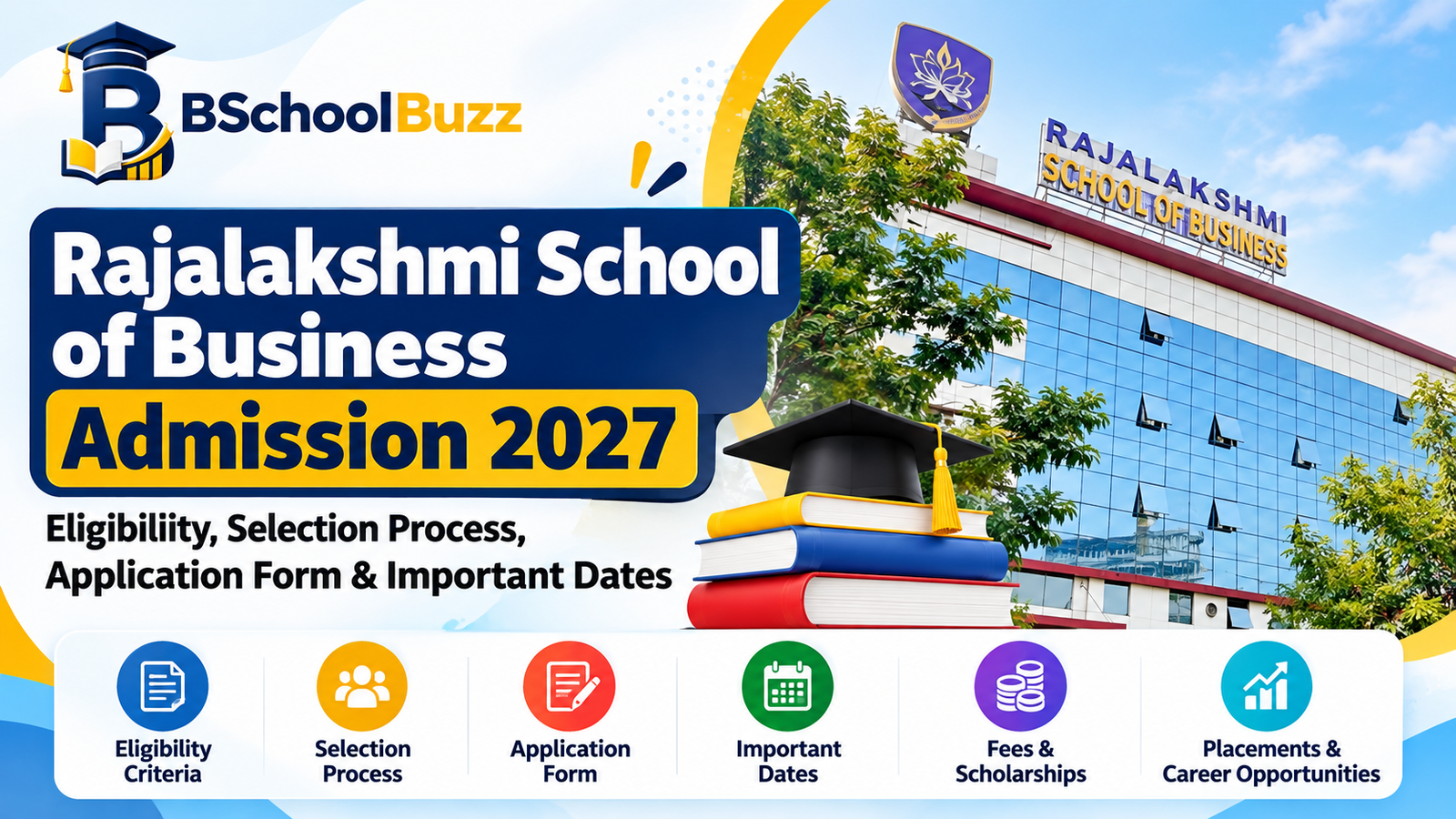
Planning to pursue a management programme in Chennai? RSB Chennai: Rajalakshmi School of Business is an option for graduates looking for a Post Graduate Diploma in Management (PGDM) with classroom learning, professional development, industry exposure and career preparation. Before applying for the 2027 admission cycle, candidates should understand the institute’s published eligibility requirements, accepted entrance examinations, selection process, fee information and programme structure.
This guide explains the major steps involved in applying to Rajalakshmi School of Business (RSB) for 2027. It also separates published institutional information from details that still require confirmation for the upcoming admission cycle. This distinction matters because entrance requirements, application deadlines, fees and selection procedures may change between academic years.
The institute’s official website describes its flagship PGDM as a two-year programme and lists entrance examinations including CAT, XAT, MAT, CMAT, GMAT, ATMA and TANCET on its admission-process page. Its PGDM page also outlines the basic graduation eligibility requirements. Candidates should check the latest admission instructions before relying on any previous-year information. Official PGDM page · Official admission-process page
Table of Contents
Rajalakshmi School of Business Admission 2027: Overview
Important Dates for RSB Chennai Admission 2027
Courses and PGDM Programme Structure
Eligibility Criteria for Admission
Entrance Exams Accepted by RSB Chennai
RSB Chennai Application Form 2027: How to Apply
Selection Process and Personal Interview Preparation
Documents Required for Admission
Rajalakshmi School of Business Fees
Scholarships and Education Loan Planning
PGDM Curriculum, Specialisations and Learning Experience
Placements and Career Opportunities
How to Evaluate RSB Chennai Before Applying
Common Application Mistakes to Avoid
Official Verification Checklist for 2027 Applicants
Conclusion
About MBA Compass
Related Search Keywords
1. Rajalakshmi School of Business Admission 2027: Overview
Rajalakshmi School of Business is a management institute in the Chennai region that offers a PGDM programme. Its official website describes the programme as a two-year management course and highlights core business subjects, professional-development training, internships, corporate interaction and mentorship.
For applicants, the first step is to identify the exact programme being offered for the 2027 intake and review the current admission conditions. The institute’s website provides information about the PGDM, its admission process and fee payments, but candidates should not assume that every published fee date or earlier admission condition automatically applies to the next intake.
RSB Chennai admission highlights
| Particular | Information |
|---|---|
| Institution name | Rajalakshmi School of Business (RSB) |
| Location | Chennai region, Tamil Nadu |
| Main programme described on the official website | Post Graduate Diploma in Management (PGDM) |
| Programme duration | Two years, as described on the official programme page |
| Basic graduation eligibility | A recognised undergraduate degree with the prescribed minimum marks |
| Entrance examinations listed by the institute | CAT, XAT, MAT, CMAT, GMAT, ATMA and TANCET |
| Selection process | Applicants should verify the current cycle’s complete selection stages directly with the institute |
| 2027 application deadline | Must be confirmed through the current admission notification |
| 2027 application fee | Must be confirmed before payment |
| Official website | rsb.edu.in |
| Admissions email published on the official website | admissions@rsb.edu.in |
| Admissions contact published on the official website | +91 90251 03674 |
The institute’s official PGDM and admissions pages support the programme, eligibility and entrance-exam information above. The website’s published contact details are useful starting points for questions about the 2027 intake. RSB PGDM · RSB admissions
What should applicants understand first?
Before filling out an application, establish four things:
Academic eligibility: Check whether your graduation marks and qualification meet the current criteria.
Entrance-exam requirement: Confirm which examinations and score validity periods the institute accepts for the 2027 intake.
Selection stages: Ask whether the current process includes a personal interview, group discussion, written assessment or any additional evaluation.
Financial commitment: Obtain the complete fee schedule and clarify whether the amount includes the caution deposit, hostel, transport and other charges.
These checks help applicants avoid making decisions based on outdated admission pages, third-party summaries or assumptions about the next academic year.
2. Important Dates for RSB Chennai Admission 2027
Admission dates are among the most important details for candidates researching Rajalakshmi School of Business admission 2027. Missing an application deadline or delaying an entrance-exam registration can affect a candidate’s options, even when the candidate meets the academic eligibility criteria.
However, an important distinction is necessary: a confirmed 2027 application opening date, last date to apply, interview schedule and final admission deadline should come from the institute’s current admission notification. Dates published for a previous intake should not be copied into a 2027 schedule without confirmation.
Expected admission timeline: what to monitor
| Admission stage | What the candidate should check | Status for the 2027 intake |
|---|---|---|
| Application opening | When the online application becomes available | Confirm with RSB |
| Entrance-exam registration | Registration and examination dates for the chosen test | Check the relevant exam authority |
| Application submission | Final date for submitting the RSB application | Confirm with RSB |
| Application screening | How and when shortlisted candidates are contacted | Confirm with RSB |
| Interview or other assessment | Date, format and required preparation | Confirm with RSB |
| Offer of admission | Offer-release schedule and acceptance deadline | Confirm with RSB |
| Fee payment | Amount, payment stages and deadlines | Obtain the current fee schedule |
| Programme commencement | Orientation and class-start date | Confirm with RSB |
This table is a planning checklist, not a list of officially announced 2027 dates.
How to track the admission schedule
1. Check the official admission page regularly. Use the RSB admission-process page and the official application page as starting points. If a page still displays dates from an earlier intake, ask the admissions team whether a revised notice has been issued.
2. Track your entrance examination separately. CAT, XAT, MAT, CMAT, GMAT, ATMA and TANCET have their own registration procedures and examination calendars. The accepted tests and applicable score rules should be reconfirmed with RSB for 2027.
3. Keep a personal deadline sheet. Record the test registration deadline, examination date, result date, RSB application deadline, interview date and fee-payment deadline. Update the sheet only when the information has been verified.
4. Save application records. Keep a copy of the submitted form, payment receipt, application reference number and any communication from the institute. These records can help resolve administrative questions.
Should you apply early?
Applying early can give you more time to organise documents, address application errors and prepare for an interview. It does not guarantee admission, a scholarship or a placement outcome. Candidates should follow the actual deadline and selection rules published for their intake rather than assuming that early submission guarantees an advantage.
3. Courses and PGDM Programme Structure
The official RSB website presents its flagship offering as a regular two-year PGDM. The programme is designed to introduce students to several functional areas of business before allowing them to develop deeper knowledge through elective subjects.
A PGDM is a postgraduate diploma rather than an MBA degree awarded directly by a university. Applicants comparing the two qualifications should examine the programme’s approval status, recognition and any applicable equivalence arrangements instead of treating the labels as automatically interchangeable.
What does the RSB PGDM cover?
According to the institute’s programme page, the curriculum includes core management subjects, career-enhancement training, industry exposure, internship experience and elective choices. The programme page describes the following broad learning components. Official PGDM programme structure
| Learning component | What students may study or experience |
|---|---|
| Foundation learning | Principles of management, financial accounting fundamentals and foundation mathematics |
| Marketing | Marketing management, consumer behaviour, brand management and related subjects |
| Finance | Financial management, capital budgeting, corporate valuation and other finance-related electives |
| Human resources | Organisational behaviour, human resource management and people-development subjects |
| Operations | Supply chain, operations management and quantitative techniques |
| Business analytics | Data analysis, visualisation, forecasting and selected analytics electives |
| Professional development | Communication, presentation, personality development and career-readiness activities |
| Industry exposure | Guest lectures, industrial visits and practical business discussions |
| Internship | The programme page describes an internship at the end of the first year |
| Mentorship | A corporate mentorship programme and faculty mentoring are described by the institute |
The exact curriculum, elective availability and course requirements should be checked against the prospectus applicable to the 2027–29 batch.
Why the curriculum matters
Management education is not limited to learning business terminology. Students need to interpret data, understand customer behaviour, evaluate costs, communicate decisions and work with people from different functions.
For example, a marketing student may need to analyse customer segments and campaign results. A finance-focused student may evaluate budgets, financial statements and investment decisions. An operations-oriented student may study inventory, supply chains and process efficiency. A human-resources student may examine recruitment, performance management and employee development.
The value of a programme therefore depends on the balance between foundational subjects, practical assignments, faculty support, internship opportunities and the depth of elective options. Applicants should ask how the curriculum is delivered and how students are assessed, rather than choosing a programme solely because a particular specialisation appears in a brochure.
How to choose an area of specialisation
RSB’s programme page lists elective areas including Marketing, Finance, Operations, Organisational Behaviour/Human Resources and Business Analytics-related subjects. The electives available to an individual batch should be confirmed with the institute.
Before choosing an area, consider:
Your undergraduate background and strongest academic subjects.
The type of work you want to pursue after graduation.
Whether you prefer quantitative analysis, customer-facing work, process management or people-related responsibilities.
The software, analytical tools and practical skills employers in your target field expect.
The availability of relevant electives, projects and internships in the actual academic year.
A specialisation can help you develop a career direction, but it does not guarantee a particular job title or salary. Recruitment outcomes also depend on your skills, internship performance, communication, prior experience and the roles available during your graduating year.
4. Eligibility Criteria for Rajalakshmi School of Business Admission 2027
Eligibility is one of the first things to verify before applying. The institute’s official PGDM page states that candidates should hold an undergraduate degree recognised by the University Grants Commission (UGC), with a minimum of 50% aggregate marks or equivalent CGPA. It also states a 45% threshold for SC/ST candidates and says final-year undergraduate students may apply, subject to submitting their final graduation certificate and marksheet. Official eligibility information
These are the criteria published on the institute’s current PGDM page. Candidates must confirm that the same rules apply to the 2027 intake and ask the admissions team how equivalent CGPA, pending results and category documentation are evaluated.
Basic eligibility at a glance
| Eligibility factor | Requirement shown on the official PGDM page | What applicants should verify |
|---|---|---|
| Educational qualification | Undergraduate degree from a UGC-recognised institution | Whether the applicant’s exact qualification is accepted |
| General minimum marks | 50% aggregate or equivalent CGPA | Calculation method and treatment of backlogs |
| SC/ST minimum marks | 45%, as stated on the page | Required category documentation and applicable rules |
| Final-year students | May apply, subject to final degree certificate and marksheet submission | The deadline for providing final results |
| Entrance examination | Valid score from an examination accepted by RSB | Accepted tests, score validity and any minimum score |
| Work experience | Not stated as a mandatory requirement on the cited eligibility page | Whether any experience is preferred or required for the current cycle |
Can final-year students apply?
The official PGDM page says final-year undergraduate students are eligible to apply, subject to submission of their final graduation certificate and marksheet. This gives students who are completing their degree an opportunity to begin the application process before their final results are available.
However, applying as a final-year student does not remove the requirement to complete the degree. Ask the admissions team for the deadline by which the final marksheet, degree certificate or provisional certificate must be submitted. Also clarify what happens if the university delays results or if the final aggregate is below the required threshold.
How should aggregate marks be calculated?
Applicants should use the method prescribed by their university and the institute’s admission rules. Do not assume that the last-semester percentage, major-subject percentage or CGPA conversion is sufficient when the eligibility requirement refers to aggregate marks.
If your university issues a CGPA rather than a percentage, ask RSB which conversion formula or official conversion certificate it requires. Keep the university’s grading policy available in case the admissions team requests it.
What if your graduation percentage is close to the minimum?
If your marks are close to the stated threshold, verify the calculation before paying an application fee. Check whether all semesters are included, whether the university has issued a formal percentage conversion and whether any revaluation or supplementary result changes your final aggregate.
Applicants should not assume that strong entrance-exam performance automatically waives an academic eligibility condition. Eligibility and selection are separate: eligibility determines whether a candidate meets the basic requirements, while selection determines how an eligible candidate is assessed for admission.
Is work experience required?
The cited PGDM eligibility page does not list work experience as a mandatory requirement. That should not be interpreted as a guarantee that the 2027 admission policy will remain unchanged. Fresh graduates should confirm whether they can apply without experience, while working applicants should ask whether their experience is considered during evaluation.
5. Entrance Exams Accepted by RSB Chennai
The institute’s official admission-process page lists CAT, XAT, MAT, CMAT, GMAT, ATMA and TANCET among the entrance examinations applicants should consider. The page states that entrance-exam scores are used as an indicator of academic and analytical ability. Official admission-process page
Because examination acceptance can change by intake, applicants should confirm the exact list for 2027 before deciding which test to take.
Entrance exams listed by RSB
| Examination | General description | What applicants should do |
|---|---|---|
| CAT | Common Admission Test | Check the official CAT notification and RSB’s score-acceptance rules |
| XAT | Xavier Aptitude Test | Confirm the relevant examination year and accepted score |
| MAT | Management Aptitude Test | Check the applicable MAT test format and score validity |
| CMAT | Common Management Admission Test | Review the official examination notice and result details |
| GMAT | Graduate Management Admission Test | Ask RSB which GMAT score format and validity period it accepts |
| ATMA | AIMS Test for Management Admissions | Check the applicable ATMA test date and score requirements |
| TANCET | Tamil Nadu Common Entrance Test | Confirm whether the relevant TANCET score is accepted for the 2027 PGDM intake |
This table identifies examinations listed by the institute; it does not establish that all scores will be accepted under every 2027 admission route.
Which entrance examination should you choose?
Start with your existing preparation, the dates of upcoming tests, the examination syllabus and the admission requirements of all the institutes on your shortlist. If you are applying to several business schools, a test accepted by multiple target institutions may help you organise your preparation more efficiently.
Do not select an examination merely because it appears easier or because another candidate used it. Compare the exam format, registration deadlines, test availability and your strengths in quantitative aptitude, reasoning, verbal ability and data interpretation.
Does RSB publish a fixed cutoff?
The cited admission pages do not establish a confirmed 2027 cutoff for each entrance examination. Candidates should therefore avoid treating an unofficial cutoff estimate as a guaranteed minimum or admission promise.
A useful question for the admissions team is whether RSB has a minimum qualifying score, whether candidates are compared using percentiles or raw scores, and how entrance results are considered alongside academic records and interviews.
How to prepare for the entrance exam
A practical preparation plan includes:
Review the official syllabus and format. Use the examination authority’s current information rather than an old coaching handout.
Take a diagnostic test. Identify weak areas before setting a study schedule.
Practise consistently. Divide time between quantitative aptitude, reasoning, verbal ability and any other sections required by the chosen test.
Analyse mock tests. Look beyond the total score: identify incorrect answers, time-consuming questions and recurring errors.
Plan around deadlines. Keep the examination date, application deadline and result timeline together.
Save score records. Download the official scorecard and retain any details needed for the RSB application.
A strong test score can support an application, but it should be considered alongside eligibility, interview preparation and the overall selection policy.
6. RSB Chennai Application Form 2027: How to Apply
The official RSB website has an application page for the PGDM programme. Applicants can use the official application page as the starting point for checking whether applications for their intended intake are open.
The steps below provide a practical application checklist. They should not be interpreted as confirmation that every screen, fee or document requirement will be identical in the 2027 cycle.
Step 1: Check the latest admission notice
Before entering personal details, verify that the application is intended for the correct programme and academic year. Read the eligibility criteria, accepted entrance exams, application fee, selection stages and deadline.
If the page does not clearly identify the 2027 intake, contact the admissions team and ask for the current application link or prospectus.
Step 2: Prepare your information
Keep your educational details, entrance-exam information and contact details ready. Enter your name and date of birth consistently with your official documents. Use an email address and mobile number that you check regularly because admission communications may be sent through those channels.
Step 3: Complete the application carefully
Fill in the requested information accurately. Review your educational history, marks, category information where applicable, entrance-exam details and communication address before submission.
Do not guess an examination score or graduation percentage. If results are pending, follow the form’s instructions for final-year applicants.
Step 4: Upload the required documents
Upload documents in the specified file type, size and format. Ensure that scans are readable and that the information matches the details entered in the form. If the application asks for a scorecard or marksheet that has not yet been issued, contact RSB for instructions rather than uploading an unrelated file.
Step 5: Confirm the application fee
The current application fee for the 2027 intake must be confirmed directly with RSB. Do not assume that a fee mentioned in a previous-year article or another website applies to the new admission cycle.
Pay only through the method authorised by the institute. Keep the transaction reference, payment confirmation and application receipt.
Step 6: Save the submitted form
Download or print the completed application if the portal provides that option. Keep a copy of the application number, payment receipt and submitted documents. These records are useful if you need to ask about your application status.
Step 7: Monitor communication from the institute
Check your registered email account and phone regularly. Review spam or junk folders as well. Respond to requests for clarification within the stated deadline, and use the contact details published on the official website if you need to verify a message.
Online versus offline application
The current official application page should determine which submission modes are available for the 2027 intake. Do not assume that an offline application, demand draft or payment method used in a previous year is still permitted. If the institute offers more than one route, ask which route is recommended and whether the same deadline and fee apply to both.
7. Selection Process and Personal Interview Preparation
The selection process is a central part of Rajalakshmi School of Business admission 2027. The institute’s official pages describe a structured management programme and entrance-exam requirements. The exact 2027 selection stages, weightage and assessment format should be confirmed with the admissions team before applicants make assumptions.
Some previous admission information and secondary coverage refer to personal interviews or other assessments. Applicants should not treat an older process as a definitive statement of the next cycle’s rules.
Selection stages to confirm
| Stage | What it may involve | What to verify with RSB |
|---|---|---|
| Application screening | Checking submitted details and eligibility | Required documents and shortlisting criteria |
| Entrance-score review | Reviewing an accepted examination score | Minimum score, score validity and relative weightage |
| Personal interview | Discussion of academic background, motivation and career plans | Whether it is compulsory and how it is conducted |
| Group discussion or other assessment | Evaluation of communication, reasoning or teamwork, if used | Whether this stage applies to the 2027 intake |
| Final decision | Consideration of the application under the institute’s selection rules | Weightage, offer deadline and waitlist process |
| Fee payment and enrolment | Acceptance of the offer and completion of formalities | Payment schedule, refund conditions and required documents |
How to prepare for a personal interview
If an interview is part of the current process, prepare to explain your academic background, career interests and reasons for choosing management education. Avoid memorising long answers that do not sound like your own experience.
Prepare for questions such as:
Why do you want to pursue a PGDM?
Why are you considering Rajalakshmi School of Business?
Which management function interests you, and why?
What did you learn from your undergraduate course, internship or work experience?
What are your short-term and long-term career goals?
What business or economic development have you followed recently?
Describe a challenge you faced and how you responded.
What skills do you want to develop during the programme?
Your answers should be specific. For example, instead of saying that you want a management qualification because it offers many opportunities, explain which role or industry interests you and how the programme’s curriculum could support that direction.
How to prepare for a group discussion
If RSB confirms a group discussion for your intake, practise presenting a clear argument, listening to opposing views and supporting your points with relevant examples. A useful contribution is not necessarily the longest contribution. Candidates should demonstrate structured thinking, respectful communication and the ability to move a discussion forward.
Possible practice themes include digital payments, artificial intelligence in business, sustainability, entrepreneurship, employment trends and the role of data in management. These are practice themes, not an official list of RSB interview or group-discussion topics.
What matters beyond entrance scores?
Applicants should ask RSB how it evaluates the complete application. Depending on the official policy, the assessment may consider academic performance, test results, interview performance and other specified factors. Do not assume that any single factor guarantees admission.
8. Documents Required for Admission
Prepare a document folder before applying. The final checklist must come from the official 2027 application instructions because requirements may vary according to a candidate’s educational background, category and application status.
Common documents to keep ready
| Document | Why it may be required |
|---|---|
| Class 10 marksheet or certificate | Verification of personal details and schooling record |
| Class 12 marksheet or certificate | Verification of higher-secondary education |
| Graduation marksheets | Assessment of undergraduate academic performance |
| Degree certificate or provisional certificate | Confirmation of degree completion |
| Entrance-exam scorecard | Verification of the accepted examination result |
| Government-issued photo ID | Identity verification |
| Recent passport-size photograph | Application and admission records |
| Signature image, if requested | Completion of the online application |
| Category certificate, where applicable | Verification of eligibility under the relevant category |
| Work-experience documents, if applicable | Verification of employment details if requested |
| Migration or transfer certificate, if required | Completion of institutional enrolment formalities |
| Payment receipt | Proof of application or admission-fee payment |
This is a preparation list, not a guarantee that every document is compulsory. The current RSB checklist takes precedence.
How to avoid document-related delays
Check that your name is consistent across your application and certificates.
Scan the complete document, including relevant seals, signatures and reverse sides where required.
Follow the portal’s file-size and file-format limits.
Keep original documents available for verification if requested.
Do not submit a fabricated certificate or altered scorecard.
Ask the admissions team how to proceed if your university has not issued a final certificate.
Final-year applicants should pay particular attention to the deadline for submitting final graduation documents. The official PGDM page specifically states that final-year candidates may apply subject to later submission of the final graduation certificate and marksheet. RSB eligibility page
9. Rajalakshmi School of Business Fees
Fees should be checked carefully before accepting an admission offer. The amount advertised for a programme may be structured as an admission payment followed by instalments, and some charges may be separate from the academic fee.
The RSB website publishes a fee-payment schedule for its PGDM programme. One schedule lists an admission payment of ₹1,75,000 followed by five instalments of ₹1,63,000 each, for a stated total of ₹9,90,000. The schedule also notes that the total includes a refundable caution deposit of ₹10,000. It displays instalment dates extending from August 2026 through December 2027. Official admission-process and fee schedule
Important: Although these dates extend into 2027, this schedule should not automatically be treated as the confirmed fee structure for every student entering in 2027. Applicants must ask the institute for the fee schedule specifically applicable to their admission offer and academic batch.
Published fee schedule: figures to clarify
| Fee component | Amount shown on the published schedule | Important clarification |
|---|---|---|
| Admission payment | ₹1,75,000 | Confirm whether this amount applies to the 2027 intake |
| First instalment | ₹1,63,000 | Published date: 5 August 2026 |
| Second instalment | ₹1,63,000 | Published date: 15 December 2026 |
| Third instalment | ₹1,63,000 | Published date: 15 April 2027 |
| Fourth instalment | ₹1,63,000 | Published date: 15 August 2027 |
| Fifth instalment | ₹1,63,000 | Published date: 15 December 2027 |
| Total shown | ₹9,90,000 | Confirm applicability to the intended batch |
| Refundable caution deposit | ₹10,000 included in the stated total | Ask about the refund conditions and timeline |
| Hostel, transport and other charges | Not established as included in the stated total | Obtain a written breakdown |
The listed amounts add up to the stated total of ₹9,90,000. The schedule’s dates and amounts are quoted as displayed on the official website, not as a promise that the same structure applies to every 2027 entrant.
What is the actual cost of studying at RSB?
The total cost of attending a management programme may include more than the academic fee. Before committing, obtain a written estimate covering:
Academic or programme fee.
Admission payment and subsequent instalments.
Refundable caution deposit and refund conditions.
Hostel charges, if accommodation is required.
Transport charges, if applicable.
Books, learning materials and personal study expenses.
Travel to campus and interview-related expenses.
Any other compulsory charges listed in the current offer.
Do not add an unverified hostel or transport amount to the published fee and present the result as an official total. Ask the institute which charges are compulsory, optional, refundable or payable separately.
Questions to ask before paying
Is the fee schedule specifically for the 2027–29 PGDM batch?
Does the admission payment form part of the total programme fee?
Is the caution deposit refundable, and under what conditions?
Are taxes or other charges additional?
What happens if a student withdraws after paying the admission amount?
Are hostel and transport fees separate?
Can instalment dates or amounts change?
Which payment methods are officially authorised?
What is the written refund and cancellation policy?
Will a formal receipt be issued for every payment?
Get answers in writing wherever possible. A fee table on a website is useful, but the current offer letter and applicable policy should govern the actual payment.
10. Scholarships and Education Loan Planning
Applicants should investigate scholarships, financial assistance and education loans before paying a non-refundable amount. The availability of a scholarship can depend on academic performance, entrance-exam results, financial circumstances, category, external sponsorship or an institute-specific policy.
The sources cited in this guide do not establish a complete, confirmed scholarship schedule for the 2027 RSB intake. Therefore, candidates should request the current scholarship policy directly rather than relying on an assumed award amount or eligibility rule.
What to ask about financial assistance
Ask whether RSB offers any merit-based scholarships, entrance-score-linked concessions, need-based assistance or other financial support for the intended batch. Confirm the application deadline, supporting documents, award conditions and whether the scholarship continues throughout the programme.
A scholarship should be treated as confirmed only after the institute communicates the award and its terms. Do not reduce your budget on the assumption that a scholarship will be granted later.
Education loans
If you plan to finance the programme through a loan, compare the total repayment obligation rather than focusing only on the initial monthly instalment. Ask the lender about interest rates, processing fees, repayment commencement, moratorium conditions, collateral requirements and any co-applicant requirements.
Before signing a loan agreement, compare the loan amount with the full cost of attendance and your expected personal expenses. Future salary is uncertain, so it is safer to assess repayment under conservative assumptions rather than relying on a best-case placement package.
Build a realistic budget
Prepare three estimates:
Minimum budget: Confirmed compulsory programme fees and essential living expenses.
Expected budget: Compulsory costs plus realistic food, travel, study and personal expenses.
Contingency budget: A reserve for unexpected costs or changes in accommodation and travel.
This approach makes it easier to compare RSB with other institutions on a like-for-like basis. Compare total programme cost, course duration, career support and outcomes—not tuition alone.
11. PGDM Curriculum, Specialisations and Learning Experience
A management programme should help students connect theory with workplace decisions. RSB’s official programme page describes a curriculum that combines core management subjects with career-enhancement training, an internship, guest lectures, industrial visits and corporate mentorship. Official programme details
Foundation learning
The institute’s programme description refers to foundation learning in principles of management, financial accounting fundamentals and mathematics. Such subjects can help students from different undergraduate backgrounds develop a shared base before moving into advanced management topics.
Students who have not studied accounting, economics or quantitative subjects recently may benefit from revising the basics before the programme begins. A foundation period is useful, but it should not replace regular preparation during the academic year.
First-year learning
The programme page describes first-year core subjects across marketing, finance and accounting, organisational behaviour, operations and quantitative techniques, economics and management information systems. It also outlines professional-development training and an internship at the end of the first year.
For students, the value of these subjects lies in understanding how business functions interact. Marketing decisions affect revenue; finance determines how resources are allocated; operations influences cost and delivery; human resources supports workforce performance; and data analysis helps managers evaluate results.
Internship experience
The official programme page describes an internship of approximately eight to ten weeks at the end of the first year. Applicants should confirm the duration, process, eligibility, evaluation method and support provided for the 2027–29 batch.
An internship can help a student test a career preference, gain workplace experience and develop examples to discuss during recruitment. However, internship availability, role quality, stipend and the possibility of a pre-placement offer should not be assumed without programme-specific confirmation.
Electives and the second year
The official curriculum page describes elective choices in areas such as Marketing, Finance, Operations, Organisational Behaviour/Human Resources and Business Analytics. It also describes a capstone project. The precise elective list, credit requirements and availability may change, so students should review the curriculum for their batch before enrolling.
Corporate and faculty mentorship
RSB describes a corporate mentorship programme and faculty mentoring. Applicants can ask how mentors are assigned, how frequently students interact with them, whether mentoring is linked to projects or internships and what support is available when students face academic difficulties.
The existence of a programme on a website is only the first point to check. Students should understand how it works in practice and what participation requires.
12. Placements and Career Opportunities
Placement information is important when evaluating a management institute, but it must be read carefully. A headline package or a placement percentage alone does not describe the experience of every student. Applicants should seek the most recent batch-specific placement report and examine how the numbers were calculated.
RSB’s official PGDM page displays promotional figures including a highest package of ₹12 lakh per annum and a recruiter count of 50 or more. The same page also refers to placement support and reports a placement percentage in its promotional material. These website figures should be treated as institutional claims displayed on the page, not as independently verified outcomes for the future 2027–29 graduating batch. RSB PGDM page
What placement information should you request?
| Placement metric | Why it matters | What to ask RSB |
|---|---|---|
| Placement percentage | Shows the proportion of eligible students placed under the report’s definition | What is the eligible-student denominator and reporting period? |
| Highest package | Indicates the top reported offer, not a typical outcome | Is it domestic or international, and what is included? |
| Average package | Gives an overall average but can be influenced by high offers | Is the mean calculated across all placed students? |
| Median package | Shows the midpoint of reported salaries and is less affected by extreme values | What was the median for the latest completed batch? |
| Number of students placed | Helps explain the scale of outcomes | How many students were eligible and how many were placed? |
| Recruiter list | Shows which organisations participated in hiring | Which organisations recruited in the latest completed season? |
| Role and sector details | Helps determine whether jobs match career interests | What roles were offered in marketing, finance, HR, operations and analytics? |
| Internship outcomes | Helps assess practical exposure before graduation | What support and reporting are provided for internships? |
How to interpret placement claims
A highest package is not the same as an average or median salary. It represents the top reported offer under the institute’s stated methodology. A placement percentage also needs context: whether it includes all students, only eligible candidates, students seeking placement or another defined group.
Ask for a batch-specific report containing the batch size, eligible candidates, number placed, salary statistics and recruitment sectors. If the institute shares only a headline number, request the underlying definition before using it to compare colleges.
Career paths after a PGDM
Depending on elective choices, skills and recruitment opportunities, management graduates may pursue roles such as:
Marketing executive or brand-related roles.
Sales and business-development positions.
Financial analysis and finance operations.
Human-resources and talent-acquisition roles.
Operations, supply-chain and process-management roles.
Business analytics and reporting roles.
Customer success and account-management positions.
Consulting or project-related roles, where candidates meet the employer’s requirements.
These are broad management career paths, not a guarantee that every role will be available through RSB placements. The actual opportunities depend on recruiters, hiring conditions, individual profiles and the requirements of each role.
Does a PGDM guarantee placement?
No programme should be evaluated on the assumption that admission automatically guarantees a job or a particular salary. Placement assistance can provide training, recruitment access and career guidance, but individual outcomes vary.
Students can strengthen their prospects by developing communication, analytical ability, practical software skills, internship experience and a clear understanding of their target roles. They should also use placement reports to assess the kinds of jobs offered rather than focusing only on the highest package.
13. How to Evaluate RSB Chennai Before Applying
Choosing a business school is a financial and career decision. RSB may suit applicants who want a management-focused programme in the Chennai region, but each candidate should assess the programme against their own academic background, career goals, budget and preferred learning environment.
Evaluate the programme, not only the brand name
Review the curriculum and ask whether it covers the business functions you want to study. Check the elective options, internship structure, teaching methods, faculty background and opportunities for practical work. If you are interested in analytics, for example, ask how much quantitative work and hands-on tool usage the curriculum includes. If you prefer marketing, ask about customer research, digital marketing, sales exposure and related projects.
Check approval and recognition
The institute’s accreditation and ranking page states that its PGDM programme is AICTE-approved. Applicants should verify the current approval and applicable programme details using the official institute information and relevant regulatory records. RSB accreditations and ranking page
Also clarify whether any claimed MBA equivalence applies to the specific qualification and purpose you have in mind. PGDM and MBA are not automatically identical in every administrative or academic context. If you plan to pursue further study or apply for a role with specific degree requirements, check the relevant institution’s or employer’s rules.
Compare total cost with career outcomes
Use a consistent comparison sheet for every institution you are considering. Record the total programme fee, accommodation costs, entrance requirements, curriculum, internship structure, placement data and location. Avoid comparing one college’s tuition fee with another college’s all-inclusive cost.
A lower fee does not automatically mean better value, and a higher fee does not guarantee a higher salary. Consider the actual learning experience and the evidence available about outcomes.
Think about location and living arrangements
The institute’s official website lists its campus address in the Chembarambakkam area on the Chennai–Bangalore Highway. Applicants should verify the precise campus location, transport arrangements and accommodation options before making travel or housing plans. Official RSB website
If you plan to live away from home, estimate rent or hostel costs, food, commuting and personal expenses. Visit the campus if practical, or request a current campus tour or student interaction before committing.
Questions to ask current students or alumni
If you can speak with current students or alumni, ask about day-to-day teaching, faculty access, assessment workload, internship support, placement preparation, hostel arrangements and the difference between advertised facilities and actual student experience.
Try to obtain perspectives from more than one person. Individual experiences can be valuable, but they may reflect a particular batch, specialisation or personal situation.
14. Common Application Mistakes to Avoid
Even eligible applicants can face delays if they overlook application instructions. Use the following checklist while preparing your RSB Chennai application.
Mistake 1: Relying on an old deadline
An earlier admission cycle’s last date may not apply to 2027. Confirm the current deadline on the official website or directly with the admissions team.
Mistake 2: Assuming all entrance exams are accepted automatically
Although the official admission page lists several examinations, the applicable tests and score-validity rules should be confirmed for the specific intake. Do not register for a test solely on the basis of an old article.
Mistake 3: Miscalculating graduation marks
If the eligibility requirement refers to aggregate marks, do not substitute a final-semester percentage or an informal CGPA conversion. Follow the institute’s stated calculation method.
Mistake 4: Submitting inconsistent personal details
Differences in spelling, date of birth or academic details can create verification problems. Review the form against your certificates before submission.
Mistake 5: Paying without understanding the fee breakdown
Ask whether the fee is for your batch, what the admission payment includes, how the caution deposit is handled and whether hostel or transport charges are additional.
Mistake 6: Treating a placement headline as a personal outcome
A highest salary or placement percentage is not a guarantee. Ask for the latest batch-specific report and understand the denominator, salary definition and reporting period.
Mistake 7: Ignoring the final-year document deadline
Final-year candidates should confirm when final results and degree documents must be submitted. Applying before graduation does not eliminate the requirement to complete the degree.
Mistake 8: Failing to save proof of submission
Keep your application copy, application number, fee receipt, entrance-exam scorecard and admission communications in one folder.
Mistake 9: Trusting unofficial payment instructions
Use only payment details confirmed by the institute through its official channels. If an instruction arrives through an unfamiliar number or email address, verify it before transferring money.
Mistake 10: Accepting an offer without reading its conditions
Before paying, review the fee schedule, refund policy, reporting date, required documents and any conditions attached to provisional admission.
15. Official Verification Checklist for 2027 Applicants
Before finalising your application, verify the following items with Rajalakshmi School of Business.
| Item to verify | Where to start | Why it matters |
|---|---|---|
| 2027 application opening and deadline | Official admission page | Prevents missed deadlines |
| Current application form | Official application page | Ensures the correct intake is selected |
| Accepted entrance exams | Admission-process page | Confirms which scores are accepted |
| Academic eligibility | Official PGDM page | Confirms marks and degree requirements |
| Selection stages | Admissions team and current prospectus | Establishes interview or other assessment requirements |
| Application fee | Current application instructions | Prevents incorrect payment |
| Programme fee | Written fee schedule for the intended batch | Supports accurate budgeting |
| Refund and cancellation rules | Current offer and policy documents | Clarifies financial risk |
| Hostel and transport charges | Admissions or administration office | Helps estimate total attendance cost |
| Placement report | Latest completed-batch report from RSB | Supports a more realistic career assessment |
| Approval and recognition | Official institute and relevant regulatory records | Helps confirm qualification status |
| Programme commencement date | Current admission notice or offer letter | Supports travel and accommodation planning |
Official contact details
The official RSB website publishes the following admissions contact information:
Email: admissions@rsb.edu.in
Mobile: +91 90251 03674
Website: https://rsb.edu.in/
Contact details and office arrangements can change. Verify the current information on the official website before sharing personal documents or making a payment.
A message you can send to admissions
You can ask the institute to confirm the most important details in a single email:
“Hello, I am interested in applying for the 2027–29 PGDM programme at Rajalakshmi School of Business. Please share the latest prospectus and confirm the eligibility criteria, accepted entrance exams, application deadline, selection stages, application fee, complete programme fee, instalment schedule, refund policy, hostel charges and the latest placement report. Please also confirm the deadline for final-year students to submit their graduation documents. Thank you.”
A written response will help you distinguish the rules for your intended batch from details published for earlier students.
Conclusion
RSB Chennai: Rajalakshmi School of Business is worth evaluating if you are looking for a PGDM programme in the Chennai region and want to compare management education, industry exposure, internships and career support. The institute’s official website provides information about its two-year PGDM, basic graduation eligibility, accepted entrance examinations and programme structure.
For the 2027 admission cycle, the most important step is to verify the current application deadline, selection stages, fee schedule and enrolment conditions directly with the institute. Do not assume that a date or fee from an earlier batch applies automatically to the next intake. Review placement statistics with their reporting definitions, calculate the full cost of attendance and compare the curriculum with your intended career path.
A well-prepared application begins with accurate documents, a suitable entrance-exam score and a clear understanding of the admission rules. Before accepting an offer, obtain the current prospectus and written fee details so you can make an informed decision.
Key Takeaways
Verify eligibility first: Check your graduation qualification, aggregate marks and any applicable category requirements.
Choose an accepted entrance exam: Confirm which test scores RSB accepts for the 2027 intake before registering.
Track dates carefully: Use the current official admission notice for application, interview and fee-payment deadlines.
Read the fee schedule closely: Confirm the programme fee, instalments, refundable deposit and additional expenses in writing.
Prepare documents early: Keep academic certificates, marksheets, entrance-exam scorecards and identification documents ready.
Understand the selection process: Ask whether the current intake requires a personal interview, group discussion or other assessment.
Assess placements realistically: Request the latest batch-specific report and distinguish the highest package from average and median salaries.
Compare curriculum and career goals: Review electives, internships, mentoring and practical learning opportunities.
Confirm recognition: Check the programme’s current approval and any equivalence requirements relevant to your plans.
Use official information before paying: Obtain the current prospectus, offer conditions and refund policy from Rajalakshmi School of Business.
Frequently Asked Questions
What is the eligibility criteria for Rajalakshmi School of Business admission 2027?
The institute’s official PGDM page specifies a UGC-recognised undergraduate degree with at least 50% aggregate marks or equivalent CGPA. It states a 45% threshold for SC/ST candidates. Applicants should confirm that these criteria apply to the 2027 intake.
Which entrance exams are accepted by RSB Chennai?
The official admission-process page lists CAT, XAT, MAT, CMAT, GMAT, ATMA and TANCET. Candidates should confirm the accepted examinations and score-validity rules for the 2027 admission cycle.
When will RSB Chennai admission 2027 applications open?
A confirmed opening date for the 2027 intake should be obtained from the institute’s current admission notification. Check the official website at https://rsb.edu.in/ or contact the admissions team.
What is the application fee for RSB admission 2027?
The application fee for the 2027 intake should be confirmed through the current application instructions. Do not rely on an application fee reported for an earlier admission cycle.
What is the total PGDM fee at Rajalakshmi School of Business?
One fee schedule published on the institute’s website lists a total of ₹9.90 lakh, including a refundable caution deposit of ₹10,000. Applicants should obtain written confirmation that this schedule applies to their intended batch and ask whether hostel, transport or other charges are additional.
Can final-year students apply to RSB Chennai?
Yes. The official PGDM page states that final-year undergraduate students may apply, subject to submitting their final graduation certificate and marksheet. Confirm the final-document submission deadline with the admissions team.
What is the selection process at Rajalakshmi School of Business?
Applicants should review the current admission instructions to confirm the exact selection stages. Ask whether entrance-exam scores, academic records, personal interviews, group discussions or other assessments are considered for the 2027 intake.
Does RSB Chennai provide placement assistance?
The institute’s official website describes placement support and career-development activities. Candidates should request the latest completed-batch placement report to understand placement percentages, salary statistics, recruiters and job roles.
What specialisations are available in the RSB PGDM programme?
The official programme page describes elective areas including Marketing, Finance, Operations, Organisational Behaviour/Human Resources and Business Analytics-related subjects. Confirm the electives offered to the 2027–29 batch before making a final decision.
How can I apply for Rajalakshmi School of Business admission 2027?
Start with the official application page at https://rsb.edu.in/apply-now/. Check that the form is for the correct admission cycle, review the eligibility criteria, submit the required information and documents, and follow the authorised payment and selection instructions.
Ask a question
Still confused? Leave your question and our team will help you.