
Quick Summary
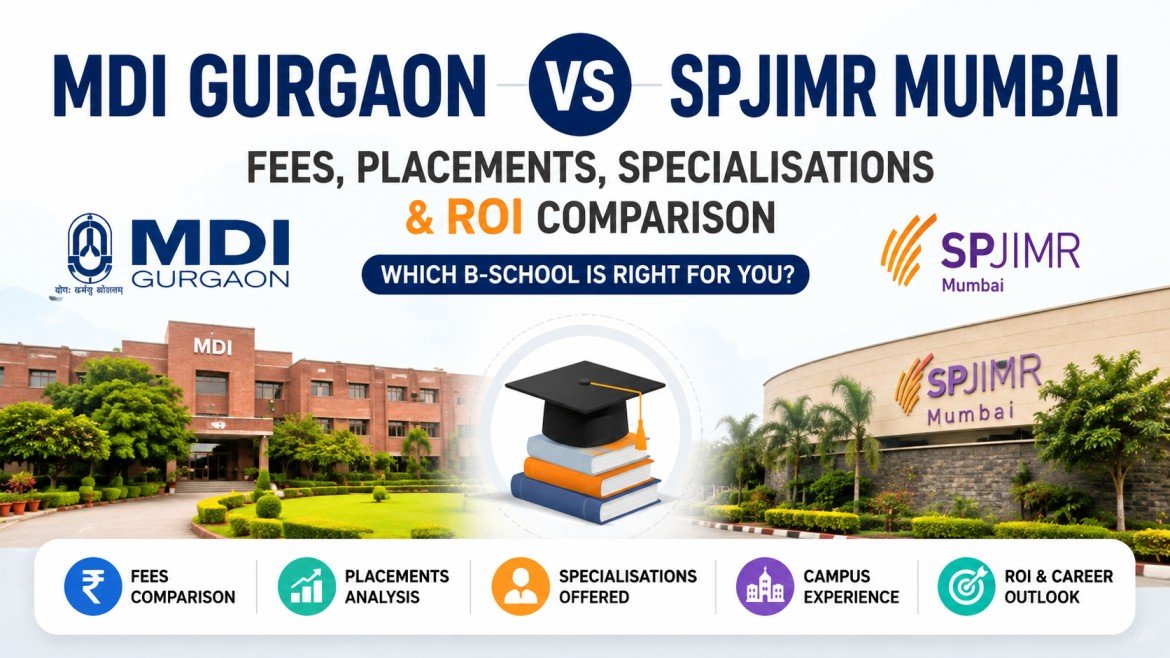
- MDI Gurgaon and SPJIMR Mumbai are leading B-schools with strong placements and corporate exposure. SPJIMR currently has an edge in recent placement averages, while MDI offers strong recruiter diversity and programme options.
Choosing between two leading Indian B-schools is rarely a simple question of which institute is “better.” The more useful question is: which institute is better for your career goals, preferred specialisation, budget and expected return on investment?
The MDI Gurgaon vs SPJIMR Mumbai comparison is particularly relevant for MBA aspirants because both institutions have strong corporate relationships, competitive admissions, residential programmes and established alumni networks. However, their academic structures, campus environments, specialisation choices, fee structures and placement outcomes are not identical.
For the latest available placement cycle, SPJIMR reported 100% final placements for its PGDM and PGDM (BM) Class of 2026, with an average CTC of ₹33.75 lakh, median CTC of ₹32.85 lakh and highest CTC of ₹75 lakh. MDI Gurgaon’s official 2024–26 final placement report recorded 157 recruiters and a highest CTC of ₹97.50 lakh, with the highest sector-specific CTCs reaching ₹63.51 lakh in technology, media and telecommunications and ₹53.58 lakh in consulting.
That makes the MDI vs SPJIMR decision more nuanced than simply comparing the highest package.
The right choice depends on what you want from an MBA.
MDI Gurgaon vs SPJIMR Mumbai at a Glance
| Factor | MDI Gurgaon | SPJIMR Mumbai |
|---|---|---|
| Institute | Management Development Institute, Gurgaon | S.P. Jain Institute of Management & Research, Mumbai |
| Location | Gurugram, Haryana | Mumbai, Maharashtra |
| Flagship programme | PGDM | PGDM |
| Programme duration | 2 years | 2 years |
| Major academic areas | Management, HRM, Business Analytics and related areas | Finance, Marketing, Information Management & Analytics, Operations & Supply Chain |
| Admission tests | CAT for Indian candidates | CAT or GMAT for the applicable admission cycle |
| 2026 placement reference | 2024–26 final placement report | 2024–26 final placement report |
| Highest CTC | ₹97.50 lakh | ₹75 lakh |
| Average CTC | Official report should be consulted for the applicable programme/metric | ₹33.75 lakh for PGDM and PGDM (BM) Class of 2026 |
| Median CTC | Official report | ₹32.85 lakh |
| Placement strength | Broad recruiter base across multiple sectors | Particularly strong in consulting, FMCG, finance, marketing and analytics |
| Campus character | Residential Gurugram B-school environment | Residential Mumbai B-school environment |
| Best suited for | Aspirants seeking broad management options and strong corporate exposure | Aspirants targeting consulting, marketing, finance, FMCG, analytics and operations |
| ROI consideration | Strong compensation relative to programme cost | Strong compensation, especially considering consulting/finance/marketing outcomes |
The comparison needs some qualification. Placement numbers are reported using different institutional methodologies, and the programmes being compared should be matched carefully. A highest CTC should never be treated as the expected salary for every graduate.
MDI vs SPJIMR: Which One Is Better?
If the decision is based primarily on the latest publicly reported placement outcomes, SPJIMR has a very strong case because its Class of 2026 reported 100% final placements, ₹33.75 lakh average CTC and ₹32.85 lakh median CTC. MDI Gurgaon also recorded a very strong placement cycle, with 157 recruiters and a ₹97.50 lakh highest CTC in its 2024–26 final placement report.
However, there is no universal winner.
Choose MDI Gurgaon if you value its programme portfolio, Gurugram corporate ecosystem, broad management exposure and the specific MDI curriculum or career track that matches your goals.
Choose SPJIMR if your target is strongly aligned with consulting, FMCG, finance, marketing, information management and analytics, or operations and supply chain.
SPJIMR's PGDM allows participants to pursue specialisations in Finance, Information Management and Analytics, Marketing, and Operations & Supply Chain. Its curriculum also provides minor options, giving students additional flexibility.
MDI, meanwhile, offers PGDM, PGDM-HRM and PGDM-Business Analytics among its full-time programmes, creating a different academic proposition. MDI's 2025–26 fact sheet also shows advanced electives and courses spanning areas such as marketing, finance, strategy, supply chain, HR and business analytics.
So the best answer to MDI vs SPJIMR is career-dependent rather than absolute.
MDI Gurgaon: What Makes the Institute Different?
MDI Gurgaon is located in Gurugram, one of India's most important corporate and business hubs. Its location gives students access to a large ecosystem of consulting firms, technology companies, financial services organisations, consumer businesses and multinational corporations.
The institute's academic offering is broader than simply a conventional general-management PGDM.
The full-time portfolio includes:
PGDM
PGDM-HRM
PGDM-Business Analytics
The academic structure also includes electives covering marketing, strategy, finance, operations, technology and analytics. MDI's current fact-sheet material lists subjects such as Brand Management, Customer Relationship Management, Behavioural Strategy, Sustainable Operations, Behavioural Finance and Business Valuation, FinTech, Gen AI for Business, Supply Chain Analytics and Financial Forecasting, among others.
This matters when comparing MDI vs SPJIMR because the two institutes do not simply provide identical MBA experiences under different names.
MDI can be attractive for a student who wants to explore multiple areas of management before narrowing down a career direction.
SPJIMR Mumbai: What Makes the Institute Different?
SPJIMR has built a distinctive identity around practice-oriented management education, non-classroom learning and a strong connection between academic learning and real business situations.
Its flagship PGDM is a two-year full-time residential programme. The institute currently lists a batch size of 240 for PGDM and 120 for PGDM (BM).
For PGDM students, the four major specialisation areas are:
Finance
Information Management and Analytics
Marketing
Operations and Supply Chain
Students can also pursue minors in areas including analytics, consulting, finance, marketing, information management and analytics, and operations and supply chain.
SPJIMR also highlights immersive experiences such as Global Fast Track, international exchange, non-classroom learning and summer internships.
For someone researching MDI vs SPJIMR, this specialisation structure is one of the most important differences to consider.
MDI vs SPJIMR Fees
Fees can significantly change the ROI calculation.
For MDI's 2026–28 PGDM, PGDM-HRM and PGDM-Business Analytics programmes, the published two-year total shown by MDI is ₹26,55,310, including tuition, boarding, lodging, learning materials, student activities, library, alumni fee and security deposit. The institute separately notes that fees may be revised with prior notice.
For SPJIMR's PGDM, the institute currently lists an indicative fee of ₹24,86,000 for Indian participants. The fee includes tuition and basic hostel/accommodation, while optional Global Fast Track and international exchange expenses are not included. SPJIMR also states that the fee is indicative and subject to revision.
MDI vs SPJIMR Fee Comparison
| Fee factor | MDI Gurgaon | SPJIMR Mumbai |
|---|---|---|
| Programme | PGDM / PGDM-HRM / PGDM-Business Analytics | PGDM |
| Published programme fee | ₹26.55 lakh | ₹24.86 lakh indicative |
| Accommodation | Included in MDI's published total | Basic hostel/accommodation included |
| Tuition | Included | Included |
| International/optional components | Depends on programme | GFT/International Exchange costs additional |
| Fee revision possibility | MDI reserves right to revise | SPJIMR states fee is indicative and subject to revision |
The difference between the published figures is not large enough to decide the college by itself.
Instead, calculate the total cost of attendance, including:
Tuition
Hostel
Food
Travel
Personal expenses
Laptop and study expenses
Opportunity cost
Loan interest
Optional international programmes
Other one-time charges
For a student taking an education loan, even a few lakh rupees can influence the payback period.
Is SPJIMR More Expensive Than MDI?
Based on the currently published figures, MDI's listed two-year PGDM-family programme total is around ₹26.55 lakh, while SPJIMR's published indicative PGDM fee for Indian participants is ₹24.86 lakh.
However, these figures should not be interpreted as a complete personal budget.
SPJIMR explicitly says that its published PGDM fee does not include expenses associated with optional Global Fast Track and International Exchange components. MDI's published fee table includes several residential and academic components.
Therefore, students should compare like-for-like costs before deciding.
MDI vs SPJIMR Placements
Placements are one of the most searched aspects of the MDI vs SPJIMR comparison.
Both institutes have strong corporate recruiter networks, but their placement profiles show different strengths.
SPJIMR Placements
SPJIMR announced 100% final placements for its PGDM and PGDM (BM) Class of 2026.
The institute reported:
100% final placements
356 participants
₹33.75 lakh average CTC
₹32.85 lakh median CTC
₹75 lakh highest CTC
46% of the batch receiving PPOs
₹39 lakh average for the top 50%
₹43.75 lakh average for the top 25%
80 participating companies
31 new recruiters
The placement report also stated that 68% of offers were at or above ₹30 lakh and 94% were at or above ₹25 lakh.
These figures provide a better picture of placement quality than the highest package alone.
A student should pay particular attention to the median CTC and distribution of offers.
MDI Gurgaon Placements
MDI's official 2024–26 final placement report recorded:
157 recruiters
189 pre-placement offers
41 maximum offers made by a single company
₹97.50 lakh highest CTC
₹80.20 lakh highest international CTC
81.90% increase in the highest CTC compared with the previous cycle's corresponding metric
34 recruiters from conglomerate, automobile, energy and logistics
40 technology, media and telecommunications recruiters
29 BFSI recruiters
24 consulting recruiters
19 FMCD/FMCG recruiters
6 e-commerce recruiters
The highest sector-level CTCs included ₹63.51 lakh in technology/media/telecommunication, ₹53.58 lakh in consulting, ₹46.43 lakh in conglomerate/automobile/energy/logistics, ₹45.86 lakh in e-commerce, ₹36 lakh in FMCD/FMCG and ₹97.50 lakh in BFSI.
This demonstrates why the MDI vs SPJIMR placements comparison cannot be reduced to one number.
MDI's highest CTC was higher in the cited placement cycles, while SPJIMR reported a particularly strong average and median CTC alongside 100% placements.
MDI vs SPJIMR Average Package
The average package is more useful than the highest package when estimating expected ROI.
SPJIMR's Class of 2026 reported an average CTC of ₹33.75 lakh and median CTC of ₹32.85 lakh.
For MDI, publicly reported third-party summaries have cited an average package around ₹29.5 lakh for the 2026 placement cycle, but students should use MDI's own final placement report as the primary reference when comparing programme-specific figures. The official report confirms the ₹97.50 lakh highest CTC and the recruiter profile, but the exact interpretation of averages depends on the report's programme and metric definitions.
This distinction is important.
A college's placement number may be presented for:
One programme
Multiple programmes
A combined batch
Domestic CTC
International CTC
A particular placement segment
Therefore, when researching MDI vs SPJIMR placements, always check the original placement report rather than relying on a comparison website.
MDI vs SPJIMR Median Package
Median salary is arguably more useful for ROI analysis than the highest salary.
At SPJIMR, the Class of 2026 median CTC was ₹32.85 lakh.
This means half of the reported CTC observations were at or above that figure and half were at or below it.
For an MBA aspirant, median CTC can answer a more practical question:
“What does a typical placement outcome look like compared with the institute's highest package?”
That is why the median should always be considered alongside the average and highest CTC.
MDI vs SPJIMR: Recruiters and Industry Exposure
Recruiter diversity is another important part of the comparison.
SPJIMR Recruiter Profile
SPJIMR's Class of 2026 placement process included recruiters across:
Consulting
FMCG
General management
BFSI
Investment banking
Private equity
Product
Technology
Analytics
E-commerce
Product marketing
Real estate
Digital marketing
Consulting accounted for 40% of all offers in the reported placement season. The institute also reported strong participation from companies such as Accenture Strategy, BCG, Deloitte, Kearney, KPMG, McKinsey, PwC and other consulting firms.
SPJIMR's FMCG ecosystem is also significant, with recruiters including Asian Paints, Colgate-Palmolive, General Mills, Godrej Consumer Products, HUL, ITC, L'Oréal, Marico, Nestlé, P&G, Pidilite and Reckitt.
For finance, the placement season included organisations such as Bank of America, Barclays, Citi, Goldman Sachs, HSBC, Morgan Stanley, Nomura and Standard Chartered.
MDI Recruiter Profile
MDI's 2024–26 final placement report recorded 157 recruiters across sectors including:
Technology
Media
Telecommunications
Consulting
BFSI
FMCG/FMCD
Conglomerates
Automobile
Energy
Logistics
E-commerce
Pharmaceutical and healthcare
The broad sector spread gives MDI students opportunities across multiple business functions and industries.
Which College Is Better for Consulting: MDI or SPJIMR?
For a student specifically targeting consulting, SPJIMR has a particularly strong recent placement signal.
Consulting represented 40% of all offers in SPJIMR's Class of 2026 placement season. Recruiters included BCG, McKinsey, Kearney, Deloitte, KPMG, PwC, Accenture Strategy and other consulting firms.
MDI also has a strong consulting ecosystem. Its 2024–26 final placement report recorded 24 consulting recruiters, with the highest consulting CTC reported at ₹53.58 lakh.
If consulting is your primary objective, compare:
Consulting recruiter count
Role quality
Strategy versus implementation roles
PPO opportunities
Average and median compensation
Alumni presence
Your own CAT/GMAT profile
Internship performance
On recent placement evidence alone, SPJIMR has a very compelling consulting profile.
Which College Is Better for Finance: MDI or SPJIMR?
SPJIMR is especially attractive for finance aspirants because Finance is one of its four major PGDM specialisations. Its 2026 placement season included recruiters from banking, investment banking and related financial services.
The Finance cohort saw participation from organisations including Bank of America, Barclays, Citi, Edelweiss Alternatives, Goldman Sachs, HSBC, Kotak Bank, Morgan Stanley, Nomura and Standard Chartered.
MDI also provides strong finance exposure through its PGDM curriculum and electives, including areas such as behavioural finance, business valuation, project and structured finance, FinTech and sustainable finance.
For a pure finance career, SPJIMR may have the clearer specialisation identity, while MDI remains a strong option.
Which College Is Better for Marketing: MDI or SPJIMR?
Both are strong choices for marketing.
SPJIMR has a particularly established marketing ecosystem. Marketing is one of its flagship PGDM specialisations, and the institute highlights its marketing specialisation as a major part of its programme.
The Class of 2026 placement season included major FMCG companies such as HUL, ITC, Marico, P&G, Nestlé, L'Oréal, Colgate-Palmolive, Asian Paints, Reckitt and others.
MDI also offers extensive marketing coursework, including brand management, customer relationship management, digital marketing-related subjects and marketing for technology products and platforms.
Students targeting FMCG, brand management, sales and marketing should examine both institutes carefully.
Which College Is Better for Business Analytics?
This is an area where the MDI vs SPJIMR comparison becomes particularly interesting.
MDI has a dedicated PGDM-Business Analytics programme, giving analytics a distinct academic identity within its portfolio. Its current academic material includes courses such as marketing analytics, HR analytics, financial forecasting, supply chain analytics, advanced mathematical modelling, applied econometrics and business storytelling using data.
SPJIMR's Information Management and Analytics specialisation combines technology, analytics and management. The institute describes it as an area designed to develop managers who can connect business requirements with technology and analytical insights.
SPJIMR's 2026 placements also included product, technology and analytics roles, with recruiters such as American Express, GE Vernova, IDFC First Bank and MakeMyTrip among those listed by the institute.
If you want a programme explicitly branded around business analytics, MDI deserves serious consideration.
If you want analytics integrated into a broader management specialisation ecosystem, SPJIMR is also compelling.
Which College Is Better for Operations and Supply Chain?
SPJIMR has a dedicated Operations and Supply Chain specialisation in its PGDM. The curriculum covers areas such as sourcing, procurement, manufacturing, transportation, inventory management, warehousing and customer service.
MDI also offers substantial operations and supply-chain coursework. Its current academic materials include sustainable operations, supply chain analytics, supply chain management and distribution/logistics-related subjects.
For a student specifically interested in operations, supply chain, manufacturing or procurement, SPJIMR's formal specialisation structure may make the choice more straightforward.
MDI vs SPJIMR Campus and Location
Location affects the MBA experience more than many applicants initially expect.
MDI Gurgaon
MDI is located in Gurugram, a major corporate hub adjacent to Delhi. The area has a large concentration of consulting, technology, finance, consumer, telecom and multinational companies.
This can be valuable for:
Corporate interactions
Guest lectures
Networking
Internships
Business events
Career opportunities
The residential campus also creates an immersive student environment.
SPJIMR Mumbai
SPJIMR is located at the Bharatiya Vidya Bhavan campus in Andheri West, Mumbai. The institute's location places students within India's financial and commercial capital.
Mumbai is particularly relevant for careers in:
Finance
Investment banking
Consulting
FMCG
Media
Marketing
Consumer businesses
Corporate headquarters
For students interested in financial services or consumer-facing businesses, the Mumbai ecosystem can be an additional advantage.
MDI vs SPJIMR Campus Life
Campus experience is subjective.
MDI's Gurugram setting provides a residential management-school atmosphere while being close to Delhi-NCR's corporate ecosystem.
SPJIMR offers a residential environment inside Mumbai, combined with its emphasis on non-classroom learning and immersive experiences.
The better campus is therefore a personal decision.
Students who prefer a relatively self-contained residential B-school environment may like MDI's setting.
Students who want the Mumbai ecosystem and SPJIMR's distinctive non-classroom-learning culture may prefer SPJIMR.
MDI vs SPJIMR Curriculum
Curriculum is one of the most important differences.
SPJIMR's PGDM begins with broad management fundamentals and then gives students the opportunity to specialise. The institute currently identifies four major areas: Finance, Information Management and Analytics, Marketing, and Operations & Supply Chain.
The institute also allows students to choose a minor, creating additional academic flexibility.
MDI's programme structure provides exposure to a broad set of management disciplines, while its programme portfolio includes specialised tracks such as HRM and Business Analytics.
This means your choice should start with a question:
Do I want a broad management programme with MDI's specific programme options, or do I want SPJIMR's specialisation-driven PGDM structure?
MDI vs SPJIMR Admission Process
Admission requirements can change between admission cycles, so applicants should always verify the official admissions page for the relevant intake.
For MDI's 2026 admissions, the institute states that Indian candidates use CAT scores for shortlisting and cannot apply on the basis of GMAT scores for the applicable programmes.
For SPJIMR's 2026–28 PGDM and PGDM (BM) admissions, the institute stated that applicants could submit CAT 2025 or an applicable GMAT score. Final-year undergraduate students were also eligible, and prior work experience was not mandatory.
The exact admissions rules, deadlines and testing requirements should always be checked against the official admission notification for your intake.
MDI vs SPJIMR: CAT Requirement
CAT is highly relevant for both institutions, but the role of the exam differs depending on the programme and applicant category.
MDI explicitly states that it uses CAT scores for Indian candidates for shortlisting.
SPJIMR's 2026–28 PGDM admissions accepted CAT 2025 or qualifying GMAT scores according to the institute's published admission information.
Therefore, students should not rely on an old cutoff article when planning applications.
A better approach is to check:
Current admission notification
Exam accepted
Sectional requirements
Overall requirements
Academic criteria
Work-experience rules
Interview process
Programme-specific eligibility
MDI vs SPJIMR: Does Work Experience Matter?
Neither institute should be treated as a school that exclusively admits experienced professionals.
SPJIMR's 2026–28 PGDM/PGDM (BM) announcement specifically stated that work experience was not mandatory and that recent graduates and professionals with up to five years of experience could apply.
This makes SPJIMR accessible to both fresh graduates and candidates with professional experience, subject to the full selection criteria.
MDI's selection process considers multiple factors, and its published admission information highlights elements such as CAT performance, academic merit, work experience and diversity-related factors depending on the programme.
The practical lesson is simple: do not decide whether to apply based only on work experience.
MDI vs SPJIMR: Which Has Better ROI?
ROI is not simply:
Placement package ÷ fees
A more realistic MBA ROI calculation should consider:
Net financial benefit = post-MBA compensation − education cost − financing cost − opportunity cost
For example, two students may pay approximately ₹25–27 lakh for their programme, but their financial outcomes can differ depending on:
Loan amount
Interest rate
Existing savings
Lost salary during two years
Placement package
Variable pay
Location
Rent after graduation
Career progression
Salary growth
Role quality
SPJIMR's Class of 2026 reported an average CTC of ₹33.75 lakh and median CTC of ₹32.85 lakh against a published indicative PGDM fee of ₹24.86 lakh for Indian participants.
That is a strong headline ROI picture, although CTC is not the same as take-home salary.
MDI's published PGDM-family programme fee for the 2026–28 intake is ₹26.55 lakh, while its latest final placement report records a ₹97.50 lakh highest CTC.
Again, the highest CTC should not be used as the expected salary for every student.
How to Calculate MDI vs SPJIMR ROI
Suppose a student takes an education loan of ₹20 lakh.
The actual financial burden includes the principal plus interest.
Now compare that with a student who pays a larger portion from savings.
Their ROI will be different even if they receive exactly the same placement package.
Students should therefore calculate:
Total investment
= tuition + accommodation + living costs + loan interest + opportunity cost
Annual post-MBA income
= fixed salary + realistic variable compensation
Payback period
= total investment ÷ annual incremental income
The word “incremental” matters.
If a candidate was earning ₹8 lakh before an MBA and earns ₹30 lakh after the MBA, the MBA's economic benefit is not the entire ₹30 lakh.
It is closer to the additional income generated because of the qualification, after accounting for taxes, costs and financing.
MDI vs SPJIMR: Highest Package vs Average Package
This is one of the biggest mistakes MBA applicants make.
A ₹75 lakh or ₹97.5 lakh highest package can be impressive, but it does not tell you what most students earned.
For SPJIMR, the institute provides a much more useful distribution:
Highest CTC: ₹75 lakh
Average CTC: ₹33.75 lakh
Median CTC: ₹32.85 lakh
Top 50% average: ₹39 lakh
Top 25% average: ₹43.75 lakh
68% of offers at ₹30 lakh or above
94% of offers at ₹25 lakh or above
This gives applicants a better understanding of placement distribution.
For MDI, the official final placement report provides extensive recruiter and sector data, including the ₹97.50 lakh highest CTC and sector-wise highest CTCs.
When evaluating MDI vs SPJIMR ROI, use as many distribution metrics as possible.
MDI vs SPJIMR: PPO Opportunities
Pre-placement offers can be a major advantage because they allow students to convert internship performance into a final job before the final placement process.
SPJIMR reported that 46% of its Class of 2026 batch received PPOs.
MDI's latest final placement report records 189 pre-placement offers, with the placement overview also identifying 157 recruiters.
However, the numbers are not directly comparable without knowing the exact denominator and reporting methodology.
The lesson is that applicants should investigate internship conversion rates and PPO distribution rather than simply counting PPOs.
MDI vs SPJIMR for Freshers
Both schools can work for fresh graduates.
For a fresher, the most important factors are:
Academic record
Entrance-test performance
Interview performance
Communication
Internship or project exposure
Leadership experience
Extracurricular activities
Career clarity
Specialisation fit
SPJIMR explicitly states that work experience is not mandatory for its PGDM and PGDM (BM) admissions.
Therefore, a fresher should not assume that SPJIMR is only for experienced candidates.
MDI also evaluates a combination of academic and profile-related factors, making the overall application more important than a single parameter.
MDI vs SPJIMR for Experienced Professionals
Professionals with work experience may benefit from both institutes, but the preferred choice can depend heavily on career direction.
For example:
A technology professional moving into consulting may value SPJIMR's consulting ecosystem.
A marketing professional seeking FMCG or brand management may find SPJIMR highly relevant.
A professional targeting analytics may compare MDI's Business Analytics option with SPJIMR's Information Management and Analytics specialisation.
A professional seeking broader management exposure may compare the overall PGDM experience at both schools.
Work experience is not automatically an advantage unless you can explain how it connects to your post-MBA goals.
MDI vs SPJIMR for International Opportunities
International exposure is increasingly important for MBA candidates.
SPJIMR's PGDM includes international opportunities such as Global Fast Track and International Exchange.
MDI also maintains international academic connections and global programmes, with its current international fact-sheet material reflecting a broad course and exchange ecosystem.
However, international exposure should be evaluated based on:
Partner schools
Duration
Cost
Academic credit
Number of students participating
Financial support
Career relevance
An “international opportunity” is not automatically valuable unless it contributes meaningfully to your academic or professional objectives.
MDI vs SPJIMR Alumni Network
Alumni strength is difficult to reduce to a single number.
Both institutions have established alumni communities across consulting, finance, FMCG, technology, operations, entrepreneurship and general management.
The practical question is not simply:
“Which college has more alumni?”
Instead ask:
“Which college's alumni are concentrated in the careers I want?”
If your goal is consulting, search alumni on professional networks by:
Institute
Consulting company
Role
Graduation year
If your goal is investment banking, do the same.
If your goal is FMCG marketing, search for alumni in:
HUL
ITC
P&G
Nestlé
Marico
Asian Paints
Colgate-Palmolive
L'Oréal
This provides more useful information than a generic alumni count.
MDI vs SPJIMR for FMCG Careers
SPJIMR has a particularly strong FMCG placement profile.
Its 2026 placement report lists recruiters including Asian Paints, Colgate-Palmolive, General Mills, Godrej Consumer Products, HUL, ITC, L'Oréal, Marico, Mondelēz, Nestlé, P&G, Pidilite and Reckitt.
For a student targeting brand management, sales, category management or consumer marketing, this is a major consideration.
MDI also has strong FMCG/FMCD recruiter participation. Its 2024–26 final placement report recorded 19 recruiters in the FMCD/FMCG category.
Both are therefore credible options, but SPJIMR's recent FMCG placement evidence is particularly notable.
MDI vs SPJIMR for Technology and Analytics
Technology-oriented MBA careers are becoming increasingly diverse.
Students are now targeting:
Product management
Business analytics
Data analytics
Technology consulting
Digital transformation
Product marketing
Business intelligence
AI strategy
MDI's Business Analytics programme is directly relevant to this trend, while its current curriculum includes analytics and technology-oriented electives.
SPJIMR's Information Management and Analytics specialisation is also designed around the intersection of management, technology and analytics.
Its Class of 2026 placement season included product, technology and analytics recruiters such as American Express, GE Vernova, IDFC First Bank and MakeMyTrip.
For technology professionals, both institutes deserve consideration.
MDI vs SPJIMR for HR
This comparison is different because MDI has a dedicated PGDM-HRM programme.
MDI's HR programme includes specialised areas such as strategic HRM, talent management, coaching and counselling, leadership and managerial effectiveness, employer branding and international HRM.
SPJIMR's flagship PGDM does not position HR as one of its four primary PGDM specialisations; its major areas are Finance, Information Management and Analytics, Marketing, and Operations & Supply Chain.
Therefore, if HR is your clear career objective, MDI deserves particularly strong consideration.
MDI vs SPJIMR: Student Profile
The student peer group influences an MBA experience substantially.
A strong peer group can provide:
Better classroom discussions
Industry knowledge
Networking
Case competition partners
Entrepreneurship opportunities
Internship referrals
Long-term professional connections
SPJIMR's Class of 2026 included 356 participants across PGDM and PGDM (BM) placement reporting.
The current SPJIMR programme page lists PGDM's batch size at 240 and PGDM (BM)'s at 120.
When comparing student profiles, look beyond average CAT scores and examine academic diversity, work experience, undergraduate backgrounds and career preferences.
MDI vs SPJIMR: Learning Style
This is an underrated factor.
Some students learn best through lectures, cases and examinations.
Others learn more effectively through:
Live projects
Internships
Simulations
Field assignments
Group work
Business cases
Leadership activities
SPJIMR explicitly highlights non-classroom learning and immersive experiences as part of its PGDM model.
MDI also offers a broad set of experiential and applied courses, including project-based and analytical subjects.
The best choice depends on how you learn.
MDI vs SPJIMR: Which Has Better Brand Value?
Both are highly respected Indian management institutions.
Brand value should be judged in relation to the career you want.
For example:
Consulting: both are strong
Finance: both are relevant, with SPJIMR having a strong recent finance recruiter profile
FMCG: SPJIMR is particularly prominent
HR: MDI has a dedicated HRM programme
Business Analytics: MDI has a dedicated Business Analytics programme
Operations: both have strong academic options
Marketing: both are strong, with SPJIMR having a major dedicated marketing specialisation
Therefore, asking “MDI vs SPJIMR brand value” without specifying a career can produce a misleading answer.
MDI vs SPJIMR: Which Is Better for MBA ROI?
If ROI is the deciding factor, do not choose based only on the highest package.
Use this checklist:
Compare the programme fee
MDI's published 2026–28 fee for its PGDM/PGDM-HRM/PGDM-Business Analytics group is ₹26.55 lakh. SPJIMR's published indicative Indian PGDM fee is ₹24.86 lakh.
Compare median CTC
SPJIMR's Class of 2026 median CTC was ₹32.85 lakh.
Compare average CTC
SPJIMR reported ₹33.75 lakh average CTC for the Class of 2026.
Compare placement distribution
SPJIMR reported that 68% of offers were at ₹30 lakh or above and 94% were at ₹25 lakh or above.
Compare financing
A ₹25 lakh education loan and a ₹15 lakh education loan create very different ROI outcomes.
Compare career progression
An MBA is a two-year investment, but your career lasts decades.
A slightly lower first-year package can sometimes produce stronger long-term career progression if the role provides better skills, brand value or mobility.
MDI vs SPJIMR: Pros and Cons
MDI Gurgaon Advantages
Strong reputation among Indian management institutes
Gurugram corporate ecosystem
Broad management curriculum
Dedicated HRM programme
Dedicated Business Analytics programme
Strong recruiter diversity
Strong consulting, BFSI, technology and FMCG exposure
Residential campus experience
Broad elective ecosystem
MDI Gurgaon Considerations
Published programme cost is substantial
ROI depends on the specific programme and placement outcome
Highest CTC should not be interpreted as the typical outcome
Applicants should compare programme-specific placement data carefully
SPJIMR Advantages
Strong recent placement outcomes
100% placements reported for Class of 2026
₹33.75 lakh average CTC
₹32.85 lakh median CTC
Strong consulting ecosystem
Strong FMCG and marketing ecosystem
Strong finance recruiter base
Dedicated Information Management and Analytics specialisation
Dedicated Operations and Supply Chain specialisation
Strong non-classroom learning orientation
International and immersive learning opportunities
Flexible specialisation/minor structure
SPJIMR Considerations
Published fee is indicative and can change
International programmes can involve additional expenses
Mumbai living costs can affect the overall personal budget
Placement figures should be interpreted programme-by-programme
The strongest fit depends on your chosen specialisation
MDI vs SPJIMR: Who Should Choose MDI?
MDI may be the better choice if:
You want a strong Gurugram/Delhi-NCR corporate environment.
You are interested in HR and want a dedicated HRM programme.
You are interested in Business Analytics as a dedicated management programme.
You want broad exposure across management functions.
Your career target aligns strongly with MDI's recruiter ecosystem.
You prefer MDI's academic and campus environment.
You have a strong preference for the specific MDI programme you have converted.
MDI vs SPJIMR: Who Should Choose SPJIMR?
SPJIMR may be the better choice if:
Consulting is your primary target.
You want FMCG or brand-management opportunities.
Finance is your primary specialisation.
You want Information Management and Analytics.
You want Operations and Supply Chain as a formal specialisation.
You value non-classroom learning.
You want a Mumbai-based business ecosystem.
You value the recent placement distribution reported by SPJIMR.
You want the option to combine a major with a minor.
MDI vs SPJIMR: Decision by Career Goal
| Career Goal | Strong Option | Why |
|---|---|---|
| Consulting | SPJIMR / MDI | Both have strong consulting ecosystems; SPJIMR reported consulting as 40% of Class of 2026 offers |
| Finance | SPJIMR | Dedicated Finance specialisation and strong recent BFSI/IB recruiter participation |
| Marketing | SPJIMR / MDI | Both have strong marketing ecosystems |
| FMCG | SPJIMR | Particularly strong recent FMCG recruiter participation |
| Business Analytics | MDI / SPJIMR | MDI has dedicated Business Analytics; SPJIMR has Information Management & Analytics |
| Operations | SPJIMR / MDI | Strong operations and supply-chain curriculum at both |
| Supply Chain | SPJIMR / MDI | SPJIMR has dedicated OSCM specialisation; MDI offers related coursework |
| HR | MDI | Dedicated PGDM-HRM |
| Technology/Product | SPJIMR / MDI | Strong analytics, technology and management opportunities at both |
| General Management | Both | Depends on programme and career target |
| Delhi-NCR careers | MDI | Gurugram location |
| Mumbai careers | SPJIMR | Mumbai location |
| FMCG marketing | SPJIMR | Strong recruiter ecosystem |
| Analytics | Both | Different academic structures |
MDI vs SPJIMR: What About Placements in 2026?
The phrase “placements in 2026” can refer to different batches and placement seasons, so students should always identify the batch.
SPJIMR's published Class of 2026 final placement results are particularly clear: 356 participants, 100% placements, ₹33.75 lakh average CTC, ₹32.85 lakh median CTC and ₹75 lakh highest CTC.
MDI's official final placement report for the 2024–26 batch records 157 recruiters and a ₹97.50 lakh highest CTC.
The two reports therefore provide strong evidence that both schools continue to attract substantial recruiter interest.
But these figures should not be treated as forecasts for the next graduating class.
Placement outcomes change with:
Economic conditions
Hiring cycles
Industry demand
Batch profile
Recruiter requirements
Internship performance
Candidate preferences
MDI vs SPJIMR: Is the Highest Package Reliable?
Yes, if it is taken directly from an official placement report, but it needs context.
MDI's official report states a ₹97.50 lakh highest CTC for the 2024–26 batch.
SPJIMR's official Class of 2026 announcement states a ₹75 lakh highest CTC.
The important point is that the highest package represents the upper end of the placement distribution.
It should not be interpreted as:
Average salary
Median salary
Guaranteed salary
Salary available to every student
Expected starting salary
Students should focus more heavily on average, median, placement percentage and salary distribution.
MDI vs SPJIMR: How Much Does Location Matter?
Location matters differently for different careers.
Gurugram offers proximity to the Delhi-NCR corporate ecosystem.
Mumbai offers proximity to:
Financial institutions
Investment firms
FMCG headquarters
Media businesses
Corporate offices
Consulting firms
Startups
If your target industry is heavily concentrated in one city, that can influence networking and internship opportunities.
However, a B-school's placement process reduces the importance of physical location because recruiters visit campuses from across India.
Therefore, location should be a secondary factor after programme and career fit.
MDI vs SPJIMR: Scholarships and Financial Assistance
Cost-conscious students should also examine financial assistance.
SPJIMR states that merit and need-based financial assistance is available to PGDM students. Its published information includes merit-cum-means assistance and the Mirae Asset Foundation scholarship.
The institute states that merit-cum-means assistance can consider financial need, academic performance, extracurricular activities and conduct.
The Mirae Asset Foundation scholarship is also described as being for meritorious and needy students whose family income is below the specified threshold, subject to the institute's conditions.
Students considering MDI should similarly check the current scholarship and fee-waiver information applicable to their programme and category.
MDI vs SPJIMR: What Should You Check Before Accepting an Offer?
Before paying the admission fee, compare the following:
Exact programme name
Programme duration
Total tuition fee
Hostel fee
Food expenses
Other mandatory charges
Optional international-programme costs
Education-loan requirement
Latest placement report
Average CTC
Median CTC
Placement percentage
Recruiter list
PPO rate
Specialisation
Curriculum
Alumni network
Campus location
Career target
Long-term role progression
This checklist can prevent a common mistake: selecting a college because of a single headline number.
Frequently Asked Questions
Is MDI Gurgaon better than SPJIMR Mumbai?
Neither institute is universally better. SPJIMR has particularly strong recent placement outcomes, including a ₹33.75 lakh average CTC and ₹32.85 lakh median CTC for the Class of 2026, while MDI's 2024–26 report recorded a ₹97.50 lakh highest CTC and 157 recruiters. The better option depends on your specialisation and career target.
Is SPJIMR better for placements than MDI?
SPJIMR reported 100% placements for its Class of 2026 with ₹33.75 lakh average CTC and ₹32.85 lakh median CTC. MDI reported 157 recruiters and a ₹97.50 lakh highest CTC for its 2024–26 batch. Because the reporting metrics are not identical, it is better to compare average, median, placement percentage and recruiter mix rather than only the highest package.
Which has higher fees, MDI or SPJIMR?
MDI's published 2026–28 fee for PGDM, PGDM-HRM and PGDM-Business Analytics is ₹26.55 lakh. SPJIMR's currently published indicative Indian PGDM fee is ₹24.86 lakh. SPJIMR notes that its fee is subject to revision and that optional international-programme expenses are additional.
What is the SPJIMR average package?
SPJIMR reported an average CTC of ₹33.75 lakh for its PGDM and PGDM (BM) Class of 2026.
What is the SPJIMR median package?
SPJIMR reported a median CTC of ₹32.85 lakh for its Class of 2026.
What is the highest package at SPJIMR?
The highest CTC reported for the PGDM and PGDM (BM) Class of 2026 was ₹75 lakh.
What is the highest package at MDI Gurgaon?
MDI's official final placement report for the 2024–26 batch reports a highest CTC of ₹97.50 lakh.
Which is better for consulting, MDI or SPJIMR?
SPJIMR has a particularly strong recent consulting placement profile. Consulting represented 40% of all offers in its Class of 2026 placement season, with recruiters including BCG, McKinsey, Kearney, Deloitte, KPMG, PwC and Accenture Strategy. MDI also has strong consulting recruitment, with 24 consulting recruiters recorded in its 2024–26 final placement report.
Which is better for finance, MDI or SPJIMR?
SPJIMR has a dedicated Finance specialisation and strong recent participation from banks and financial institutions. MDI also provides finance-related electives and career opportunities. If finance is your primary goal, SPJIMR deserves particularly close consideration.
Which is better for marketing, MDI or SPJIMR?
Both are strong. SPJIMR has a dedicated Marketing specialisation and a strong FMCG recruiter ecosystem, while MDI offers extensive marketing coursework and corporate exposure.
Which is better for HR, MDI or SPJIMR?
MDI has an important advantage for students specifically targeting HR because it offers a dedicated PGDM-HRM programme.
Which is better for Business Analytics?
MDI offers a dedicated PGDM-Business Analytics programme. SPJIMR offers Information Management and Analytics as one of its PGDM specialisations. The better choice depends on whether you prefer a dedicated analytics programme or analytics within SPJIMR's specialisation structure.
Is SPJIMR good for freshers?
Yes. SPJIMR states that work experience is not mandatory for its PGDM and PGDM (BM) programmes and that recent graduates are encouraged to apply.
Does MDI accept GMAT for Indian candidates?
For the applicable MDI programmes, the institute states that Indian candidates use CAT scores for shortlisting and cannot apply on the basis of GMAT scores. Applicants should verify the current admission notification for their intake.
Does SPJIMR accept GMAT?
For its 2026–28 PGDM and PGDM (BM) admissions, SPJIMR stated that applicants could submit CAT 2025 or an applicable GMAT score.
Which has better ROI, MDI or SPJIMR?
SPJIMR's recent average and median placement figures make its ROI proposition particularly strong, while MDI's placement performance and broad recruiter ecosystem also support a strong ROI case. Your personal ROI depends on fees, loan amount, opportunity cost, placement outcome and career progression.
Should I choose MDI or SPJIMR if I have converted both?
Start with your career goal. Choose SPJIMR if its specialisations and recruiter ecosystem align better with your target. Choose MDI if its programme structure, location or specialised options such as HRM or Business Analytics are a stronger fit.
Final Verdict: MDI vs SPJIMR
The MDI vs SPJIMR decision should not be made from the highest package alone.
SPJIMR stands out for its recent placement distribution, with the Class of 2026 reporting 100% placements, ₹33.75 lakh average CTC, ₹32.85 lakh median CTC, ₹75 lakh highest CTC and 46% PPOs. Its strengths are particularly visible in consulting, FMCG, marketing, finance, information management and analytics, and operations and supply chain.
MDI Gurgaon has a strong and diverse corporate ecosystem, a broad academic portfolio and a large recruiter base. Its official 2024–26 final placement report recorded 157 recruiters, 189 pre-placement offers and a ₹97.50 lakh highest CTC, with recruitment spread across technology, consulting, BFSI, FMCG, e-commerce and other sectors.
The fee difference is not dramatic: MDI currently lists ₹26.55 lakh for its PGDM/PGDM-HRM/PGDM-Business Analytics group for 2026–28, while SPJIMR lists an indicative ₹24.86 lakh fee for Indian PGDM participants.
So, if both colleges are available to you, make the final decision based on career fit rather than brand alone.
For consulting, FMCG, marketing, finance and a specialisation-driven PGDM experience, SPJIMR can be an excellent choice.
For students targeting HR, Business Analytics, broader management exposure or careers closely connected to the Delhi-NCR/Gurugram ecosystem, MDI can be equally compelling.
The best MBA is ultimately the one that gives you the strongest combination of career fit, placement opportunity, financial affordability, learning environment and long-term ROI.
Sources
MDI Gurgaon official admissions and fee information.
MDI Gurgaon official 2024–26 Final Placement Report.
SPJIMR official PGDM fee information.
SPJIMR official Class of 2026 placement announcement.
SPJIMR official PGDM curriculum and specialisation information.
SPJIMR official 2026–28 admission information.
Search Keywords
mdi vs spjimr, mdi vs spjimr placements, mdi vs spjimr fees, mdi vs spjimr roi, mdi vs spjimr which is better, mdi gurgaon vs spjimr mumbai, mdi gurgaon vs spjimr, mdi vs spjain, mdi gurgaon or spjimr, spjimr or mdi, mdi vs spjimr for mba, mdi vs spjimr for pgdm, mdi vs spjimr admission, mdi vs spjimr cutoff, mdi vs spjimr placement, mdi vs spjimr average package, mdi vs spjimr highest package, mdi vs spjimr median package, mdi vs spjimr salary, mdi vs spjimr recruiters, mdi vs spjimr campus, mdi vs spjimr curriculum, mdi vs spjimr specialisation, mdi vs spjimr finance, mdi vs spjimr marketing, mdi vs spjimr consulting, mdi vs spjimr hr, mdi vs spjimr analytics, mdi vs spjimr business analytics, mdi vs spjimr operations, mdi vs spjimr supply chain, mdi vs spjimr roi comparison, mdi vs spjimr fees comparison, mdi vs spjimr placement comparison, mdi vs spjimr package comparison, mdi vs spjimr career, mdi vs spjimr career opportunities, mdi vs spjimr career growth, mdi vs spjimr job opportunities, mdi vs spjimr corporate exposure, mdi vs spjimr alumni, mdi vs spjimr brand value, mdi vs spjimr reputation, mdi vs spjimr ranking, mdi vs spjimr student profile, mdi vs spjimr batch size, mdi vs spjimr hostel, mdi vs spjimr campus life, mdi vs spjimr location, mdi vs spjimr gurgaon mumbai, mdi gurgaon fees, mdi gurgaon placements, mdi gurgaon average package, mdi gurgaon highest package, mdi gurgaon median package, mdi gurgaon roi, mdi pgdm fees, mdi pgdm placements, mdi business analytics fees, mdi hrm fees, mdi hrm placements, spjimr fees, spjimr placements, spjimr average package, spjimr highest package, spjimr median package, spjimr roi, spjimr pgdm fees, spjimr pgdm placements, spjimr marketing placements, spjimr finance placements, spjimr consulting placements, spjimr analytics placements, spjimr operations placements, spjimr salary, spjimr recruiters, spjimr campus, spjimr curriculum, spjimr specialisations, spjimr admission, spjimr eligibility, mdi eligibility, mdi admission process, spjimr admission process, mdi cat cutoff, spjimr cat cutoff, mdi cat score, spjimr cat score, mdi vs spjimr cat, mdi vs spjimr gmAT, mdi vs spjimr for freshers, mdi vs spjimr for working professionals, mdi vs spjimr for finance, mdi vs spjimr for marketing, mdi vs spjimr for consulting, mdi vs spjimr for hr, mdi vs spjimr for analytics, mdi vs spjimr for product management, mdi vs spjimr for technology, mdi vs spjimr for operations, mdi vs spjimr for supply chain, mdi vs spjimr for FMCG, mdi vs spjimr 2026, mdi placements 2026, spjimr placements 2026, mdi fees 2026, spjimr fees 2026, mdi pgdm 2026, spjimr pgdm 2026, mdi gurgaon admission 2026, spjimr admission 2026, mdi vs spjimr 2026 comparison, best between mdi and spjimr, should I choose mdi or spjimr, mdi or spjimr for mba, mdi or spjimr for consulting, mdi or spjimr for finance, mdi or spjimr for marketing, mdi or spjimr for analytics, mdi or spjimr for HR, mdi or spjimr ROI, mba ROI mdi spjimr, pgdm ROI mdi spjimr
Long-Tail & Short-Tail Searches
which is better mdi gurgaon or spjimr mumbai, mdi vs spjimr which college should I choose, mdi vs spjimr which has better placements, mdi vs spjimr which has better roi, mdi vs spjimr fees and placements comparison, mdi vs spjimr average salary comparison, mdi vs spjimr median salary comparison, mdi vs spjimr highest package comparison, mdi vs spjimr placement percentage comparison, mdi vs spjimr recruiter comparison, mdi vs spjimr for consulting careers, mdi vs spjimr for investment banking, mdi vs spjimr for FMCG marketing, mdi vs spjimr for brand management, mdi vs spjimr for business analytics, mdi vs spjimr for data analytics, mdi vs spjimr for product management, mdi vs spjimr for technology consulting, mdi vs spjimr for supply chain management, mdi vs spjimr for operations careers, mdi vs spjimr for human resources, mdi vs spjimr for fresh graduates, mdi vs spjimr for experienced candidates, is spjimr worth the fees, is mdi gurgaon worth the fees, is spjimr good for finance, is mdi good for finance, is spjimr good for marketing, is mdi good for marketing, is spjimr good for consulting, is mdi good for consulting, is mdi good for business analytics, is spjimr good for analytics, how much does mdi gurgaon cost, how much does spjimr cost, what is mdi gurgaon average package, what is spjimr average package, what is mdi gurgaon highest package, what is spjimr highest package, what is mdi gurgaon median package, what is spjimr median package, what is the roi of mdi gurgaon, what is the roi of spjimr, how to choose between mdi and spjimr, should I take mdi or spjimr, which mba college has better roi mdi or spjimr, which college has better consulting placements mdi or spjimr, which college has better finance placements mdi or spjimr, which college has better marketing placements mdi or spjimr, which college has better FMCG placements mdi or spjimr, which college has better analytics placements mdi or spjimr, which college has better campus mdi or spjimr, which college has better alumni mdi or spjimr, which college has better brand value mdi or spjimr, mdi vs spjimr placement statistics, mdi vs spjimr fee structure, mdi vs spjimr total cost, mdi vs spjimr education loan, mdi vs spjimr salary after mba, mdi vs spjimr career opportunities, mdi vs spjimr specialisation options, mdi vs spjimr international exposure, mdi vs spjimr exchange programme, mdi vs spjimr internship opportunities, mdi vs spjimr PPO opportunities, mdi vs spjimr recruiter list, mdi vs spjimr 2026 placements, mdi vs spjimr 2026 fees, mdi vs spjimr 2026 admission, mdi vs spjimr 2026 roi.
Key Takeaways
MDI Gurgaon and SPJIMR Mumbai are both strong choices for MBA aspirants.
SPJIMR reported a ₹33.75 lakh average CTC and ₹32.85 lakh median CTC for its Class of 2026.
MDI Gurgaon reported a ₹29.5 lakh average CTC and ₹29 lakh median CTC for its latest flagship PGDM placement cycle.
SPJIMR's indicative PGDM fee is around ₹24.86 lakh, while MDI's published 2026–28 fee is around ₹26.55 lakh.
SPJIMR is particularly attractive for consulting, finance, marketing and FMCG careers.
MDI offers strong opportunities across consulting, BFSI, technology, FMCG, HR and business analytics.
MDI has dedicated PGDM-HRM and PGDM-Business Analytics programmes.
SPJIMR offers specialisations in Finance, Marketing, Information Management & Analytics, and Operations & Supply Chain.
For recent placement-to-fee metrics, SPJIMR has a slight advantage.
The final choice should depend on career goals, specialisation, financial situation, location preference and long-term ROI.
Ask a question
Still confused? Leave your question and our team will help you.