
Quick Summary
- Masters' Union offers a shorter, technology-focused programme, while SPJIMR provides an established two-year management experience. Both report strong placements, making individual career goals and ROI decisive.
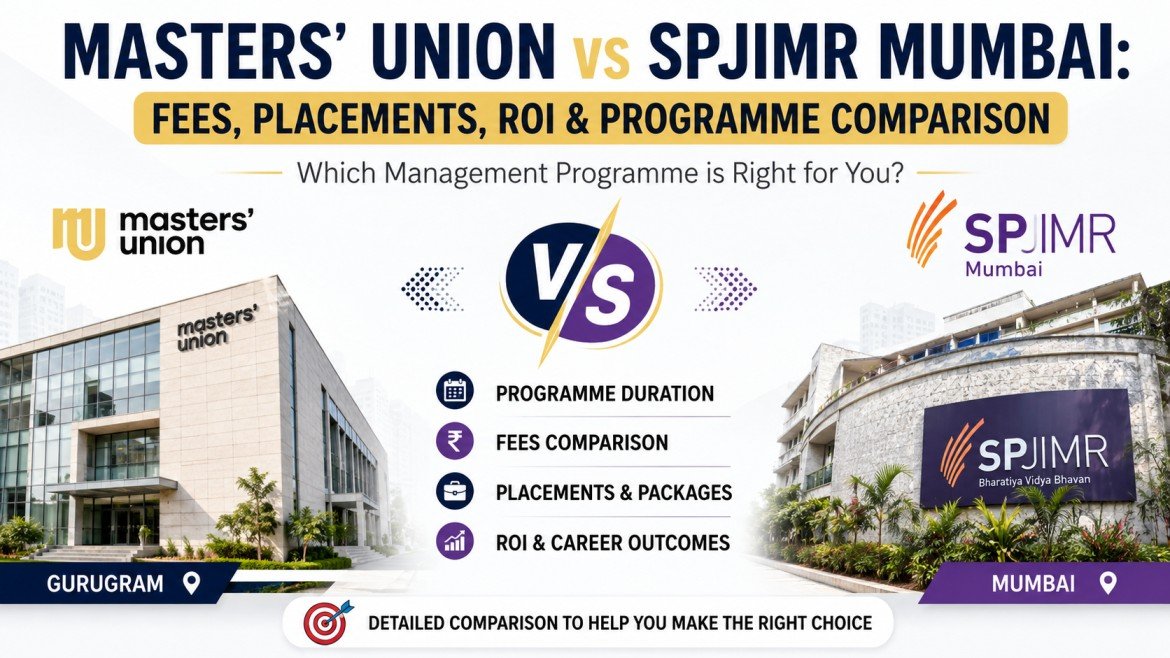
Choosing between Masters' Union vs SPJIMR Mumbai can be difficult because both institutions appeal to ambitious management aspirants, but they offer very different educational experiences.
The comparison is not simply about which institute reports a higher average package. Students also need to consider programme duration, total financial commitment, previous work experience, learning model, brand recognition, peer group, location, career goals and the type of management education they want.
Masters' Union is a relatively new-age business school located in Gurugram and is known for its practitioner-led approach, industry exposure and focus on technology, business and entrepreneurship. Its flagship PGP TBM is a 16-month programme designed for professionals with prior work experience.
SPJIMR Mumbai, on the other hand, is an established management institution with a much longer institutional history and a traditional two-year PGDM structure combined with experiential and non-classroom learning. Its placement ecosystem, alumni network and corporate relationships are major considerations for applicants.
For students comparing Masters' Union vs SPJIMR Mumbai, the better option depends heavily on personal circumstances.
If your priority is an established B-school brand, a traditional two-year management experience and a deep alumni network, SPJIMR may have an advantage. If you are a working professional looking for an intensive programme with a technology-and-business orientation and a shorter duration, Masters' Union may be more suitable.
This article compares Masters' Union vs SPJIMR Mumbai across programme structure, fees, placements, ROI, admissions, career opportunities and long-term value using the latest information available for the 2026 admission and placement context.
Masters' Union vs SPJIMR Mumbai: Quick Comparison
| Comparison Factor | Masters' Union | SPJIMR Mumbai |
|---|---|---|
| Location | Gurugram | Mumbai |
| Main programme considered | PGP in Technology and Business Management | PGDM / PGDM (BM) |
| Programme duration | 16 months for PGP TBM | Two years |
| Indicative programme fee | ₹33.65 lakh before scholarships and applicable benefits | Fee varies by programme and intake; applicants should verify the current official admission fee structure |
| Work experience orientation | PGP TBM is designed for candidates with prior work experience | Two-year PGDM attracts candidates with varying levels of work experience |
| Latest placement average reported | ₹33.39 LPA for Masters' Union PGP TBM Cohort '25 | ₹33.6 LPA for SPJIMR PGDM 2024–26; combined PGDM and PGDM (BM) Class of 2026 announcement reported ₹33.75 LPA |
| Latest median reported | ₹27.79 LPA for PGP TBM Cohort '25 | ₹32.85 LPA for Class of 2026 |
| Highest CTC reported | ₹1.28 crore for PGP TBM Cohort '25 | ₹75 LPA for the Class of 2026 combined PGDM and PGDM (BM) placement announcement |
| Learning approach | Practitioner-led, business and technology focused | Management education with classroom and non-classroom learning |
| Major location advantage | Gurugram corporate ecosystem | Mumbai corporate ecosystem |
The comparison should not be treated as a simple ranking exercise. Programme formats, student profiles and placement cohorts can differ, which means salary figures should always be interpreted in context. Masters' Union currently reports its PGP TBM programme as a 16-month offering, while SPJIMR's flagship PGDM and PGDM (BM) are two-year programmes.
What Is Masters' Union?
Masters' Union is a business education institution based in Gurugram. Its educational model places substantial emphasis on learning from industry practitioners, business leaders, founders and executives.
The institution is located in the Delhi-NCR corporate ecosystem, which gives students proximity to technology companies, startups, consulting firms, consumer businesses and large corporations.
For the purpose of this Masters' Union vs SPJIMR Mumbai comparison, the primary programme considered is the PGP in Technology and Business Management, commonly referred to as PGP TBM.
The current programme information lists PGP TBM as a 16-month programme for professionals with more than one year of pre-MBA work experience.
This distinction is important.
A student comparing Masters' Union and SPJIMR should first ask:
Am I looking for a programme primarily designed for early-career professionals with work experience, or am I looking for a traditional two-year postgraduate management programme?
That question can influence the decision more than placement statistics alone.
What Is SPJIMR Mumbai?
SPJIMR, formally known as the S.P. Jain Institute of Management & Research, is located in Mumbai and offers multiple management programmes.
Its flagship full-time management offerings include the two-year PGDM and PGDM (Business Management). The institute is widely known for combining academic learning with practical and experiential components.
SPJIMR's educational model includes corporate exposure, internships and non-classroom learning initiatives.
The institute's placement ecosystem covers major sectors including consulting, FMCG, BFSI, general management, product and technology-related roles. Its latest Class of 2026 placement announcement reported participation from recruiters across these sectors.
For a student considering Masters' Union vs SPJIMR Mumbai, SPJIMR may be especially attractive if the student values an established management-school ecosystem and a longer programme duration.
Masters' Union vs SPJIMR Mumbai: Programme Duration
Programme duration is one of the biggest structural differences between Masters' Union and SPJIMR.
Masters' Union currently lists its PGP TBM as a 16-month programme.
SPJIMR's PGDM and PGDM (BM) follow a two-year structure.
A shorter programme can reduce the time a professional spends away from full-time employment. However, a two-year programme can provide additional time for internships, academic exploration, networking and career preparation.
Neither model is automatically better.
When a shorter programme may make sense
A shorter programme may be attractive for:
- Professionals with existing work experience.
- Candidates seeking a faster return to the job market.
- Students who want an intensive academic schedule.
- Professionals looking to minimise career interruption.
- Candidates with clear post-MBA career goals.
When a two-year programme may make sense
A two-year programme may appeal to:
- Candidates seeking a more traditional MBA-style experience.
- Students who want additional internship exposure.
- Applicants exploring multiple career paths.
- Candidates who value an extended campus experience.
- Students building professional networks from scratch.
Therefore, in the Masters' Union vs SPJIMR Mumbai duration comparison, the right choice depends on your career stage.
Masters' Union vs SPJIMR Mumbai Fees
Fees are among the most important parts of this comparison because students should evaluate not only tuition but also accommodation, living costs, lost salary and financing costs.
Masters' Union currently lists a total PGP TBM programme fee of ₹33,65,384, comprising admission and tuition components before scholarships and applicable benefits. The institution also lists hostel pricing separately from the programme fee.
The current Masters' Union information also states that scholarships may be available and that applicants can be considered for applicable scholarships.
SPJIMR applicants should check the official fee schedule applicable to their exact programme and intake because programme fees and payment structures can change between admission cycles.
The real cost is larger than tuition
When comparing Masters' Union vs SPJIMR Mumbai fees, students should calculate:
- Tuition and programme fees.
- Admission charges.
- Hostel expenses.
- Accommodation if living independently.
- Food and daily expenses.
- Travel.
- Laptop and study requirements.
- Insurance or miscellaneous institutional expenses.
- Education loan interest.
- Salary sacrificed while studying.
A candidate earning ₹10 lakh annually who leaves work for a two-year programme may face a significant opportunity cost beyond tuition.
The same candidate may face a lower opportunity cost in a shorter programme, although the exact calculation depends on the candidate's salary and programme schedule.
Masters' Union vs SPJIMR Mumbai Placements
Placements are naturally one of the most searched aspects of the Masters' Union vs SPJIMR Mumbai comparison.
However, placement statistics should not be compared without context.
Averages can be influenced by:
- Batch composition.
- Previous work experience.
- Number of students.
- Industry conditions.
- Domestic versus international offers.
- Salary components.
- Fixed compensation versus stock or variable pay.
- Programme type.
The latest Masters' Union placement information available on its official programme pages reports the following PGP TBM figures for Cohort '25:
| Masters' Union PGP TBM Cohort '25 | Reported Figure |
|---|---|
| Average CTC | ₹33.39 LPA |
| Median CTC | ₹27.79 LPA |
| Highest CTC | ₹1.28 crore |
| Top 25% average CTC | ₹54.80 LPA |
| Bottom 25% average CTC | ₹22.75 LPA |
| Middle 80% average CTC | ₹29.20 LPA |
Masters' Union states that its placement reports are audited by Brickworks and follow the IPRS Revision 2.2 framework.
SPJIMR's official placement page reports the following for PGDM 2024–26 final placements:
| SPJIMR PGDM 2024–26 | Reported Figure |
|---|---|
| Average CTC | ₹33.6 LPA |
| Highest CTC | ₹75 LPA |
| Median CTC | ₹32.85 LPA |
For PGDM (BM), SPJIMR's placement page reports an average CTC of ₹34.05 LPA, a highest CTC of ₹65 LPA and a median CTC of ₹32.85 LPA.
SPJIMR also announced that its combined PGDM and PGDM (BM) Class of 2026 achieved 100% final placements, with an average CTC of ₹33.75 LPA, a median CTC of ₹32.85 LPA and a highest CTC of ₹75 LPA.
How Should Students Compare Placement Figures?
The average salary numbers reported by the institutions are relatively close in the latest data.
Masters' Union PGP TBM Cohort '25 reports an average CTC of ₹33.39 LPA.
SPJIMR's combined Class of 2026 announcement reports an average CTC of ₹33.75 LPA.
The difference between these averages should not be used alone to select a programme.
The more meaningful question is:
What type of student achieved these outcomes?
If one programme has a larger proportion of experienced professionals, their previous salaries and work experience may influence post-programme compensation.
Students should therefore compare:
- Their current salary.
- Their years of experience.
- Their target industry.
- Their target job role.
- The programme's recruiter base.
- The median package.
- The salary distribution.
- The likely cost of financing.
Masters' Union vs SPJIMR Mumbai Median Salary Comparison
Median salary can sometimes provide a useful additional perspective because it is less influenced by a small number of extremely high packages than an average.
Masters' Union reports a median CTC of ₹27.79 LPA for PGP TBM Cohort '25.
SPJIMR reports a median CTC of ₹32.85 LPA for its latest 2026 placement outcomes.
On this reported metric, SPJIMR's latest median is higher.
However, this does not automatically mean every candidate will achieve a better outcome at SPJIMR.
The cohorts, student profiles and programmes are different.
A professional's individual result will depend on:
- Previous experience.
- Academic performance.
- Interview performance.
- Specialisation.
- Market conditions.
- Networking.
- Internship performance.
- Career preparation.
Masters' Union vs SPJIMR Mumbai Highest Package Comparison
Masters' Union reports a ₹1.28 crore highest CTC for PGP TBM Cohort '25.
SPJIMR reported a highest CTC of ₹75 LPA for the combined Class of 2026 PGDM and PGDM (BM) placement announcement.
The highest package should be treated as an example of an exceptional outcome rather than an expected salary.
Students should give more importance to:
- Median CTC.
- Salary distribution.
- Percentage of students placed.
- Role quality.
- Recruiter diversity.
- Alignment with personal career goals.
A student entering an MBA expecting the highest reported package is making an unrealistic comparison.
The median and broader placement distribution generally provide a more useful perspective for planning.
Masters' Union vs SPJIMR Mumbai ROI
Return on investment is where the Masters' Union vs SPJIMR Mumbai decision becomes highly personal.
ROI should not be calculated simply as:
Average package minus programme fee.
That approach ignores taxes, living expenses, loan interest and opportunity cost.
A more realistic approach is:
Total Financial Cost = Programme Cost + Living Expenses + Financing Cost + Opportunity Cost
Then compare this with:
Expected Career Benefit = Salary Growth + Career Transition + Long-Term Promotion Potential + Network Value
Example of opportunity cost
Imagine two professionals.
Student A currently earns ₹8 lakh annually.
Student B currently earns ₹18 lakh annually.
Both join the same programme.
The financial sacrifice is very different because Student B gives up a much higher salary while studying.
This is why the same programme can have an excellent ROI for one person and a poor ROI for another.
Masters' Union ROI Analysis
Masters' Union's 16-month programme structure can potentially reduce the period spent outside the workforce compared with a two-year programme.
For experienced professionals, this shorter duration may be financially attractive.
The current listed programme fee of ₹33.65 lakh should nevertheless be considered alongside:
- Accommodation costs.
- Financing costs.
- Lost income.
- Personal financial responsibilities.
Masters' Union's reported PGP TBM Cohort '25 average CTC is ₹33.39 LPA and the median is ₹27.79 LPA. These numbers provide useful context, but individual outcomes can vary significantly.
SPJIMR ROI Analysis
SPJIMR's latest placement outcomes are strong, with the Class of 2026 reporting a ₹33.75 LPA average CTC and ₹32.85 LPA median CTC across the combined PGDM and PGDM (BM) placement announcement.
The programme's two-year duration means students should carefully consider opportunity cost, especially if they are already earning a strong salary.
However, the longer duration may also provide additional time for internships, career exploration and network building.
The right ROI calculation depends on what the student wants after graduation.
Which Institute Has Better ROI?
There is no universal winner in the Masters' Union vs SPJIMR Mumbai ROI comparison.
Masters' Union may provide stronger ROI for someone who:
- Already has work experience.
- Wants to return to the workforce sooner.
- Wants technology and business exposure.
- Wants to work in the Delhi-NCR ecosystem.
- Has clear career goals.
SPJIMR may provide stronger ROI for someone who:
- Values an established institutional brand.
- Wants a traditional two-year management experience.
- Wants to explore internships and multiple career paths.
- Values a large and established alumni ecosystem.
- Wants stronger exposure to Mumbai's corporate environment.
Masters' Union vs SPJIMR Mumbai: Learning Experience
The two institutions differ significantly in educational philosophy.
Masters' Union emphasises practitioner-led learning and exposure to business leaders and industry professionals.
Its model is particularly relevant to students who want direct exposure to contemporary business practices.
The programme also places significant attention on technology, entrepreneurship and modern business roles.
SPJIMR follows a broader management-school model that combines academic instruction with experiential and non-classroom learning.
The latest SPJIMR placement communication highlights areas such as internships and corporate engagement as important parts of its career development ecosystem.
Masters' Union vs SPJIMR Mumbai: Location Advantage
Location can influence:
- Corporate networking.
- Internships.
- Guest sessions.
- Live projects.
- Job opportunities.
- Alumni access.
Masters' Union in Gurugram
Gurugram is one of India's major corporate and technology hubs.
Students can benefit from proximity to:
- Technology companies.
- Startups.
- Consulting firms.
- Consumer technology companies.
- Venture capital firms.
- Financial services organisations.
Masters' Union also highlights its location in DLF Cyber Park and its proximity to major companies.
SPJIMR in Mumbai
Mumbai provides access to a major corporate ecosystem with strong representation in:
- Financial services.
- Consulting.
- FMCG.
- Media.
- Consumer businesses.
- Conglomerates.
- Technology and digital businesses.
For students targeting finance and large corporate roles, Mumbai's ecosystem can be an important consideration.
Masters' Union vs SPJIMR Mumbai for Consulting
Students targeting consulting should examine the recruiter lists rather than simply looking at average salary.
SPJIMR's Class of 2026 placement announcement reported consulting as the largest recruiting domain, accounting for 40% of offers.
Recruiters listed by SPJIMR included organisations such as Accenture Strategy, BCG, Deloitte, EY, Kearney, KPMG, McKinsey and PwC among others.
A student targeting consulting should therefore examine:
- Their academic profile.
- Case interview preparation.
- Previous experience.
- Recruiter eligibility requirements.
- Campus opportunities.
SPJIMR's established consulting presence can be particularly relevant for candidates with this career objective.
Masters' Union vs SPJIMR Mumbai for Technology
Masters' Union may particularly appeal to candidates interested in the intersection of technology and management.
The PGP TBM programme is explicitly positioned around Technology and Business Management.
This can make the programme attractive for professionals targeting:
- Product management.
- Technology strategy.
- Business operations.
- Startup roles.
- Digital transformation.
- Chief of Staff positions.
- Technology leadership.
Masters' Union's current placement information also highlights students moving into Entrepreneur-in-Residence and Chief of Staff roles.
Masters' Union vs SPJIMR Mumbai for Entrepreneurship
Entrepreneurial candidates should consider more than placement statistics.
The relevant questions include:
- Does the programme provide founder interaction?
- Are there opportunities to build projects?
- Is there access to investors?
- Does the peer group include entrepreneurs?
- Can students test business ideas?
Masters' Union has positioned entrepreneurship and founder-led learning as important parts of its ecosystem.
Students interested in entrepreneurship should nevertheless evaluate the current programme structure, support mechanisms and their own financial situation before enrolling.
Masters' Union vs SPJIMR Mumbai for Freshers
The comparison changes significantly for candidates with little or no work experience.
Masters' Union's current PGP TBM information specifically describes the programme as requiring more than one year of pre-MBA work experience.
Therefore, applicants should carefully check eligibility for the exact Masters' Union programme they intend to apply for.
SPJIMR's two-year PGDM route may be more aligned with candidates looking for a traditional postgraduate management programme, although each applicant must verify current programme eligibility directly with the institute.
A fresher should not choose a programme simply because its reported average salary is high.
Programme eligibility and peer-group compatibility are equally important.
Masters' Union vs SPJIMR Mumbai for Working Professionals
Experienced professionals should calculate the opportunity cost carefully.
Masters' Union's 16-month format can be attractive because it may reduce the duration of career interruption.
However, professionals should ask whether the expected role change justifies:
- Tuition.
- Lost salary.
- Financing costs.
- Relocation expenses.
SPJIMR may be attractive for professionals seeking a more extended management experience and access to its established corporate ecosystem.
The better choice depends on whether the candidate wants acceleration, career transformation or broader management exposure.
Admission Considerations
Admissions should never be treated as an afterthought.
Before applying, students should review:
- Eligibility.
- Work-experience requirements.
- Entrance examinations or assessment requirements.
- Application deadlines.
- Essays and interviews.
- Scholarships.
- Financing options.
Masters' Union currently shows applications and admission activity for its 2026 intake cycle and provides information about scholarships and financial support.
SPJIMR applicants should check the official admissions page for the current intake because deadlines and requirements can change.
Do not rely on an old blog when submitting an application.
Masters' Union vs SPJIMR Mumbai: Alumni Network
Alumni networks are difficult to measure with one statistic.
An established institution usually has an advantage in terms of the length and size of its alumni history.
SPJIMR has a substantially longer institutional presence and therefore offers a more established alumni ecosystem.
Masters' Union is a newer institution and has a growing alumni base.
The current Masters' Union programme material highlights more than 2,500 students and alumni across India and abroad.
Students should not assume that an alumni network is valuable merely because it is large.
They should consider:
- Alumni accessibility.
- Industry relevance.
- Geographic distribution.
- Willingness to mentor.
- Seniority of alumni.
- Strength in the student's target sector.
Brand Value: Masters' Union vs SPJIMR Mumbai
Brand value matters because it can influence:
- Recruiter recognition.
- Alumni connections.
- Long-term credibility.
- Career mobility.
SPJIMR has a more established institutional history and internationally recognised accreditations.
The institute's official Class of 2026 placement announcement describes SPJIMR as holding EQUIS, AACSB and AMBA accreditations.
Masters' Union represents a newer model of management education and has built recognition through its practitioner-led positioning and industry-focused programmes.
Students should consider which type of brand aligns better with their career strategy.
Masters' Union vs SPJIMR Mumbai: Student Profile
The peer group is often underestimated.
Your classmates may become:
- Colleagues.
- Business partners.
- Recruiters.
- Investors.
- Founders.
- Professional contacts.
Masters' Union's PGP TBM is designed for professionals with prior experience, which can create a peer group with more workplace exposure.
SPJIMR's two-year programmes can include students with diverse professional backgrounds and career objectives.
Before deciding, candidates should attend official information sessions and speak with current students and alumni.
Who Should Choose Masters' Union?
Masters' Union may be a stronger fit for candidates who:
- Have relevant work experience.
- Prefer a shorter programme.
- Want technology and business exposure.
- Want proximity to the Delhi-NCR corporate ecosystem.
- Are interested in startup and technology-oriented roles.
- Prefer learning from industry practitioners.
- Want to return to employment faster.
Who Should Choose SPJIMR Mumbai?
SPJIMR may be a stronger fit for candidates who:
- Want a traditional two-year management programme.
- Value an established B-school brand.
- Want access to an extensive alumni ecosystem.
- Are interested in consulting, FMCG, BFSI or corporate leadership roles.
- Want a strong Mumbai corporate network.
- Prefer a longer campus experience.
- Value the institute's established placement ecosystem.
A Practical Masters' Union vs SPJIMR Mumbai Decision Framework
Instead of asking, "Which college is better?", score both options against your own priorities.
Give each factor a score out of 10.
| Factor | Masters' Union | SPJIMR |
|---|---|---|
| Programme duration | Score based on preference | Score based on preference |
| Fee affordability | Score based on personal finances | Score based on personal finances |
| Opportunity cost | Score based on current salary | Score based on current salary |
| Target industry | Compare recruiters and roles | Compare recruiters and roles |
| Location preference | Gurugram/NCR | Mumbai |
| Brand preference | New-age and growing | Established |
| Alumni preference | Growing network | Long-established network |
| Learning style | Practitioner-led orientation | Traditional plus experiential |
| Career objective | Technology/business/startups | Broad management and corporate roles |
The option with the higher score for your circumstances may be more appropriate.
Common Mistakes Students Make
Choosing based only on the highest package
A highest package is an exceptional outcome.
It should not be treated as the expected salary.
Ignoring previous salary
A programme may produce a high average CTC but still provide limited financial improvement for someone already earning a substantial salary.
Ignoring programme duration
A shorter programme can reduce opportunity cost.
A longer programme can provide more time for exploration.
Ignoring loan interest
Education financing can significantly increase the real cost of management education.
Ignoring career goals
A student targeting consulting should evaluate consulting outcomes.
A student targeting product management should evaluate technology and product opportunities.
Assuming every student's outcome will match the average
Placement outcomes depend on individual performance and market conditions.
Is Masters' Union Better Than SPJIMR?
There is no objective answer for every applicant.
SPJIMR may be stronger for candidates prioritising institutional legacy, established alumni networks, a two-year programme and broad corporate placement exposure.
Masters' Union may be stronger for experienced professionals prioritising a shorter programme and a technology-and-business-focused learning environment.
The correct question is not:
"Which college is better?"
The better question is:
"Which programme provides the strongest career outcome for my profile, finances and long-term goals?"
Final Verdict: Masters' Union vs SPJIMR Mumbai
The Masters' Union vs SPJIMR Mumbai comparison does not produce a single universal winner.
Masters' Union currently offers a 16-month PGP TBM programme and reports a ₹33.39 LPA average CTC, ₹27.79 LPA median CTC and ₹1.28 crore highest CTC for Cohort '25. Its current listed programme fee is ₹33.65 lakh before scholarships and applicable benefits.
SPJIMR's latest combined PGDM and PGDM (BM) Class of 2026 placement announcement reported 100% placements, a ₹33.75 LPA average CTC, ₹32.85 LPA median CTC and ₹75 LPA highest CTC.
The placement averages are close, but the institutions differ substantially in programme format and student experience.
Choose Masters' Union if its shorter, industry-oriented and technology-focused approach matches your career stage and objectives.
Choose SPJIMR if you value an established B-school ecosystem, a two-year programme, broad corporate exposure and a long-standing alumni network.
Before making the final decision, compare the official programme documents, calculate your complete financial cost and speak with current students or alumni from both institutions. The right management programme should improve your career trajectory—not simply provide a number that looks impressive on a placement brochure.
Frequently Asked Questions
Is Masters' Union better than SPJIMR Mumbai?
It depends on the student's profile. SPJIMR may be preferable for applicants seeking an established two-year B-school experience, while Masters' Union may appeal to experienced professionals seeking a shorter technology-and-business-focused programme.
Which has higher average placements, Masters' Union or SPJIMR?
Masters' Union reports a ₹33.39 LPA average CTC for PGP TBM Cohort '25. SPJIMR reported a ₹33.75 LPA average CTC for the combined PGDM and PGDM (BM) Class of 2026 placement announcement. These figures should be compared with programme and cohort differences in mind.
Which has a higher median salary?
Masters' Union reports a ₹27.79 LPA median for PGP TBM Cohort '25, while SPJIMR reported a ₹32.85 LPA median for the Class of 2026 combined PGDM and PGDM (BM) placement announcement.
How long is the Masters' Union PGP TBM programme?
The current programme information lists PGP TBM as a 16-month programme.
Is SPJIMR a two-year programme?
The flagship PGDM and PGDM (BM) programmes follow a two-year structure.
What is the Masters' Union programme fee?
Masters' Union currently lists a total PGP TBM programme fee of ₹33,65,384 before scholarships and applicable benefits. Students should verify the current fee structure before applying because fees may change.
Which is better for consulting?
SPJIMR has a strong consulting recruitment presence. Its Class of 2026 placement announcement stated that consulting accounted for 40% of offers.
Which is better for technology and product roles?
Masters' Union may be particularly relevant for candidates interested in technology and business management because of the orientation of its PGP TBM programme. Students should compare current recruiter lists and role availability before making a decision.
Is Masters' Union good for working professionals?
Its PGP TBM programme is specifically positioned toward candidates with prior work experience. The current programme information lists more than one year of pre-MBA work experience as an eligibility orientation.
Should I choose based on the highest package?
No. The highest package represents an exceptional outcome. Median salary, placement distribution, programme cost and individual career goals are more useful for decision-making.
Search Keywords
masters union vs spjimr, masters union vs spjimr mumbai, masters union vs spjimr placements, masters union vs spjimr fees, masters union vs spjimr roi, masters union vs spjimr average package, masters union vs spjimr median package, masters union vs spjimr highest package, masters union vs spjimr 2026, masters union or spjimr, spjimr vs masters union, masters union fees, spjimr fees, masters union placement, spjimr placement, masters union average package, spjimr average package, masters union median package, spjimr median package, masters union highest package, spjimr highest package, masters union programme duration, spjimr programme duration, masters union 16 month course, spjimr two year mba, masters union pgtbm, masters union pgp tbm fees, masters union pgp tbm placement, spjimr pgdm placement, spjimr pgdm bm placement, best mba college masters union or spjimr, masters union review, spjimr review, masters union gurugram, spjimr mumbai, masters union roi, spjimr roi, masters union worth it, spjimr worth it, masters union salary, spjimr salary, masters union placement report, spjimr placement report, masters union admission, spjimr admission, masters union eligibility, spjimr eligibility, masters union work experience, spjimr work experience, masters union for working professionals, spjimr for freshers, masters union for product management, spjimr for consulting, masters union for technology, spjimr for finance, masters union for entrepreneurship, spjimr for marketing, masters union campus, spjimr campus, masters union alumni, spjimr alumni, masters union recruiter list, spjimr recruiter list, masters union scholarship, spjimr scholarship, masters union education loan, spjimr education loan, masters union career outcomes, spjimr career outcomes, masters union ctc, spjimr ctc, masters union mba alternative, spjimr mba, masters union pgp, masters union placement 2026, spjimr placement 2026, masters union latest placement, spjimr latest placement, masters union vs spjimr salary comparison, masters union vs spjimr fees comparison, masters union vs spjimr placement comparison, masters union vs spjimr course comparison, masters union vs spjimr career comparison, masters union vs spjimr brand value, masters union vs spjimr alumni network, masters union vs spjimr for consulting, masters union vs spjimr for product management, masters union vs spjimr for finance, masters union vs spjimr for freshers, masters union vs spjimr for experienced professionals, masters union vs spjimr which is better, should i choose masters union or spjimr, masters union vs top mba colleges, spjimr management programme, masters union management programme, best management school in gurugram, best management school in mumbai, mba roi comparison india, private mba college roi, management education placement comparison, masters union career growth, spjimr career growth, masters union industry exposure, spjimr industry exposure, masters union practitioner led learning, spjimr non classroom learning, masters union technology business management, spjimr pgdm 2026, masters union cohort 2025 placement, spjimr class of 2026 placement, masters union 33.39 lpa, spjimr 33.75 lpa, masters union median 27.79 lpa, spjimr median 32.85 lpa, masters union highest 1.28 crore, spjimr highest 75 lpa
Long-Tail & Short-Tail Searches
masters union vs spjimr which is better, masters union vs spjimr mumbai fees and placements, should i choose masters union or spjimr, masters union vs spjimr roi comparison, masters union vs spjimr for working professionals, masters union vs spjimr for freshers, masters union vs spjimr placement statistics, masters union vs spjimr average salary comparison, masters union vs spjimr median salary comparison, masters union vs spjimr highest package comparison, is masters union worth the fees, is spjimr worth the fees, what is the roi of masters union, what is the roi of spjimr, how much does masters union cost, how much does spjimr cost, which programme has better placements masters union or spjimr, which has better alumni network masters union or spjimr, which college is better for consulting, which college is better for product management, which college is better for technology management, which college is better for finance, which college is better for entrepreneurship, masters union 16 month programme review, spjimr two year pgdm review, what is masters union pgtbm, what is spjimr pgdm, how are masters union placements, how are spjimr placements, masters union placement report latest, spjimr placement report latest, masters union average package 2026, spjimr average package 2026, masters union median package 2026, spjimr median package 2026, masters union highest package 2026, spjimr highest package 2026, does masters union require work experience, does spjimr require work experience, is masters union good for career switch, is spjimr good for career switch, masters union versus established mba colleges, spjimr versus new age business schools, best mba for technology professionals, best mba for consulting careers in india, best mba for product management in india, mba programme with best roi for working professionals, how to compare mba fees and placements, what should i check before choosing an mba, is average package important for mba roi, how to calculate mba opportunity cost, masters union vs spjimr brand comparison, masters union vs spjimr campus life, masters union vs spjimr corporate exposure, masters union vs spjimr location advantage, gurugram versus mumbai for mba, masters union placement after work experience, spjimr placement after mba, should experienced professionals choose masters union, should freshers choose spjimr, which mba gives faster return to work, 16 month mba versus 2 year mba, short mba versus two year mba in india.
Key Takeaways
Masters' Union offers a 16-month PGP TBM programme, while SPJIMR offers a traditional two-year management programme.
Masters' Union currently lists a programme fee of ₹33.65 lakh before scholarships and benefits.
SPJIMR reported strong Class of 2026 placement outcomes, including a ₹33.75 LPA average CTC.
Masters' Union reported a ₹33.39 LPA average CTC for its PGP TBM Cohort '25.
SPJIMR reported a higher median CTC of ₹32.85 LPA in its latest placement results.
Masters' Union may suit experienced professionals seeking a faster return to the workforce.
SPJIMR may suit students seeking an established brand and broader traditional MBA experience.
Programme duration and opportunity cost significantly affect the overall ROI.
Students should compare recruiter profiles and target roles rather than relying only on average packages.
The best choice depends on your work experience, financial situation and long-term career goals.
Ask a question
Still confused? Leave your question and our team will help you.