
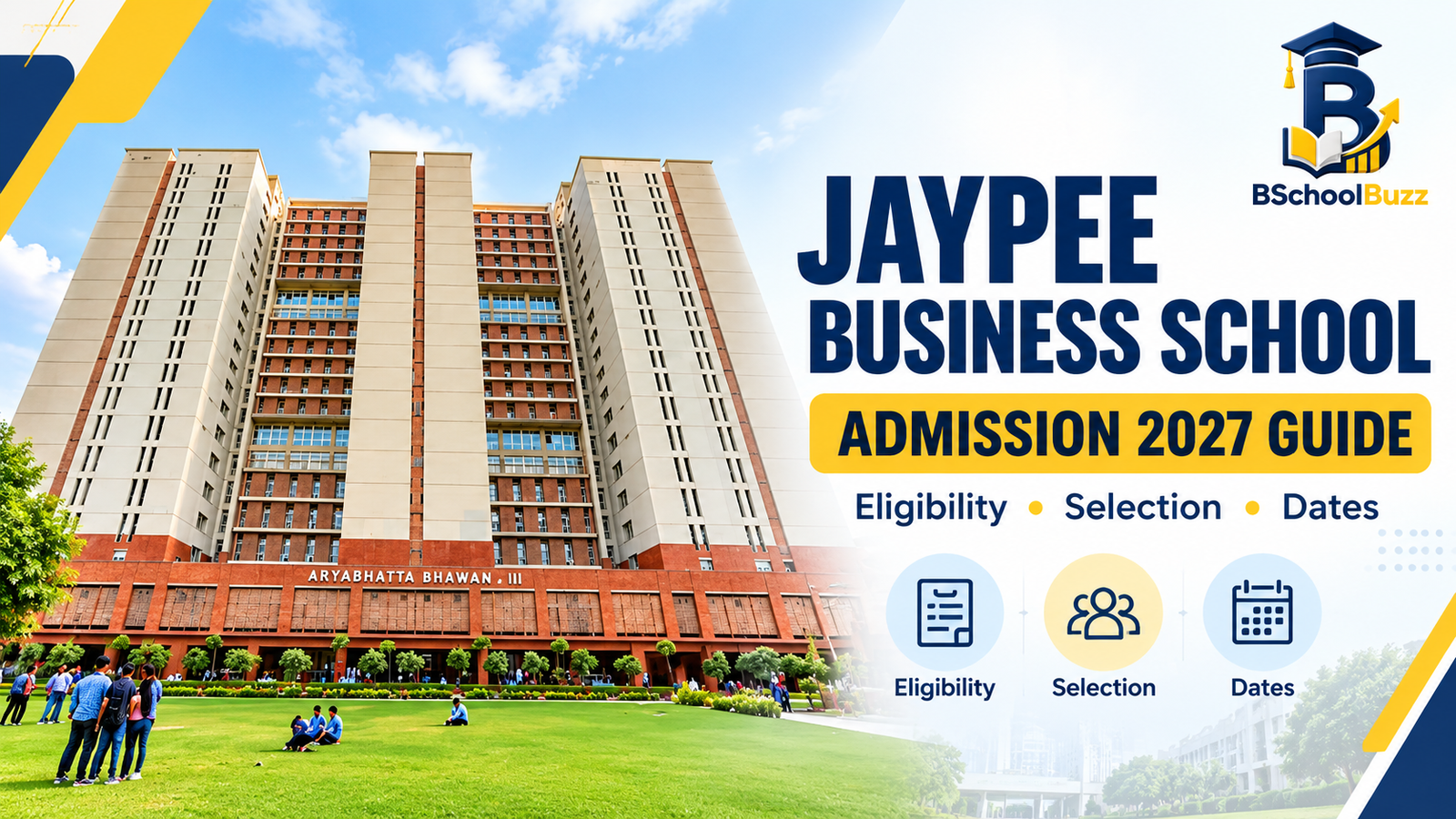
Quick Summary
- Institute: Jaypee Business School (JBS), associated with Jaypee Institute of Information Technology, Noida.
- Programme: Two-year MBA.
- Minimum graduation marks: 50% aggregate or equivalent CGPA under the currently published criteria.
- Entrance exams: CAT, MAT, CMAT, XAT, GMAT, ATMA and CUET-PG are listed in the current admission information.
- Selection process: Entrance-score shortlisting followed by Group Discussion and Personal Interview.
- Application fee reference: ₹1,000 under the currently published admission information; confirm the 2027 fee.
- MBA fee reference: ₹13.68 lakh for the 2026–28 batch.
- Caution money: ₹20,000, described as refundable under the published fee conditions.
- Scholarships: The 2026–28 scheme lists merit-based fee waivers of 20% to 50%, subject to eligibility and continuation rules.
- Specialisations: Finance, Marketing, Human Resource Management, Operations, Information Technology and Business Analytics.
- Placements: Review the latest batch-specific placement report before relying on salary or placement figures.
- Admission 2027 dates: Confirm the opening date, deadline and selection schedule through the official website.
- Official website: https://jbs.ac.in/
Jaypee Business School Admission 2027: Eligibility, Selection Process, Application Form & Important Dates
Jaypee Business School (JBS), Noida, is a management institution associated with Jaypee Institute of Information Technology (JIIT), a deemed-to-be university located in Sector 62, Noida, Uttar Pradesh. Its MBA programme is designed for graduates seeking formal management education, exposure to business functions and preparation for professional roles across industries.
Students searching for Jaypee Business School, Noida admission 2027 generally want to know whether they are eligible, which entrance examinations are accepted, how the application process works, what the programme costs and what career opportunities may follow graduation. These details should be checked against the official admission information for the correct academic year.
The institute’s currently published information includes admission and fee details for the 2026–28 MBA batch. Those figures can help applicants understand the existing process, but they must not be treated as confirmed requirements for the 2027–29 batch. The application deadline, fee structure, scholarship rules and selection conditions may be revised for a future intake.
This guide explains the published admission requirements, current fee reference, application procedure, selection stages, specialisations, scholarships and placement information, while distinguishing established information from details that still need confirmation for 2027.
Table of Contents
Jaypee Business School, Noida: Overview
Jaypee Business School Admission 2027: Important Dates
MBA Programmes and Specialisations
Eligibility Criteria for MBA Admission
Entrance Exams Accepted by JBS
Application Form and Admission Process
Documents Required for Admission
Selection Process: GD, Personal Interview and Merit
Jaypee Business School MBA Fees
Scholarships and Fee Waivers
Hostel and Living Expenses
MBA Curriculum and Learning Experience
Placements and Career Opportunities
Recognition, Accreditation and Institutional Background
How to Prepare for Admission 2027
Is Jaypee Business School the Right Choice?
Common Application Mistakes
Official Contact Details
Frequently Asked Questions
Conclusion
About MBA Compass
Related Search Keywords
1. Jaypee Business School, Noida: Overview
Jaypee Business School is situated at the JIIT campus in Sector 62, Noida. The school offers management education with a focus on business fundamentals, information technology integration, functional electives and practical learning activities. Its official programme information describes a mix of classroom teaching, case studies, presentations, business simulations, projects, guest lectures and other learning methods.
The standard MBA programme is a two-year management course. Students develop a foundation across core business functions before pursuing subjects aligned with their academic interests and career goals. The institute also lists a separate MBA in Hospital and Healthcare Management and an MBA in Artificial Intelligence and Data Science. Applicants should select the correct programme when reviewing eligibility, fees and application instructions rather than assuming that every MBA option has identical requirements.
Jaypee Business School at a glance
| Particular | Details |
|---|---|
| Institution | Jaypee Business School (JBS) |
| University association | Jaypee Institute of Information Technology (JIIT) |
| Location | A-10, Sector 62, Noida, Uttar Pradesh |
| Main programme covered in this guide | Two-year MBA |
| Minimum graduation marks | 50% aggregate or equivalent CGPA under the currently published criteria |
| Entrance examinations listed | CAT, MAT, CMAT, XAT, GMAT, ATMA and CUET-PG |
| Selection stages | Entrance-score shortlisting, Group Discussion and Personal Interview |
| Published MBA fee reference | ₹13.68 lakh institutional fee for the 2026–28 batch |
| Additional caution money | ₹20,000, described as refundable under the published fee schedule |
| 2027–29 dates and fees | Must be confirmed through the applicable official admission notice |
| Official website | https://jbs.ac.in/ |
The eligibility and entrance-exam list above is based on the currently published MBA admission information. The fee is explicitly for the 2026–28 academic session and is not a confirmed quotation for 2027–29. Official JBS admission information · Official fee structure
What should students evaluate before applying?
Choosing a business school involves more than checking whether a candidate meets the minimum marks requirement. Applicants should evaluate the following factors together:
Programme suitability: Confirm that the MBA course and its available specialisations match your interests.
Entrance-test readiness: Identify which accepted examination scores you can submit within the admission timeline.
Total cost: Consider tuition, institutional charges, caution money, accommodation, meals, travel and personal spending.
Selection process: Prepare for the Group Discussion and Personal Interview rather than focusing only on the entrance examination.
Placement information: Review the latest batch-specific data, including the number of students placed and the salary measures reported.
Learning experience: Examine the curriculum, industry activities, case-based teaching and practical projects.
Location: Consider the cost and convenience of living in Noida or commuting to campus.
These factors help students compare colleges on the basis of their own priorities rather than relying on one ranking or salary figure.
2. Jaypee Business School Admission 2027: Important Dates
Applicants planning for the 2027–29 MBA batch should monitor the official JBS admissions page. The currently available official pages provide information about the 2026–28 admission cycle, but a confirmed 2027–29 application schedule should be taken only from the relevant official announcement.
It is important not to copy dates from an earlier cycle and publish them as confirmed dates for the next intake.
Admission timeline for the 2027–29 batch
| Admission activity | Current status |
|---|---|
| Application opening date | Confirm through the official 2027–29 notice |
| Application deadline | Confirm through the official 2027–29 notice |
| Entrance-test registration | Check the respective examination authority’s calendar |
| GD and PI dates | Follow the schedule announced by JBS |
| Merit list or admission offer | Follow official institute communication |
| Initial fee payment | Deadline and amount will be stated in the applicable offer letter |
| Document verification | Follow the institute’s instructions |
| MBA programme commencement | Confirm from the official academic calendar |
The absence of a confirmed date in the information reviewed here should not be interpreted as an indication that applications will not open. It simply means a date should not be stated as final until the relevant notice is published.
How to track admission announcements
Students can reduce the risk of missing a deadline by following a simple routine:
Visit the official JBS admissions page.
Open the MBA admission-procedure page and check the batch year.
Read the latest programme brochure before filling in the form.
Check the registration and examination calendar for the entrance test you plan to use.
Monitor your email and phone after submitting the application.
Keep a record of application submission, payment and communication from the institute.
Note the deadlines stated in the offer letter if you receive an admission offer.
Applicants should also confirm whether the 2027–29 intake will use the same application method, accepted examinations and selection stages as the currently published cycle.
3. MBA Programmes and Specialisations
Jaypee Business School lists multiple management programmes. This guide focuses primarily on the general MBA admission route; students interested in specialised MBA options should review the separate programme pages because the curriculum and admission conditions may differ.
The institute’s published general MBA specialisations include Human Resource Management, Finance, Marketing, Operations, Information Technology and Business Analytics. Official JBS MBA information
General MBA specialisations
| Specialisation | Main area of study | Illustrative career directions |
|---|---|---|
| Finance | Financial analysis, corporate finance, financial services and investment-related concepts | Financial analyst, finance executive, credit analyst, banking roles |
| Marketing | Consumer behaviour, sales, brand management and marketing strategy | Marketing executive, sales roles, brand-support roles, market research |
| Human Resource Management | Recruitment, employee relations, training and organisational development | HR executive, talent acquisition, HR operations |
| Operations Management | Process improvement, service delivery, resource planning and operational efficiency | Operations executive, process analyst, supply-chain roles |
| Information Technology | Business applications of technology, information systems and digital processes | Business systems analyst, IT project support, technology consulting support |
| Business Analytics | Data interpretation, analytical methods and evidence-based business decisions | Business analyst, reporting analyst, analytics support roles |
These career directions are examples of the kinds of work associated with the respective fields. They are not guarantees of recruitment, salary or placement through the institute.
Separate MBA options
JBS also lists specialised programmes, including MBA in Hospital and Healthcare Management and MBA in Artificial Intelligence and Data Science. Their presence is important because a student interested in healthcare administration or data-oriented management may be looking for a different curriculum from the general MBA.
Before applying, check:
The exact programme name on the application form.
Its programme-specific eligibility criteria.
Accepted entrance examinations.
Fee structure and any additional charges.
Curriculum and specialisation options.
The applicable selection process.
Whether the same scholarship terms apply.
Do not combine fee or eligibility information from the general MBA with a specialised programme unless the official documentation explicitly confirms that the same conditions apply.
How to choose a specialisation
Finance may suit students interested in financial statements, budgeting, banking, financial services or corporate financial decisions. Comfort with numbers, attention to detail and analytical reasoning can be useful.
Marketing may appeal to students who enjoy understanding customers, developing campaigns, managing sales processes and analysing market behaviour. It can involve both creative thinking and measurable business targets.
Human Resource Management focuses on people and organisational practices. Students interested in recruitment, employee development, workplace processes and organisational behaviour may find it relevant.
Operations Management is concerned with how organisations deliver products and services efficiently. It can suit students interested in process improvement, planning, logistics and coordination.
Information Technology connects business requirements with technology systems. Students should examine the actual course content to understand how much emphasis is placed on business processes, technology applications and project-related skills.
Business Analytics involves using data to support decisions. Students should review the curriculum and technical requirements rather than assuming that all analytics programmes teach the same tools or level of mathematics.
A useful way to choose is to identify three roles you might want after graduation, then compare those roles with the curriculum and practical opportunities associated with each specialisation.
4. Eligibility Criteria for Jaypee Business School Admission 2027
The currently published JBS MBA admission information states that candidates should hold a bachelor’s degree, or an equivalent qualification, in any discipline from a recognised or statutory university with at least 50% aggregate marks or equivalent CGPA. A valid score from an accepted entrance examination is also required under the published admission process. Official MBA admission page · Official admission FAQ
Basic eligibility requirements
| Requirement | Published information | What applicants should verify for 2027–29 |
|---|---|---|
| Educational qualification | Bachelor’s degree or equivalent in any discipline | Whether the qualification meets the current rules |
| Minimum marks | 50% aggregate or equivalent CGPA | The minimum requirement and any applicable equivalence rule |
| Entrance examination | Valid score from an accepted exam | Which exams and score-reporting rules apply to the new batch |
| Final-year students | Can apply if they meet the published completion and proof deadlines | The new batch’s qualifying-examination deadline |
| Work experience | Not stated as mandatory in the published FAQ | Whether any programme-specific condition has been introduced |
| Diploma-only qualification | The published FAQ says diploma holders cannot apply on that basis | Whether the candidate has a separate recognised bachelor’s qualification |
Can final-year graduation students apply?
The currently published JBS FAQ permits final-year candidates to apply, subject to completing their qualifying degree within the prescribed timeline and submitting proof of eligibility. The dates shown in the existing information relate to the 2026 admission cycle and should not be reused as the 2027–29 deadline.
Final-year applicants should check the next prospectus for the last date by which they must complete their degree and provide the required marksheets or certificate. An application submitted while results are pending does not remove the requirement to satisfy the final eligibility conditions.
Is work experience compulsory?
The official FAQ states that work experience is not mandatory for the programme. This means fresh graduates may apply if they meet the applicable academic and entrance-test requirements.
However, students who have worked or completed relevant internships may use those experiences to explain their career interests during selection. Work experience should be described accurately, and candidates should be ready to explain their actual responsibilities.
Are 50% graduation marks enough to secure admission?
No. The minimum marks requirement establishes basic academic eligibility; it does not guarantee selection. The current JBS admission information describes a process that includes entrance-test score shortlisting, Group Discussion and Personal Interview, with final merit based on multiple elements.
Students should therefore work on their entrance examination and interview preparation even after confirming that they meet the minimum academic requirement.
What if your CGPA is not expressed as a percentage?
The official admission criteria refer to 50% aggregate marks or equivalent CGPA. Candidates whose transcripts use a CGPA should check how their university calculates equivalence and whether JBS requires a conversion certificate or another supporting document.
Do not convert a CGPA into a percentage using an assumed formula. Use the method prescribed by the awarding university and confirm any additional requirements with the admissions office.
5. Entrance Exams Accepted by JBS
The official general MBA admission information lists the following entrance examinations:
Common Admission Test (CAT)
Management Aptitude Test (MAT)
Common Management Admission Test (CMAT)
Xavier Aptitude Test (XAT)
Graduate Management Admission Test (GMAT)
AIMS Test for Management Admissions (ATMA)
Common University Entrance Test for Postgraduate programmes (CUET-PG)
Applicants should verify this list for the 2027–29 batch before registering for an examination. The exam authority—not the college—sets its registration dates, test schedule, result announcements and score-reporting procedures. Official JBS MBA admission information
How should you choose an entrance examination?
The best option depends on your target colleges, exam preparation, eligibility and available time. If you are applying to several management institutions, compare the accepted exams across your shortlist before committing to a preparation schedule.
| Exam | What applicants should check |
|---|---|
| CAT | Official registration, exam date, result timeline and score validity |
| MAT | Accepted test format, registration window and score-reporting rules |
| CMAT | Official examination notice and score availability |
| XAT | Registration deadline, test structure and result schedule |
| GMAT | Applicable test format, score-reporting procedure and accepted score conditions |
| ATMA | Test schedule and registration requirements |
| CUET-PG | Applicable examination notification, eligibility and result timeline |
This table is a planning aid, not a statement that every exam will necessarily remain accepted for the 2027–29 cycle.
What score is needed for JBS admission?
The official information reviewed for the current MBA process lists accepted entrance examinations but does not establish a confirmed 2027–29 cut-off. Applicants should avoid publishing an estimated percentile as a guaranteed requirement.
A valid score allows the application to be assessed under the relevant admission rules, but meeting any minimum threshold does not automatically secure an offer. The institute’s published selection process also includes GD and PI performance and other merit considerations.
Preparing for the entrance test
A useful preparation plan should include:
Checking the official syllabus and test format.
Building a weekly schedule based on strengths and weaknesses.
Practising questions under timed conditions.
Taking mock tests and reviewing errors.
Revising topics that repeatedly reduce your score.
Tracking registration and result deadlines.
Leaving enough time to submit scores and supporting documents to JBS.
If you plan to apply to multiple institutions, create a simple spreadsheet showing each college’s accepted exams, application deadline, fee and document requirements. This makes it easier to avoid missed deadlines.
6. Jaypee Business School Application Form: Step-by-Step Process
JBS provides an MBA application page through which applicants can access the application process and programme information. The official website also describes the selection stages and accepted entrance examinations. The precise form, payment options and deadlines for 2027–29 should be confirmed when the new cycle is announced. Official application page · Official admissions page
Step 1: Select the correct MBA programme
Start by deciding whether you want the general MBA or a specialised programme such as Hospital and Healthcare Management or Artificial Intelligence and Data Science.
Read the correct programme page before proceeding. The requirements for one MBA option should not be assumed to apply to another.
Step 2: Confirm eligibility
Check your graduation marks, qualification status and entrance-exam options. If you are a final-year student, identify the deadline by which the degree and final marks must be submitted.
If your academic qualification or CGPA conversion is unclear, contact the admissions office before submitting the form.
Step 3: Take an accepted entrance examination
Register for an examination that JBS accepts for the relevant batch. If you already have a valid score, check whether it meets the score-submission rules stated in the current admission notice.
Do not assume that a score from a particular year will remain valid indefinitely. Follow the rules of both the examination authority and the institute.
Step 4: Access the official application form
Use the application link published on the official JBS website. The current application page asks prospective applicants to provide contact details to access the form. Check the form’s instructions carefully before entering personal or academic information.
Step 5: Complete the form accurately
Enter your name, contact information, educational details and entrance-test information exactly as they appear in your official records.
Review all entries before submission. Incorrect marks, misspelled names, inaccurate dates or an incorrect programme selection may delay processing or require correction.
Step 6: Pay the application fee
The published admission information for the current cycle lists an application fee of ₹1,000. This is a reference to the existing process, not a confirmed application fee for 2027–29. Check the latest form for the amount, accepted payment methods and refund conditions.
Save the payment receipt and application acknowledgement.
Step 7: Submit the required supporting documents
Follow the current portal’s instructions for uploading or submitting academic records, entrance-test score information and identity documents. The current admission procedure also describes submission of the application and scorecard through specified institutional channels.
Because the process can change, applicants should use the instructions for their own intake rather than relying on an old printed form or third-party guide.
Step 8: Attend Group Discussion and Personal Interview
Shortlisted applicants are called for the GD and PI stages under the published selection process. Check the official communication for the format, date, location or online instructions.
Prepare to explain your academic background, reasons for choosing management, preferred specialisation and career goals.
Step 9: Review the admission offer
If selected, read the offer letter carefully. It should specify the conditions of admission, required payment, registration deadline and any documents that remain outstanding.
Do not assume a seat is secured merely because you have been shortlisted or interviewed. Follow the official payment and registration instructions to complete the process.
Step 10: Keep copies of every record
Retain the application form, scorecard, payment receipt, offer letter and communication from the institute. These records are useful if you need to clarify a submission, payment or deadline.
7. Documents Required for MBA Admission
The final document list should be checked against the current application form and admission offer. Applicants can prepare the following common records in advance, but the institute’s actual instructions take precedence.
| Document | Why it may be required |
|---|---|
| Class 10 marksheet or certificate | Verification of school-level academic records |
| Class 12 marksheet or certificate | Verification of school-level academic records |
| Graduation marksheets | Verification of degree marks or CGPA |
| Degree certificate or provisional certificate, if available | Confirmation of completed graduation |
| Entrance-exam scorecard | Verification of the submitted score |
| Government-issued identity proof | Identity verification |
| Recent photograph | Application and student records |
| Application acknowledgement | Evidence of submission |
| Application-fee receipt | Evidence of payment |
| Category or other supporting certificate, if applicable | Verification where a specific rule requires it |
| Work-experience documents, if relevant | Support for any experience claimed by the applicant |
| CGPA conversion certificate, if required | Clarification of equivalence between CGPA and percentage |
Document checklist for final-year students
Candidates awaiting final results should keep available marksheets and any provisional academic records ready. They should also confirm the deadline for submitting final results and degree-completion evidence.
If a document has not yet been issued, ask the admissions office which temporary record is acceptable. Do not substitute an unofficial document without checking the current instructions.
Avoid common document errors
Ensure your name is consistent across academic and identity records.
Use readable scans or photographs.
Check that all pages of each marksheet are included.
Do not alter marksheets or certificates.
Make sure the entrance-test scorecard belongs to the correct examination and candidate.
Keep a copy of the submitted form and all receipts.
Respond promptly if the institute requests clarification.
A complete and consistent application makes it easier for the institute to verify the candidate’s details.
8. Jaypee Business School Selection Process
The currently published JBS MBA process begins with shortlisting based on a valid entrance-test score. Shortlisted candidates are called for Group Discussion and Personal Interview. The final selection is based on merit that considers the test score, language proficiency and performance in GD/PI. Official JBS admission page
Stage 1: Entrance-test score shortlisting
The entrance score is used to determine whether an application should progress to the next stage under the applicable criteria. Candidates should confirm the accepted examinations and any minimum score conditions announced for their admission batch.
A good score can strengthen an application, but students should not treat it as a guaranteed admission offer.
Stage 2: Group Discussion
The Group Discussion may be used to assess how candidates communicate, organise ideas, respond to different opinions and contribute to a discussion. The exact format and topics should be confirmed through the current selection instructions.
Preparation can include reading business news, practising structured arguments and learning to support an opinion with relevant examples. Candidates should focus on listening as well as speaking.
A useful GD contribution generally includes:
A clear statement of the issue.
A logical explanation.
Relevant evidence or examples.
Respectful engagement with other viewpoints.
A concise summary where appropriate.
Speaking continuously is not necessarily the same as contributing effectively. Candidates should aim to add relevant points without interrupting others or making unsupported claims.
Stage 3: Personal Interview
The Personal Interview allows the selection panel to explore a candidate’s motivation, communication, academic background and career direction.
Possible preparation questions include:
Why do you want to pursue an MBA?
Why have you chosen Jaypee Business School?
Which specialisation interests you?
What have you learned from your graduation subject?
What are your short-term and long-term career goals?
Which business or economic development have you followed recently?
What is one skill you want to improve?
How have you handled a challenge or disagreement?
What would you contribute to a team?
Candidates should prepare honest answers based on their own experiences rather than memorising generic scripts. If asked about a subject they do not know, a clear and thoughtful response is preferable to guessing confidently.
Stage 4: Final merit and offer
According to the currently published admission information, the final selection considers entrance-test performance, language proficiency and GD/PI performance. Applicants should confirm the detailed evaluation criteria for the 2027–29 batch if the institute publishes revised rules.
Shortlisting, an interview invitation or participation in a GD does not itself guarantee admission. The official offer and registration instructions determine the next steps.
How to improve your selection preparation
Prepare for the accepted entrance examination.
Read current business and economic news regularly.
Practise speaking clearly and structuring an argument.
Review the main subjects from your graduation degree.
Learn about the MBA curriculum and specialisations.
Prepare specific reasons for choosing JBS.
Use genuine examples from projects, internships, work or extracurricular activities.
Keep documents ready and follow the official schedule.
9. Jaypee Business School MBA Fees
The official fee information currently lists a total institutional fee of ₹13.68 lakh for the two-year MBA programme for the 2026–28 academic session. It also lists one-time caution money of ₹20,000, described as refundable after completion of the programme. These are reference figures for the published 2026–28 fee schedule and should not be presented as the confirmed 2027–29 fee. Official JBS fee information · Official fee-structure page
MBA fee structure for the 2026–28 reference batch
| Fee component | First year | Second year |
|---|---|---|
| Admission fee | ₹25,000 | Not listed |
| Tuition fee | ₹5,50,000 | ₹5,78,000 |
| Development fee | ₹90,000 | ₹95,000 |
| Study material | ₹15,000 | ₹15,000 |
| Annual institutional fee | ₹6,80,000 | ₹6,88,000 |
| Two-year institutional fee | ₹13,68,000 | |
| One-time caution money | ₹20,000 | — |
| Total including caution money | ₹13,88,000 |
The published table shows the academic fee components separately and lists caution money as an additional one-time refundable amount. Applicants should confirm the exact amount due at each stage from the offer letter and the current fee notification.
How should students interpret the fee?
The institutional fee is not necessarily the same as the complete cost of attending the programme. Students may also need to budget for accommodation, food, travel, books or supplies beyond the stated study-material component, and personal expenses.
The caution money is listed separately from the institutional fee and is described as refundable under the published conditions. It should still be included in the amount the student may need to pay initially, while being treated separately when calculating the expected final cost.
How is the fee paid?
The published fee information says that a partial academic fee for the first semester is required after the admission offer to secure the seat. The balance for that semester is payable on the registration date, and fees for subsequent semesters are payable according to the academic calendar.
Students should follow the payment instructions in their own offer letter because the amount and deadlines for a new admission cycle may change.
What will the 2027–29 MBA fee be?
A confirmed 2027–29 total should be taken from the official fee structure for that batch. The 2026–28 figure of ₹13.68 lakh is useful as a historical reference but should not be assumed to remain unchanged.
Before accepting an offer, ask the institute to confirm:
The total institutional fee for the full programme.
Whether any one-time charges are additional.
The amount and timing of each instalment.
Whether hostel accommodation and meals are separate.
The caution-money refund conditions.
The applicable withdrawal and refund policy.
Any programme-specific additional charges.
10. Scholarships and Fee Waivers
JBS publishes a merit-based MBA scholarship scheme for the 2026–28 batch. The official scholarship page describes fee waivers of up to 50%, linked to qualifying academic performance and CAT percentile. The published scheme says that the scholarship is assessed during admission without a separate scholarship application. Applicants for 2027–29 should verify whether the scheme and its thresholds will remain the same. Official JBS scholarship page
Published scholarship tiers for 2026–28
| Qualifying CGPA / academic criterion shown | CAT percentile shown | Published fee waiver |
|---|---|---|
| 7.50–7.99 | 60.0–70.0 | 20% |
| 8.00–8.49 | 70.0–80.0 | 30% |
| 8.50–8.99 | 80.0–90.0 | 40% |
| 9.00 and above | At least 90.1 | 50% |
These thresholds are reproduced from the official page for the stated programme cycle. Applicants should not assume that the same tiers will apply to the next batch, and they should ask how qualifying-degree CGPA and MBA semester SGPA are assessed.
How does the scholarship process work?
The official page describes the following process for the current scheme:
Obtain a valid score from an accepted entrance examination.
Submit the MBA application and relevant academic information.
Attend the required selection stages.
Review the offer letter for any scholarship decision and the resulting fee payable.
Meet the required academic performance conditions to continue receiving the fee waiver.
The official page states that the scholarship is automatically assessed at admission. Students should still verify their eligibility and confirm that any approved award is explicitly recorded in their offer letter.
Scholarship continuation conditions
The current published scheme says that the required SGPA must be maintained in each semester. It also states that the scholarship will be withdrawn if SGPA falls below 7.5, if the student receives a fail grade or if the student is debarred in any subject.
Students considering a scholarship should understand that an initial award may be conditional on continuing academic performance. A fee waiver should not be treated as permanent until the student has reviewed and accepted its terms.
How to plan finances when applying for a scholarship
Prepare a budget using the full published fee before subtracting any possible award. Then use the scholarship only after the institute confirms the applicable amount and conditions.
If you need an education loan, discuss the expected net fee with the lender after confirming the scholarship decision. Do not borrow based on an assumed waiver that has not been officially approved.
11. Hostel and Living Expenses
The reviewed MBA fee information separates the institutional fee from the one-time caution money. Students who plan to live near campus should confirm current hostel availability and charges directly with JBS before making a financial decision.
A confirmed hostel tariff for the 2027–29 batch should be taken from the applicable official hostel or admission information. Do not assume that accommodation is included in the ₹13.68 lakh institutional fee for the 2026–28 batch.
Expenses to consider beyond the institutional fee
| Expense category | What to confirm |
|---|---|
| Hostel accommodation | Room availability, room type, payment schedule and refund terms |
| Food and meals | Whether meals are included in accommodation or billed separately |
| Local transport | Daily commuting costs and travel requirements |
| Study materials | Which materials are included and which may need to be purchased separately |
| Personal expenses | Mobile service, clothing, laundry and other everyday needs |
| Academic or activity-related costs | Whether any specific programme activity carries an additional charge |
| Emergency funds | Money reserved for unexpected travel or personal expenses |
How to prepare a realistic budget
First, confirm the complete institutional fee and the amount due before registration. Next, ask for the current accommodation and meal charges if you intend to live away from home. Add travel and personal expenses based on your own habits and living arrangement.
Students should also keep a contingency amount for unexpected costs. The purpose of budgeting is not to predict every rupee precisely, but to avoid accepting an offer without understanding the financial commitment.
Commuting versus staying near campus
The better choice depends on distance, travel time, family circumstances and total cost. A student living nearby may prefer commuting, while someone travelling from another city may need accommodation.
Compare the combined cost of travel and time against the cost of living near campus. Ask the institute about hostel availability rather than assuming that a room will automatically be allocated after admission.
12. MBA Curriculum and Learning Experience
JBS describes its general MBA learning approach as a combination of management fundamentals, information-technology integration and practical learning methods. Its published admissions information mentions business cases, presentations, seminars, guest lectures, group exercises, role plays, simulations and live corporate projects. Official JBS programme information
Management fundamentals
A management programme helps students understand how different business functions operate and interact. Finance, marketing, human resources, operations and technology are not isolated areas: decisions in one function can affect costs, customers, people and organisational performance elsewhere.
Students should use the core curriculum to develop a broad understanding before concentrating on a specific career direction.
Case studies and business simulations
Case-based learning asks students to analyse a business situation, identify the central problem and justify a recommended course of action. The aim is to practise decision-making rather than simply memorise definitions.
Students can benefit from case studies by learning to distinguish facts from assumptions, consider more than one solution and explain the trade-offs involved in a decision.
Information technology and business applications
JBS’s published programme description highlights the integration of information technology into functional areas of management. Such integration can help students understand how organisations use systems and data to support activities such as customer management, human resources and operations.
Applicants should review the current curriculum to see which tools, platforms and technology-related subjects are included in their intended programme.
Projects, presentations and teamwork
Group exercises, presentations and live projects can help students practise communication, research, analysis and coordination. These activities also require students to manage deadlines, divide responsibilities and explain their conclusions.
Students should retain evidence of substantial projects where permitted, including the problem studied, their contribution, the methods used and the result. Being able to explain this work clearly can help during interviews and early-career recruitment.
Industry exposure
The official MBA admissions page refers to industry visits, global exposure and practical learning activities. The exact activities available to a particular student may depend on the academic calendar, programme, eligibility and the arrangements made for that batch.
Before enrolling, applicants should ask which activities are included in the programme, whether any carry additional charges and how participation is assessed.
13. Jaypee Business School Placements and Career Opportunities
JBS maintains a dedicated MBA placements page describing its Training and Placement department, pre-placement training, guest lectures, workshops, written tests, interviews and Group Discussions. Its admissions page also describes corporate exposure and visiting companies. These details indicate the types of career support described by the institute, but they do not guarantee a job for an individual student. Official JBS MBA placements page · Official MBA admissions page
Placement figures: check the batch before quoting them
JBS has published different placement highlights across its website pages. For example, an admissions page displays figures for a 2025 batch, while another page contains batch-specific figures for earlier years. Such numbers should not be combined or presented as a single current placement result.
| Placement information | What students should verify |
|---|---|
| Placement percentage | The graduating batch, number eligible and number placed |
| Highest package | The applicable batch and compensation definition |
| Average package | Sample size and whether the average covers all students or only placed students |
| Median package | Whether it is reported and how it is calculated |
| Recruiter list | Which employers recruited for the stated batch |
| Role profiles | Whether the offered roles match the student’s specialisation |
| Internship opportunities | Whether internships are part of the curriculum and how they are allocated |
The official placements page includes placement-status sections for several MBA batches. Applicants should open the latest detailed report or placement graphic and check its batch label before quoting a figure in a comparison. Official placement page
Why the highest package is not the whole story
The highest package represents the top reported offer, not the salary received by most graduates. It does not explain how many students obtained offers, how salaries are distributed or whether the role aligns with a particular student’s interests.
The average package is useful but also needs context. A few high offers may affect an average, so students should examine the median when available and review the number of students covered by the data.
How placement support may help students
The institute describes pre-placement preparation, guest lectures, workshops, written tests, interviews and Group Discussions as part of its training and placement activities. Students still need to participate actively and develop the skills employers expect.
Useful preparation includes:
Building a clear résumé.
Practising interview answers based on actual experience.
Improving written and spoken communication.
Developing relevant technical or analytical skills.
Understanding the industry and roles they are targeting.
Preparing examples of teamwork, leadership and problem-solving.
Reviewing internship and project work so they can explain their contribution.
Career opportunities after an MBA
Possible career directions depend on the specialisation and individual profile.
| Specialisation | Examples of related roles |
|---|---|
| Finance | Financial analyst, credit analyst, finance executive, banking roles |
| Marketing | Marketing executive, sales roles, market research, brand-support roles |
| Human Resource Management | HR executive, recruitment, talent acquisition, HR operations |
| Operations Management | Operations executive, process analyst, supply-chain support |
| Information Technology | Business systems analyst, IT project support, technology consulting support |
| Business Analytics | Business analyst, reporting analyst, analytics support |
These examples are indicative, not a list of guaranteed campus offers. Job outcomes depend on the candidate’s skills, interview performance, academic record, work experience, specialisation and employer requirements.
Questions to ask about placements
Before accepting an offer, ask for the most recent detailed placement information and clarify:
Which graduating batch does the report cover?
How many students were eligible for placements?
How many students were placed?
Is the average calculated using all eligible students or only placed students?
Is the median salary available?
Are the figures based on fixed pay, total compensation or another measure?
Which sectors and job functions recruited?
How are internship and full-time opportunities coordinated?
Are placement figures different for different programmes?
These questions make comparisons more meaningful than relying on a single headline number.
14. Recognition, Accreditation and Institutional Background
Jaypee Business School is associated with Jaypee Institute of Information Technology, which describes itself as a deemed-to-be university. The institution’s website lists information about its university status and approvals. Applicants should verify the current programme-specific approval and institutional recognition details from official documentation rather than assuming that every programme has identical regulatory conditions. Official JBS website · Official JIIT-associated MBA page
Why programme-specific verification matters
Students often use terms such as approval, accreditation, recognition and ranking as if they mean the same thing. They do not.
Approval refers to a programme or institution meeting the requirements of the relevant approving authority.
Accreditation is an evaluation of quality against the criteria used by an accreditation body.
University status relates to the legal and regulatory status of the degree-awarding institution.
Ranking compares institutions using a particular publisher’s methodology and selected indicators.
Applicants should check the exact programme name and academic session covered by any approval or recognition document. This is especially important when comparing the general MBA with specialised MBA programmes.
How should students interpret rankings?
Rankings can offer a reference point, but they should not be the only factor in a college decision. The ranking body, year, category and methodology affect what a position means.
A practical comparison should also include curriculum, cost, location, internship opportunities, placement outcomes and personal career goals. If a ranking is important to your decision, read the original source and verify that the same category is being used when comparing other colleges.
15. How to Prepare for Jaypee Business School Admission 2027
Preparation can begin before the application deadline is announced. Applicants can organise their documents, prepare for an accepted entrance test and develop a clear explanation of their academic and career goals.
Build an entrance-exam plan
Start by choosing an accepted examination that fits your target institutions and available preparation time. Use the official syllabus and test format to build a study schedule.
Take timed practice tests and review incorrect answers. Repeatedly taking mocks without analysing errors may not address the underlying weaknesses.
Understand the programme
Read the JBS MBA programme page, curriculum information, specialisation details and placement reports. Decide which specialisation fits your interests and what skills you want to develop.
Prepare a specific answer to “Why Jaypee Business School?” based on the actual curriculum and learning activities that matter to you. A reasoned explanation is more useful than a generic statement about reputation.
Practise GD and PI
Read business news regularly and practise discussing issues in a structured way. For the interview, prepare examples from your graduation, projects, internships, work or extracurricular activities.
Think through your short-term goals, longer-term interests, strengths and areas for improvement. Do not exaggerate achievements or claim knowledge you cannot demonstrate.
Organise your documents
Keep academic marksheets, identity documents, entrance-test score information and application records ready. Final-year students should pay particular attention to the official deadline for proving degree completion.
Check every form field before submission and retain copies of all receipts and communication.
Plan your finances
Use the published 2026–28 fee only as a reference until the 2027–29 fee is announced. Prepare a budget that includes the institutional fee, caution money, accommodation, meals, transport and personal expenses.
If you expect to receive a scholarship, confirm the terms and continuation conditions. Do not assume that a fee waiver is guaranteed before it appears in the official offer.
16. Is Jaypee Business School the Right Choice?
Jaypee Business School may be worth considering for students seeking an MBA in Noida with a curriculum covering core management areas, several specialisation options and structured GD/PI selection. The institute’s published information describes case-based learning, information-technology integration, projects and placement preparation.
Whether it is the right choice depends on your objectives and constraints. A student interested in analytics should examine the actual analytical curriculum and technical subjects. A finance-oriented applicant should check the relevant electives and role opportunities. Someone with a limited budget should compare the total cost with other suitable institutions.
Questions to answer before accepting admission
Does the MBA specialisation match my intended career?
What are the confirmed eligibility rules for the 2027–29 batch?
Which entrance examinations will be accepted?
What is the final institutional fee and payment schedule?
Are hostel and food costs separate?
What are the scholarship eligibility and continuation conditions?
What does the latest detailed placement report show?
Which roles and industries recruit from the programme?
What are the withdrawal and fee-refund rules?
What documents must be submitted before registration?
Review these points together rather than choosing solely on the basis of a headline salary, scholarship percentage or ranking.
17. Common Application Mistakes
Reusing old admission dates
Dates from the 2026–28 cycle should not be presented as confirmed dates for 2027–29. Always check the current official notice.
Assuming the minimum marks guarantee admission
Meeting the 50% graduation requirement does not guarantee selection. Applicants must also meet the relevant entrance-test and selection conditions.
Choosing the wrong programme
The general MBA, MBA in Hospital and Healthcare Management, and MBA in Artificial Intelligence and Data Science are distinct programme options. Check the exact programme before applying.
Ignoring the full cost
The institutional fee is not necessarily the complete cost of attendance. Ask about accommodation, meals, caution money and any additional charges.
Assuming a scholarship is permanent
The published merit-based scheme has continuation conditions. Review the official rules and check the award details in the offer letter.
Quoting placement statistics without context
Always identify the batch and source. Avoid combining figures from different years or using a highest package as a proxy for typical outcomes.
Submitting incomplete or inconsistent records
Check names, marks, dates and uploaded documents carefully. Keep the application acknowledgement and receipts in case you need to clarify a submission.
Paying through unverified channels
Use only payment methods confirmed by the official institute. Do not rely on an unofficial promise of admission or scholarship.
18. Official Contact Details
Students who need clarification about eligibility, application procedures, fees, scholarships or selection stages should use the contact information published by JBS.
| Contact item | Published information |
|---|---|
| Institution | Jaypee Business School |
| Address | A-10, Sector 62, Noida, Uttar Pradesh – 201309 |
| General enquiry telephone | +91 (120) 2400973–975, extensions 173/179 |
| Mobile contact shown on the official site | +91-9560349500 / +91-9560349700 |
| Email shown on the current MBA page | jbs@mail.jiit.ac.in |
| Official website | https://jbs.ac.in/ |
| MBA admissions page | https://jbs.ac.in/admissions/ |
| MBA application page | https://jbs.ac.in/mba-application-form |
| MBA fee and scholarship information | https://jbs.ac.in/mba-scholarship |
Contact details can change, so confirm the latest information on the official website before calling or sending personal documents. Official JBS MBA page
Conclusion
Jaypee Business School admission 2027 is relevant to graduates seeking a management qualification in Noida and wanting to understand eligibility, entrance examinations, application requirements, selection stages, fees, scholarships and career support before applying.
The currently published information describes a two-year MBA, a minimum graduation requirement of 50% or equivalent CGPA, accepted entrance examinations and a selection process involving shortlisting, Group Discussion and Personal Interview. The published fee of ₹13.68 lakh plus ₹20,000 caution money applies to the 2026–28 reference batch, not automatically to 2027–29.
Before applying, read the latest official prospectus, verify the entrance-test requirements and deadline, review the full fee structure, understand scholarship continuation rules and examine batch-specific placement data. A careful assessment of programme fit, total cost and career goals will help you make a more informed admission decision.
Key Takeaways
Check the official JBS website for the latest 2027–29 admission notification.
Confirm the minimum academic requirements and accepted entrance examinations before applying.
Meeting the eligibility criteria does not guarantee admission; prepare for the GD and Personal Interview.
Treat the ₹13.68 lakh institutional fee as a 2026–28 reference, not a confirmed 2027–29 fee.
Review the scholarship conditions carefully, including the academic performance required to continue a fee waiver.
Budget separately for accommodation, meals, travel and personal expenses.
Verify the programme name before applying, especially if considering a specialised MBA.
Use the latest detailed placement report to compare outcomes across batches.
Keep academic records, entrance-test scorecards, payment receipts and application documents organised.
Read the admission offer and refund conditions before paying fees or confirming your seat.
Frequently Asked Questions
When will Jaypee Business School Admission 2027 start?
The confirmed opening date for the 2027–29 MBA admission cycle should be checked on the official JBS admissions page. The currently published admission information primarily refers to the 2026–28 batch.
What is the eligibility for Jaypee Business School MBA admission?
The current published criteria require a bachelor’s degree or equivalent in any discipline with at least 50% aggregate marks or equivalent CGPA. Applicants must also meet the applicable entrance-examination requirements.
Which entrance exams are accepted by JBS Noida?
The current MBA admission information lists CAT, MAT, CMAT, XAT, GMAT, ATMA and CUET-PG. Confirm the accepted examinations for the 2027–29 intake before registering.
What is the application fee for Jaypee Business School?
The currently published admission information lists an application fee of ₹1,000. Applicants should verify the amount and payment instructions for the 2027 admission cycle.
What is the MBA fee at Jaypee Business School Noida?
The published institutional fee for the 2026–28 MBA batch is ₹13.68 lakh, with an additional ₹20,000 refundable caution-money deposit. The fee for 2027–29 must be confirmed from the applicable official fee structure.
What is the selection process at Jaypee Business School?
The published process includes shortlisting based on an accepted entrance-test score, followed by Group Discussion and Personal Interview. Final merit considers the test score, language proficiency and GD/PI performance.
Can final-year students apply for JBS MBA admission?
Yes, the current admission information allows eligible final-year candidates to apply, subject to completing their qualifying degree and providing proof within the prescribed timeline. The exact deadline for the 2027–29 batch should be verified.
Does Jaypee Business School offer MBA scholarships?
Yes. JBS publishes a merit-based scholarship scheme for the 2026–28 batch with fee waivers ranging from 20% to 50%, subject to academic and entrance-score criteria. Confirm whether the same scheme will apply to the 2027–29 intake.
Which MBA specialisations are available at JBS?
The general MBA programme lists Finance, Marketing, Human Resource Management, Operations, Information Technology and Business Analytics. JBS also lists separate specialised MBA programmes, so applicants should check the curriculum and eligibility for their chosen course.
What is the average placement package at Jaypee Business School?
Placement figures vary by batch and by the reporting method used. Check the latest official placement report for the graduating batch, average and median salary where available, placement percentage and recruiter information before comparing outcomes.
Ask a question
Still confused? Leave your question and our team will help you.