
Quick Summary
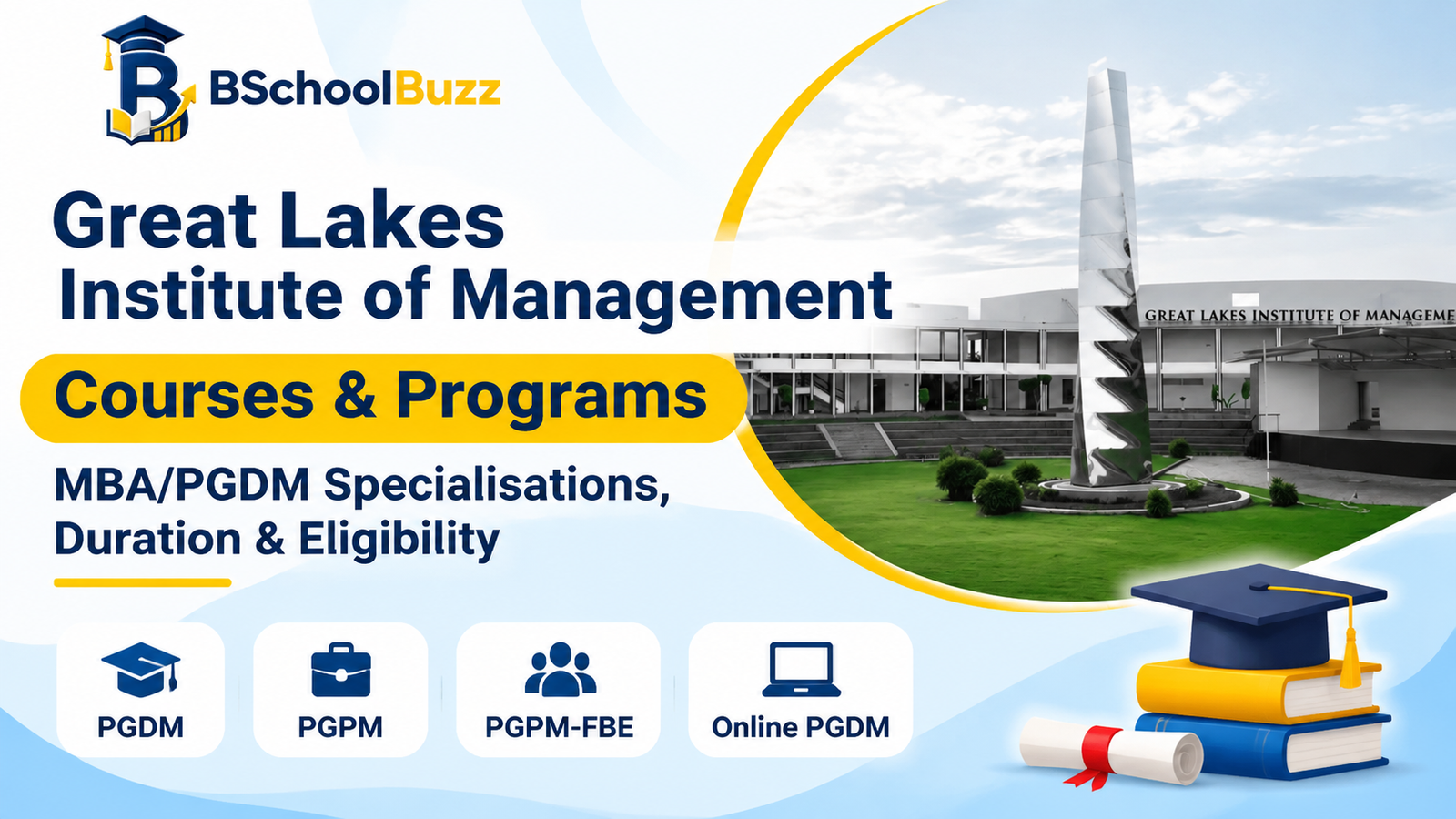
- Great Lakes Institute of Management offers PGDM, PGPM, PGPM-FBE and Online PGDM programmes.
- PGDM is a two-year full-time residential programme designed mainly for fresh graduates and early-career professionals.
- PGPM is a one-year management programme for candidates with at least two years of work experience.
- PGPM-FBE focuses on family business management, entrepreneurship and business development.
- Online PGDM offers flexible management education over two years.
- Major specialisation areas include Finance, Marketing, Operations, Business Analytics, Data Science, Consulting and Product Management.
- Admission requirements differ according to the programme and campus.
- CAT, XAT and GMAT scores are accepted for the full-time management programmes, with NMAT additionally accepted for PGPM.
- The curriculum combines management fundamentals, practical projects, case studies, internships and specialised electives.
- Great Lakes has campuses in Chennai and Gurgaon.
- Placement opportunities cover Finance, Consulting, Marketing, Analytics, Technology and Operations.
- Students should compare programme fees, eligibility, specialisations and career opportunities before applying.
Great Lakes Institute of Management Courses & Programs: MBA/PGDM Specialisations, Duration & Eligibility
Introduction
Great Lakes Institute of Management is an established business school in India offering management programmes for fresh graduates, early-career professionals, experienced executives and entrepreneurs. Its academic portfolio includes the two-year Post Graduate Diploma in Management (PGDM), the one-year Post Graduate Program in Management (PGPM), the PGPM in Family Business & Entrepreneurship and the Online PGDM.
Students exploring Great Lakes Institute of Management courses generally want to understand more than just the programme names. They need to compare specialisations, course duration, eligibility requirements, admission examinations, curriculum, campus facilities and career opportunities before deciding which programme suits their background.
The institute operates campuses in Chennai and Gurgaon, with programme availability varying by location. Its courses cover important business disciplines such as Finance, Marketing, Operations, Business Analytics, Data Science, Consulting, Product Management and Strategy.
This article explains the major Great Lakes management programmes, their academic structure, specialisation options, eligibility requirements and other factors students should consider before applying.
1. Overview of Great Lakes Institute of Management
Great Lakes Institute of Management is a private business school offering postgraduate management education in India. The institution focuses on combining academic management knowledge with practical business exposure, analytical thinking, leadership development and industry interaction.
Its programmes are designed for students at different stages of their professional journeys. A recent graduate may consider the two-year PGDM, while someone with professional experience may prefer the one-year PGPM.
The institute's curriculum includes case-based learning, management simulations, projects, classroom discussions, industry interactions and specialised electives.
Important institutional details
| Particular | Details |
|---|---|
| Institution | Great Lakes Institute of Management |
| Main campuses | Chennai and Gurgaon |
| Major programmes | PGDM, PGPM, PGPM-FBE |
| Online programme | Online PGDM |
| PGDM duration | 2 years |
| PGPM duration | 1 year |
| Main academic areas | Finance, Marketing, Operations, Analytics and Strategy |
| PGDM approval | AICTE-approved |
| Official website | greatlakes.edu.in |
The institution offers different programme formats instead of following a single admission model. Applicants should therefore compare the eligibility, experience requirements and academic structure of each course independently.
2. Courses and Programmes Offered by Great Lakes Institute of Management
Great Lakes Institute of Management courses can broadly be divided into full-time residential management programmes and online management education.
The major programmes include:
| Programme | Duration | Intended candidates | Learning format |
|---|---|---|---|
| PGDM | 2 years | Fresh graduates and early-career professionals | Full-time residential |
| PGPM | 1 year | Professionals with 2+ years of experience | Full-time residential |
| PGPM-FBE | 1 year | Family business successors and entrepreneurs | Full-time residential |
| Online PGDM | 2 years | Graduates and working professionals | Online learning |
Each programme has a different purpose.
The PGDM focuses on building management fundamentals over two years. PGPM is an accelerated management programme for candidates who already have professional experience. PGPM-FBE is designed around entrepreneurship and family business development. Online PGDM provides management education through virtual classes, recorded learning material and practical projects.
Applicants should not assume that all four programmes have identical admission requirements or specialisation choices.
3. Great Lakes PGDM Programme
The Post Graduate Diploma in Management is one of the principal programmes offered by Great Lakes Institute of Management.
It is a two-year, full-time residential programme designed primarily for fresh graduates and candidates with limited professional experience.
The programme develops knowledge across different business functions before allowing students to explore their preferred management areas through electives.
Key features of the PGDM programme
Two-year full-time residential management programme.
Designed for fresh graduates and early-career professionals.
Industry-oriented curriculum.
Case-study-based teaching methodology.
Summer internship opportunities.
Functional and cross-functional electives.
Exposure to business analytics and emerging technologies.
Leadership and communication development.
The PGDM curriculum is structured to help students understand how different business departments operate and how managers make decisions.
For example, a student interested in financial management first develops a foundation in accounting, economics and financial decision-making before studying advanced subjects such as corporate valuation, financial risk management and investment banking.
Similarly, a student interested in Marketing studies consumer behaviour, marketing management, branding and digital marketing.
Who should choose PGDM?
The PGDM is suitable for:
Fresh graduates planning to enter management careers.
Candidates from engineering backgrounds who want to move into business roles.
Commerce graduates interested in Finance or Consulting.
Students interested in Marketing and Brand Management.
Candidates interested in Analytics and technology-driven business roles.
Early-career professionals seeking structured management education.
The two-year duration gives students time to develop foundational knowledge, participate in internships and explore multiple management disciplines.
4. Great Lakes PGPM Programme
The Post Graduate Program in Management is a one-year, full-time management programme designed for professionals who already have work experience.
Unlike the PGDM, which is designed primarily for early-career candidates, PGPM focuses on accelerating the professional development of candidates who have already worked in business or technical roles.
The curriculum includes advanced management subjects, functional specialisations, industry-oriented learning and practical application.
Key features of PGPM
One-year full-time programme.
Minimum two years of work experience considered for admission.
Advanced management curriculum.
Functional and industry specialisations.
Applied business learning.
Faculty and industry mentorship.
Leadership and strategic decision-making development.
The PGPM is particularly relevant for professionals who want to transition into management positions, consulting, product management, analytics or leadership roles.
PGPM specialisation options
The programme offers a combination of functional and industry-focused specialisations.
Functional areas:
Finance
Marketing
Operations
Industry-focused areas:
Business Analytics
Data Science
Consulting
Product Management
Students can build expertise across functional and industry areas according to the programme's specialisation structure.
For example, a professional with a software development background may explore Product Management or Data Science. A finance professional may prefer Finance combined with Business Analytics.
The official curriculum includes subjects such as predictive modelling, AI applications, digital transformation, product strategy, financial valuation and supply chain management.
5. PGPM – Family Business & Entrepreneurship
Great Lakes also offers the PGPM – Family Business & Entrepreneurship programme.
This is a specialised one-year, full-time management programme designed for the next generation of family business owners, entrepreneurs and individuals interested in developing business ventures.
Unlike a conventional management programme, this course places particular emphasis on business growth, entrepreneurship, family business management and leadership.
Major learning areas
Family business management.
Entrepreneurship and innovation.
Business strategy.
Leadership development.
Business growth and expansion.
Managing professional teams.
Business planning.
Startup development and funding.
Family business dynamics.
The programme also focuses on mentoring by experienced business leaders, CXOs and faculty members.
Who should consider PGPM-FBE?
This programme may be suitable for:
Students preparing to take responsibility for an existing family business.
Entrepreneurs looking to expand their business.
Individuals planning to establish a new venture.
Family business successors interested in professionalising operations.
Business owners looking to develop strategic leadership capabilities.
The programme is different from the regular PGPM because its academic focus is specifically aligned with family enterprises and entrepreneurship.
Applicants should review the dedicated PGPM-FBE eligibility requirements rather than assuming that all PGPM admission conditions apply identically.
6. Great Lakes Online PGDM
For students and working professionals who cannot attend a full-time residential programme, Great Lakes offers an Online PGDM.
The programme provides management education through online learning resources, live virtual classes, discussion forums, assessments and projects.
It is structured over two years.
Online PGDM curriculum
The programme covers core business management subjects and specialised courses.
Major core subjects include:
Marketing Management
Organisational Behaviour and Human Resources
Managerial Economics
Statistical Methods for Decision Making
Strategic Management and Entrepreneurship
Business Finance
Financial Accounting
Operations and Supply Chain Management
Business Communication
Project Management
Business Ethics and Leadership
Design Thinking and Innovation
Online PGDM specialisations
The institute lists the following specialisation areas:
| Specialisation | Major learning areas |
|---|---|
| Data Science & Analytics | Business Analytics, AI, Machine Learning, Financial Analytics and Predictive Analytics |
| Marketing | Digital Marketing, Product Management, Branding and Consumer Experience |
| Operations | Supply Chain Management, ERP, Quality Management and Logistics |
The curriculum includes core management courses, specialisation electives and two capstone projects.
Eligibility
The official Online PGDM admission information specifies:
Bachelor's degree or equivalent qualification.
Degree from a recognised university or institution.
Minimum 50% marks, with 45% specified for SC/ST candidates.
The institute also lists a programme fee of ₹3,50,000 on its online fee page. Applicants should verify the latest fee and payment conditions before enrolling.
How online learning works
Students use a combination of:
Recorded lectures.
Live virtual classes.
Online study material.
Discussion forums.
Case-based learning.
Assignments and assessments.
Capstone projects.
The format is useful for candidates who want to continue working while studying management.
7. Great Lakes Institute of Management Specialisations
Specialisation selection is an important part of management education because it influences the subjects students study in greater depth and the types of roles they may pursue.
Great Lakes offers different specialisation combinations across its PGDM and PGPM programmes.
The following sections explain the major academic areas.
7.1 Finance
Finance focuses on financial planning, investment decisions, corporate valuation, risk assessment and management of financial resources.
Students interested in financial services, banking, corporate finance and investment-related careers may consider this area.
Important subjects include:
Financial Management
Corporate Valuation
Financial Statement Analysis
Investment Banking
Financial Risk Management
Mergers and Acquisitions
Fixed Income Securities
Options, Futures and Derivatives
Security Analysis and Portfolio Management
FinTech
Potential career opportunities:
Financial Analyst
Corporate Finance Analyst
Investment Banking Analyst
Credit Analyst
Risk Analyst
Financial Planning Analyst
Banking Professional
Finance is suitable for students who enjoy numerical analysis, financial decision-making and understanding how businesses manage capital.
7.2 Marketing
Marketing focuses on understanding customers, identifying market opportunities, developing brands and creating strategies to increase sales.
The specialisation combines consumer research, communication, digital channels and business development.
Important subjects include:
Marketing Management
Consumer Behaviour
Brand Management
Digital Marketing
Customer Relationship Management
Marketing Analytics
Sales and Distribution Management
Business-to-Business Marketing
Integrated Marketing Communications
Product Management
Potential career opportunities:
Marketing Manager
Brand Manager
Digital Marketing Manager
Product Marketing Manager
Sales Manager
Market Research Analyst
Customer Relationship Manager
Marketing is appropriate for students interested in customer behaviour, business growth, communication and brand development.
7.3 Operations Management
Operations Management focuses on the systems and processes that help businesses deliver products and services efficiently.
It covers planning, production, logistics, supply chain activities, quality and process improvement.
Important subjects include:
Supply Chain Management
Operations Management
Project Management
Logistics and Distribution
Enterprise Resource Planning
Strategic Sourcing
Service Operations Management
Lean and Six Sigma
Production Planning
Supply Chain Analytics
Potential career opportunities:
Operations Manager
Supply Chain Analyst
Logistics Manager
Procurement Manager
Project Manager
Process Improvement Consultant
Operations Analyst
This specialisation can be useful for students interested in manufacturing, logistics, consulting, retail and service industries.
7.4 Business Analytics
Business Analytics combines business knowledge with statistical and analytical methods.
Students learn how to use data to identify business problems, understand customer behaviour, forecast demand and support management decisions.
Important subjects include:
Business Intelligence
Predictive Analytics
Data Mining
Machine Learning
Data Visualisation
Marketing Analytics
Financial Risk Analytics
Time Series Analysis
Big Data Technologies
Business Applications of AI
Potential career opportunities:
Business Analyst
Data Analyst
Business Intelligence Analyst
Marketing Analyst
Financial Analyst
Analytics Consultant
Decision Science Analyst
This area is relevant to students interested in data-driven decision-making and analytical problem-solving.
7.5 Human Resources and Organisational Behaviour
Human Resources focuses on managing people, improving organisational performance and developing effective workplace practices.
The academic area includes:
Human Resource Management
Talent Acquisition
Compensation Management
Performance Management
Leadership
Organisational Behaviour
Negotiation
HR Analytics
Managing Global Teams
Potential career opportunities:
HR Manager
Talent Acquisition Specialist
HR Business Partner
Learning and Development Manager
Compensation Analyst
HR Analytics Specialist
Students who enjoy people management, organisational development and employee engagement may find this area relevant.
7.6 Strategy and Consulting
Strategy focuses on how organisations establish business objectives, compete in markets and manage long-term growth.
It also helps students understand how consultants analyse complex business problems.
Relevant subjects include:
Strategic Management
Business Research Methods
Digital Transformation
Strategy Execution
Business Consulting
Design Thinking
Innovation Management
Leadership and Negotiation
Enterprise Growth Strategies
Potential career opportunities:
Strategy Analyst
Management Consultant
Business Consultant
Corporate Strategy Associate
Transformation Consultant
Business Development Manager
This specialisation is particularly relevant for students interested in problem-solving, business transformation and strategic decision-making.
7.7 Product Management
Product Management combines business strategy, customer research, technology understanding and product development.
It is particularly relevant for technology companies, digital businesses and organisations developing software or consumer products.
Important learning areas include:
Product Strategy
Product Discovery
Market Fit
Product Development
Product Analytics
Product Roadmapping
AI for Product Managers
Pricing and Growth
Stakeholder Management
Technology Product Sales and Marketing
Potential career opportunities:
Associate Product Manager
Product Manager
Product Analyst
Product Strategy Associate
Product Marketing Manager
Business Product Consultant
Students with engineering, technology, analytics or business backgrounds may consider this specialisation.
7.8 Data Science and Artificial Intelligence
Data Science and AI are increasingly important in business decision-making, automation and digital transformation.
Great Lakes' specialised learning areas include:
Advanced Data Mining
Predictive Modelling
Machine Learning
Deep Learning
Natural Language Processing
Computer Vision
Big Data Technologies
Generative AI Models
AI Applications in Business
Potential career opportunities:
Data Science Analyst
Business Analytics Consultant
AI Business Analyst
Analytics Specialist
Data Strategy Consultant
Business Intelligence Professional
These courses focus on applying analytical and AI-related methods to business challenges. They should not be confused with a standalone technical engineering degree in artificial intelligence.
8. Programme Duration and Course Structure
The duration of Great Lakes Institute of Management courses depends on the programme selected.
| Programme | Duration | Structure |
|---|---|---|
| PGDM | 2 years | Six terms/trimesters and summer internship |
| PGPM | 1 year | Intensive full-time management curriculum |
| PGPM-FBE | 1 year | Full-time entrepreneurship and family business curriculum |
| Online PGDM | 2 years | Core courses, specialisation electives and capstone projects |
PGDM academic structure
The Chennai PGDM curriculum is organised into six trimesters.
The first part of the programme develops foundational management knowledge. Students study subjects such as:
Business Statistics
Financial Accounting
Marketing Management
Microeconomics
Operations Management
Organisational Behaviour
Business Communication
Business Research Methods
Financial Management
Macroeconomics
Business Analytics
Human Resource Management
Strategic Management
A summer internship provides practical industry exposure.
In the later trimesters, students undertake specialisation electives and general electives.
The Gurgaon PGDM curriculum is also structured across six terms, with core subjects followed by electives and experiential learning.
PGPM academic structure
PGPM follows a shorter, intensive academic structure.
It combines management foundations with specialised learning and applied business projects.
The programme's focus is on developing the ability to solve business problems, manage teams and make strategic decisions within a shorter period.
Online PGDM structure
The Online PGDM spans two years and includes:
16 core courses as listed on the academic page.
Eight specialisation courses.
Two capstone projects.
The institute's online academic information describes a combination of recorded lectures, live classes, discussion forums, case studies and assessments.
9. Eligibility Criteria for Great Lakes Courses
Eligibility is one of the most important factors when choosing between Great Lakes Institute of Management courses.
The academic qualification, work experience and entrance examination requirements vary by programme.
PGDM eligibility
For the 2027–29 admission cycle, the institute specifies:
Bachelor's degree in any discipline from a recognised institution.
At least 50% marks across Class 10, Class 12 and graduation.
Fresh graduates may apply.
Candidates with less than three years of work experience are eligible.
The institute also specifies that work experience is assessed according to the programme's applicable reference date.
PGPM eligibility
For PGPM admission 2027–28:
Bachelor's degree in any discipline.
At least two years of work experience.
Accepted entrance examination scores.
Work experience should represent valid professional employment. Academic internships and articleship are not automatically treated as equivalent to full-time employment.
PGPM-FBE eligibility
This programme is intended for candidates connected with family businesses and entrepreneurship.
Applicants should review the specific admission requirements and supporting documentation through the official PGPM-FBE admissions information.
Online PGDM eligibility
The published eligibility conditions include:
Bachelor's degree or equivalent qualification.
Recognised university or institution.
Minimum 50% marks.
45% marks for SC/ST candidates.
Eligibility comparison
| Criteria | PGDM | PGPM | Online PGDM |
|---|---|---|---|
| Graduation | Required | Required | Required |
| Fresh graduates | Eligible | Not the primary target group | Eligible |
| Work experience | 0–less than 3 years | 2+ years | Working professionals and fresh graduates |
| Entrance exams | CAT, XAT, GMAT | CAT, XAT, GMAT, NMAT | Separate admission process |
| Learning format | Residential | Residential | Online |
Eligibility for PGPM-FBE should be checked separately.
10. Entrance Examinations Accepted by Great Lakes
Great Lakes considers recognised management entrance examination scores for its full-time programmes.
For the 2027–29 PGDM admission cycle, the official application FAQs list:
CAT 2025
CAT 2026
XAT 2026
XAT 2027
GMAT taken on or after 1 January 2024
For PGPM 2027–28, the accepted scores additionally include NMAT 2025 onwards.
Entrance examination comparison
| Entrance examination | PGDM | PGPM |
|---|---|---|
| CAT 2025 | Accepted | Accepted |
| CAT 2026 | Accepted | Accepted |
| XAT 2026 | Accepted | Accepted |
| XAT 2027 | Accepted | Accepted |
| GMAT from 1 January 2024 onwards | Accepted | Accepted |
| NMAT 2025 onwards | Not listed for PGDM | Accepted |
Applicants should verify score submission rules and applicable examination dates before submitting the application.
11. Admission Process at Great Lakes Institute of Management
The admission process generally involves online registration, application submission, evaluation of academic and examination performance, interviews and final selection.
Step 1: Visit the official website
Visit the Great Lakes Institute of Management website and open the admissions section for your selected programme.
Step 2: Select the programme
Choose the appropriate programme based on your qualifications and experience.
Applicants should carefully distinguish between PGDM and PGPM because their work experience requirements differ.
Step 3: Complete the application form
Provide the required information, including:
Personal details
Educational qualifications
Entrance examination scores
Professional experience
Contact information
Other requested application details
Step 4: Submit supporting information
Provide the academic and professional information requested by the admissions portal.
Ensure that the information is consistent with official records.
Step 5: Application evaluation
The institute evaluates applicants using the applicable selection criteria.
Academic performance, entrance examination scores, work experience and overall profile may be considered.
Step 6: Interview process
Shortlisted candidates may be required to participate in an AI-proctored interview and personal interview, depending on the programme's admission process.
Step 7: Final selection
Selected candidates receive admission-related communication from the institute.
They must follow the specified offer acceptance and fee payment instructions to confirm their admission.
12. Great Lakes Chennai vs Gurgaon Campus
Great Lakes operates management campuses in Chennai and Gurgaon.
Both campuses offer management education, but their location, academic offerings and fee structures should be compared separately.
Chennai campus
The Chennai campus provides PGDM and PGPM programmes, along with the specialised PGPM-FBE offering.
The campus offers a residential academic environment and access to the Chennai business ecosystem.
Gurgaon campus
The Gurgaon campus is located in the Delhi NCR business region.
It offers PGDM and PGPM programmes, providing students with exposure to organisations and business activities in the wider NCR region.
Campus comparison
| Parameter | Chennai | Gurgaon |
|---|---|---|
| Location | Chennai, Tamil Nadu | Gurgaon, Haryana |
| PGDM | Offered | Offered |
| PGPM | Offered | Offered |
| PGPM-FBE | Listed at Chennai | Check current availability |
| Online PGDM | Institution-wide online offering | Institution-wide online offering |
| Corporate exposure | Chennai business ecosystem | Delhi NCR business ecosystem |
| Residential programmes | Yes | Yes |
Students should select a campus based on programme availability, curriculum, total cost, location preferences and career considerations.
13. Course Fees and Financial Planning
The cost of management education is an important factor when comparing Great Lakes Institute of Management courses.
Students should consider the total programme cost rather than looking only at the tuition fee.
The published 2026–28 PGDM fee structures provide the following reference figures.
Chennai PGDM fees
| Fee component | Amount |
|---|---|
| Tuition fee | ₹10,25,000 |
| Programme fee | ₹5,78,000 |
| Accommodation charges (Twin AC) | ₹6,32,000 |
| Refundable caution deposit | ₹10,000 |
| Alumni subscription | ₹5,000 |
| Total | ₹22,50,000 |
Gurgaon PGDM fees
| Fee component | Amount |
|---|---|
| Tuition fee | ₹8,30,000 |
| Programme fee | ₹5,05,000 |
| Accommodation charges (Twin AC) | ₹6,32,000 |
| Refundable caution deposit | ₹10,000 |
| Alumni subscription | ₹5,000 |
| Total | ₹19,82,000 |
These are published 2026–28 fee figures, not a confirmed fee quotation for every subsequent admission batch.
Online PGDM fees
The official online fee page lists tuition fees of ₹3,50,000.
Online students should also consider any applicable financing costs and personal study-related expenses.
What should students check before paying?
Before accepting an admission offer, applicants should confirm:
Total programme fee.
Accommodation charges.
Whether meals are included.
Refundable deposits.
Payment instalments and deadlines.
Refund and withdrawal conditions.
Additional personal expenses.
Education loan arrangements.
The residential PGDM programmes include accommodation and vegetarian meals in the published fee structures. Optional non-vegetarian meals may involve additional charges.
14. Curriculum and Teaching Methodology
The teaching methodology at Great Lakes combines academic concepts with practical business applications.
Students are expected to understand management theories and apply them to realistic business situations.
Case-based learning
Case studies help students understand how companies respond to market competition, financial challenges, customer requirements and operational problems.
Students evaluate business situations and develop possible solutions.
Classroom discussions
Management education involves analysing different business perspectives.
Classroom discussions help students develop communication, critical thinking and decision-making skills.
Business simulations
Simulations provide opportunities to understand how decisions affect different business functions.
Students can evaluate the impact of financial, operational and marketing decisions in structured learning environments.
Industry-oriented electives
Specialisation electives help students gain deeper knowledge in selected business disciplines.
For example, a Finance student may study corporate valuation, while a Marketing student may focus on digital marketing and consumer behaviour.
Projects and practical assignments
Projects allow students to apply management concepts to business problems.
The Online PGDM also includes capstone projects as part of its academic structure.
15. Internships and Industry Exposure
Internships are an important part of the two-year PGDM programme.
They allow students to experience organisational environments and understand how classroom concepts are used in business operations.
Students may gain exposure to areas such as:
Marketing
Finance
Consulting
Analytics
Product Management
Operations
Supply Chain Management
Business Strategy
The Chennai PGDM internship report for 2025 describes participation from 153 corporates for the 2024–26 batch.
The report identifies Finance and Sales & Marketing among the major functional areas for internship offers.
Internships are particularly useful for students who are entering the management field without substantial previous professional experience.
For experienced PGPM candidates, the focus is more closely aligned with advanced management learning and career progression.
16. Placements and Career Opportunities
Placement opportunities are an important consideration when evaluating management programmes.
Great Lakes publishes separate placement reports for its Chennai and Gurgaon campuses and for different programmes.
The placement outcomes should always be compared using the same campus, programme and graduating batch.
Chennai placement information
The official Chennai placement page publishes separate information for PGDM and PGPM.
It lists participating organisations such as:
Deloitte
Accenture
Bain
EY
KPMG
JPMorgan Chase
Wells Fargo
Infosys Consulting
Mastercard
Standard Chartered
Swiggy
ITC
Recruiter participation can vary from one batch to another.
Gurgaon PGDM placement information
According to the official PGDM 2026 placement report:
| Placement parameter | Reported figure |
|---|---|
| Average CTC | ₹12.1 LPA |
| Highest CTC | ₹24 LPA |
The report identifies opportunities across Finance, Consulting, Technology, Analytics, Sales & Marketing, Project Management, Strategy and Business Development.
Recruiters listed include Deloitte, EY, Bank of America, KPMG, JPMorgan Chase, Capgemini, ICICI Bank, HDFC Bank and Infosys Consulting.
Potential career paths
| Specialisation | Possible career roles |
|---|---|
| Finance | Financial Analyst, Credit Analyst, Risk Analyst |
| Marketing | Brand Manager, Marketing Manager, Sales Manager |
| Operations | Operations Manager, Supply Chain Analyst |
| Analytics | Business Analyst, Data Analyst, Analytics Consultant |
| HR | HR Manager, Talent Acquisition Specialist |
| Consulting | Business Consultant, Strategy Analyst |
| Product Management | Associate Product Manager, Product Analyst |
| Data Science | Data Science Analyst, AI Business Analyst |
Students should understand that placement reports describe previous graduating batches. They do not guarantee a particular salary or job offer for future students.
17. Accreditations and Institutional Recognition
Accreditation provides information about the academic standards and quality assurance associated with a management institution or programme.
Great Lakes publishes institutional accreditation and programme approval information separately for its Chennai and Gurgaon campuses.
The official accreditation pages identify:
AACSB accreditation.
AMBA recognition/accreditation information.
AICTE approval.
NBA accreditation for the PGDM programme.
SAQS accreditation information for Chennai.
The Gurgaon accreditation page also lists AIU recognition of its two-year PGDM as equivalent to an MBA.
Students should check the precise scope and validity of each accreditation, particularly when accreditation applies to a particular programme rather than the institution as a whole.
18. How to Choose the Right Great Lakes Programme
Selecting the right programme depends on professional experience, career objectives, financial capacity and preferred learning format.
Choose PGDM if:
You are a fresh graduate.
You have limited professional experience.
You want a two-year residential programme.
You want time to explore management specialisations.
You are looking for a structured internship experience.
Choose PGPM if:
You have at least two years of work experience.
You want an intensive one-year programme.
You want to develop advanced management skills.
You are considering consulting, product management or leadership opportunities.
You want to build on your previous professional experience.
Choose PGPM-FBE if:
You are involved in a family business.
You want to take over an existing enterprise.
You want to establish a business.
You want to understand professional business management.
You want specialised entrepreneurial learning.
Choose Online PGDM if:
You cannot attend a residential programme.
You want to continue working while studying.
You prefer online classes and flexible study arrangements.
You want to develop management knowledge through core courses and specialisation electives.
Important factors before making a decision
Do not choose a programme only because of its duration or advertised placement figures.
Compare:
Programme curriculum.
Admission eligibility.
Work experience requirements.
Specialisation availability.
Total programme fees.
Campus location.
Learning format.
Internship opportunities.
Placement information.
Career objectives.
A programme that matches your experience and professional goals is generally more useful than selecting one solely on the basis of its popularity.
Conclusion
Great Lakes Institute of Management offers management programmes for candidates with different academic backgrounds and professional experience levels.
The two-year PGDM is primarily suitable for fresh graduates and early-career candidates, while the one-year PGPM is designed for professionals with at least two years of work experience. PGPM-FBE focuses on family business development and entrepreneurship, whereas Online PGDM provides a flexible route for graduates and working professionals.
The available specialisation areas include Finance, Marketing, Operations, Business Analytics, Data Science, Consulting, Product Management and Strategy. However, the exact options depend on the programme, campus and academic year.
Before applying, students should carefully review the latest eligibility criteria, entrance examination requirements, programme fees and admission deadlines on the official Great Lakes website.
The most important decision is to choose a programme that aligns with your current experience, preferred learning format and long-term career plans.
Key Takeaways
Choose the right programme: PGDM is suitable for fresh graduates, while PGPM is designed for experienced professionals.
Understand the duration: PGDM takes two years, whereas PGPM and PGPM-FBE are one-year programmes.
Explore specialisations: Finance, Marketing, Operations, Business Analytics, Data Science and Product Management offer different career pathways.
Check eligibility carefully: Academic marks and professional experience requirements vary across programmes.
Prepare for entrance examinations: CAT, XAT and GMAT are important admission examinations, while NMAT is additionally accepted for PGPM.
Compare both campuses: Evaluate Chennai and Gurgaon based on programme availability, curriculum, location and fees.
Consider the total investment: Compare tuition, accommodation, programme charges and other expenses before admission.
Focus on practical learning: Internships, case studies, projects and industry interactions contribute to management skill development.
Understand placement outcomes: Review campus-specific and programme-specific placement reports rather than relying only on the highest salary package.
Make a career-oriented decision: Select a programme and specialisation that match your educational background, work experience and long-term professional goals.
Verify admission updates: Always check the latest official admission notification, eligibility criteria, fee structure and deadlines before applying.
Frequently Asked Questions
What courses are offered by Great Lakes Institute of Management?
Great Lakes Institute of Management offers several management programmes, including the two-year PGDM, one-year PGPM, PGPM in Family Business and Entrepreneurship, and Online PGDM. Programme availability and delivery mode vary by campus.
Is Great Lakes Institute of Management good for an MBA?
Great Lakes is a recognised management education institution offering industry-oriented management programmes. Its curriculum includes case studies, internships, practical projects, management electives and specialised learning in areas such as Finance, Marketing, Analytics and Consulting.
What is the duration of the PGDM programme at Great Lakes?
The PGDM is a two-year, full-time residential management programme. It includes core management subjects, specialisation electives, experiential learning and a summer internship.
What is the duration of the PGPM programme at Great Lakes?
The PGPM is a one-year, full-time management programme designed primarily for professionals with at least two years of work experience.
What specialisations are available in Great Lakes PGDM?
The PGDM curriculum offers learning opportunities in Finance, Marketing, Operations, Analytics, Human Resources, Strategy and related management areas. Elective availability may differ between campuses and academic years.
What are the specialisations available in Great Lakes PGPM?
The PGPM offers functional specialisations in Finance, Marketing and Operations, along with industry-oriented areas such as Business Analytics, Data Science, Consulting and Product Management.
What is the eligibility criteria for Great Lakes PGDM?
Applicants need a bachelor's degree in any discipline from a recognised institution. For the 2027–29 admission cycle, the institute specifies at least 50% marks across Class 10, Class 12 and graduation. Fresh graduates and candidates with less than three years of work experience can apply.
What is the eligibility criteria for Great Lakes PGPM?
Applicants must hold a bachelor's degree from a recognised institution and have at least two years of full-time work experience. Eligible entrance examination scores are also required.
Which entrance exams are accepted by Great Lakes Institute of Management?
For the 2027–29 PGDM admission cycle, Great Lakes accepts CAT 2025/2026, XAT 2026/2027 and GMAT scores from tests taken on or after 1 January 2024. For PGPM, NMAT 2025 onwards is additionally accepted.
Does Great Lakes Institute of Management offer online management courses?
Yes. Great Lakes offers an Online PGDM programme with specialisations including Data Science and Analytics, Marketing and Operations. It combines core management subjects, electives and project-based learning. Candidates should check the official online programme page for current eligibility and admission details.
Ask a question
Still confused? Leave your question and our team will help you.