
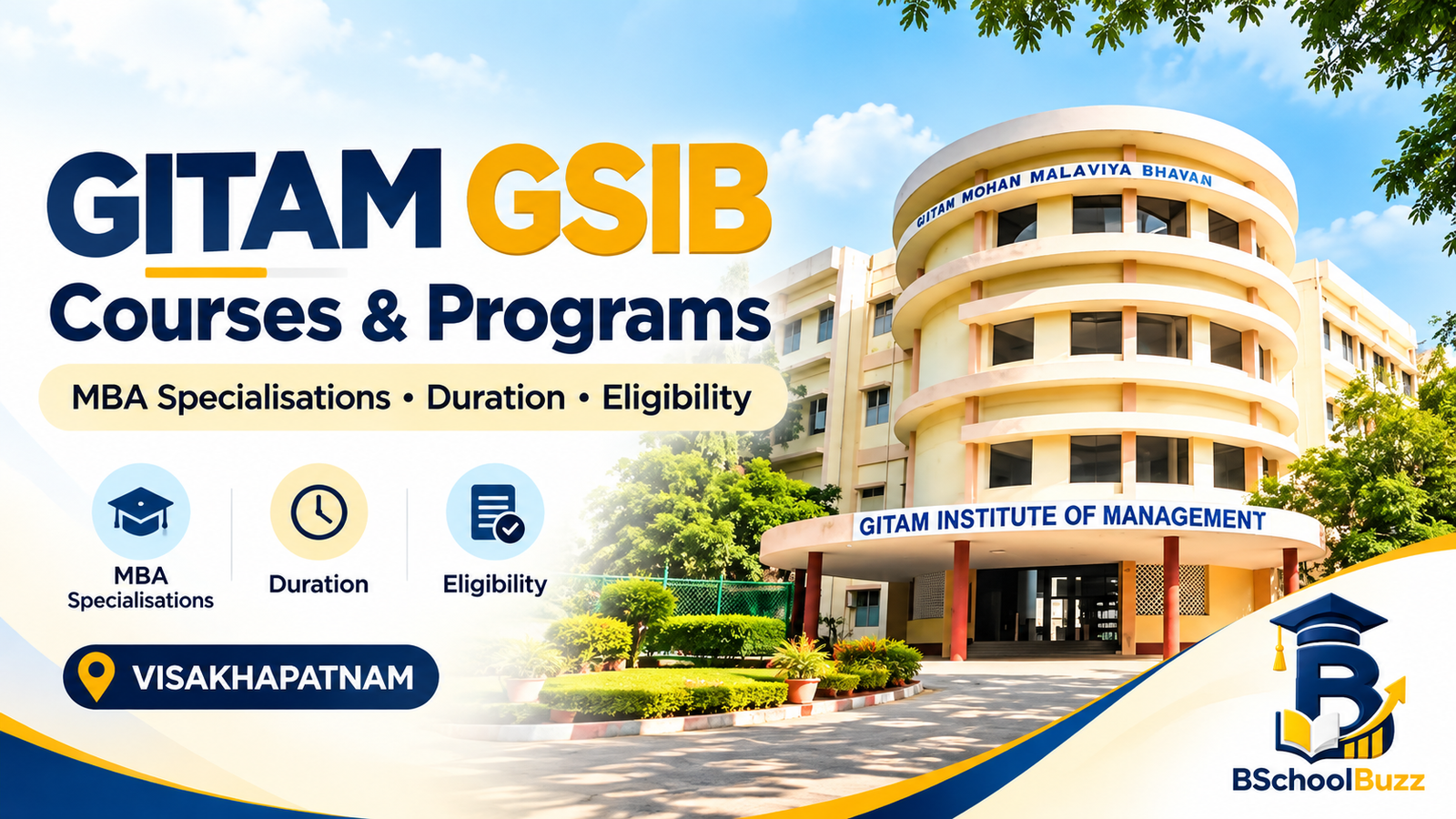
Quick Summary
- GITAM’s current management school name is GITAM School of Business (GSB), while GSIB is a historical name used in older references.
- The current official website lists MBA International Business as a specialisation at the Visakhapatnam campus.
- The MBA programme is described as a two-year course structured across eight terms.
- The published eligibility requirement is a minimum of 60% aggregate marks or 6.0 CGPA in a recognised bachelor’s degree, or an equivalent
- qualification.
- The listed qualifying examinations are GBAT, CAT, MAT, NMAT, CMAT, SNAP and AP/TG ICET.
- GITAM’s admissions portal describes application, entrance-test qualification where required, shortlisting for an extempore round and counselling.
- The current programme pages reviewed for this article do not establish a separate PGDM in International Business.
- Applicants should confirm the current syllabus, programme availability, fees, application dates and selection requirements through official GITAM sources.
GITAM GSIB Courses & Programs: MBA/PGDM Specialisations, Duration & Eligibility
Introduction
Students searching for GITAM School of International Business (GSIB) Visakhapatnam generally want to understand which management programmes are available, whether the institute offers an MBA or PGDM, what specialisations they can choose, how long the programme takes and which eligibility requirements they must satisfy.
The first point to clarify is the institution’s current naming. GITAM’s official website now presents its management school as GITAM School of Business (GSB). The name GITAM School of International Business (GSIB) is still used in older materials and searches relating to the institute’s history. For current applications, students should rely on the programme title and admission information displayed on GITAM’s official website.
The current official Visakhapatnam MBA page lists International Business as one of the MBA specialisations. It describes the MBA as a two-year programme and sets out the academic eligibility and accepted qualifying examinations. The university also lists a separate MBA in Health Care and Hospital Management at Visakhapatnam. These are distinct programmes, so students should check the exact programme before applying.
This guide explains the available programme options, specialisation choices, duration, eligibility criteria, entrance examinations, admission stages, curriculum structure and questions applicants should clarify before making a decision. It focuses on published official information rather than assuming that older GSIB course lists or historical PGDM descriptions remain current.
Table of Contents
GITAM GSIB: Understanding the Name and Current School
Courses and Programmes at Visakhapatnam
MBA International Business: Programme Overview
MBA Specialisations Available at GITAM
Course Duration and Academic Structure
Eligibility Criteria
Entrance Exams Accepted
Admission Process
Curriculum and Learning Approach
International Business: What Students Study
Career Paths After an MBA
MBA or PGDM: What Applicants Should Know
How to Choose the Right Programme
Documents and Application Preparation
Questions to Verify Before Applying
Frequently Asked Questions
Conclusion
About MBA Compass
Also Read
1. GITAM GSIB: Understanding the Name and Current School
GITAM is a deemed-to-be university with campuses in Visakhapatnam, Hyderabad and Bengaluru. Its current website lists management education under GITAM School of Business. Older references to GITAM School of International Business, or GSIB, are associated with the university’s international-business education history.
This distinction matters because online searches can return older brochures, previous curriculum documents and historical programme names. Such materials may be useful for understanding the institution’s background, but they should not automatically be treated as the current admission offer.
For prospective students, the safest approach is to separate three things:
Institution name: the school or academic unit currently shown on GITAM’s official website.
Programme name: the specific MBA or other qualification for which the student intends to apply.
Specialisation: the subject area or academic track available within that programme.
The current official Visakhapatnam MBA page identifies International Business among the MBA specialisations. The current admissions portal also lists the MBA programme and its eligibility requirements. Students looking for an MBA in International Business should therefore begin with these current pages rather than relying solely on an older GSIB brochure.
Official references:
GITAM MBA at Visakhapatnam: https://www.gitam.edu/visakhapatnam/management/course/master-of-business-administration
GITAM MBA admissions portal: https://programmes.gitam.edu/mba/
2. Courses and Programmes at Visakhapatnam
The exact programme matters because the university offers management education in more than one subject area. The current official website identifies the following options relevant to prospective management students at Visakhapatnam.
| Programme | Academic focus | Duration shown by the official programme information |
|---|---|---|
| Master of Business Administration (MBA) | General management education with a range of specialisations, including International Business | Two years |
| MBA in Health Care and Hospital Management | Management of healthcare organisations and hospitals | Two years |
The MBA in Health Care and Hospital Management is presented as a specialised programme delivered with the involvement of Andhra Pradesh MedTech Zone (AMTZ) and the Academy of Hospital Administration (AHA). It is a separate course, not another name for MBA International Business.
The general MBA page includes International Business as a specialisation and describes the programme as a structured management degree. The current programme information does not establish a separate, currently advertised PGDM in International Business. Therefore, applicants should not assume that a historical PGDM title is interchangeable with the current MBA offering.
Which programme should you consider?
Choose the general MBA route if you want broad management education and intend to evaluate specialisations such as International Business, Finance, Marketing or Business Analytics. Consider the healthcare-focused MBA if your primary career interest is hospital administration, healthcare operations or related management work.
Before making a final choice, confirm that the programme is available for your intended admission cycle and at the campus where you plan to study. A specialisation appearing on a general university page does not by itself confirm every detail of the next batch’s curriculum or seat availability.
3. MBA International Business: Programme Overview
The MBA at GITAM Visakhapatnam combines general management education with the opportunity to pursue a subject specialisation. International Business is particularly relevant to students interested in how organisations trade, invest, source products, market offerings and manage operations across national borders.
| Programme detail | Published information |
|---|---|
| University | GITAM (Deemed to be University) |
| Current school name on the website | GITAM School of Business (GSB) |
| Campus relevant to this article | Visakhapatnam |
| Programme | Master of Business Administration (MBA) |
| Specialisation of interest | International Business |
| Duration | Two years |
| Academic structure | Eight terms, as described on the current MBA programme information |
| Minimum academic eligibility | 60% aggregate marks or 6.0 CGPA in a recognised bachelor’s degree, or equivalent |
| Listed qualifying examinations | GBAT, CAT, MAT, NMAT, CMAT, SNAP, AP/TG ICET |
The table summarises information published on GITAM’s current MBA pages. Applicants should check the live admissions portal for any changes to the requirements, application deadlines, selection stages or programme availability for their particular intake.
Why International Business may be a suitable specialisation
International Business is intended for students who want to understand commercial activity across borders. Businesses entering another country need to assess consumer demand, competition, trade conditions, logistics, currency exposure, local regulations and cultural differences. Management professionals working in these areas need to connect strategic decisions with practical business constraints.
A student choosing this specialisation should be interested in more than international travel or working for a multinational company. The subject can involve analysing markets, evaluating export opportunities, understanding global supply chains and examining how a company adapts its products or operating model to different countries.
The value of the specialisation depends on the curriculum, the student’s own skills and the career opportunities they pursue. A specialisation alone does not guarantee an international job or a particular salary.
4. MBA Specialisations Available at GITAM
GITAM’s current MBA information lists the following specialisations:
| Specialisation | Main area of focus |
|---|---|
| Strategy and Consulting | Business strategy, organisational problems and management recommendations |
| Business Analytics | Using data and analytical methods to support decisions |
| Accounting and Finance | Financial reporting, financial analysis and business finance |
| Marketing | Customers, markets, branding and sales strategy |
| International Business | Cross-border trade, global markets and international operations |
| Information Systems | The role of information technology and systems in organisations |
| Organisation Development and Human Resource | People management, organisational behaviour and workforce development |
| Operations and Supply Chain | Processes, procurement, production, distribution and logistics |
| Entrepreneurship | New ventures, business models and business development |
The exact combination of electives, term-wise subjects and available tracks can change with curriculum revisions. Applicants should check the syllabus associated with their admission year rather than assuming that every subject listed in an older brochure remains unchanged.
How to select a specialisation
Start with the type of work you want to explore. Students interested in financial analysis may prefer Accounting and Finance; those who enjoy data interpretation may consider Business Analytics; and students interested in customer behaviour, branding and market development may look at Marketing.
International Business is a possible fit for learners interested in trade, global markets and business operations that span countries. Operations and Supply Chain can appeal to students interested in how goods and services move through an organisation and its suppliers. Strategy and Consulting may suit those who enjoy structured problem-solving and evaluating business decisions.
These descriptions are broad guides, not a substitute for the official syllabus. Compare actual course titles, elective choices, practical projects and internship arrangements before deciding.
5. Course Duration and Academic Structure
GITAM’s current MBA information describes the programme as a two-year course organised across eight terms. This means students should expect a term-based academic structure rather than treating the programme as a single annual block.
| Feature | Officially described structure |
|---|---|
| Overall duration | Two years |
| Number of terms | Eight |
| Teaching approach | Case-based and activity-oriented learning, as described on the programme pages |
| Practical exposure | Internship and immersion tracks are listed |
| Specialisation choice | Available subject areas are listed on the MBA page |
A term-based structure can require students to manage several academic deadlines across the year. Case discussions, assignments, group projects, examinations and experiential activities may all contribute to the learning experience. Students should read the programme handbook to understand assessment rules and the exact term-wise subjects for their batch.
What does the duration mean for planning?
Applicants should plan for the full two-year commitment, including academic work and any programme-required practical components. Do not assume that every internship or immersion activity will occur in the same term or have identical arrangements for every student. The exact schedule should be confirmed with the school.
Students comparing management programmes should also look beyond duration. A two-year course can differ considerably from another two-year course in the subjects taught, depth of specialisation, practical exposure, assessment method and opportunities to build professional experience.
6. GITAM MBA Eligibility Criteria
GITAM’s current official MBA page states that applicants need a minimum of 60% aggregate marks or a 6.0 CGPA in a bachelor’s degree from a recognised Central or State University, or an equivalent qualification. The applicant must also present a valid score in one of the qualifying examinations listed by the university.
| Eligibility component | Current published requirement |
|---|---|
| Qualification | Bachelor’s degree |
| Minimum academic performance | 60% aggregate marks or 6.0 CGPA |
| University or qualification | Recognised Central/State University or equivalent |
| Entrance qualification | A valid score in an examination recognised by GITAM |
| Final admission decision | Subject to the applicable admission and selection process |
Source: https://www.gitam.edu/visakhapatnam/management/course/master-of-business-administration
Does the undergraduate discipline matter?
The current MBA page describes eligibility in terms of a bachelor’s degree and the minimum aggregate requirement. It does not restrict the general MBA eligibility statement to one undergraduate discipline. Candidates from different academic backgrounds should nevertheless confirm that their qualification meets the university’s current equivalence and documentation rules.
Students who studied engineering, commerce, science, arts or another discipline should not assume that their degree title alone determines admission. The published academic threshold, qualifying examination and any additional instructions in the active application cycle must be considered together.
What if your percentage is close to the minimum?
Check your official marksheets and the method used to calculate your aggregate. If your university awards CGPA rather than percentage, confirm the accepted conversion method instead of applying an informal conversion. The current page refers to 60% or 6.0 CGPA; applicants should follow the precise instructions provided for their qualification.
Do not rely on a previous year’s eligibility summary if the current application portal gives different directions. If there is a discrepancy, ask the admissions team for written clarification before paying the application fee or submitting documents.
Is work experience compulsory?
The current general MBA eligibility information cited here does not list compulsory work experience as a condition for the programme. Applicants should still read the active programme-specific notice to check whether any additional conditions apply to a particular course or category of applicant.
7. Entrance Exams Accepted for GITAM MBA
The current official MBA information lists the following qualifying examinations:
| Examination | What applicants should verify |
|---|---|
| GBAT — GITAM Business Aptitude Test | Registration, test schedule and applicable admission instructions |
| CAT | Valid score and the university’s current acceptance rules |
| MAT | Valid score and the relevant examination cycle |
| NMAT | Score validity and the accepted testing window |
| CMAT | Applicable score and admission-cycle instructions |
| SNAP | Valid score and current university requirements |
| AP/TG ICET | Applicable state-level test result and current acceptance conditions |
The university’s admissions portal states that GBAT is mandatory when a candidate does not have one of the listed alternative scores. Candidates should verify the exact wording and current test requirements before selecting an examination route.
Official source: https://programmes.gitam.edu/mba/
How should you choose an entrance examination?
Start by checking which examinations you have already taken and whether their scores are valid for the intended admission cycle. If you do not have a score accepted by GITAM, check the current GBAT registration and test instructions.
Do not assume that a score accepted by one business school will automatically be accepted by another. Universities may differ in the examinations they recognise, the score-validity period and the steps that follow the test. A candidate should also distinguish between a university’s general entrance-exam list and the specific requirements shown for the chosen programme.
Is a particular cutoff guaranteed?
The official pages referenced for this article list qualifying examinations but do not establish one universal numerical cutoff that guarantees admission to every applicant. Meeting the minimum academic eligibility and having a recognised entrance score should not be interpreted as a guarantee of selection.
If GITAM publishes a programme-specific cutoff, shortlist rule or score requirement for the active cycle, use that notice. Otherwise, do not rely on unofficial predictions as if they were confirmed admission thresholds.
8. GITAM MBA Admission Process
The current GITAM MBA admissions information describes a process involving application, entrance-test qualification where required, shortlisting for an extempore round and counselling to select the programme and campus.
| Stage | What the applicant should do |
|---|---|
| 1. Review the programme | Confirm the current programme title, campus, eligibility and specialisation options |
| 2. Submit the application | Complete the official application and provide accurate academic details |
| 3. Meet the entrance requirement | Submit an accepted score or take GBAT if required under the current rules |
| 4. Attend the next selection stage | Follow the instructions for the extempore round if shortlisted |
| 5. Attend counselling | Review programme and campus choices with the university |
| 6. Complete admission formalities | Follow the official offer, document and payment instructions |
This is a practical summary of the process described on the current admissions page, not a substitute for the official admission notice. The university may update its process, dates or documentation requirements for a future intake.
Step 1: Confirm the course before applying
Students searching for GITAM GSIB should verify that they are applying to the current MBA programme at Visakhapatnam and that International Business is available for the relevant batch. If the application portal presents multiple MBA options, check each programme’s title and campus carefully.
Step 2: Complete the application accurately
Use the official admissions portal and ensure that the name, marks, examination information and contact details match the supporting documents. An incorrect percentage, incomplete score information or mismatched identity details can delay verification.
Step 3: Check entrance-exam requirements
Candidates with a recognised score should follow the university’s current submission instructions. Candidates without one of the listed alternative scores should check the GBAT requirement and the schedule applicable to their intake.
Step 4: Prepare for the extempore round
The admissions portal lists an extempore round for shortlisted candidates. An extempore exercise generally involves speaking on a given topic with limited preparation time. Applicants can prepare by practising clear explanations, organising ideas quickly and discussing business or general topics without memorising scripted answers.
The precise format, topic allocation, duration and evaluation criteria should be confirmed from the university’s current instructions. Do not assume that a particular format from an older admission cycle will necessarily be repeated.
Step 5: Attend counselling and review the offer
Use counselling to clarify programme choices, campus arrangements, fee components and the academic structure. Before confirming admission, read the offer and payment instructions carefully. Keep copies of receipts and submitted documents for your records.
9. Curriculum and Learning Approach
The current MBA page describes a learning model that uses case studies, activity-based teaching, collaborative projects, internships and immersion opportunities. The aim is to connect management concepts with business decisions rather than treating the course as theory alone.
GITAM’s current programme page lists the following immersion tracks:
International immersion
Industry immersion
Social immersion
Entrepreneurship immersion
Research immersion
The page also lists internship tracks that include a summer internship, Founder’s Lab and research. Students should verify which tracks are required, optional or available to their particular cohort.
Why case-based learning matters
A business case presents a decision, problem or organisational situation that students must analyse. Instead of simply recalling a definition, students may need to identify the central issue, compare alternatives, consider costs and risks, and defend a recommendation.
This approach can help students practise structured reasoning and communication. Its value depends on the quality of classroom discussion, preparation and feedback, as well as how well students connect the case to business concepts.
The role of projects and internships
Projects and internships can help students test their interests in a practical setting. A student interested in International Business might look for experience related to export operations, market research, cross-border supply chains, international sales or trade documentation, depending on what opportunities are available.
However, the existence of an internship track does not guarantee a specific company, job role or international placement. Students should ask the school how internships are allocated, what support is provided and which requirements apply to the programme.
10. International Business: What Students Study
International Business examines the decisions organisations make when they operate across national boundaries. It brings together business strategy, markets, trade, finance, logistics and the challenges of working across different regulatory and cultural environments.
A student evaluating the specialisation should look for course content and electives that develop the following areas.
International trade and market entry
Businesses entering a foreign market need to understand demand, competitors, distribution channels and the local business environment. Market-entry decisions can involve exporting, partnerships, local distribution or other arrangements. The best option depends on the company, product, market and regulatory context.
Global marketing
A product that succeeds in one market may require changes in another. Consumer preferences, language, purchasing power, distribution and local competition can all affect marketing decisions. International marketing therefore involves balancing a consistent brand strategy with local market requirements.
International finance and risk
Cross-border transactions may involve different currencies, payment arrangements and country-specific risks. Understanding the financial context helps managers evaluate prices, costs and exposure when conducting business internationally.
Global operations and supply chains
International supply chains depend on suppliers, transport, inventory, customs procedures and delivery reliability. Students interested in this area should explore how the curriculum treats sourcing, logistics, procurement and coordination across locations.
International management and communication
Working with teams, clients and partners across cultures requires clear communication and an understanding of different business practices. This does not mean stereotyping people by nationality; it means recognising that expectations and working methods may differ across organisations and markets.
These topics describe the broader field of International Business. They should not be read as a confirmed term-by-term list of GITAM subjects. For the exact course titles and credit requirements, consult the official syllabus applicable to the intended admission year.
11. Career Paths After an MBA
An MBA with an International Business specialisation may be relevant to roles involving global trade, market development, international sales, sourcing and business analysis. Actual opportunities depend on the student’s skills, internships, work experience, performance and the requirements of individual employers.
Possible career areas include:
| Career area | Typical work |
|---|---|
| Export and import operations | Coordinating trade processes, documents and shipments |
| International sales | Developing customer relationships and business across markets |
| Global marketing | Researching markets and adapting marketing plans |
| Supply chain and logistics | Supporting sourcing, transport, inventory and delivery |
| Market research | Analysing demand, competitors and market-entry opportunities |
| Business development | Identifying potential customers, partners and markets |
| Procurement and sourcing | Evaluating suppliers and supporting purchasing decisions |
| Management consulting | Analysing business problems and preparing recommendations |
| Trade compliance support | Helping organisations follow applicable trade and documentation requirements |
The table gives examples of relevant career areas, not a promise that every role is offered through campus placements. Applicants should review official placement reports for the specific school and programme, including the year, batch size, placement methodology and salary measures. General university placement claims should not automatically be treated as outcomes for MBA International Business alone.
How to build a stronger profile
Students can strengthen their preparation by developing business communication, analytical ability, spreadsheet skills, presentation skills and familiarity with international markets. Depending on their interests, they may also benefit from learning about trade documentation, logistics, financial analysis or market research.
An internship or project is most useful when the student can explain what problem they worked on, how they analysed it and what they learned. A specialisation provides academic direction, but career progress also depends on the practical skills and evidence of work a candidate develops during the programme.
12. MBA or PGDM: What Applicants Should Know
The title of this article includes both MBA and PGDM because students often search for the two qualifications together. They are not automatically the same programme, and a college’s historical course listing should not be treated as proof that a particular PGDM is currently offered.
The current GITAM programme pages reviewed for this article advertise the Master of Business Administration (MBA) at Visakhapatnam and identify International Business as a specialisation. They do not establish a separate current PGDM in International Business.
| Question | What applicants should do |
|---|---|
| Is the course an MBA or PGDM? | Check the exact qualification title on the current official programme page |
| Is International Business a specialisation? | Confirm it on the programme page and in the current syllabus |
| Does an older GSIB brochure show a different course? | Check the brochure’s year and compare it with the current admissions portal |
| Can an MBA and PGDM be compared by title alone? | No; compare the awarding institution, recognition, curriculum, duration and current programme rules |
| Which details are most important before applying? | Exact programme, campus, eligibility, fee schedule, assessment structure and admission process |
The practical rule is straightforward: apply for the qualification the university currently advertises, not the qualification assumed from a historical name or search result. If the portal uses a title that differs from an older brochure, ask admissions to confirm the current programme in writing.
13. How to Choose the Right Programme
A management programme should be evaluated against the student’s academic background, professional goals, budget and preferred learning environment. Brand recognition alone is not enough to establish whether a course is the right fit.
Use the following checklist when comparing GITAM’s MBA options with other management programmes.
Match the programme to your goal
If you are interested in cross-border commerce, international markets or global supply chains, examine the International Business specialisation and the actual subjects it offers. If you are more interested in healthcare organisations and hospital administration, review the separate MBA in Health Care and Hospital Management.
Examine the curriculum rather than relying only on the title
Two programmes with similar names can have different electives, practical components and assessment methods. Read the current syllabus, identify the subjects that matter to your goals and ask how students choose electives.
Compare total costs carefully
Review the official fee schedule for the correct course and admission year. Check tuition, any additional compulsory charges, accommodation if applicable, deposits and payment deadlines. Do not calculate a total from an old brochure without confirming whether the amounts still apply.
Understand the selection process
Check accepted entrance exams, minimum academic requirements, selection rounds and any score-validity rules. A qualifying score is one part of the application and should not be confused with a guaranteed admission offer.
Evaluate practical exposure
Ask what internships, industry projects, immersion activities and career services are available. Check whether the programme requires students to find their own internship or whether the university provides structured support. Ask for programme-specific evidence rather than relying only on general promotional statements.
Ask for programme-specific placement information
When reviewing placement statistics, establish which batch and programme they refer to. Highest salary alone is not enough to compare two courses. Average and median salary, placement percentage, the number of students seeking placement, role profiles and the method used to calculate compensation can all affect interpretation.
14. Documents and Application Preparation
Applicants should follow the current official application checklist. The exact list may vary by qualification, entrance examination and admission cycle, so the following is a preparation guide rather than a claim that every item is compulsory in every case.
| Document or information | Why it may be needed |
|---|---|
| Class 10 marksheet or certificate | Academic history and date-of-birth verification, where required |
| Class 12 marksheet or certificate | Previous academic record |
| Bachelor’s degree marksheets | Verification of graduation and aggregate marks |
| Degree or provisional certificate | Confirmation of degree completion, where applicable |
| Entrance examination scorecard | Verification of the qualifying test score |
| Government-issued photo identification | Identity verification |
| Recent photograph and signature | Application or identity records, where required |
| Category or other supporting certificate | Only where applicable under the current instructions |
| Contact and academic details | Completion of the application form |
Before uploading files, check that scans are readable and the details match the application. If you are awaiting a final-year result or have a provisional document, do not assume that the university will accept a particular substitute. Confirm the rule for your situation directly with admissions.
Applicants should also save the application acknowledgement, payment receipt, entrance-test details and any written communication about eligibility. Keeping these records makes it easier to resolve questions if a document or application status needs clarification.
15. Questions to Verify Before Applying
The official programme page is the starting point, but some details need to be checked against the live intake-specific notice. Before paying a fee or accepting an offer, obtain clear answers to the following questions.
Is MBA International Business available at the Visakhapatnam campus for the intended admission cycle?
What is the exact programme name and qualification awarded?
What is the current fee schedule, including compulsory charges and payment dates?
Which entrance exams and score-validity periods are accepted for this intake?
Is GBAT required for applicants who already have another recognised entrance score?
What is the current selection process after the entrance-score stage?
Is there a published programme-specific cutoff or shortlist requirement?
Which International Business subjects and electives are available to the next batch?
What internships and immersion activities are required, and how are they organised?
Are programme-specific placement statistics available for recent batches?
What are the rules for final-year applicants and document submission?
What are the current cancellation and fee-refund rules?
These questions help students avoid a common mistake: treating a general course page as a complete admission contract. The live application instructions and formal offer should govern the final decision.
16. Frequently Asked Questions
1. What is the current name of GITAM GSIB?
GITAM’s current website presents its management school as GITAM School of Business (GSB). GITAM School of International Business (GSIB) is a historical name commonly associated with the institution. Applicants should use the current official website for present-day programme and admission information.
2. Does GITAM offer MBA International Business at Visakhapatnam?
Yes. International Business is listed among the specialisations on GITAM’s official MBA page for Visakhapatnam. Applicants should confirm the availability and curriculum for their intended intake.
3. What is the duration of the GITAM MBA?
The current official MBA information describes a two-year programme structured across eight terms.
4. What is the minimum academic eligibility?
The current MBA page specifies a minimum of 60% aggregate marks or 6.0 CGPA in a bachelor’s degree from a recognised Central or State University, or an equivalent qualification. Check the current admission instructions for any additional conditions.
5. Which entrance exams does GITAM accept for MBA admission?
The current admissions information lists GBAT, CAT, MAT, NMAT, CMAT, SNAP and AP/TG ICET. Candidates should check the live admissions portal for the rules applicable to their admission cycle.
6. Is GBAT compulsory for all applicants?
The admissions portal states that GBAT is mandatory if the candidate does not have one of the listed alternative scores. Applicants with an alternative score should verify that the examination and score are accepted for their intended intake.
7. Is PGDM International Business currently listed by GITAM?
The current official programme pages reviewed here list an MBA with International Business as a specialisation. They do not establish a separate current PGDM in International Business. Verify the qualification title on the live portal before applying.
8. What subjects are taught in International Business?
The field commonly covers international trade, global markets, cross-border operations, international marketing and related management issues. The exact subjects taught at GITAM should be confirmed in the syllabus for the applicable batch.
9. What is the admission process?
GITAM’s current admissions information describes an application stage, qualifying entrance examination where required, shortlisting for an extempore round and counselling to select the course and campus. Follow the active admission notice for the definitive sequence and deadlines.
10. Where should students check current programme details?
Students should begin with the official GITAM Visakhapatnam MBA page and the official MBA admissions portal. These pages provide the institution’s current published programme and eligibility information.
Conclusion
GITAM GSIB remains a familiar search term for students exploring International Business education at GITAM’s Visakhapatnam campus. However, the current official website presents the management school as GITAM School of Business and lists International Business as a specialisation within its MBA programme.
The current MBA information describes a two-year course organised across eight terms. It specifies a minimum of 60% aggregate marks or 6.0 CGPA in a recognised bachelor’s degree and lists GBAT, CAT, MAT, NMAT, CMAT, SNAP and AP/TG ICET as qualifying examinations. The admissions portal also describes shortlisting and an extempore stage, followed by counselling.
The title of a programme, its eligibility and the specialisations available can change over time. Students should therefore confirm the active intake’s programme name, course structure, entrance-test rules, fee schedule and application deadlines before making a payment or accepting an offer. An informed decision should be based on the current official syllabus and admission documents, alongside a careful assessment of career goals and total study costs.
About MBA Compass
MBA Compass helps prospective management students understand MBA and PGDM options, admission requirements, entrance examinations, course structures and career-related considerations. Its goal is to make complex education information easier to compare by organising important details into clear, practical guides.
Students should use these guides as a starting point and confirm final admission requirements with the official institution. Programme availability, eligibility and application instructions can change between admission cycles.
Also Read
MBA Eligibility Criteria: Academic Requirements and Entrance Exams
MBA in International Business: Subjects, Skills and Career Paths
MBA Admission Process: Application, Selection and Documents
MBA vs PGDM: Key Differences Applicants Should Understand
Official sources for verification
GITAM MBA at Visakhapatnam: https://www.gitam.edu/visakhapatnam/management/course/master-of-business-administration
GITAM MBA admissions portal: https://programmes.gitam.edu/mba/
GITAM MBA in Health Care and Hospital Management: https://www.gitam.edu/visakhapatnam/management/course/mba-health-care-and-hospital-management
GITAM School of Business, Visakhapatnam: https://www.gitam.edu/visakhapatnam/gitam-school-of-business
These sources should be checked again when the university publishes or updates information for the relevant admission cycle.
Key Takeaways
Use GITAM’s current official programme pages rather than relying only on older GSIB brochures.
Confirm that MBA International Business is available for your intended admission cycle.
Check the two-year duration and eight-term structure against the syllabus for your batch.
Verify that your undergraduate marks or CGPA meet the published academic eligibility.
Confirm the validity and acceptance of your entrance examination score.
Check whether GBAT is required in your case.
Prepare for the extempore round if it forms part of your selection process.
Compare specialisations based on actual subjects, electives and career interests.
Review the official fee schedule and payment conditions before accepting an offer.
Ask for programme-specific internship and placement information before making a final decision.
Frequently Asked Questions
What courses are offered by GITAM GSIB Visakhapatnam?
GITAM’s current official website lists the MBA at Visakhapatnam, with International Business among the available specialisations. The university also lists a separate MBA in Health Care and Hospital Management at the same campus.
Is GITAM GSIB the same as GITAM School of Business?
GSIB is the historical name commonly used for GITAM School of International Business. The current GITAM website presents the management school as GITAM School of Business (GSB). Applicants should use the current official programme and admission pages when applying.
What is the duration of the MBA at GITAM Visakhapatnam?
The current GITAM MBA information describes the programme as a two-year course structured across eight terms.
What is the eligibility for the GITAM MBA programme?
The current MBA page specifies a minimum of 60% aggregate marks or a 6.0 CGPA in a bachelor’s degree from a recognised Central or State University, or an equivalent qualification. Applicants should confirm the applicable admission-cycle rules before submitting an application.
Which entrance exams are accepted for the GITAM MBA?
The official MBA information lists GBAT, CAT, MAT, NMAT, CMAT, SNAP and AP/TG ICET as recognised qualifying exams. GBAT is stated to be mandatory for candidates who do not have one of the listed alternative scores.
Is International Business available at the GITAM Visakhapatnam campus?
Yes. GITAM’s official MBA page identifies International Business as a specialisation and states that International Business is offered only at Visakhapatnam in its listed campus-specific career and programme information.
Does GITAM offer a PGDM in International Business?
The current official programme pages reviewed for this article identify an MBA rather than a separate PGDM in International Business. Applicants should verify the exact qualification and programme name on the official admissions portal before applying.
What is the difference between MBA International Business and a general MBA?
An MBA provides broad management training, while an International Business specialisation focuses more closely on cross-border trade, international markets and global business operations. The precise subjects and electives depend on the applicable curriculum.
What is the admission process for the GITAM MBA?
The current GITAM admissions information describes applying and appearing for GBAT where required, shortlisting for an extempore round, and counselling to select the course and campus. The final process should be checked against the active admission cycle.
Where can I verify the latest GITAM GSIB course details?
Use the official GITAM MBA programme page and the official Visakhapatnam MBA page. These sources are the best starting points for confirming eligibility, entrance exams, specialisations, curriculum and current admissions instructions.
Ask a question
Still confused? Leave your question and our team will help you.