
Quick Summary
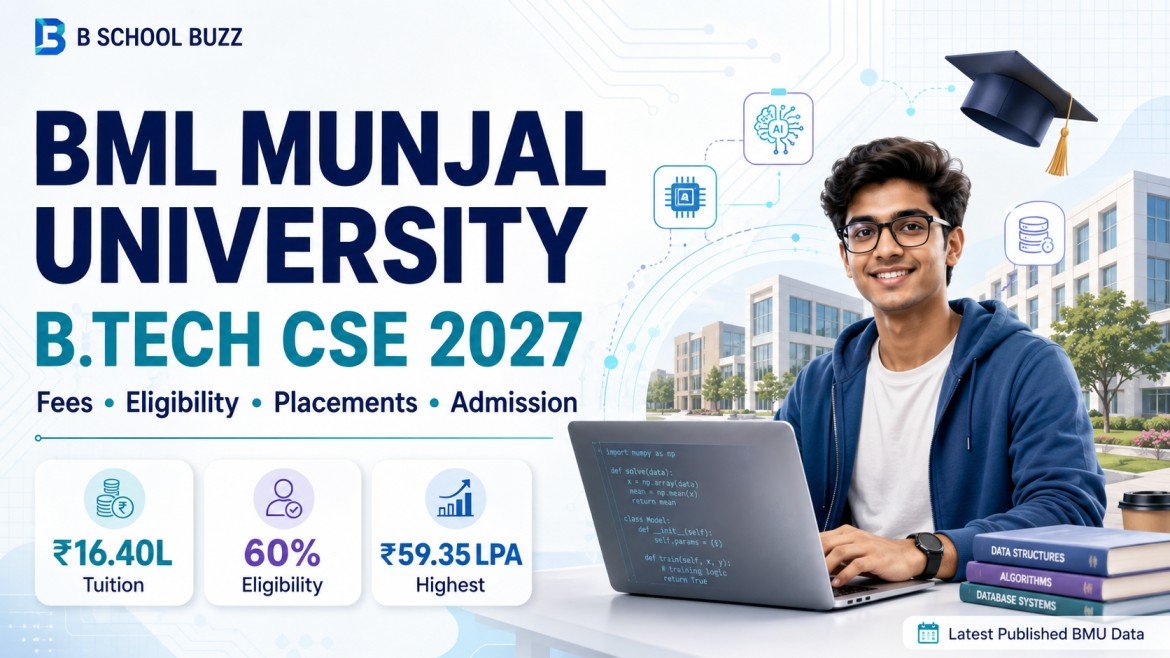
- BMU’s four-year B.Tech CSE currently requires 60% in specified Class 12 subjects. Latest tuition is ₹16.40 lakh, while reported B.Tech placements reached ₹59.35 LPA highest in the 2021–2025 engineering cohort.
Students researching BML Munjal University B.Tech CSE 2027 usually want clear answers to five questions: Can I get admission with my Class 12 and entrance-test scores? How much will the complete degree cost? What will I actually study? What placement outcomes has the university reported? And does the programme offer enough value to justify the investment?
The short answer is that BML Munjal University, commonly called BMU, offers a four-year, eight-semester B.Tech in Computer Science and Engineering through its School of Engineering & Technology. The latest official eligibility policy available in August 2026 requires at least 60% aggregate across Physics, Mathematics, English and one permitted fourth subject, along with at least 50% in either Physics or Mathematics. BMU currently accepts JEE Main, SAT, CUET or BMU-SAT; the CSE-specific page states a minimum 60 percentile in JEE Main, while cut-offs for the other tests may be set from time to time.
For financial planning, the latest published BML Munjal University CSE fees are ₹4.10 lakh per year and ₹16.40 lakh for four years of tuition for Indian students. At the latest listed rates, hostel accommodation with food costs ₹2.25 lakh per year for triple occupancy or ₹2.36 lakh for double occupancy. A one-time registration fee of ₹35,000 and a refundable security deposit of ₹25,000 are additional. These are the university's published 2026 figures, not a guaranteed 2027 fee quotation.
The most recent placement figures published by BMU are for the B.Tech 2021–2025 batch across the School of Engineering & Technology, not for CSE alone. The university reports an approximately 90% placement rate, a ₹59.35 lakh highest salary, ₹19.38 lakh average CTC for the top 10% and ₹14.09 lakh average CTC for the top 25%. These numbers are useful indicators, but they should not be misread as the overall average package or as a guaranteed outcome for every CSE student.
This article explains the BMU B.Tech CSE programme in practical terms, distinguishes confirmed facts from future-cycle information, and shows how a student should assess admission, cost, curriculum, specialisation and career potential before paying a seat-confirmation fee.
2027 information status: As of 18 August 2026, BMU's official B.Tech pages advertise admissions for the 2026 session. The university has not yet published a separate 2027 B.Tech CSE application calendar, 2027 fee sheet or 2027 scholarship matrix on the pages reviewed for this article. Whenever this article discusses 2027 preparation, it uses the latest verified 2026 policy as a planning reference and clearly labels it. Applicants must recheck the official BMU website and their offer letter when the 2027 cycle opens.
BML Munjal University B.Tech CSE 2027 at a Glance
| Particular | Latest verified information available in August 2026 |
|---|---|
| University | BML Munjal University (BMU) |
| School | School of Engineering & Technology (SoET) |
| Programme | B.Tech in Computer Science and Engineering |
| Programme duration | 4 years |
| Academic structure | 8 semesters, 160 credits in the published curriculum |
| Mode | Full-time undergraduate programme |
| Campus | 67th Milestone, NH 48, Kapriwas, Gurugram, Haryana – 122413 |
| Class 12 requirement | Minimum 60% aggregate in Physics, Mathematics, English and Chemistry/Biology/Technical Vocational subject |
| Subject-level condition | Minimum 50% in either Physics or Mathematics; all subjects must be cleared |
| Accepted entrance tests | JEE Main, SAT, CUET or BMU-SAT |
| CSE JEE Main requirement | Minimum 60 percentile under the currently published policy |
| Selection components | Application, document/academic review, entrance route and counselling; BMU-SAT route available under the current process |
| Latest CSE tuition fee | ₹4.10 lakh per year; ₹16.40 lakh over four years |
| Latest hostel fee | ₹2.25 lakh per year for triple AC or ₹2.36 lakh per year for double AC, including food |
| Other published charges | ₹35,000 one-time registration; ₹25,000 refundable security deposit |
| Major CSE specialisations listed | Data Science and Artificial Intelligence, Internet of Things, Cyber Security |
| Other cross-stream major options listed | VLSI Design, Automobile Engineering, Robotics and Automation |
| Experiential-learning claim | Up to 45% experiential learning on the current B.Tech page |
| Practice School | Structured internship model; the dedicated page describes about 28 weeks across the programme |
| Latest official B.Tech placement cohort | 2021–2025 batch, School of Engineering & Technology |
| Latest reported placement rate | Approximately 90% for B.Tech 2021–2025 |
| Latest reported highest salary | ₹59.35 LPA |
| Latest reported top 10% average CTC | ₹19.38 LPA |
| Latest reported top 25% average CTC | ₹14.09 LPA |
| Recognition | UGC-recognised under Section 2(f), empowered to award degrees under Section 22 of the UGC Act |
| Accreditation | NAAC grade A, as displayed by BMU |
| Latest NIRF Engineering position available | 201–300 rank band in NIRF 2025 |
| 2027 application dates | Not officially published as of 18 August 2026 |
| 2027 fees | Not officially published as of 18 August 2026 |
Table of Contents
What Is BMU B.Tech CSE?
The BMU B.Tech CSE programme is a full-time Bachelor of Technology degree in Computer Science and Engineering. It runs for four academic years and eight semesters. The published curriculum totals 160 credits and combines computing foundations, mathematics, general engineering, communication, ethics, design thinking, projects, electives and Practice School internships.
Computer Science and Engineering is wider than learning one programming language. A sound CSE programme should help a student understand how algorithms solve problems, how computer hardware executes instructions, how operating systems allocate resources, how databases store and retrieve information, how networks move data, how software is designed and tested, and how intelligent or secure systems are built. BMU's published semester plan includes these pillars through subjects such as C and Python programming, data structures and algorithms, object-oriented programming in Java, database management, computer networks, operating systems, machine learning, artificial intelligence, cloud computing, software engineering, theory of computation, cryptography and NoSQL databases.
The programme also contains courses that are not narrowly technical. Communication and Writing Skills, Engineering Ethics, Innovation and Entrepreneurship, Corporate Training and Career Skills, Design Thinking and co-curricular components are part of the academic structure. This mixed model matters because entry-level technology jobs often test more than code: recruiters evaluate problem-solving, communication, teamwork, project decisions and the ability to learn unfamiliar tools.
BMU describes its B.Tech model as industry-aligned and experiential. Its current B.Tech page advertises up to 45% experiential learning, while its Practice School page describes sustained work exposure through internships. Students should treat those statements as features of the academic design, then verify the exact experience available to their batch, chosen specialisation and internship employer.
University Recognition, Location and Academic Context
BML Munjal University is a private university in Gurugram, Haryana. It was established in 2014 and is associated with the Hero Group legacy. The university's official recognition page states that BMU is recognised by the University Grants Commission under Section 2(f) and is empowered to award degrees under Section 22 of the UGC Act, 1956. This is a more meaningful verification than relying only on advertising labels such as “top” or “best.”
BMU displays a grade A accreditation from the National Assessment and Accreditation Council. Its official UGC submission lists a NAAC score of 3.20. For engineering-specific national context, the latest published NIRF result available during this research is NIRF 2025, where BML Munjal University appears in the 201–300 Engineering rank band. NIRF does not assign an exact rank to institutions within that band, so it would be inaccurate to call BMU “rank 201” or “rank 300.”
The campus is located at 67th Milestone, NH 48, Kapriwas, Gurugram, Haryana. BMU describes it as a 50-acre green, semi-residential campus. The location may appeal to students seeking access to the Delhi NCR employment ecosystem while studying in a residential or semi-residential environment away from central-city congestion. Location alone does not secure internships or jobs, but proximity to a major corporate region can support events, employer engagement and networking when a student actively uses those opportunities.
BMU's School of Engineering & Technology offers B.Tech branches in Computer Science and Engineering, Electronics and Computer Engineering, and Mechanical Engineering on the current programme page. Its CSE stream carries the higher published tuition fee among these categories: ₹4.10 lakh per year for CSE compared with ₹3.65 lakh per year for EComE and Mechanical Engineering in the latest fee table. Students comparing branches should therefore examine curriculum fit, not select CSE only because software jobs are popular.
Recognition checklist for applicants
Before paying any university, an applicant should verify:
The exact legal name of the university and its UGC recognition.
Whether the offered credential is a degree from the university itself.
The programme title printed on the offer letter.
The campus at which the programme will be delivered.
The current fee refund policy and the date on which deductions change.
The accreditation or ranking year rather than accepting an undated claim.
Whether placement data covers the same school, programme and graduating batch being discussed.
For BMU, the official UGC recognition and the B.Tech programme are clearly identifiable. The more careful work is interpreting fees, scholarships and placements without combining figures from different admission or graduation years.
Why Students Consider Computer Science at BMU
There is no single reason to choose BML Munjal University Computer Science. The programme may attract one student because of its internship structure, another because of scholarship eligibility, and another because the curriculum includes AI, cloud, security and software-engineering courses. A useful decision begins with the features that can be verified.
A curriculum that covers computing foundations and emerging domains
The published curriculum does not start and end with AI. It introduces foundational programming and mathematics, then moves through algorithms, database systems, operating systems, networks, computer architecture and theory of computation before and alongside newer domains. That sequence is valuable because fashionable tools change quickly, while fundamental concepts remain useful across software, data, cybersecurity and research roles.
Multiple programming and development contexts
The programme lists programming in C, Python and Java, along with web programming and mobile application development. Exposure to several languages can help a student understand programming paradigms, but the number of languages on a syllabus is not a measure of employability. Depth comes from writing, debugging, testing and documenting substantial programs.
Major specialisation choices
BMU's CSE curriculum page directly lists major pathways in Data Science and Artificial Intelligence, Internet of Things, and Cyber Security. It also says a CSE student can pursue a major specialisation in VLSI Design, Automobile Engineering, or Robotics and Automation. The university should confirm the exact combination, seat availability, prerequisites and award nomenclature for the 2027 batch before a student relies on a specialisation promise.
Practice School and project credits
Practice School appears across the curriculum, with an audited first component, a credit-bearing second component and a 10-credit final-semester component. The separate Practice School page states that engineering students spend around 28 weeks, or about 22% of total contact hours, interning over the programme. This model can be valuable when work assignments are substantive and well supervised.
Interdisciplinary and professional development
Engineering Ethics, communication, design thinking, innovation, entrepreneurship, career skills, open electives and minor options broaden the degree. Students interested in startups, product management or technical leadership may benefit from that breadth, provided it does not replace consistent practice in core computer science.
Scholarship range
The latest BMU scholarship table shows CSE tuition waivers from 10% to 100% based on JEE Main or SAT performance, subject to policy terms. A strong entrance score can materially change the effective cost of the degree. Scholarship retention conditions are just as important as the initial award, so students should model both the scholarship and no-scholarship scenarios.
BMU B.Tech CSE Eligibility
The currently published BMU B.Tech CSE eligibility criteria contain both an aggregate requirement and a subject-level requirement. Meeting one does not cancel the other.
Eligibility for Indian board students
Under the latest official CSE eligibility page, a candidate must:
Complete Class 12 or an equivalent examination from a recognised board.
Study Physics, Mathematics and English.
Include one additional subject from Chemistry, Biology or a Technical Vocational subject.
Secure at least 60% aggregate across those four specified subjects.
Secure at least 50% in either Physics or Mathematics.
Pass all required subjects.
Complete an accepted entrance examination: JEE, SAT, CUET or BMU-SAT.
For JEE Main, the CSE-specific page currently states a minimum of 60 percentile. For SAT, CUET and BMU-SAT, the page says applicable scores may be specified from time to time. A minimum eligibility score is not the same as a guaranteed admission cut-off. When applications exceed available seats, merit, counselling performance, timing and seat availability may affect selection.
How the four-subject aggregate works
The wording matters. BMU does not simply say “60% in Class 12 overall” on its detailed eligibility page. It specifies an aggregate across Physics, Mathematics, English and one eligible fourth subject. A student with a 62% overall board result could still fail the stated calculation if the four specified subjects average below 60%. Conversely, marks in an unrelated high-scoring subject may not compensate if it is not part of the defined combination.
A practical check is:
[
\text{Specified aggregate} = \frac{P + M + E + X}{4}
]
where (P) is Physics, (M) is Mathematics, (E) is English and (X) is Chemistry, Biology or an eligible Technical Vocational subject.
For example, marks of 64 in Physics, 58 in Mathematics, 72 in English and 70 in Chemistry produce:
[
\frac{64+58+72+70}{4}=66%
]
This hypothetical student clears the 60% aggregate requirement and also has more than 50% in Physics and Mathematics. The example only explains the calculation; BMU makes the final eligibility decision after document verification.
IBCP eligibility
For the International Baccalaureate Career-related Programme, BMU states that candidates in the Engineering or Medical strand who graduate with three Diploma Programme subjects—such as Mathematics, Physics, Chemistry, Biology or similar subjects—may apply if at least one subject is at Higher Level and the candidate has at least three points in each DP subject.
Cambridge and approved British examination bodies
The university states that Cambridge/IGCSE or approved British examination candidates should have at least five subjects and Physics, Chemistry and Biology/Mathematics at A Level. Because international curricula and equivalence rules can be interpreted case by case, such applicants should obtain written confirmation from BMU Admissions before making a non-refundable commitment.
NRI, PIO, OCI and foreign-national eligibility
Applicants who are foreign nationals, Persons of Indian Origin, Non-Resident Indians or Overseas Citizens of India must have an equivalent qualifying examination recognised by the Association of Indian Universities. BMU states a minimum 60% aggregate or equivalent with the required professional-course subject combination. Candidates may need an AIU equivalence certificate depending on their board or qualification.
Can a student apply before Class 12 results?
Yes. BMU's current CSE eligibility page says students may apply early even before Class 12 results are declared. Any early or provisional offer remains subject to verification of the final Class 12 result and satisfaction of eligibility conditions. An offer before results should therefore be understood as conditional, not as a waiver of the minimum marks.
Eligibility versus selection
This distinction protects students from a common misunderstanding:
Eligibility means the applicant meets the minimum academic and testing conditions to be considered.
Selection means the university has evaluated the applicant and offered a seat.
Admission confirmation usually requires document verification and payment within the offer deadline.
Scholarship eligibility is a separate decision governed by the scholarship matrix and its terms.
A 60 JEE Main percentile may satisfy the currently stated CSE test minimum, but it does not automatically produce a scholarship or guarantee a seat. The published CSE scholarship table begins its JEE-based waivers at 75 percentile.
Accepted Entrance Exams and Admission Routes
The latest BMU material names JEE Main, SAT, CUET and BMU-SAT as accepted routes for B.Tech. CSE. The detailed central admission-process page describes two operational modes—one based on JEE Main and another based on Class 12 marks plus BMU-SAT—while the CSE eligibility page also lists SAT and CUET. For the 2027 cycle, applicants should confirm how SAT or CUET scores feed into selection because the exact score thresholds can be revised.
JEE Main route
For CSE, the current minimum is 60 percentile on the programme-specific eligibility page. Under the JEE route, the central admission page describes application submission, upload of academic certificates and the JEE scorecard, application review, a merit list based on JEE Main percentile, evaluation of academic credentials and counselling, communication of the result, a provisional offer and seat confirmation through payment.
JEE Main is also the clearest route for the currently published CSE merit-scholarship table. Higher percentiles correspond to larger tuition waivers, from 10% beginning at 75 percentile to 100% at 95 percentile and above under the latest policy.
BMU-SAT route
Students without a qualifying standardised test can be shortlisted for BMU-SAT. Under the currently described mode, BMU evaluates Class 12 academic performance along with the BMU-SAT result. A counselling session remains part of the broader process. Students should check the 2027 BMU-SAT format, syllabus, test dates, attempt rules and score requirements only after the university publishes the cycle-specific notice.
SAT route
The CSE eligibility page lists SAT as an accepted test, and the B.Tech scholarship table supplies SAT thresholds for tuition waivers. SAT can therefore serve both admission and scholarship purposes under the current policy. The scholarship bands begin at a score of 1250 for a 10% waiver and rise to 1451 or above for a 100% waiver. These bands must be rechecked for the 2027 intake.
CUET route
CUET is listed as an accepted examination, but the university states that the required score may be specified from time to time. Students should not rely on an unofficial “BMU CUET cut-off” copied from an aggregator unless it matches a current BMU notice or an individual offer communication.
Does BMU accept direct B.Tech CSE admission without JEE Main?
A student does not necessarily need JEE Main under the current framework because SAT, CUET and BMU-SAT are also listed. However, calling this “direct admission” can be misleading if it suggests admission without academic or test evaluation. BMU still reviews eligibility, academic records and the applicable entrance route, and shortlisted applicants may attend counselling. Students without JEE Main should expect to follow another accepted route rather than assume an unrestricted management-quota seat.
BML Munjal University CSE Admission Process
The BMU CSE admission journey is straightforward in concept but requires careful document and deadline management. The following workflow combines the current programme-specific and central B.Tech instructions.
Submit the online application
Use the official BMU application portal and select B.Tech CSE as the intended programme. Enter the name, date of birth, contact details and academic information exactly as they appear on official documents. Discrepancies in spelling or marks can delay verification.
Select the applicable entrance route
Enter JEE Main, SAT or CUET details if available, or follow the BMU-SAT process when applicable. If a result is awaited, the current process permits an early application, but applicants should update test or board information in the manner specified by Admissions.
Upload supporting records
Typical records include Class 10 and available Class 12 marksheets, entrance-test scorecard, government identity proof, photograph and category or scholarship documents where relevant. The final 2027 portal checklist will control, so students should not treat a generic document list as exhaustive.
Pay the application fee
The official BMU admission-process search result currently displays a ₹2,000 B.Tech CSE application fee. Applicants must verify the amount on the live 2027 application portal before payment. Save the transaction receipt and application number.
Application screening or BMU-SAT
JEE-route applications are reviewed using the submitted academics and JEE percentile. Applicants using the university-test route may be shortlisted for BMU-SAT. The existence of a minimum percentile does not prevent BMU from using a merit list when required.
Attend counselling
BMU describes counselling as an opportunity to understand the programme, curriculum, faculty, specialisations, campus life and global connections, followed by questions and answers. Its central admission page also includes counselling in selection-committee evaluation. Applicants should be ready to discuss academic interests, projects, choice of branch and career goals in clear terms.
Receive and audit the provisional offer
A selected applicant receives communication from the Admissions Team. Before accepting, read the programme name, campus, scholarship, tuition, hostel terms, refund clause, payment schedule, document conditions and deadline. Do not assume a verbal scholarship promise is binding unless it appears in official written communication.
Confirm the seat
Pay the specified amount before the offer deadline if the terms are acceptable. Keep invoices and acknowledgement emails. Students awaiting final board results must still meet the stated Class 12 eligibility when results are declared.
Complete registration and verification
Carry or upload originals as directed, complete anti-ragging and other mandatory forms, pay the remaining instalments and follow joining instructions. A provisional offer becomes final only after all admission conditions are satisfied.
Expected 2027 Admission Timeline
BMU has not published a separate B.Tech CSE 2027 calendar as of 18 August 2026. It would be inaccurate to supply invented opening, closing, BMU-SAT, counselling or class-commencement dates. The timeline below is a preparation framework, not an official schedule.
| Preparation period | What a 2027 applicant can do | Official status |
| August–October 2026 | Shortlist programmes, review eligibility, prepare JEE Main/CUET/SAT strategy, estimate finances | Planning action; BMU 2027 dates not published |
| When BMU opens 2027 applications | Register on the official portal and record application credentials | Wait for official announcement |
| During entrance-test registration windows | Complete JEE Main, CUET or SAT registration as applicable | Follow each exam authority's official schedule |
| After a score becomes available | Upload the result and check scholarship eligibility | BMU process to be confirmed for 2027 |
| If using BMU-SAT | Book or appear for the university test when invited | Dates and rules not yet published |
| Counselling and offer stage | Compare the written fee, scholarship, refund and hostel terms | Offer-specific |
| Before joining | Complete result verification, fee payment and registration documents | University instructions will apply |
Students should monitor the official BMU B.Tech page and official application portal rather than using a third-party deadline without cross-checking it. Admission phases can close, extend or reopen depending on seat availability; the date printed on a student's offer letter is operationally more important than a general web article.
Documents to prepare in advance
Class 10 marksheet and passing certificate.
Class 12 marksheet or available school-predicted/pre-board information if the portal requests it.
JEE Main, SAT or CUET scorecard, if using that route.
Recent passport-size photograph and scanned signature.
Aadhaar card, passport or other accepted identity proof.
Transfer, migration and character certificates when required at registration.
Haryana domicile certificate if applying for the applicable category benefit.
Defence-service, Hero Group employment or sports documents if seeking the corresponding waiver.
International-board equivalence documentation where applicable.
Payment receipts, offer letter and scholarship letter.
The university's final checklist can add or remove documents. Applicants should use clear scans, consistent names and accessible email and mobile numbers throughout the process.
BML Munjal University CSE Fees
The latest published BML Munjal University CSE fees for Indian students are ₹4,10,000 per year in tuition. The same annual tuition is listed for each of the four years, producing a published programme tuition total of ₹16,40,000.
Latest published CSE tuition table
| Academic year | Tuition fee for Indian students* |
| First year | ₹4,10,000 |
| Second year | ₹4,10,000 |
| Third year | ₹4,10,000 |
| Fourth year | ₹4,10,000 |
| Four-year tuition total | ₹16,40,000 |
*The official table includes Indian students and residents of Nepal, Bangladesh, Sri Lanka and Bhutan in this category. BMU separately lists US-dollar fees for other foreign nationals, PIOs, NRIs and OCIs.
The published foreign-category CSE tuition is $7,100 per year and $28,400 over four years. International applicants should ask whether taxes, bank charges, currency-conversion effects, insurance or visa-related expenses apply in addition.
Other published charges
| Charge | Latest published amount for Indian students | Nature |
| One-time registration fee | ₹35,000 | Non-recurring charge |
| Refundable security deposit | ₹25,000 | Refundable subject to university rules |
The fee page says the structure includes tuition, registration and other academic costs, but families should still ask for a complete, offer-specific schedule. Costs for a laptop, travel, personal expenses, optional international exposure, examination re-registration, damage, laundry, medical needs or student activities may not be captured by the tuition headline.
Important 2027 fee caution
The ₹16.40 lakh figure is the latest official tuition total available during research, not a promise that BMU CSE fees will remain unchanged for a student entering in 2027. A future offer letter may revise tuition, hostel charges, payment dates or ancillary fees. The correct amount for an applicant is the amount in the 2027 fee notification and individual offer.
Questions to ask about the fee schedule
Is the tuition fixed for all four years of the admitted batch?
Are there separate examination, lab, technology or student-activity charges?
When is each instalment due?
What happens if payment is late?
Which part of the seat-confirmation amount is refundable?
Does the refund follow the latest UGC fee-refund policy?
Is hostel residence mandatory for the programme or only subject to availability?
Are mess charges included in the quoted hostel amount?
Does the scholarship apply only to tuition or also to registration and hostel?
How is the scholarship adjusted against instalments?
Written answers make financial comparison much more reliable than a verbal estimate.
Hostel Charges and Total Cost
BMU's latest B.Tech fee page lists air-conditioned tower accommodation with food. The annual charges are ₹2,36,000 for double occupancy and ₹2,25,000 for triple occupancy for the Indian-student category used on the page.
| Accommodation | Occupancy | Latest annual charge including food |
| Tower AC | Double | ₹2,36,000 |
| Tower AC | Triple | ₹2,25,000 |
For the specified foreign-national/NRI/PIO/OCI category, the corresponding published amounts are $4,100 for double occupancy and $3,900 for triple occupancy per academic period.
Illustrative four-year cost at unchanged 2026 rates
The following calculation is useful for budgeting, but it is not an official 2027 total. It assumes the latest published tuition and hostel charges remain unchanged for four years, includes the registration fee and refundable deposit, and excludes personal or optional expenditure.
| Cost component | Triple occupancy illustration | Double occupancy illustration |
| Four-year CSE tuition | ₹16,40,000 | ₹16,40,000 |
| Four years of hostel and food at current annual rate | ₹9,00,000 | ₹9,44,000 |
| One-time registration | ₹35,000 | ₹35,000 |
| Refundable security deposit | ₹25,000 | ₹25,000 |
| Illustrative cash outlay | ₹26,00,000 | ₹26,44,000 |
| Less refundable deposit, if fully returned | ₹25,000 | ₹25,000 |
| Illustrative net cost after full security refund | ₹25,75,000 | ₹26,19,000 |
This estimate can change because hostel rates may rise, room types may not be guaranteed, scholarships may reduce tuition, and a student's travel and personal spending vary. A realistic family budget should add a contingency rather than planning only for the headline amount.
Personal and academic expenses to model
A CSE student may need a capable laptop, peripherals, software or cloud credits, internet backup, books, travel home, local transportation, clothing, medical costs and project components. Many development tools are free for students, but hardware-heavy work, specialised certification exams or international programmes can add substantial cost.
Instead of choosing an arbitrary personal-expense figure, families can build a monthly budget under four headings:
Essential personal spending.
Travel between home and campus.
Academic equipment and project costs.
Optional certifications, competitions or international experiences.
This method produces a more honest total cost of attendance than comparing tuition alone.
Scholarships and Fee Waivers
Scholarships can significantly alter the value equation for BML Munjal University B.Tech CSE 2027. The latest published matrix includes Dean's Scholarships and Programme Scholarships based on JEE Main or SAT performance. It also describes Haryana domicile concessions, defence and Hero ward waivers, sports scholarships and an equity scholarship.
Latest CSE merit-scholarship matrix
| Scholarship | Tuition-fee waiver | JEE Main percentile for CSE | SAT score |
| Dean's Scholarship | 100% | 95 and above | 1451 and above |
| Dean's Scholarship | 75% | 90–94.99 | 1401–1450 |
| Programme Scholarship | 50% | 85–89.99 | 1351–1400 |
| Programme Scholarship | 25% | 80–84.99 | 1326–1350 |
| Programme Scholarship | 10% | 75–79.99 | 1250–1325 |
These are current published bands for planning. The 2027 scholarship matrix may differ. Scholarships are also subject to availability and policy conditions; meeting a score band should not be treated as a final award until BMU confirms it in writing.
What a waiver means in rupees at the latest tuition rate
The following arithmetic applies the percentage to the current ₹4.10 lakh annual tuition. It does not determine the duration or renewal of an actual award.
| Waiver | Tuition reduction on ₹4.10 lakh | Remaining annual tuition |
| 100% | ₹4,10,000 | ₹0 |
| 75% | ₹3,07,500 | ₹1,02,500 |
| 50% | ₹2,05,000 | ₹2,05,000 |
| 25% | ₹1,02,500 | ₹3,07,500 |
| 10% | ₹41,000 | ₹3,69,000 |
The Dean's Scholarship is described as a full-duration scholarship subject to retention conditions. The Programme Scholarship is described as a first-year award that may be renewed annually from the second year based on academic performance, attendance, discipline and rank in the programme merit list. Therefore, multiplying every Programme Scholarship percentage by four years without qualification would be misleading.
Dean's Scholarship retention conditions
BMU's current policy states that a Dean's Scholarship recipient must maintain:
A minimum CGPA of 8.5 every year.
At least 80% attendance across courses in each semester or module in the previous year.
A record without disciplinary action.
The policy says the Dean's Scholarship will be revoked if the required CGPA is not achieved, without an option for reinstatement. This creates meaningful academic risk in a family budget. A student should know whether the household can continue the programme if the waiver is lost.
Programme Scholarship renewal conditions
From the second year, renewal may depend on rank in the programme merit list and requires at least:
A 7.00 CGPA at the end of the previous academic year.
80% attendance across the relevant courses.
No disciplinary action.
The university also says scholarships are awarded on a first-come, first-served basis. Early application can therefore matter, but students should never rush into payment without reading the refund and scholarship terms.
Haryana domicile concession
BMU states that the Haryana domicile provision follows the Haryana Private Universities Act. According to the current page, 25% of students admitted under the Haryana domicile category are eligible for full or partial fee concessions. Within that eligible group, one-fifth receive full concession, two-fifths receive 50% concession and the remaining two-fifths receive 25% concession. Subsequent-year awards depend on merit, academic performance, attendance and family income under the university's process.
Defence Ward Fee Waiver
Eligible children of serving or retired armed-forces officers or personnel of other ranks may receive a 10% tuition-fee waiver for the full programme duration, subject to terms and conditions. Applicants should confirm acceptable service documents and whether multiple awards can be combined.
Hero Ward Scholarship
Eligible children of employees of listed Hero Group companies may receive a 10% tuition-fee waiver for the programme duration, subject to policy conditions. BMU names companies such as Hero MotoCorp, Hero FinCorp, Hero Future Energies, Munjal Showa, Rockman Industries, Hero Cycles and Hero Enterprise on the current page.
Sports Scholarship
BMU describes a 25% to 100% tuition waiver for eligible sportspersons, depending on state, national or international participation. Candidates must satisfy a physical fitness and sports-proficiency assessment and may be required to represent the university. Renewal is reviewed under applicable academic, attendance and conduct conditions.
Equity Scholarship
The Equity Scholarship is intended for academically strong students from economically weaker backgrounds. The Admissions & Scholarship Committee reviews applications, including a personal interaction, and may in exceptional cases consider student-housing support. Continued aid is subject to criteria such as a 7.00 CGPA, 80% attendance and no disciplinary action under the current policy.
Scholarship questions to settle before admission
Is the award guaranteed or provisional?
Does it apply to tuition only?
Is the percentage fixed or reviewed annually?
What CGPA and attendance rules apply?
Does the award depend on programme rank after the first year?
Can it be combined with a domicile, ward or sports concession?
What happens if a student changes branch or specialisation?
Is a lost scholarship restorable?
Is the scholarship amount adjusted before or after the fee deadline?
Does withdrawal affect the scholarship calculation or refund?
The safest financial model includes three scenarios: full scholarship retention, partial or no renewal, and complete loss of the waiver. If the no-scholarship scenario is unaffordable, the risk deserves serious attention before enrolment.
BMU B.Tech CSE Curriculum
The published BMU B.Tech CSE curriculum is organised into eight semesters and totals 160 credits. It moves from general engineering, mathematics and introductory programming to core computer science, advanced electives, projects and a final Practice School term.
No syllabus should be judged only by the presence of popular terms. A strong CSE education depends on sequencing, teaching quality, assessment, lab work, project depth and student practice. BMU's listed subjects show a broad and recognisable computing foundation, but each applicant should ask for the curriculum applicable to the 2027 entry batch because universities periodically revise credits, course titles and electives.
Semester-wise curriculum overview
| Semester | Selected subjects in the currently published curriculum | Main learning purpose |
| Semester 1 | Engineering Ethics, Communication and Writing Skills, Elements of Mechanical Engineering, C Programming, Basic Electrical and Electronics Engineering, Calculus, Design Thinking | Engineering foundation, communication and first programming exposure |
| Semester 2 | Python Programming, Joy of Engineering, Probability and Statistics, Engineering Physics, Environmental Science and Sustainability, basket courses | Computing fluency, scientific reasoning and multidisciplinary learning |
| Semester 3 | Innovation and Entrepreneurship, Data Structures and Algorithms, Data Analytics using Python, Linear Algebra and Differential Equations, Web Programming, Digital Logic Design, Java OOP | Core problem-solving, software and digital-systems foundation |
| Semester 4 | Corporate Training and Career Skills, DBMS, Design and Analysis of Algorithms, Computer Networks, Operating Systems, Mobile Application Development, Human–Computer Interaction, Practice School 2 | Core systems, application development and industry exposure |
| Semester 5 | Project 1, Machine Learning, Computer Organisation and Architecture, Digital Image Processing, Artificial Intelligence, specialisation elective | AI-oriented study, architecture and first substantial project |
| Semester 6 | Logical Reasoning and Quantitative Analysis, Software Engineering, IoT Sensors and Applications, Cloud Computing, specialisation electives, Project 2, open elective | Software delivery, connected systems, cloud and deeper specialisation |
| Semester 7 | Network Security and Cryptography, Theory of Computation, NoSQL Database Management, specialisation electives, open elective | Security, theoretical depth, modern data systems and advanced choices |
| Semester 8 | Practice School 3 | Extended applied or industry experience |
First year: engineering and computational foundations
Semester 1 contains 20 credits. Computer Programming using C introduces structured programming, control flow, functions, arrays, pointers and problem decomposition, depending on the detailed course implementation. Calculus supports modelling and later algorithmic or machine-learning work. Basic Electrical and Electronics Engineering and Elements of Mechanical Engineering expose students to the wider engineering context. Communication and Writing Skills is directly relevant to technical reports, interviews and teamwork.
Design Thinking – The Way to Joy of Engineering and Engineering Ethics introduce problem definition, user needs, social responsibility and professional conduct. These subjects can appear less important to a student focused only on coding, but software engineers routinely make decisions involving privacy, safety, accessibility, bias, security and environmental impact.
Semester 2 lists 22 credits plus Practice School I/Community Project as an audit component. Python Programming gives students a second language suited to scripting, data work and rapid prototyping. Probability and Statistics is central to data science and machine learning. Engineering Physics and Environmental Science maintain the broader engineering foundation. The published semester also contains ability-enhancement, value-added and science basket choices, so exact titles may depend on the available basket.
Second year: the heart of core computer science
Semester 3 introduces Data Structures and Algorithms, one of the most important courses for both computing competence and placement preparation. A student should use it to understand arrays, linked structures, stacks, queues, trees, graphs, hashing, sorting, searching and complexity rather than memorising interview answers.
Data Analytics using Python connects programming with data handling. Linear Algebra and Differential Equations support optimisation, graphics, machine learning and scientific computation. Web Programming adds an application context. Digital Logic Design explains how binary information is represented and processed. Object-Oriented Programming using Java builds concepts such as classes, encapsulation, inheritance, polymorphism and interfaces.
Semester 4 deepens the systems and software foundation. Database Management System covers structured data, modelling, SQL, normalisation, transactions and indexing in a typical CSE context. Design and Analysis of Algorithms studies strategies and complexity beyond introductory data structures. Data Communications and Computer Networks explains protocols and network behaviour. Operating Systems covers processes, memory, concurrency, file systems and resource management.
Mobile Application Development and Human–Computer Interaction help students build user-facing systems, while Corporate Training and Career Skills introduces professional preparation. Practice School 2 carries four credits in the published plan. By the end of the second year, a serious student should be able to build and explain a database-backed application, solve intermediate algorithmic problems and describe how operating systems and networks support the application.
Third year: AI, software engineering, cloud and specialisation
Semester 5 contains Machine Learning, Artificial Intelligence and Digital Image Processing. Machine learning should be approached with an understanding of statistics, linear algebra, evaluation and data quality—not only model-library calls. Computer Organisation and Architecture connects software execution with processors, memory and instruction behaviour. Project 1 and the first specialisation-specific core elective allow students to begin showing depth.
Semester 6 includes Software Engineering, IoT Sensors, Peripherals, Processors and Applications, and Cloud Computing. Software Engineering is especially relevant to professional development because maintainable systems require requirements analysis, design, version control, testing, deployment and team processes. Cloud Computing introduces remote infrastructure, services, scaling and distributed delivery concepts. Two more specialisation electives, Project 2 and an open elective permit a more individual academic path.
Logical Reasoning and Quantitative Analysis can support recruitment preparation, but students should not postpone coding and aptitude work until this course. Placement performance is built gradually through problem-solving, projects, internships and communication.
Fourth year: advanced foundations and applied immersion
Semester 7 includes Network Security and Cryptography, Theory of Computation and NoSQL Database Management. Theory of Computation gives formal grounding in what machines can compute and how languages are recognised. Cryptography and network security address confidentiality, integrity, authentication and attack models. NoSQL systems introduce non-relational storage patterns suited to different data and scaling requirements.
The remaining semester includes advanced specialisation and open electives. Semester 8 is a 10-credit Practice School 3 component in the current curriculum. This structure creates time for industry work or applied problem-solving, but outcomes depend on the role, mentor, deliverables and the student's contribution.
Published credit distribution by semester
| Semester/component | Credits in the published curriculum |
| Semester 1 | 20 |
| Semester 2 | 22 |
| Semester 3 | 22 |
| Semester 4 | 22 |
| Practice School 2 | 4 |
| Semester 5 | 20 |
| Semester 6 | 22 |
| Semester 7 | 18 |
| Semester 8 / Practice School 3 | 10 |
| Programme total | 160 |
Practice School 1 is shown as an audit component and is not added as a numerical credit in this table. The official page is the controlling source if BMU changes the plan.
What is good about the curriculum design?
Several features are academically sensible:
Algorithms appear at introductory and advanced levels.
Systems courses include architecture, operating systems, networks and databases.
Mathematics includes calculus, probability, statistics and linear algebra.
AI and machine learning follow earlier programming and mathematical preparation.
Security, cloud, IoT and NoSQL widen the advanced computing scope.
Projects are credit-bearing rather than purely extracurricular.
The final semester emphasises applied work through Practice School.
Communication, ethics, entrepreneurship and career training support professional growth.
What should an applicant still verify?
A curriculum webpage cannot answer every quality question. Ask BMU:
Which curriculum version will apply to the 2027 batch?
Which programming, cloud and laboratory platforms are currently used?
How large are lab sections?
What proportion of assessment comes from projects versus written exams?
How are Project 1 and Project 2 supervised and evaluated?
Which specialisation electives actually run every year?
Can a specialisation be cancelled if too few students choose it?
Is Practice School 3 always external, or can it be university/research based?
How are students matched to internships?
Are there prerequisites or minimum CGPA rules for specialisations?
These questions distinguish a published curriculum from the lived academic experience.
CSE Specialisations
BMU's current CSE curriculum page lists three direct CSE major specialisations—Data Science and Artificial Intelligence, Internet of Things, and Cyber Security. It also states that a CSE student can take a major specialisation in VLSI Design, Automobile Engineering, or Robotics and Automation. The current generic B.Tech page presents six specialisations across engineering streams.
Data Science and Artificial Intelligence
This pathway suits students interested in data analysis, predictive modelling, computer vision, natural-language applications, recommendation systems or intelligent automation. The base curriculum already includes probability, statistics, linear algebra, data analytics, machine learning, artificial intelligence and image processing.
A strong AI/data profile needs more than completing those subjects. Students should learn to clean and document datasets, establish baselines, select proper evaluation metrics, avoid data leakage, explain model limitations and consider fairness and privacy. Useful portfolio projects solve a real problem and show the entire pipeline from data collection to evaluation or deployment.
Potential roles include data analyst, junior data scientist, machine-learning engineer, AI application developer, data engineer and business-intelligence developer. Entry-level job titles vary, and many “data scientist” positions expect postgraduate study or prior experience. Students should therefore build solid software and database skills alongside modelling.
Internet of Things
IoT connects sensors, embedded devices, networks, cloud platforms and applications. BMU's core plan includes IoT Sensors, Peripherals, Processors and Applications, cloud computing, networks and programming, which form a relevant base.
This specialisation may suit students who enjoy both software and physical systems. Projects could involve environmental monitoring, predictive maintenance, energy use, mobility, agriculture, logistics or health devices. Good IoT work must address power constraints, unreliable networks, security, device management, data storage and user value—not only connect a sensor to a dashboard.
Career options can include IoT developer, embedded-software engineer, cloud-IoT engineer, automation engineer, solutions engineer or test engineer. Students should verify how much hardware access, embedded programming and electronics support the actual elective basket provides.
Cyber Security
Cyber Security suits students interested in secure software, networks, identity, risk, incident response, vulnerability analysis or digital forensics. The core curriculum includes networks, operating systems, database systems, software engineering, cloud computing, network security and cryptography—all relevant foundations.
Security requires ethical discipline. Students should practise only in authorised labs, capture-the-flag environments and systems for which they have permission. A responsible portfolio can include secure coding, threat modelling, log analysis, network monitoring, vulnerability remediation and security automation.
Possible roles include security analyst, security engineer, SOC analyst, application-security trainee, cloud-security associate, vulnerability analyst and governance/risk/compliance analyst. Some roles value certifications, but certifications should supplement rather than replace operating-system, networking and programming competence.
VLSI Design
VLSI focuses on integrated-circuit and digital-system design. For a CSE student, this can connect digital logic, computer architecture and hardware-description concepts. It may appeal to students curious about processors, accelerators, edge computing and semiconductor design. Because VLSI is hardware-intensive, applicants should ask which EDA tools, fabrication or design labs, faculty expertise and placement roles are available to CSE students taking this pathway.
Robotics and Automation
Robotics brings together software, sensing, control, mechanical systems, electronics and AI. BMU lists robotics, automation and mechatronics facilities within its centres. CSE students may contribute through perception, planning, simulation, embedded software, computer vision or human–robot interaction. Verify whether the specialisation structure includes sufficient control, hardware and mathematics for the intended career.
Automobile Engineering
An automobile-oriented major can make sense for students interested in connected vehicles, mobility software, autonomous systems, diagnostics, embedded computing or manufacturing technology. The value depends on the elective sequence and hands-on access. A student seeking conventional web-development roles may receive less direct benefit from this pathway than one targeting automotive technology.
Minor specialisations
The current curriculum page lists minor options in Energy Harvesting and Storage, Materials Science, Nanotechnology, Entrepreneurship and Computational Mathematics. A minor can broaden a profile, but students should first master the CSE core. The university should confirm eligibility, seat limits, timetable compatibility and how the minor appears on the transcript or degree documentation.
How to choose a specialisation
Choose based on the work you enjoy and the problems you want to solve, not only the current popularity of a label. A practical decision method is:
Review the actual elective names and prerequisites.
Inspect faculty profiles and recent research in that domain.
Look at available labs and software tools.
Ask which projects students completed in the last two years.
Check whether internship and placement roles match the specialisation.
Preserve general software and algorithms competence.
Select a pathway that you can demonstrate through two or three serious projects.
General CSE skills remain transferable. A student in AI still needs data structures and software engineering; a cybersecurity student still needs operating systems and networks; an IoT student still needs programming and secure system design.
Practice School, Projects and Experiential Learning
Practice School is one of BMU's more distinctive academic claims. The official page describes it as an internship concept that enables B.Tech students to gain meaningful work experience during the degree. It says School of Engineering & Technology students spend around 28 weeks, or 22% of total contact hours, interning over four years.
The published CSE curriculum shows Practice School at three points:
Practice School 1 or Community Project after the early foundation stage, listed as an audit component.
Practice School 2 after Semester 4, carrying four credits.
Practice School 3 in Semester 8, carrying ten credits.
Another BMU page describes historical modules of approximately one week, eight weeks and 22 weeks. Applicants should verify the schedule for their own batch because formats can evolve.
Why structured internships can help
An internship embedded in the curriculum can provide:
Exposure to professional requirements and deadlines.
Experience with code review, testing, documentation and collaboration.
A better understanding of how businesses define technology problems.
Material for a resume and interview discussion.
Mentorship and professional references.
A chance to discover whether a chosen domain fits the student's interests.
Potential pathways to a pre-placement interview or offer, depending on the employer.
What determines internship quality
The duration alone does not make an internship valuable. A strong experience usually has a defined problem, appropriate access, a technical mentor, regular feedback, measurable deliverables and a final review. A weak experience may consist largely of observation, repetitive non-technical tasks or an artificial project with little guidance.
Before relying on Practice School as a major reason to enrol, ask:
Does every eligible student receive an internship through the university, or may students source one independently?
How many internship partners offer software, data, security or product roles?
How are students allocated when demand exceeds a company's slots?
Are internships paid, unpaid or mixed?
What happens if an employer withdraws?
How are remote, research or startup internships evaluated?
Can a student reject an unsuitable role?
What academic supervision occurs during the work term?
How does the internship grade affect CGPA?
What percentage of recent students received pre-placement offers?
BMU reports a ₹67,000 highest monthly internship stipend and ₹22,800 average monthly stipend for the B.Tech 2021–2025 cohort. These are cohort-level historical figures, not a promised stipend for every Practice School placement.
Project 1 and Project 2
The curriculum includes Project 1 in Semester 5 and Project 2 in Semester 6. Projects help students integrate algorithms, data, interfaces, infrastructure and documentation. A good project should answer four questions:
What problem does it solve and for whom?
What technical decisions were made and why?
How was correctness or performance evaluated?
What did the student personally implement?
For hiring, a modest but complete project is often more credible than a large copied application. Students should maintain version history, a readable README, architecture notes, test evidence and a short demo. If a project uses machine learning, it should include data provenance and proper evaluation. If it handles users, it should consider authentication, security and privacy.
Hackathons and technical communities
The current B.Tech page mentions hackathons and tech meetups. These can accelerate learning when students use them to build under time constraints, work with unfamiliar teammates and present decisions. They should not replace semester-long depth. A strong profile combines sustained academic work with selective competitions or community involvement.
Labs, Research and Innovation Environment
BMU lists laboratories and centres spanning computing, robotics, automation, design and advanced manufacturing. The CSE specialisation page refers to facilities for IoT, cloud computing, high-performance computing, machine learning, AI, data science and VLSI, alongside industrial labs. The research-facilities page highlights the Siemens Centre of Excellence in Automation, Robotics and Mechatronics and a KUKA Robotics Laboratory.
Computing-relevant facilities
For a CSE student, the most relevant environment may include:
High-performance computing resources.
Machine-learning, AI and data-science labs.
Cloud-computing and IoT facilities.
VLSI and digital-systems resources.
Robotics, automation and mechatronics labs.
Library databases and late study hours.
Project spaces, maker facilities or incubator access.
Access matters more than the existence of a lab. Students should ask whether undergraduate CSE students can use the facility for coursework and independent projects, what training is required, how equipment time is allocated and whether usage carries extra charges.
Innovation and entrepreneurship
Innovation and Entrepreneurship is a curriculum course, and BMU also promotes incubation and startup support through its ecosystem. Students interested in entrepreneurship should look for practical evidence: mentor availability, prototype support, intellectual-property guidance, grants, incubated student ventures and access to customers or industry partners.
A startup label is not necessary for every student. The same resources can support a capstone, research prototype or social-impact project. What matters is whether the environment helps students test assumptions and build usable solutions.
Research opportunities
Undergraduate research can be valuable for students considering an MS, M.Tech or research-focused career. Candidates can explore faculty interests, publications, funded projects, research centres and opportunities for undergraduate assistants. A research-ready CSE student should learn literature review, experiment design, reproducibility, data ethics and technical writing.
The university's Centre for Computational and Complexity Sciences and broader research facilities may be relevant, but students should verify current faculty projects and undergraduate participation rather than infer access from a centre name alone.
BMU B.Tech CSE Placement Outcomes
Placement data is the most frequently misunderstood part of a college decision. For BMU B.Tech CSE placement, three distinctions are essential:
The latest official figures are for B.Tech students in the School of Engineering & Technology, not a separately disclosed CSE-only report.
The latest cohort identified on BMU's placement page is the 2021–2025 batch.
Top-10% and top-25% averages are not the overall batch average.
Latest official B.Tech placement figures
| Placement measure | BMU's published figure | Correct interpretation |
| Placement rate | Approximately 90% | Reported for B.Tech 2021–2025 across SoET |
| Highest salary | ₹59.35 LPA | Single highest reported offer, not typical salary |
| Top 10% average CTC | ₹19.38 LPA | Mean CTC among the highest-paid 10% |
| Top 25% average CTC | ₹14.09 LPA | Mean CTC among the highest-paid 25% |
| Highest internship stipend | ₹67,000 per month | Highest reported internship stipend in the cohort |
| Average internship stipend | ₹22,800 per month | Reported B.Tech internship average |
These figures are useful and the 90% rate indicates broad placement participation, but the official page reviewed does not publish an overall B.Tech average CTC, overall median CTC, CSE-only average, CSE-only median, number of CSE students, number eligible, or domestic-versus-international split for this cohort. A responsible article should not calculate or invent those missing values.
Why the highest package needs context
The ₹59.35 lakh figure shows that at least one strong offer reached that level under the university's reporting. It does not mean most students receive similar pay. Highest packages can reflect exceptional skills, a specialised role, stock components, variable pay or an international/remote cost structure. CTC can also include benefits that differ from in-hand salary.
When comparing universities, use the same metric and cohort. Comparing BMU's highest CTC with another institution's median is meaningless. Similarly, comparing a 2025 cohort at one university with an in-progress 2027 placement season at another can distort the decision.
Why top-percentile averages are useful but incomplete
Top-10% and top-25% averages show the outcomes of stronger segments. They can help an ambitious applicant estimate the upside available to students who perform well. They do not show the centre of the distribution. An overall median would better indicate the middle student's outcome, while branch-wise placement rates would clarify CSE performance. Because BMU has not published those fields on the reviewed page, students should ask the Career Guidance and Development Centre for the latest placement report.
Questions to ask the placement team
Are the figures for all registered students, all eligible students or only students seeking placement?
What is the CSE-only placement rate for the latest completed batch?
What are the CSE overall average and median CTC?
How many students were in the denominator?
How many offers were software-development, data, cybersecurity or product roles?
How many were internships converted to full-time offers?
Are off-campus offers included?
Does the highest CTC include stock, bonus or foreign-currency conversion?
What is the lowest or most common CTC band?
How many students pursued higher studies or entrepreneurship and were excluded from placement-seeking counts?
Written, branch-wise data is more useful than a list of logos.
Can 2027 applicants use 2025 placement data?
Yes, but only as historical evidence. Students entering in 2027 will ordinarily graduate in 2031 if they follow the four-year schedule. Technology hiring, the economy, batch size, curriculum and recruiter demand may look different by then. The 2021–2025 results show the university's recent placement capability; they do not forecast a 2031 salary.
Recruiters, Internships and Career Support
BMU's official placement page lists a range of prominent B.Tech recruiting partners for 2025, including Bharat Electronics Limited, Centific, Cognizant, Commvault, ConsultAdd, Cvent, Deloitte USI, HCLTech, Hero MotoCorp, Hitachi Systems, JK Tech, Josh Technology Group, KPMG India, Maruti Suzuki, ServiceNow, Siemens, Tech Mahindra, Uno Minda, Zomato and others.
The presence of a company name can mean different things: the company may have hired one or several students, offered internships, recruited for a particular role or participated in an engagement. A logo does not disclose salary, role, selection rate or annual consistency. Students should focus on the role distribution and number of hires.
Career preparation beyond job postings
The curriculum includes Corporate Training and Career Skills, Logical Reasoning and Quantitative Analysis, and projects. The current programme material also mentions coding modules, mock interviews, industry-expert sessions and advanced placement training in later years. Effective career support can help with resumes, interview practice and employer connections, but students still need to build technical evidence.
What employers typically assess in CSE graduates
Programming fluency and debugging.
Data structures, algorithms and complexity.
Computer-science fundamentals such as DBMS, OS and networks.
Project ownership and system-design thinking.
Communication and the ability to explain trade-offs.
Internship contribution and professional behaviour.
Aptitude or reasoning for certain hiring processes.
Domain skills for data, cloud, security, IoT or other specialised roles.
Academic consistency where companies impose CGPA filters.
Students should read current job descriptions during the degree rather than wait for final-year placement training. Job descriptions reveal the skills, tools and evidence employers actually request.
Career Opportunities After BMU CSE
A CSE degree can lead to technical, analytical, product and research pathways. The degree creates eligibility and foundational knowledge; it does not automatically confer readiness for every role. Career fit depends on electives, projects, internships and sustained practice.
Software developer or software engineer
Software roles involve designing, implementing, testing and maintaining applications or services. Relevant BMU subjects include C, Python, Java, web programming, mobile development, algorithms, DBMS, operating systems, networks and software engineering. Students should learn version control, testing, APIs, deployment and code review in addition to course languages.
Backend developer
Backend engineers build services, business logic, APIs and data layers. DBMS, NoSQL, networks, cloud, operating systems and software engineering are directly relevant. A strong backend portfolio shows authentication, data modelling, error handling, observability, testing and deployment—not only endpoint creation.
Frontend or full-stack developer
Web Programming, Human–Computer Interaction, mobile development and database courses support this path. Frontend work benefits from accessibility, performance and design-system knowledge. Full-stack candidates should avoid superficial exposure to many frameworks and instead demonstrate one complete, well-tested application.
Mobile application developer
The curriculum contains Mobile Application Development. Students can deepen this with platform fundamentals, state management, networking, local storage, testing, security and app-release processes. A published or realistically tested app provides stronger evidence than a classroom clone.
Data analyst
Data analysts clean, query, interpret and visualise data. Python data analytics, probability, statistics, DBMS and machine learning support this role. SQL proficiency, spreadsheet competence, data visualisation and clear business communication are especially valuable.
Data engineer
Data engineers build pipelines and storage systems. Database, NoSQL, cloud, programming and software engineering create a base. Students should learn batch and streaming concepts, orchestration, data quality, schema evolution and secure access.
Machine-learning or AI engineer
Machine Learning, Artificial Intelligence, Digital Image Processing, probability, linear algebra and Python are relevant. Entry-level readiness requires model evaluation, data engineering and deployment alongside theory. Students should be able to explain why a model works, what can fail and how performance was measured.
Cybersecurity analyst or engineer
Operating Systems, networks, cloud, software engineering, network security and cryptography support security careers. Practical labs, scripting, log analysis, secure coding and authorised security exercises help convert classroom concepts into evidence.
Cloud or DevOps associate
Cloud Computing, operating systems, networks and software engineering are relevant. Students can add Linux, containers, continuous integration, infrastructure-as-code concepts, monitoring and cost awareness. Cloud certifications may help structure learning but should be accompanied by deployed projects.
Site reliability or platform engineering pathway
These roles combine software and operations to keep systems reliable. They normally require strong Linux, networking, programming, observability and distributed-systems knowledge. A graduate may enter through a cloud, operations or software role before moving into SRE.
IoT or embedded-software developer
IoT, digital logic, architecture, networks and programming support connected-device work. Students need hands-on experience with microcontrollers, protocols, sensor data, power and device security. An IoT specialisation may provide deeper electives.
Quality-assurance or test-automation engineer
QA roles protect product reliability through test design, automation and defect analysis. Software engineering and programming provide the base. Strong candidates understand unit, integration, API, UI, performance and security testing rather than treating QA as manual clicking.
Product analyst or technical product pathway
Data analytics, HCI, communication, entrepreneurship and engineering knowledge can support product roles. New graduates often enter through analyst, business-analysis or technical roles. Product work requires user research, prioritisation, metrics and coordination, not merely generating ideas.
Research and higher studies
Students interested in algorithms, AI, systems, security, robotics or computational science can pursue M.Tech, MS or PhD pathways. Theory of Computation, mathematics, projects and research exposure can help, but competitive programmes also require strong grades, recommendations, research evidence and exam preparation where applicable.
Entrepreneurship
Programming, design thinking, entrepreneurship courses, projects and incubation access can help students prototype products. Startup success still requires customer discovery, distribution, finance, legal awareness and sustained execution. Students should validate a real problem before building complex technology.
Government and public-sector opportunities
B.Tech graduates may apply for eligible government technology roles, public-sector recruitment, technical examinations or further study through GATE, subject to each organisation's rules. Students should check official notifications because eligibility, age, discipline and examination conditions vary.
How to Build a Strong CSE Profile at BMU
A university can provide curriculum, faculty, facilities and employer access, but a student's outcomes depend heavily on how those resources are used. The following four-year plan aligns with the broad BMU curriculum without pretending that every student must follow the same path.
First year: learn to program and communicate
Focus on C and Python fundamentals, mathematics, debugging and problem decomposition. Build small programs without copying complete solutions. Learn Git and write clear README files. Participate in one community or design project and practise explaining technical work in plain language.
Useful first-year outcomes include:
Comfort with variables, functions, data structures and file handling.
Ability to debug using systematic tests.
A small command-line or web project.
A clean GitHub profile with original work.
Strong calculus, probability and logical-reasoning habits.
Respectable academic performance for scholarship retention and future filters.
Second year: master core computer science
Take Data Structures and Algorithms, DBMS, Operating Systems, Networks and Java seriously. Build a database-backed web or mobile application. Use Practice School 2 to understand professional work. Start solving timed algorithmic problems but avoid measuring growth only by problem count.
By the end of the second year, aim to:
Implement and compare common data structures.
Write meaningful SQL queries and design a normalised schema.
Explain processes, threads, memory and networking at a basic level.
Build and deploy a secure, documented application.
Complete an internship with clear deliverables.
Write a one-page resume based on evidence, not adjectives.
Third year: choose depth and prove it
Select a specialisation after sampling the work, not because a field is fashionable. Use Project 1 and Project 2 to create a coherent portfolio. Learn software testing, cloud deployment and team development. Begin internship and placement preparation early.
A strong third-year profile might include:
One substantial specialisation project.
One well-engineered general software project.
A credible internship or research contribution.
Consistent algorithm and core-subject revision.
A technical presentation, paper, open-source contribution or competition result.
Interview-ready explanations of decisions, failures and improvements.
Fourth year: convert experience into outcomes
Use advanced courses and Practice School 3 to deepen the target role. Track applications and tailor the resume. Practise coding, core-CS interviews, project discussions and behavioural questions. Ask mentors for specific feedback.
For higher studies, final-year priorities may instead include research, examination preparation, statement drafting and recommendation letters. For entrepreneurship, priorities may include user validation, product iteration and financial runway.
Portfolio standards that recruiters can trust
Original problem statement or meaningful adaptation.
Clear statement of personal contribution.
Source code with understandable structure.
Setup instructions and documentation.
Tests or evaluation evidence.
Security and privacy considerations.
Deployment or a reliable demonstration.
Honest description of limitations.
Version history showing development over time.
Avoid listing tools you cannot explain. A concise portfolio with two strong projects is better than ten copied repositories.
Campus Life and Location
BMU describes a 50-acre green campus in Gurugram and provides accommodation for students. The current fee page lists AC double- and triple-occupancy tower rooms with food. Campus life also includes sports, clubs, activities, workshops, library access and academic facilities.
The library publishes extended opening hours—up to 1:30 a.m. on listed days—which can be useful for residential students, though students should confirm current access rules. BMU also promotes sports facilities and student communities. Such features matter because a four-year degree is not only a sequence of classes; peer learning, wellbeing, teamwork and independent activity shape the experience.
Benefits of a residential or semi-residential setting
Easier access to labs, project teammates and faculty activities.
Reduced daily commuting compared with living far from campus.
Opportunities to participate in clubs, sports and evening events.
A peer community that can support collaborative learning.
Points to inspect during a campus visit
Actual hostel room and washroom condition.
Internet reliability and network restrictions.
Mess menu, hygiene and grievance process.
Lab access outside scheduled classes.
Medical support and emergency procedures.
Campus transport and access to Gurugram/Delhi NCR.
Safety measures and student support.
Accommodation rules, curfew and leave process.
Availability of the quoted room type.
Spaces for quiet study, group work and recreation.
Speak with current students from different years, not only an official ambassador. Ask specific questions about teaching, internship allocation, scholarship renewal, hostel administration and placement roles. Personal experiences vary, so look for recurring patterns rather than one extreme review.
Return on Investment and Decision Framework
Whether the programme is “worth it” cannot be answered by comparing ₹16.40 lakh tuition with a ₹59.35 lakh highest package. That comparison uses a four-year education cost against one exceptional annual CTC and ignores hostel, scholarship, distribution of salaries, taxes, loan interest and individual outcomes.
A more responsible ROI view
Start with the expected total cost:
[
\text{Total cost} = \text{tuition} + \text{hostel/food} + \text{fees} + \text{personal cost} + \text{financing cost} - \text{confirmed scholarship}
]
Then assess career outcomes using a realistic salary range informed by branch-wise overall and median data, if BMU supplies it—not the highest package. Consider the time required to repay education debt while paying taxes and living expenses.
Scholarship-sensitive cost scenarios
Using the latest ₹16.40 lakh tuition only, a scholarship can change the headline cost substantially. The simple figures below assume the same waiver applied for all four years, which is not guaranteed for Programme Scholarships and depends on retention conditions for Dean's Scholarships.
| Hypothetical four-year waiver | Tuition saved | Remaining four-year tuition |
| 100% | ₹16,40,000 | ₹0 |
| 75% | ₹12,30,000 | ₹4,10,000 |
| 50% | ₹8,20,000 | ₹8,20,000 |
| 25% | ₹4,10,000 | ₹12,30,000 |
| 10% | ₹1,64,000 | ₹14,76,000 |
These numbers show why scholarship retention matters. A first-year 50% Programme Scholarship saves ₹2.05 lakh initially, not automatically ₹8.20 lakh over four years. Model the actual written award.
When the investment may make sense
BMU CSE may be financially reasonable when:
The family can fund the degree without unsustainable debt.
A substantial written scholarship reduces tuition.
The student values the curriculum, Practice School and campus model.
The student is prepared to use labs, projects and placement support actively.
Alternative offers have similar cost but weaker programme fit or industry exposure.
The family has planned for scholarship loss or fee changes.
When to be cautious
Reconsider or negotiate the decision when:
The family must borrow nearly the entire residential cost at a high interest rate.
The decision relies on the single highest placement number.
A scholarship is verbal, conditional or unaffordable if revoked.
The desired specialisation is not confirmed in writing.
Another recognised programme offers a comparable curriculum at a much lower net cost.
The student is choosing CSE despite disliking programming and mathematical problem-solving.
Compare offers on net cost, not sticker price
For each university, create a table with:
Confirmed tuition for the entire batch.
Mandatory hostel and food.
One-time and recurring fees.
Written scholarship and renewal conditions.
Overall and branch-wise placement statistics for the same year.
Curriculum depth and elective availability.
Internship structure and allocation method.
Accreditation, recognition and current ranking context.
Travel burden and campus fit.
Student support and wellbeing.
This method may lead different students to different conclusions—and that is appropriate.
Strengths and Limitations to Consider
Potential strengths
A published CSE curriculum covering algorithms, systems, AI, cloud, security and software engineering.
A 160-credit structure with projects and a final Practice School component.
Multiple specialisation options, subject to batch availability.
Up to 45% experiential learning claimed on the current B.Tech page.
A structured internship model described across the programme.
Strong top-segment placement figures in the latest completed B.Tech cohort.
Scholarships ranging from 10% to 100% under the current entrance-score matrix.
UGC recognition and NAAC grade A.
Location in the Gurugram/Delhi NCR region.
Computing, robotics, automation, IoT, cloud and high-performance facilities listed by the university.
Limitations or uncertainties
The current tuition and hostel rates are significant without scholarship.
2027 fees, dates and scholarship bands are not yet published.
The latest placement page reports school-wide B.Tech data, not CSE-only figures.
The official page does not show an overall B.Tech average or median for the 2021–2025 cohort.
Scholarship continuation involves academic, attendance, discipline and sometimes merit-rank conditions.
A specialisation listed online may still depend on seats, prerequisites and academic rules.
A student entering in 2027 graduates years after the latest placement cohort, so outcomes cannot be guaranteed.
Facilities and collaborations create opportunity but not automatic access or career results.
Balanced evaluation does not mean treating every strength and limitation as equal. It means identifying which factors materially affect the individual student.
Who Should Choose BMU B.Tech CSE?
The programme may suit a student who:
Enjoys programming, analytical thinking and building systems.
Wants a full-time residential or semi-residential university experience in Gurugram.
Values projects and structured internships alongside classroom study.
Is interested in AI/data science, IoT, cybersecurity or an interdisciplinary engineering pathway.
Can meet the published academic and entrance conditions.
Has a sustainable financial plan, ideally with a confirmed scholarship where needed.
Is willing to take ownership of projects, internships and placement preparation.
It may be a poor fit for a student who:
Is selecting CSE solely because of salary headlines.
Strongly dislikes mathematics, programming or continuous self-learning.
Needs a substantially lower-cost option and does not receive enough aid.
Assumes the university will guarantee a particular company or salary.
Wants a very specific specialisation that BMU has not confirmed for the relevant batch.
Cannot absorb the financial impact of scholarship non-renewal.
Final pre-payment checklist
Before accepting a BMU CSE admission offer, verify:
The offer explicitly says B.Tech in Computer Science and Engineering.
Class 12 and entrance eligibility are satisfied.
The 2027 tuition and annual payment schedule are written.
Hostel cost and availability are clear.
The scholarship percentage, duration and renewal rules are written.
The fee-refund schedule is saved.
The preferred specialisation is available and its allocation rule is understood.
Branch-wise placement data has been requested.
Loan repayment remains manageable under a conservative salary scenario.
The student has visited the campus or attended a detailed virtual interaction.
Current students have been asked specific academic and internship questions.
Family and student agree on the financial contingency plan.
Frequently Asked Questions
Is BML Munjal University B.Tech CSE 2027 admission open?
As of 18 August 2026, the official BMU B.Tech pages reviewed for this article advertise the 2026 session, not a distinct 2027 B.Tech CSE cycle. Students should monitor the official B.Tech and application pages for the 2027 opening notice. Do not infer that a generic enquiry form is a confirmed 2027 application.
What is the duration of BMU B.Tech CSE?
The programme is four years long and divided into eight semesters. The currently published curriculum totals 160 credits and includes courses, projects, electives and Practice School components.
What is the BML Munjal University CSE eligibility requirement?
Under the latest published criteria, students need at least 60% aggregate in Physics, Mathematics, English and one subject from Chemistry, Biology or Technical Vocational subjects. They also need at least 50% in either Physics or Mathematics, must pass all subjects and must complete an accepted entrance test.
Is Mathematics compulsory for BMU B.Tech CSE?
Yes. Mathematics is part of the required Class 12 subject combination and the degree curriculum. The programme includes calculus, probability, statistics, linear algebra and other mathematical reasoning relevant to computer science.
Which entrance exams does BMU accept for B.Tech CSE?
The current CSE page lists JEE Main, SAT, CUET and BMU-SAT. The CSE-specific minimum for JEE Main is presently 60 percentile, while SAT, CUET and BMU-SAT selection scores may be set from time to time.
Can I get BMU CSE admission without JEE Main?
The current policy provides alternatives because SAT, CUET and BMU-SAT are also accepted. You still need to meet academic eligibility and complete the applicable selection process. Admission without JEE Main should not be confused with admission without evaluation.
Is 60 percentile in JEE Main enough for BMU CSE?
It meets the minimum currently stated on BMU's CSE eligibility page, but a minimum threshold does not guarantee selection. Merit, counselling, application timing and seat availability may matter. The current merit-scholarship table begins at 75 percentile for CSE.
What are the latest BMU CSE fees?
The latest official fee page lists ₹4.10 lakh per year and ₹16.40 lakh across four years for Indian-category CSE tuition. A ₹35,000 one-time registration fee and ₹25,000 refundable security deposit are additional. These are the published 2026 rates; applicants must verify the 2027 fee notification.
How much does BMU B.Tech CSE cost with hostel?
At unchanged latest rates, the illustrative four-year cash outlay is about ₹26.00 lakh with triple occupancy or ₹26.44 lakh with double occupancy, including tuition, four years of hostel/food, registration and refundable security. This is not an official 2027 total and excludes personal, travel, laptop and optional costs.
Is the BMU hostel fee inclusive of food?
Yes, the current B.Tech fee table describes the listed annual double- and triple-occupancy AC accommodation charges as including food for the academic period.
Does BMU provide scholarships for CSE students?
Yes. The latest matrix lists 10%, 25%, 50%, 75% and 100% tuition waivers based on specified JEE Main or SAT bands. The university also describes Haryana domicile, defence ward, Hero ward, sports and equity support. Availability, documentation and renewal conditions apply.
What JEE Main percentile is required for a 100% BMU CSE scholarship?
The current published matrix lists 95 percentile and above for a 100% Dean's Scholarship in CSE. The corresponding SAT band is 1451 and above. The 2027 matrix may change, and the final award must be confirmed in writing.
Is a BMU scholarship guaranteed for all four years?
Not automatically. Dean's Scholarships are described as full-duration awards subject to an 8.5 annual CGPA, 80% attendance and conduct conditions. Programme Scholarships may be renewed from the second year based on a minimum 7.0 CGPA, 80% attendance, conduct and merit rank. Applicants should read their exact award letter.
What specialisations are available in BMU B.Tech CSE?
The current CSE curriculum lists majors in Data Science and Artificial Intelligence, Internet of Things and Cyber Security. It also says CSE students can pursue major options in VLSI Design, Automobile Engineering or Robotics and Automation. Availability and allocation should be confirmed for the 2027 batch.
What subjects are taught in BMU Computer Science?
The curriculum includes C, Python and Java programming; data structures and algorithms; web and mobile development; DBMS; operating systems; networks; computer architecture; AI; machine learning; image processing; cloud computing; IoT; software engineering; cryptography; theory of computation; NoSQL; mathematics; projects and electives.
What is Practice School at BMU?
Practice School is BMU's structured internship and work-experience model. The dedicated page says SoET students spend around 28 weeks, or about 22% of contact hours, in internships over the programme. The CSE curriculum includes Practice School stages, culminating in a 10-credit Semester 8 component.
What is the BMU B.Tech CSE placement rate?
BMU reports an approximately 90% placement rate for the B.Tech 2021–2025 School of Engineering & Technology batch. The reviewed official page does not provide a separate CSE-only rate, so the school-wide figure should not be relabelled as a CSE figure.
What is the highest package for BMU B.Tech?
The latest official B.Tech placement page reports ₹59.35 LPA for the 2021–2025 batch. It also reports a top-10% average of ₹19.38 LPA and a top-25% average of ₹14.09 LPA. These are historical CTC figures, not guaranteed salaries.
What is the average package for BMU B.Tech CSE?
BMU's current placement page does not publish a CSE-only overall average. It reports top-segment averages for the combined B.Tech cohort. Any article presenting ₹19.38 LPA as the overall CSE average would misinterpret the official data.
Which companies recruit BMU B.Tech students?
The 2025 recruiting-partner list includes companies such as BEL, Cognizant, Commvault, Cvent, Deloitte USI, HCLTech, Hero MotoCorp, Hitachi Systems, Josh Technology Group, KPMG India, Maruti Suzuki, ServiceNow, Siemens, Tech Mahindra, Uno Minda and Zomato, among others. Roles and hiring volume vary.
Is BMU UGC approved?
BMU's official recognition page states that the university is recognised by the UGC under Section 2(f) and empowered to award degrees under Section 22 of the UGC Act, 1956.
What is BMU's latest NIRF Engineering ranking?
In NIRF 2025, BML Munjal University is listed in the 201–300 Engineering rank band. The band does not provide an exact individual position. A 2026 NIRF Engineering result was not available on the official NIRF ranking pages reviewed for this article.
Is BMU B.Tech CSE worth it?
It can be worth considering for students who value its curriculum, Practice School, specialisations and Gurugram campus and who have a sustainable net-cost plan. The decision is stronger with a substantial written scholarship. It is weaker when it requires excessive debt or depends on the highest placement number as if it were typical.
Conclusion
BML Munjal University B.Tech CSE 2027 offers a broad computer-science curriculum, multiple emerging-technology pathways, projects and an embedded Practice School model. The latest official information shows clear academic eligibility, several entrance routes, CSE tuition of ₹16.40 lakh at the published 2026 rate, scholarship bands up to 100%, and strong top-segment results in the 2021–2025 B.Tech placement cohort.
The most important decision is not whether those headlines look attractive. It is whether the programme fits the student's interests, the 2027 written offer is financially sustainable, and the available opportunities can be turned into demonstrable skills. Applicants should wait for the university's official 2027 fee, scholarship and admission calendar; request CSE-specific placement distribution; understand scholarship-renewal risk; and compare net four-year cost with other recognised offers.
If the academic fit is strong, the cost remains manageable even under a conservative scenario, and the student is prepared to build projects and use internships actively, BMU CSE can be a credible option. If the choice depends on an unconfirmed specialisation, a verbal scholarship or an exceptional highest package, pause and obtain the missing information in writing before paying.
Sources and Verification Notes
All time-sensitive information was checked on 18 August 2026. BMU's official pages remained focused on the 2026 admission session at that time. Figures labelled 2025 refer to the identified placement or ranking year; they are not presented as 2027 outcomes.
Search Keywords
bml munjal university btech cse 2027, bmu btech cse, bml munjal university cse fees, bmu cse fees, bmu cse admission, bml munjal university computer science, bmu btech cse placement, bmu btech cse eligibility, bml munjal university btech cse fees 2027, bml munjal university cse admission 2027, bmu btech admission 2027, bmu cse eligibility 2027, bmu btech cse course, bml munjal university computer science fees, bmu cse total fees, bmu cse hostel fees, bml munjal university btech fees, bmu btech cse scholarship, bml munjal university cse scholarship, bmu cse placement 2025, bmu cse placement 2026, bmu cse average package, bmu cse highest package, bml munjal university cse average package, bml munjal university cse highest package, bmu btech placement rate, bml munjal university btech placement, bmu cse admission process, bmu cse application form, bmu btech application 2027, bmu cse admission last date, bmu btech cse entrance exam, bmu cse jee mains cutoff, bmu cse jee percentile, bmu sat for btech, bmu sat cse admission, bmu cse admission without jee, bmu btech direct admission, bmu cuet cse admission, bmu sat score for cse, bml munjal university cse cutoff, bmu btech cse syllabus, bml munjal university cse syllabus, bmu cse curriculum, bmu cse subjects semester wise, bmu btech cse specialisations, bmu cse artificial intelligence, bmu cse data science, bmu cse cyber security, bmu cse internet of things, bmu cse robotics, bmu cse vlsi, bmu practice school btech, bmu cse internship, bmu btech internship stipend, bmu experiential learning, bmu cse labs, bml munjal university engineering, bmu school of engineering and technology, bmu gurgaon btech cse, bml munjal university gurgaon cse, bmu campus btech, bmu hostel fees 2027, bmu hostel fees btech, bmu cse fees with hostel, bmu btech total cost, bmu cse four year fees, bmu cse registration fee, bmu cse security deposit, bmu cse scholarship jee percentile, bmu cse 100 percent scholarship, bmu dean scholarship cse, bmu programme scholarship btech, bmu haryana domicile scholarship, bmu defence ward scholarship, bmu sports scholarship, bmu equity scholarship, bmu scholarship renewal criteria, bmu cse scholarship cgpa, bmu cse placements recruiters, bmu btech recruiters 2025, bmu cse career opportunities, jobs after bmu cse, bmu cse software engineering, bmu cse ai placement, bmu cse cyber security careers, is bmu good for cse, is bml munjal university good for btech, is bmu btech cse worth it, bmu cse review 2027, bml munjal university cse review, bmu cse roi, bmu cse vs other private universities, bmu cse admission documents, bmu btech counselling process, bmu provisional offer btech, bmu cse class 12 marks, bmu cse pcm requirement, bmu cse minimum marks, bmu cse mathematics compulsory, bmu cse sat admission, bmu cse cuet cutoff, bmu cse course duration, bmu cse credits, bmu cse semester 8 internship, bmu cse project curriculum, bmu cse cloud computing, bmu cse machine learning syllabus, bmu cse data structures syllabus, bmu cse operating systems, bmu cse practice school 3, bmu cse minor specialisation, bmu cse major specialisation, bml munjal university ugc recognition, bmu naac grade, bmu nirf engineering ranking 2025, bmu engineering rank 2026, bmu campus location, bmu gurugram address, bmu 50 acre campus, bmu btech admission official website, bml munjal university btech 2027 application, bmu cse fee refund policy, bmu cse education loan, bmu cse admission scholarship, bmu cse placement percentage, bmu cse median package, bmu btech top 10 average package, bmu btech top 25 average package, bmu highest internship stipend, bmu cse campus life, bmu cse student experience, bmu cse faculty, bmu cse research opportunities, bmu cse higher studies, bmu cse coding culture, bmu cse placement preparation, bmu cse internship companies, bmu btech 2021 2025 placement, bmu cse graduation 2031
Long-Tail & Short-Tail Searches
what is the fee for B.Tech CSE at BML Munjal University, how can I get admission to BMU CSE in 2027, is JEE Main compulsory for BMU B.Tech CSE, what JEE percentile is required for BMU CSE admission, can I join BML Munjal University CSE through CUET, can I get BMU CSE admission through SAT, how does BMU-SAT work for engineering admission, what Class 12 subjects are required for BMU CSE, does BMU calculate best four marks for B.Tech eligibility, is 60 percent enough for BML Munjal University CSE, when will BMU B.Tech applications open for 2027, what is the last date for BMU CSE application 2027, how much is BMU CSE tuition per semester, what is the complete four-year cost of BMU CSE, how much does BMU CSE cost including hostel and mess, are BMU hostel charges included in tuition, which BMU CSE scholarship can I get with 90 percentile, can I get a full scholarship at BML Munjal University for CSE, what CGPA is needed to retain BMU Dean's Scholarship, is BMU Programme Scholarship renewed every year, can Haryana domicile students get fee concession at BMU, does BMU offer a sports scholarship for B.Tech students, which specialisation is best in BMU B.Tech CSE, does BMU offer AI and data science with CSE, is cybersecurity available in BMU computer science, can CSE students choose robotics at BML Munjal University, what subjects are taught each semester in BMU CSE, does BMU CSE include cloud computing and machine learning, how many credits are in the BMU B.Tech CSE programme, what is Practice School at BML Munjal University, how long are BMU B.Tech internships, are BMU Practice School internships paid, what is the average internship stipend for BMU B.Tech, what is the latest placement rate for BMU engineering, what is the CSE average package at BML Munjal University, does BMU publish a CSE median package, which companies visited BMU for B.Tech placements, is the ₹59.35 LPA BMU package for CSE, what does BMU top 10 percent average package mean, is BML Munjal University CSE worth ₹16.4 lakh tuition, should I take an education loan for BMU CSE, how can I calculate ROI for BMU B.Tech CSE, is BMU CSE better with a 50 percent scholarship, what are the advantages and disadvantages of BMU CSE, is BMU a residential campus for B.Tech students, where is BML Munjal University located in Gurugram, is BMU recognised by UGC for engineering degrees, what is BMU's latest NIRF Engineering rank band, is BMU NAAC accredited, what documents are needed for BMU CSE counselling, can I apply to BMU before Class 12 results, how does BMU make a provisional B.Tech offer, does minimum eligibility guarantee BMU CSE selection, how should I prepare for BMU B.Tech counselling, what should I ask BMU before paying the admission fee, how do I verify a BMU CSE scholarship letter, what laptop do I need for BMU CSE, how can I prepare for placements during BMU CSE, which projects should a BMU CSE student build, can BMU CSE graduates become software engineers, what career options follow BMU CSE AI specialisation, can I pursue an MS after BMU B.Tech CSE, what year will a 2027 BMU CSE student graduate, are 2025 placements relevant for BMU 2027 applicants, where can I find the official BMU CSE fee structure, how often does BMU revise B.Tech fees, is the BMU security deposit refundable, what personal costs should I add to BMU CSE fees, can BMU scholarships cover hostel charges, is the BMU CSE specialisation guaranteed at admission, how are BMU CSE specialisations allocated, what happens if a BMU scholarship is revoked, does BMU have labs for AI IoT and cybersecurity, can undergraduate CSE students do research at BMU, does BMU help students find internships, what is the difference between BMU CSE placement rate and average package.
Key Takeaways
BMU B.Tech CSE is a four-year, eight-semester programme with a 160-credit curriculum.
Eligibility requires 60% aggregate in specified Class 12 subjects and at least 50% in Physics or Mathematics.
Accepted entrance examinations include JEE Main, SAT, CUET and BMU-SAT.
The latest published CSE tuition fee is ₹16.40 lakh for four years.
Scholarships ranging from 10% to 100% are available under the current policy.
BMU reported approximately 90% B.Tech placements for the 2021–2025 engineering cohort.
The reported highest B.Tech package was ₹59.35 LPA.
Official 2027 admission dates, fees and scholarship policies are not yet published.
Ask a question
Still confused? Leave your question and our team will help you.