
Quick Summary
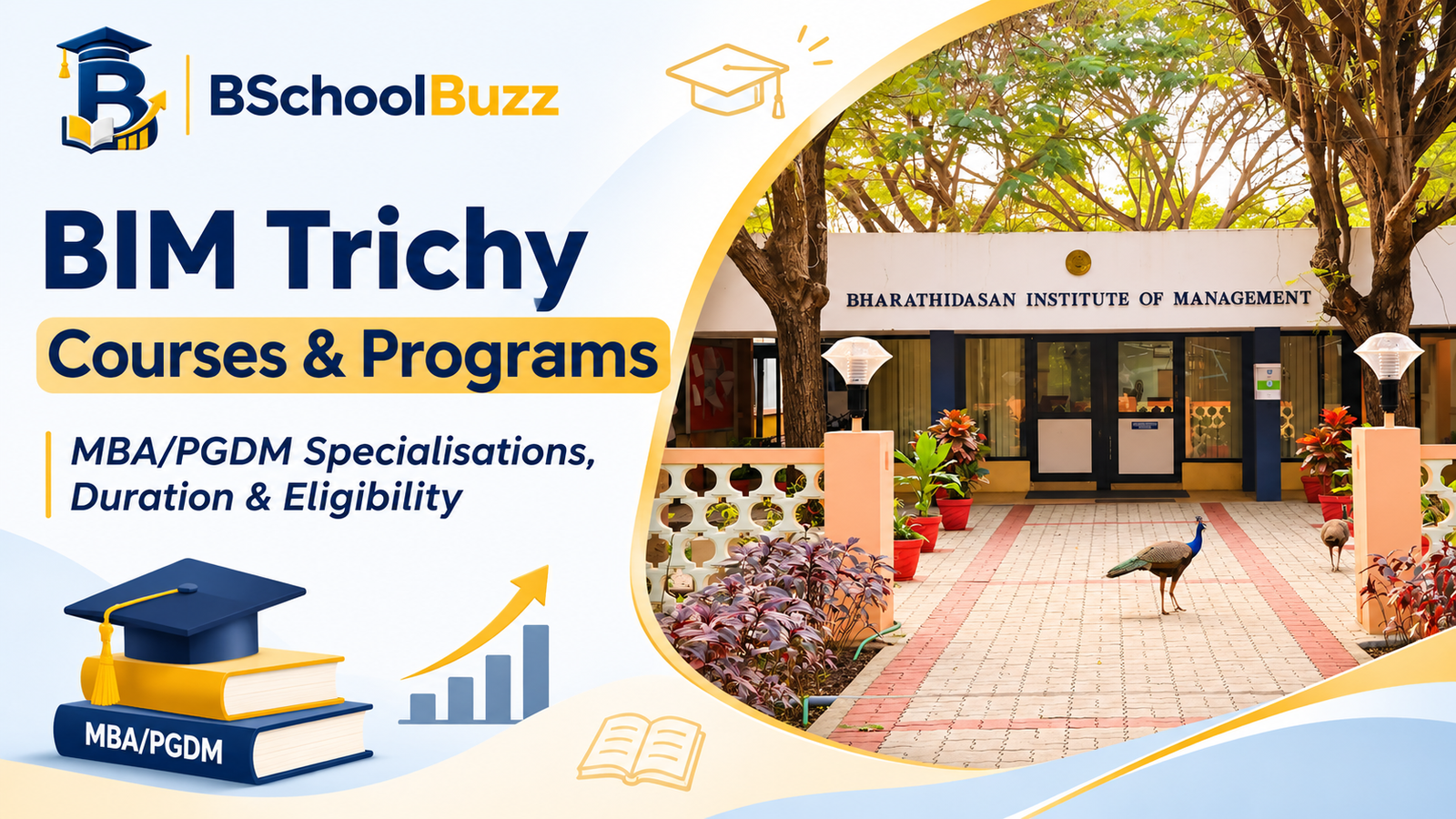
- Bharathidasan Institute of Management (BIM) is located in Tiruchirappalli, Tamil Nadu.
- BIM was established in 1984.
- Its flagship programme is a two-year, full-time residential MBA.
- BIM offers five MBA specialisation areas.
- The specialisations include Marketing, Finance, Human Resource Management, Operations and Supply Chain Management, and Digital Business & Analytics.
- The MBA curriculum is divided into PGP-I and PGP-II academic stages.
- PGP-I focuses on foundational and functional management subjects.
- PGP-II focuses on advanced courses and specialised electives.
- Students receive exposure to practical learning, business simulations, research and corporate immersion.
- BIM has specialised centres, including FINTRAC, RTCML and the Centre for Operations Excellence.
- The institute also identifies PG Certification in ERP (SAP), Public Policy & Management, and Digital HR & Analytics.
- BIM conducts Management Development and Faculty Development Programmes.
- The Tamil Nadu Chief Minister's Fellowship Programme is another major institutional initiative.
- MBA applicants need at least 50% marks in a recognised bachelor's degree, master's degree or equivalent qualification.
- Final-year students can apply subject to completing their degree requirements with 50% marks by June 2027.
- CAT 2026, XAT 2027 and eligible GMAT scores are accepted for shortlisting.
- Work experience is not compulsory for MBA admission.
- The MBA programme is residential, and students must stay on campus.
- BIM's flagship qualification is an MBA, not a separately listed PGDM programme.
- Official website: https://bim.edu/
BIM Trichy Courses & Programs: MBA/PGDM Specialisations, Duration & Eligibility
Introduction
Bharathidasan Institute of Management (BIM), Tiruchirappalli, offers management education through its flagship two-year residential MBA programme, executive education initiatives, postgraduate certificate programmes and specialised management development activities. The institute focuses on developing management professionals with expertise in traditional business functions, emerging technologies, analytics, leadership and sustainable business practices.
Students researching BIM Trichy courses will find five major MBA specialisation areas: Marketing, Finance, Human Resource Management, Operations and Supply Chain Management, and Digital Business & Analytics. The MBA programme combines foundational management subjects with specialised electives, practical projects, industry exposure and experiential learning.
One important clarification for applicants is that BIM's flagship postgraduate management qualification is an MBA, not a separately listed PGDM programme. The institute also uses the term Post Graduate Programme in Management (PGP) when describing the academic stages of its MBA curriculum. Therefore, students searching for BIM Trichy MBA/PGDM courses should distinguish between the MBA degree and the institute's other certificate and executive education offerings.
This article explains the available programmes, specialisations, course subjects, duration, eligibility requirements, academic structure, career opportunities and important points students should consider before choosing a programme.
1. Bharathidasan Institute of Management (BIM Trichy): Overview
Bharathidasan Institute of Management is a management education institution located in Tiruchirappalli, Tamil Nadu. Established in 1984, BIM was developed with an emphasis on connecting management education with industry.
The institution was established in collaboration with Bharat Heavy Electricals Limited (BHEL), providing an industry-linked foundation for its management education approach.
BIM operates as an independent School of Excellence of Bharathidasan University and is governed by an independent society.
Its flagship MBA programme is approved by the All India Council for Technical Education (AICTE). The institute's published 2026 admission brochure also identifies NBA accreditation for the 2024–2027 period.
The institution's academic approach combines management fundamentals, specialised knowledge, technology applications, practical learning and social responsibility.
BIM Trichy: Important Details
| Particulars | Details |
|---|---|
| Institute name | Bharathidasan Institute of Management |
| Popular name | BIM Trichy |
| Established | 1984 |
| Location | Tiruchirappalli, Tamil Nadu |
| Flagship programme | Master of Business Administration (MBA) |
| MBA duration | 2 years |
| Programme mode | Full-time |
| Programme type | Residential |
| Academic structure | Post Graduate Programme (PGP) |
| Specialisation areas | 5 |
| Approval | AICTE |
| University relationship | School of Excellence of Bharathidasan University |
| Additional activities | PG certificate programmes, executive education, management development and faculty development |
| Official website | https://bim.edu/ |
The institute's official admission information describes its flagship programme as a two-year, full-time residential MBA. <Cite refs={["turn502562search0","turn884870view0","turn502562search4"]}/>
What Makes BIM Trichy Different?
BIM's programme architecture focuses on developing professionals who can combine functional business knowledge with technology skills, leadership capabilities and social awareness.
The institute describes this approach as its unique Pi-shaped programme architecture.
It combines three broad learning dimensions:
A broad foundation in different management functions.
Specialised knowledge supported by technology applications.
Personal development, leadership, ethical behaviour and social responsibility.
This means that students are not expected to learn only one functional area. They also study subjects that help them understand how different business departments work together.
For example, a student specialising in Marketing may also learn business analytics, data visualisation and technology-enabled management.
Similarly, a student specialising in Finance may gain exposure to financial technology, investment analysis and financial market tools.
This integrated approach is relevant for students who want to develop both managerial and analytical capabilities.
2. List of BIM Trichy Courses and Programmes
Students searching for BIM Trichy courses should understand that the institute offers more than one type of educational and professional development activity.
However, not all programmes are conventional degree programmes.
The flagship academic qualification is the two-year MBA. Other offerings include postgraduate certificates, executive development, faculty development and the Tamil Nadu Chief Minister's Fellowship Programme.
BIM Trichy Courses and Programme Categories
| Programme category | Programme or offering | Duration |
|---|---|---|
| Flagship management degree | MBA | 2 years |
| Postgraduate certification | PG Certification in ERP (SAP) | Refer to current programme notification |
| Postgraduate certification | PG Certification in Public Policy & Management | Refer to current programme notification |
| Postgraduate certification | PG Certification in Digital HR & Analytics | Refer to current programme notification |
| Government-linked programme | Tamil Nadu Chief Minister's Fellowship Programme | 2 years |
| Professional education | Management Development Programmes | Depends on programme |
| Academic development | Faculty Development Programmes | Depends on programme |
| Research-linked programme | PhD in Public Policy and Management for eligible TN CM Fellowship participants | Subject to the applicable Anna University and BIM arrangements |
The 2026 MBA admission brochure identifies these programme categories and additional educational initiatives. Their availability, admission conditions and schedules should be checked separately because they do not all follow the MBA admission process. <Cite refs={["turn884870view0","turn550517search0","turn550517search21","turn550517search23"]}/>
Does BIM Trichy Offer a PGDM Programme?
This is an important question for students comparing MBA and PGDM colleges.
BIM's flagship programme is officially described as an MBA.
The institute also uses the term PGP, meaning Post Graduate Programme, in its academic curriculum and programme administration.
However, PGP should not be confused with a separate PGDM qualification.
The distinction is:
| Term | Meaning at BIM |
|---|---|
| MBA | The flagship postgraduate management degree |
| PGP | The academic programme structure used within the MBA |
| PGDM | A separate diploma qualification; not listed as BIM's flagship programme |
| PG Certificate | A specialised certificate offering |
| MDP | Management Development Programme |
| FDP | Faculty Development Programme |
Therefore, candidates looking for a recognised MBA degree should consider BIM's MBA programme rather than assuming that a separate PGDM course is available.
Which BIM Programme Should Students Consider?
The appropriate programme depends on the applicant's educational background and career objective.
Fresh graduates interested in management careers can explore the two-year MBA.
Working professionals can enquire about relevant management development programmes.
Professionals interested in specific functional knowledge can investigate the PG certificate offerings.
Faculty members and academic professionals can look at Faculty Development Programmes.
Eligible candidates interested in public policy and government administration can explore the Tamil Nadu Chief Minister's Fellowship Programme.
The programmes have different purposes, eligibility requirements and application procedures. Students should not assume that the MBA entrance examination requirements apply to every programme.
3. BIM Trichy MBA Programme: Duration and Structure
The MBA is BIM's flagship programme and is designed to provide students with broad management knowledge and specialised functional capabilities.
BIM MBA Duration
The duration of the BIM MBA programme is two years.
It is a full-time residential programme. Students admitted to the MBA are required to stay on campus for the duration of the programme, subject to institute regulations.
Programme Structure
The academic programme uses two broad stages:
PGP-I: Foundation and functional management education.
PGP-II: Advanced learning, electives and specialisation-focused education.
The first stage provides a common management foundation.
The later stage allows students to develop deeper expertise through electives in their preferred functional areas.
BIM MBA Programme Structure
| Academic stage | Main focus | Learning approach |
|---|---|---|
| PGP-I | Foundation and functional management | Core management courses |
| Summer corporate immersion | Practical organisational exposure | Internship and corporate projects |
| PGP-II | Advanced management and specialisation | Core courses, electives and projects |
| Overall programme | Managerial and professional development | Academic, practical and experiential learning |
The 2026 admission brochure identifies PGP-I foundation courses and the summer corporate immersion component. BIM's academic guidelines also describe the PGP-I and PGP-II structure. <Cite refs={["turn884870view0","turn831153view0"]}/>
What Is PGP-I?
PGP-I is the foundation stage of the MBA.
Students study fundamental management subjects that help them understand how businesses operate.
The subjects cover areas such as:
Accounting and financial reporting.
Corporate finance.
Marketing management.
Organisational behaviour.
Economics.
Operations management.
Data science tools.
Business research.
Strategic management.
Digital business.
Students from engineering, commerce, arts, science and other backgrounds receive exposure to these common management disciplines.
This is useful because MBA students often enter the programme with different academic qualifications.
For example, an engineering graduate may have strong technical knowledge but limited exposure to corporate finance or marketing. Similarly, a commerce graduate may understand accounting but require additional exposure to technology and operations management.
The foundation curriculum helps students develop a common understanding of business functions.
What Is PGP-II?
PGP-II is the advanced academic stage.
Students develop their subject expertise through elective courses and specialised learning.
The institute offers five major specialisation areas.
Students can select electives based on their academic interests and professional goals, subject to the programme's applicable course-registration rules.
The academic guidelines for Batch 41 describe a credit structure that includes core courses, electives and practice-school activities. Students must satisfy the applicable academic requirements before progressing to the next stage. <Cite refs={["turn831153view0","turn884870view0"]}/>
Summer Internship and Corporate Immersion
Practical business exposure is an important part of the BIM MBA structure.
The institute's brochure includes a Corporate Immersion Programme through a summer internship.
Students get an opportunity to understand how organisations operate beyond classroom discussions.
A corporate project can involve activities such as:
Analysing a business problem.
Studying an organisational process.
Collecting and evaluating information.
Preparing recommendations.
Working with an industry guide.
Presenting findings to faculty members.
The purpose is to connect academic learning with workplace situations.
Practice-Based Learning
BIM's programme also includes activities that support personal development, leadership and social responsibility.
Examples identified in the institute's programme material include:
Personal Growth Lab.
Outbound Leadership Programme.
Social Immersion Programme.
Corporate Immersion Programme.
Design Thinking.
Personality Enhancement through Sports.
Research Incubation.
Effective Execution.
These activities provide opportunities for students to improve teamwork, communication, decision-making and leadership skills. <Cite refs={["turn884870view0","turn831153view0"]}/>
4. BIM Trichy MBA Specialisations
One of the most important factors when choosing BIM Trichy courses is understanding the available specialisation areas.
BIM offers five major MBA specialisations:
Marketing.
Finance.
Human Resource Management.
Operations and Supply Chain Management.
Digital Business & Analytics.
Each area has a different academic focus and prepares students for different types of managerial responsibilities.
The specialisation should be selected after considering the student's interests, existing skills and long-term career plans.
BIM MBA Specialisations Overview
| Specialisation | Main academic focus | Example career areas |
|---|---|---|
| Marketing | Branding, sales, customer behaviour and marketing analytics | Brand management, digital marketing, sales |
| Finance | Financial analysis, investment, banking and risk | Financial analysis, investment research, banking |
| Human Resource Management | Recruitment, HR strategy, talent and organisational development | HR management, talent acquisition, HR analytics |
| Operations and Supply Chain Management | Logistics, procurement, production and supply chain analytics | Operations, supply chain, logistics |
| Digital Business & Analytics | AI, machine learning, data management and digital products | Business analytics, data analytics, digital transformation |
The five areas are listed in BIM's official MBA admission brochure. <Cite refs={["turn884870view0","turn502562search0"]}/>
4.1 Marketing Specialisation
The Marketing specialisation is designed for students interested in understanding customer needs, market behaviour, brand development and business growth.
Marketing is no longer limited to traditional advertising and sales.
Organisations increasingly use customer analytics, digital platforms, market research and data-driven strategies to make marketing decisions.
BIM's Marketing curriculum includes subjects that cover both traditional marketing concepts and modern analytical applications.
Important Marketing Subjects
Some of the elective courses listed in the institute's brochure include:
| Marketing elective | What students learn |
|---|---|
| Brand Management | Developing and managing brands |
| Sales and Distribution Management | Managing sales operations and distribution networks |
| Business-to-Business Marketing | Marketing products and services to other businesses |
| Marketing Metrics and Analytics | Evaluating marketing performance |
| Consumer Behaviour | Understanding purchasing decisions |
| Services Marketing | Marketing service-based businesses |
| Marketing of Financial Services | Marketing banking and financial products |
| Social Media Analytics | Evaluating social media performance |
| Retail Management | Understanding retail operations |
| Integrated Marketing Communications | Coordinating marketing communication |
| Advanced Marketing Analytics | Using analytical methods for marketing decisions |
| Customer Relationship Management | Managing customer relationships |
| Strategic Marketing | Developing long-term marketing strategies |
| Sustainable Marketing | Understanding marketing in a circular economy |
<Cite refs={["turn671474view2"]}/>
Marketing Technology and Practical Exposure
BIM's Real-Time Contextual Marketing Lab supports practical learning in marketing analytics.
The brochure identifies applications such as:
Text mining.
Market basket analysis.
Recommendation engines.
Data visualisation.
Social media analytics.
Customer sentiment analysis.
The institute also identifies MarkStrat certification for students specialising in Marketing.
Career Opportunities After Marketing
Students interested in this specialisation can explore career paths such as:
Brand Manager.
Product Manager.
Digital Marketing Manager.
Marketing Analyst.
Growth Marketing Specialist.
Area Sales Manager.
Customer Insights Manager.
Business Development Manager.
Category Manager.
E-commerce Marketing Manager.
Who Should Choose Marketing?
Marketing may suit students who enjoy:
Communication.
Market research.
Consumer psychology.
Business development.
Branding.
Sales strategy.
Digital platforms.
Customer analytics.
Students who prefer a combination of creativity, business strategy and data analysis may find this area particularly relevant.
4.2 Finance Specialisation
Finance is suitable for students interested in financial markets, banking, investment decisions, corporate finance and risk management.
The finance area combines theoretical financial concepts with practical tools and analytical applications.
Students learn how organisations manage money, evaluate investments and assess financial risks.
Important Finance Subjects
The institute's brochure lists the following elective areas:
| Finance elective | Main learning focus |
|---|---|
| Credit Rating and Analysis | Assessing creditworthiness |
| Portfolio Management Practices | Managing investment portfolios |
| Financial Technologies (FinTech) | Technology applications in financial services |
| Corporate Valuation | Estimating business value |
| Investment Banking | Financial transactions and capital markets |
| Managing Banks and Financial Institutions | Banking operations and strategies |
| Financial Derivatives | Derivative instruments and financial markets |
| Financial Modelling Using Spreadsheets | Building financial models |
| Sustainable Finance | Environmental and social considerations in finance |
| Infrastructure Project Finance | Evaluating infrastructure investments |
| Financial Planning and Wealth Management | Managing financial goals and investments |
| Financial Risk Management | Identifying and managing financial risk |
| International Financial Management | Financial decisions across countries |
| Behavioural Finance | Psychological factors in investment decisions |
<Cite refs={["turn671474view1","turn671474view2"]}/>
FINTRAC: Financial Trading and Analytics Centre
A major component of BIM's finance-related learning ecosystem is FINTRAC, the Financial Trading and Analytics Centre.
The institute's admission brochure describes the centre as having 12 functional Bloomberg terminals and an NSE SMART Trading simulation facility.
These facilities support practical learning in financial trading, market analysis, research and investment-related activities.
Students may also explore relevant certifications, including:
Bloomberg Finance Fundamentals.
Bloomberg Market Concepts.
Chartered Market Technician.
Chartered Financial Analyst.
Financial Risk Manager.
Certified Financial Planner.
These are external professional credentials with their own examination and eligibility requirements. Their mention in the brochure should not be interpreted as automatic qualification through MBA enrolment. <Cite refs={["turn671474view1","turn884870view0"]}/>
Career Opportunities After Finance
Possible career directions include:
Financial Analyst.
Equity Research Analyst.
Investment Banking Analyst.
Credit Analyst.
Risk Analyst.
Portfolio Management Associate.
Financial Planning Professional.
Banking Professional.
FinTech Analyst.
ESG Analyst.
Corporate Finance Analyst.
Who Should Choose Finance?
Finance can be considered by students interested in:
Financial statements.
Stock markets.
Investment research.
Banking.
Corporate finance.
Financial modelling.
Risk analysis.
Wealth management.
Students who enjoy quantitative analysis and financial decision-making may find this specialisation suitable.
4.3 Human Resource Management Specialisation
Human Resource Management focuses on the people and organisational side of business.
Companies need professionals who can recruit employees, manage talent, develop workplace policies and improve employee performance.
Modern HR departments also use analytics and technology to support organisational decisions.
BIM's HR specialisation includes traditional people-management subjects as well as digital HR and analytics-related topics.
Important HR Subjects
| HR elective | Main learning focus |
|---|---|
| Talent Acquisition | Recruiting and selecting employees |
| HR Analytics | Using employee data for HR decisions |
| Training and Development | Improving employee skills |
| Employee Relations and Labour Laws | Understanding workplace relationships and labour regulations |
| Future of Work and HR Function | Understanding changes in HR practices |
| Performance Management | Evaluating employee performance |
| Compensation Management | Designing compensation structures |
| Organisational Development | Improving organisational effectiveness |
| Cross-Cultural Diversity | Managing diverse workplaces |
| Digital HR | Using technology in HR operations |
| Leaders and Leadership | Developing leadership capabilities |
| Managerial Counselling and Coaching | Supporting employee development |
| Strategic HRM | Connecting HR strategy with business goals |
<Cite refs={["turn167196view0"]}/>
Practical HR Learning
The institute identifies learning opportunities in:
HR analytics.
Digital HR.
Organisational development.
Leadership.
Talent acquisition.
Employee relations.
These areas help students understand how HR contributes to business performance.
The programme brochure also lists certifications related to Appreciative Inquiry, Neuro-Linguistic Programming, Emotional Intelligence and Assessment Centres.
Students should verify the current availability and certification arrangements for their batch.
Career Opportunities After HR
Potential career areas include:
HR Business Partner.
Talent Acquisition Specialist.
HR Analyst.
Learning and Development Specialist.
Compensation and Benefits Analyst.
Organisational Development Specialist.
Employee Relations Professional.
Digital HR Specialist.
HR Operations Manager.
Talent Management Professional.
Who Should Choose HR?
This specialisation may suit students interested in:
People management.
Recruitment.
Organisational behaviour.
Leadership.
Employee development.
Workplace policies.
HR technology.
Employee engagement.
Students who enjoy working with people and understanding organisational behaviour can consider this area.
4.4 Operations and Supply Chain Management Specialisation
Operations and Supply Chain Management focuses on how organisations produce, distribute and deliver products and services efficiently.
It covers the movement of materials, management of suppliers, production planning, logistics and process improvement.
This specialisation is relevant to manufacturing, retail, e-commerce, consulting, logistics and service organisations.
Important Operations and Supply Chain Subjects
| Subject | Main learning focus |
|---|---|
| Advanced Logistics and Supply Chain Management | Managing supply networks |
| Service Operations Management | Improving service delivery |
| Lean Six Sigma | Reducing process inefficiencies |
| Demand-Driven Supply Chain Analytics | Planning supply based on demand |
| Value Chain Simulation | Understanding business value chains |
| Supply Chain Decision Analysis | Making supply chain decisions |
| Logistics Analysis and Modelling | Analysing logistics systems |
| Digital Supply Chain Planning | Using technology in supply chain operations |
| Procurement Management and Analytics | Managing sourcing and procurement |
| Sustainable Supply Chain Modelling | Developing sustainable supply networks |
| Operations Strategy | Planning operations for business objectives |
| Digital Transformation of Supply Chains | Applying digital technology to supply chains |
| Advanced Project Management | Managing projects |
| Action Project in Operations | Applying learning to operational problems |
<Cite refs={["turn671474view2","turn167196view0"]}/>
Centre for Operations Excellence
BIM has established a Centre for Operations Excellence to support practical learning in operations and supply chain management.
The brochure identifies collaborations and simulation-based learning tools, including INCHAINGE simulation software.
Students can use such learning environments to understand supply chain decisions, process management and complex operational situations.
Career Opportunities After Operations and Supply Chain Management
Graduates may explore roles such as:
Supply Chain Specialist.
Supply Chain Planner.
Operations Analyst.
Logistics Manager.
Demand Planner.
Procurement Analyst.
Production Planner.
Operations Consultant.
Service Delivery Manager.
Project Management Specialist.
Supply Chain Transformation Professional.
Business Strategy and Operations Manager.
Who Should Choose Operations?
This area may suit students interested in:
Manufacturing.
Logistics.
Supply chain planning.
Procurement.
Production management.
Process improvement.
Business operations.
Project management.
Students who prefer solving practical business problems and improving organisational efficiency can consider this specialisation.
4.5 Digital Business & Analytics Specialisation
Digital Business & Analytics is one of the technology-focused areas of BIM's MBA programme.
Businesses increasingly depend on data, automation, artificial intelligence and digital platforms.
This specialisation focuses on how technology can support business operations, customer experiences and strategic decisions.
It combines management knowledge with analytical and digital capabilities.
Important Digital Business & Analytics Subjects
| Subject | Main learning focus |
|---|---|
| Digital Product and Service Management | Managing technology-enabled products and services |
| Data Management and Governance | Managing business data |
| Artificial Intelligence and Machine Learning | Applying AI and ML to business problems |
| Digital Technology | Understanding digital business technologies |
| Business Data Visualisation | Presenting business data effectively |
| Text Mining and Sentiment Analysis | Analysing text and customer opinions |
| Advanced Predictive Analytics | Using data to forecast outcomes |
| Blockchain for Business | Understanding blockchain applications |
| E-Commerce | Managing online business models |
| Robotic Process Automation | Automating business processes |
| Cybersecurity for Business Leaders | Understanding business security risks |
| Generative AI for Business | Applying generative AI in business contexts |
<Cite refs={["turn671474view3"]}/>
Practical Learning and Technology Exposure
The BIM programme architecture encourages students to understand technology applications across management functions.
The institute's brochure identifies tools and technologies such as:
Python.
R.
KNIME.
SPSS.
Orange.
SmartPLS.
Power BI.
NVivo.
Tableau.
The exact tool exposure depends on the course and applicable curriculum.
Students can gain experience in analysing data, preparing visualisations and understanding how technology supports managerial decisions.
Career Opportunities After Digital Business & Analytics
Potential career directions include:
Business Analyst.
Data Analyst.
Business Intelligence Analyst.
Analytics Consultant.
Digital Transformation Specialist.
Product Analyst.
Data Science Professional.
Technology Strategy Analyst.
Digital Business Consultant.
Analytics Project Professional.
The exact job role depends on the student's technical skills, academic performance, projects and recruitment opportunities.
Who Should Choose Digital Business & Analytics?
This specialisation may suit students interested in:
Data analytics.
Artificial intelligence.
Machine learning.
Digital transformation.
Business intelligence.
Technology consulting.
Automation.
Digital products.
A technical undergraduate degree is not identified as a compulsory requirement for the MBA. However, students should be prepared to develop quantitative and analytical skills.
5. BIM Trichy MBA Curriculum: Core Subjects and Electives
The MBA curriculum combines common management subjects with area-specific electives.
This structure is important because management professionals need an understanding of different business functions even when they specialise in one area.
PGP-I: Core Management Courses
BIM's 2026 admission brochure provides the following first-stage curriculum.
Trimester I
| Course | Learning area |
|---|---|
| Universal Human Values | Ethics and personal development |
| Quantitative Science for Managers | Quantitative decision-making |
| Managerial Decision Analytics | Analytical management decisions |
| Written Analysis and Communication | Business communication |
| Organisational Behaviour I | Individual and group behaviour |
| Financial Reporting and Performance Analysis | Accounting and financial reporting |
| Microeconomics for Managers | Economic decision-making |
| Marketing Management I | Marketing fundamentals |
| Business Simulation – Foundation | Business simulation |
Trimester II
| Course | Learning area |
|---|---|
| Macroeconomic Environment for Business | Business economics |
| Corporate Finance I | Financial decisions |
| Marketing Management II | Marketing strategy |
| Organisational Behaviour II | Organisational management |
| Managerial Applications of Operations Research | Operations analytics |
| Operations Management | Process and operations management |
| Data Science Tools | Data and analytical applications |
| Entrepreneurship and Start-up Ecosystem | Entrepreneurship |
Trimester III
| Course | Learning area |
|---|---|
| Cost Analysis and Management | Cost management |
| Corporate Finance II | Advanced finance |
| Regulatory and Legal Aspects of Business | Business regulations |
| Human Resource Management | People management |
| Technology-Enabled Business Management | Technology in business |
| Business Research Methods | Research and analysis |
| Digital Business Modelling | Digital business models |
| Ethics, Governance, and Sustainability | Responsible management |
| Comprehensive Viva | Integrated management understanding |
<Cite refs={["turn671474view0","turn671474view1"]}/>
What Do These Core Subjects Mean?
Financial Reporting and Performance Analysis
Students learn how to understand financial information and evaluate organisational performance.
Marketing Management
This subject introduces customer needs, market analysis, product strategy and marketing decisions.
Organisational Behaviour
Students examine individual behaviour, teamwork, leadership and organisational culture.
Operations Management
This subject focuses on business processes, operational efficiency and resource management.
Data Science Tools
Students are introduced to analytical methods and tools that support management decisions.
Business Research Methods
This subject helps students understand how to identify business problems, collect information and conduct structured research.
Digital Business Modelling
Students explore how technology and digital platforms can support business models.
Ethics, Governance and Sustainability
This area focuses on responsible business decisions and the relationship between organisations, society and the environment.
PGP-II: Elective and Specialisation Learning
After completing the foundation stage, students progress towards advanced management learning.
The second stage includes specialised electives and practice-based activities.
Students can select courses according to their preferred functional area, subject to the institute's course availability and academic rules.
The programme brochure includes electives in all five major areas, along with General Management and Strategy courses.
This gives students opportunities to develop domain knowledge while retaining an understanding of broader management issues.
General Management and Strategy Electives
The brochure also lists subjects such as:
Managing Strategic Alliances.
Enterprise Risk Management.
Business Dynamics.
Revenue Management.
SDG and ESG Frameworks in Practice.
Water Management and Policy.
These courses are useful because senior management decisions often involve more than one functional department. <Cite refs={["turn671474view3"]}/>
6. Other Educational Programmes at BIM Trichy
Apart from the flagship MBA, BIM's official brochure identifies several additional academic and professional development activities.
These programmes have different objectives and should be considered separately from the regular MBA.
6.1 PG Certification in ERP (SAP)
BIM lists a postgraduate certificate offering in ERP (SAP).
Enterprise Resource Planning systems help organisations integrate functions such as:
Finance.
Procurement.
Inventory.
Human resources.
Production.
Supply chain management.
SAP is a widely used enterprise software platform.
A programme in this area can be relevant to graduates and professionals who want to understand enterprise systems and their applications in organisations.
However, candidates should verify the current batch schedule, duration, fee, admission criteria and certification details directly with BIM before enrolling.
6.2 PG Certification in Public Policy & Management
Public Policy and Management focuses on the relationship between government, public administration, policy decisions and organisational management.
The subject area may be relevant to professionals interested in:
Government administration.
Public sector management.
Policy research.
Development projects.
Governance.
Social sector programmes.
Public service delivery.
BIM's involvement in the Tamil Nadu Chief Minister's Fellowship Programme also reflects its engagement with public policy and management.
The availability and eligibility conditions for the standalone certificate should be confirmed with the institute.
6.3 PG Certification in Digital HR & Analytics
Digital HR & Analytics combines traditional human resource management with technology and data analysis.
The subject area can be relevant to professionals interested in:
HR analytics.
Employee data management.
Talent acquisition systems.
Digital HR operations.
Workforce planning.
Employee performance analysis.
Students should distinguish this specialised certificate from the Human Resource Management specialisation available within the full-time MBA.
6.4 Management Development Programmes
BIM also conducts Management Development Programmes for executives and professionals.
These programmes are designed to improve managerial skills and leadership capabilities.
The institute's brochure identifies programmes conducted for organisations such as:
Tamil Nadu e-Governance Agency.
Matrimony.com.
BHEL.
Examples include leadership development, executive presence, achievement motivation, design thinking and team effectiveness.
MDPs are generally designed around organisational requirements and may have different durations and participant profiles. <Cite refs={["turn167196view1","turn550517search21"]}/>
6.5 Faculty Development Programmes
Faculty Development Programmes are intended for academic professionals and faculty members.
These initiatives support teaching capabilities, management knowledge and academic development.
Unlike the regular MBA, FDPs are not a two-year residential degree programme.
Their duration, subject matter and admission arrangements depend on the individual programme.
6.6 Tamil Nadu Chief Minister's Fellowship Programme
BIM is also associated with the Tamil Nadu Chief Minister's Two-Year Fellowship Programme.
This is a government-linked fellowship initiative focused on public policy and management.
The fellowship provides exposure to government departments, public administration and policy-related assignments.
It is different from the regular MBA programme.
Candidates interested in this opportunity should check the relevant Tamil Nadu Government notification for eligibility, selection, fellowship conditions and application dates.
6.7 PhD-Related Research Programme
BIM and Anna University announced an academic and research partnership for a PhD programme in Public Policy and Management specifically for participants of the Tamil Nadu Chief Minister's Fellowship Programme.
The announcement identifies Anna University faculty as PhD supervisors and BIM faculty as co-advisors.
The programme is subject to the applicable Anna University norms and arrangements.
This should not be interpreted as evidence that BIM is currently accepting general PhD applications from all candidates. <Cite refs={["turn550517search0","turn550517search1"]}/>
7. BIM Trichy Courses: Duration Comparison
Students often compare programme duration before deciding where to apply.
The flagship MBA has a clearly specified duration of two years.
Other programmes have separate schedules depending on their purpose and delivery model.
Programme Duration Table
| Programme | Duration | Programme format |
|---|---|---|
| BIM MBA | 2 years | Full-time residential |
| PG Certification in ERP (SAP) | Confirm with institute | Certificate |
| PG Certification in Public Policy & Management | Confirm with institute | Certificate |
| PG Certification in Digital HR & Analytics | Confirm with institute | Certificate |
| TN CM's Fellowship Programme | 2 years | Government-linked fellowship |
| Management Development Programmes | Programme-specific | Executive training |
| Faculty Development Programmes | Programme-specific | Academic development |
| Fellowship-linked PhD | As per applicable doctoral regulations | Research programme |
The two-year duration of the MBA and fellowship is supported by BIM's published material. Specific certificate schedules should be checked through current programme notifications rather than assumed. <Cite refs={["turn884870view0","turn550517search23","turn550517search25"]}/>
Which Programme Is Suitable for Fresh Graduates?
Fresh graduates looking for a comprehensive management qualification can consider the MBA.
It offers a structured two-year learning experience covering multiple business functions and specialisation areas.
Which Programme Is Suitable for Working Professionals?
Working professionals may explore relevant certificate programmes and Management Development Programmes.
However, they should check the specific schedule and delivery format because not every offering is necessarily designed for part-time or online study.
Which Programme Is Suitable for Public Policy Aspirants?
Candidates interested in government administration and policy work can explore the TN CM's Fellowship Programme and related public policy initiatives.
These opportunities have their own eligibility and selection conditions.
8. BIM Trichy MBA Eligibility Criteria 2027
Students applying for the MBA should verify the latest eligibility requirements before completing the admission application.
For the 2027–29 admission cycle, BIM's official admission page identifies the following requirements.
Educational Qualification
Applicants should possess a bachelor's degree, master's degree or equivalent qualification in any discipline from a recognised university.
The minimum required academic score is 50%.
Students from different academic backgrounds can apply, including:
Arts.
Science.
Commerce.
Engineering.
Management.
Social Sciences.
Other recognised disciplines.
Minimum Marks Requirement
Candidates must have secured at least 50% marks in their qualifying degree.
Applicants should ensure that their marks meet the institute's requirement.
Final-Year Students
Candidates currently pursuing their final-year degree can also apply.
However, they must complete their degree requirements with a minimum of 50% marks by June 2027.
Entrance Examination Requirements
BIM uses any one of the following examination scores for shortlisting:
CAT 2026.
XAT 2027.
GMAT scores valid from January 2025 to January 2027.
BIM MBA Eligibility Table
| Eligibility parameter | Requirement |
|---|---|
| Minimum qualification | Bachelor's degree, master's degree or equivalent |
| Academic discipline | Any discipline |
| Recognised institution | Required |
| Minimum marks | 50% |
| Final-year candidates | Eligible |
| Final-year completion | By June 2027 |
| Entrance examination | CAT 2026, XAT 2027 or eligible GMAT |
| Work experience | Not compulsory |
| Upper age limit | No prescribed upper age limit |
<Cite refs={["turn437980search0","turn502562search2"]}/>
Is Work Experience Required for BIM MBA?
No.
Prior work experience is not compulsory for applying to the BIM MBA programme.
Fresh graduates can apply if they satisfy the educational and entrance examination requirements.
However, the institute states that relevant full-time work experience receives weightage during the final selection process.
Therefore, applicants with professional experience should provide accurate employment information.
Is There an Age Limit?
According to BIM's official admission FAQ, there is no prescribed upper age limit for applying to the MBA programme, subject to meeting the admission requirements. <Cite refs={["turn502562search2"]}/>
Can Non-Engineering Students Apply?
Yes.
BIM does not restrict MBA eligibility to engineering graduates.
Candidates from arts, science, commerce and other recognised disciplines can apply if they meet the minimum academic requirements.
Can Commerce Graduates Apply?
Yes.
B.Com and other commerce graduates can apply with the required academic qualification and valid entrance examination score.
Can BBA Graduates Apply?
Yes.
BBA graduates are eligible if they satisfy the minimum academic requirements and accepted entrance examination conditions.
Can Working Professionals Apply?
Yes.
Working professionals can apply if they satisfy the eligibility requirements.
However, the programme is full-time and residential, so applicants should consider their employment commitments before accepting admission.
9. BIM Trichy MBA Admission Process
The MBA admission process involves entrance examination-based shortlisting followed by further selection stages.
Candidates must complete the official application process and provide accurate academic and examination details.
Step 1: Check Eligibility
Verify the graduation qualification and minimum marks requirement.
Final-year applicants should also confirm that they can complete their degree within the institute's prescribed timeline.
Step 2: Appear for an Accepted Entrance Examination
Candidates should have a valid score in CAT 2026, XAT 2027 or GMAT within the specified validity period.
Step 3: Complete Online Registration
Visit the official admission portal:
Create an account and verify the registered email address.
Step 4: Fill in the Application Form
Enter the required personal, academic and entrance examination information.
Step 5: Upload Documents
Upload the photograph, signature and applicable community certificate in the specified format.
Step 6: Pay the Application Fee
The published fee is ₹1,500 for general applicants and ₹1,000 for SC/SCA/ST applicants.
Step 7: Complete Final Submission
Check the application details and submit the completed form.
Step 8: Participate in Selection Rounds
Candidates shortlisted based on entrance examination scores are called for Group Discussion and Personal Interview.
Step 9: Final Selection
The final selection considers the candidate's overall performance, including entrance examination scores, academic performance, work experience and GD/PI performance. <Cite refs={["turn437980search0","turn502562search1"]}/>
Important Admission Links
| Admission resource | Official link |
|---|---|
| BIM official website | https://bim.edu/ |
| MBA admission information | https://bim.edu/index/admissions-2027-2029/ |
| Online application portal | https://admission.bim.edu/ |
| Admission FAQs | https://bim.edu/index/admissions-2027-2029/faq/ |
| Curriculum | https://bim.edu/index/curriculum/ |
10. BIM Trichy MBA Curriculum and Learning Methodology
The BIM curriculum combines classroom teaching with experiential learning and industry-related activities.
Students are exposed to management concepts, analytical tools, business simulations, practical projects and professional development exercises.
Case-Based Learning
Case discussions help students understand how businesses respond to real organisational problems.
Students analyse information, evaluate alternatives and explain their decisions.
This helps develop critical thinking and structured problem-solving.
Business Simulations
BIM's programme material identifies simulation-based learning across its academic areas.
Students can use business simulations to understand decisions relating to:
Pricing.
Marketing.
Production.
Finance.
Supply chain.
Competition.
Resource allocation.
Simulations allow students to evaluate the possible impact of decisions in a controlled learning environment.
Technology-Based Learning
Technology applications are integrated into the curriculum.
Examples identified by BIM include Python, R, KNIME, SPSS, Power BI and Tableau.
The objective is to develop students who can understand business problems and use relevant tools to analyse them.
Research Incubation
Research Incubation provides opportunities for students to investigate a business or administrative problem.
Students may work on:
Business research.
Literature reviews.
Qualitative analysis.
Quantitative analysis.
Research proposals.
Practical business problems.
Project reports.
Social Immersion Programme
The Social Immersion Programme introduces students to community-related challenges.
The programme involves understanding issues connected with sustainability, society, government and corporate responsibility.
Students gain exposure to social and economic problems that require practical management solutions.
Corporate Immersion Programme
The Corporate Immersion Programme provides exposure to organisational activities.
Students undertake practical projects and assignments, with guidance from industry and faculty mentors.
This gives them an opportunity to connect academic learning with business operations.
<Cite refs={["turn831153view0","turn884870view0"]}/>
11. Centres of Excellence at BIM Trichy
BIM has established specialised centres to support research, technology applications and practical management education.
These centres are relevant to students who want to understand how management concepts are applied in specific industries.
Major Centres
| Centre | Main area of focus |
|---|---|
| Financial Trading and Analytics Centre (FINTRAC) | Financial markets and trading analytics |
| Real-Time Contextual Marketing Lab (RTCML) | Marketing technology and customer analytics |
| Centre for Operations Excellence | Operations and supply chain management |
| Centre for Sustainable Development | Sustainability and public policy |
| qBotica Robotic Process Automation Lab | Business process automation |
| Centre for Design Thinking | Innovation and problem-solving |
<Cite refs={["turn884870view0","turn502562search0"]}/>
FINTRAC
FINTRAC supports financial education, trading simulations and market-related research.
The 2026 admission brochure identifies Bloomberg terminals and an NSE SMART Trading simulation facility.
Real-Time Contextual Marketing Lab
The marketing lab provides exposure to tools and applications for customer insights, market analytics, text mining and recommendation systems.
Centre for Operations Excellence
This centre supports learning in supply chain management, operational simulations and process improvement.
Centre for Sustainable Development
The centre focuses on sustainability, public policy, ESG-related research and socially responsible business practices.
Robotic Process Automation Lab
The RPA lab introduces students to business process automation and its practical applications.
Centre for Design Thinking
Design thinking encourages students to understand problems from the perspective of users and develop practical solutions.
These facilities support BIM's broader objective of integrating technology, research and practical management education.
12. Career Opportunities After Completing BIM Trichy Courses
The career opportunities available to students depend on the programme completed, specialisation, skills, projects, academic performance and professional experience.
MBA graduates may explore management roles across different industries.
Career Opportunities by MBA Specialisation
| Specialisation | Potential career roles |
|---|---|
| Marketing | Brand Manager, Marketing Analyst, Sales Manager, Digital Marketing Manager |
| Finance | Financial Analyst, Equity Research Analyst, Risk Analyst, Investment Banking Analyst |
| Human Resource Management | HR Analyst, Talent Acquisition Specialist, HR Business Partner |
| Operations and Supply Chain | Operations Analyst, Supply Chain Planner, Logistics Specialist |
| Digital Business & Analytics | Business Analyst, Data Analyst, Analytics Consultant, Digital Transformation Specialist |
Industries That Recruit Management Graduates
BIM's admission brochure identifies recruiters from several sectors, including:
Banking and financial services.
Consulting.
Manufacturing.
Technology.
Automotive.
Consumer products.
Analytics.
Supply chain management.
Business services.
The brochure lists organisations such as Bosch Global Software, o9 Solutions, Ford, Godrej & Boyce, Wipro, Vedanta, Infosys, Asian Paints, Schneider Electric, CRISIL and Accenture.
Recruiter participation and job opportunities can vary between placement seasons. <Cite refs={["turn167196view2","turn167196view3"]}/>
Does Specialisation Guarantee a Particular Job?
No.
Choosing a particular specialisation does not guarantee a specific designation or salary.
Employers evaluate candidates based on several factors, including:
Academic performance.
Functional knowledge.
Analytical ability.
Communication.
Internship experience.
Projects.
Technical skills.
Interview performance.
Students should use their MBA years to develop both subject knowledge and practical capabilities.
13. How to Choose the Right BIM Trichy Specialisation
Choosing an MBA specialisation is an important academic decision.
Students should not select an area simply because it is popular or because someone else recommends it.
The decision should be based on the kind of work the candidate wants to pursue.
Compare Your Interests
| If you enjoy... | Consider this specialisation |
|---|---|
| Branding, communication and customer behaviour | Marketing |
| Financial markets and investment analysis | Finance |
| Recruitment, employee development and leadership | Human Resource Management |
| Logistics, production and process improvement | Operations and Supply Chain Management |
| Data, technology, AI and digital products | Digital Business & Analytics |
Consider Your Previous Academic Background
Your undergraduate degree can help you identify areas of interest, but it should not restrict your MBA choices.
For example:
Engineering graduates may explore Operations or Digital Business & Analytics.
Commerce graduates may be interested in Finance.
Arts and humanities graduates may explore Marketing or HR.
Science graduates may consider Analytics or Operations.
These are possible interest-based starting points, not compulsory subject-to-specialisation rules.
Evaluate Long-Term Career Goals
Ask yourself:
Do I want to work in a customer-facing role?
Am I interested in financial analysis?
Do I enjoy working with people?
Do I prefer operational problem-solving?
Am I interested in technology and analytics?
Do I want to work in consulting or business strategy?
Your answers can help narrow down the options.
Review Elective Availability
Students should also check the electives offered in the relevant academic year.
The presence of a course in an older brochure does not guarantee that it will be offered in every trimester or batch.
Course availability can depend on academic planning and institutional requirements.
14. Important Points Students Should Check Before Joining BIM Trichy
Before selecting any institution, applicants should evaluate the programme beyond its name.
The following considerations can help students make an informed decision.
Programme Recognition
Check the current approval and accreditation details for the programme.
BIM's published brochure identifies AICTE approval and NBA accreditation for the 2024–2027 period. Candidates should verify the applicable status for their joining batch.
Residential Requirement
The MBA is a residential programme.
Students should be comfortable with campus-based living and the academic commitments associated with a full-time programme.
Specialisation Availability
Check the latest elective list and understand the requirements for selecting a major or minor specialisation.
Practical Learning
Review the curriculum's internship, research, simulation and practice-school components.
These activities can influence the practical skills students develop during the programme.
Financial Planning
Obtain the current fee structure for the intended batch.
Do not use a previous admission brochure's fee as the confirmed amount for a later academic year.
Also ask for details of hostel, mess, deposits and other charges.
Career Preparation
Review the institute's latest placement report, recruiter participation and role distribution.
Avoid making a decision based only on the highest salary figure.
Average and median compensation, placement coverage and the type of roles offered are also important.
Additional Certification Options
Students interested in professional certifications should confirm:
Whether the certification is included.
Whether an additional fee applies.
Whether an external examination is required.
Whether certification is optional or compulsory.
Whether the certification is available for their specialisation.
15. Frequently Asked Questions
The following questions address common searches related to BIM Trichy courses, MBA specialisations, PGDM programmes, duration and eligibility.
1. What courses are offered at BIM Trichy?
BIM Trichy's flagship programme is a two-year full-time residential MBA with five specialisation areas: Marketing, Finance, Human Resource Management, Operations and Supply Chain Management, and Digital Business & Analytics. The institute also lists PG certificate programmes, executive education, management development and faculty development initiatives.
2. Does BIM Trichy offer MBA or PGDM?
BIM's flagship postgraduate management qualification is an MBA. Its curriculum uses the term Post Graduate Programme (PGP), but the PGP designation should not be confused with a separate PGDM diploma.
3. What is the duration of the BIM Trichy MBA programme?
The BIM MBA programme has a duration of two years. It is a full-time residential programme.
4. What are the MBA specialisations available at BIM Trichy?
BIM offers five major specialisation areas: Marketing, Finance, Human Resource Management, Operations and Supply Chain Management, and Digital Business & Analytics.
5. What is the eligibility for BIM Trichy MBA admission 2027?
Applicants must have a bachelor's degree, master's degree or equivalent qualification in any discipline with at least 50% marks from a recognised university. Final-year students may also apply subject to completing their degree with at least 50% marks by June 2027.
6. Which entrance examinations are accepted by BIM Trichy?
For the 2027–29 admission cycle, BIM accepts CAT 2026, XAT 2027 and GMAT scores within the validity period January 2025 to January 2027 for shortlisting.
7. Can freshers apply for BIM Trichy MBA?
Yes. Work experience is not compulsory. Fresh graduates can apply if they meet the educational and entrance examination requirements.
8. Is BIM Trichy MBA a residential programme?
Yes. BIM's MBA is a full-time residential programme. Admitted students are required to reside on campus for the duration of the programme, subject to institute regulations.
9. Does BIM Trichy offer Digital Business and Analytics?
Yes. Digital Business & Analytics is one of the five MBA specialisation areas. Its curriculum includes subjects such as artificial intelligence, machine learning, data management, business data visualisation, predictive analytics, blockchain and robotic process automation.
10. Does BIM Trichy offer a Finance specialisation?
Yes. The Finance specialisation covers areas such as corporate valuation, portfolio management, investment banking, financial derivatives, FinTech, financial modelling and risk management.
11. What is the Marketing specialisation at BIM Trichy?
The Marketing specialisation covers subjects such as brand management, sales and distribution, consumer behaviour, marketing analytics, retail management, customer relationship management and strategic marketing.
12. What subjects are included in BIM Trichy's HR specialisation?
The HR specialisation includes Talent Acquisition, HR Analytics, Training and Development, Performance Management, Compensation Management, Digital HR, Organisational Development and Strategic HRM.
13. What does BIM Trichy's Operations and Supply Chain specialisation cover?
It includes logistics, supply chain analytics, procurement management, operations strategy, digital supply chain planning, Lean Six Sigma and sustainable supply chain modelling.
14. Does BIM Trichy offer postgraduate certificate programmes?
Yes. The institute's published brochure identifies PG Certification in ERP (SAP), Public Policy & Management, and Digital HR & Analytics. Applicants should confirm the current batch availability, eligibility and programme fees with BIM.
15. Does BIM Trichy offer a PhD programme?
BIM and Anna University announced a PhD in Public Policy and Management specifically for participants of the Tamil Nadu Chief Minister's Fellowship Programme. Applicants should verify the current research admission arrangements and applicable eligibility conditions.
16. What is the difference between BIM MBA and its PG certificate programmes?
The MBA is a two-year postgraduate management degree covering multiple business functions and specialisation areas. PG certificate programmes focus on specific professional subjects and have separate course structures and admission arrangements.
17. Can students from non-commerce backgrounds apply to BIM Trichy?
Yes. BIM's MBA eligibility requirements allow graduates from any discipline, provided they meet the minimum academic marks and accepted entrance examination requirements.
18. What career opportunities are available after BIM Trichy MBA?
Career opportunities depend on the chosen specialisation and individual skills. Graduates may explore roles in marketing, finance, HR, operations, supply chain management, analytics, consulting and digital business.
19. Does BIM Trichy provide practical learning opportunities?
Yes. The MBA programme includes activities such as corporate immersion, social immersion, research incubation, business simulations and specialised learning through its Centres of Excellence.
20. Where can students find the official BIM Trichy course details?
Students can visit https://bim.edu/ for programme information, curriculum, admission requirements and official updates. The MBA admission page is https://bim.edu/index/admissions-2027-2029/.
16. Conclusion
Bharathidasan Institute of Management offers a two-year residential MBA programme supported by five major specialisation areas: Marketing, Finance, Human Resource Management, Operations and Supply Chain Management, and Digital Business & Analytics.
The BIM Trichy courses structure combines common management subjects, advanced electives, technology applications, internships, research and experiential learning. This gives students an opportunity to develop a broad understanding of business while building knowledge in a preferred functional area.
For students searching for MBA and PGDM programmes, it is important to understand that BIM's flagship qualification is an MBA degree. The institute's PGP terminology refers to the academic structure of the MBA rather than a separate PGDM qualification.
Beyond the MBA, BIM also identifies postgraduate certificate programmes, executive education, faculty development and the Tamil Nadu Chief Minister's Fellowship Programme among its educational activities.
Candidates should compare the available specialisations with their career interests, verify the latest academic curriculum and check the eligibility requirements before applying.
For accurate information about current courses, fees, admissions and programme availability, students should refer to BIM's official website and the latest programme-specific notifications.
Key Takeaways
BIM Trichy offers a two-year, full-time residential MBA programme.
The institute provides five major MBA specialisations covering different management functions.
Marketing is suitable for students interested in branding, sales, customer behaviour and marketing analytics.
Finance focuses on investment analysis, banking, financial markets, corporate valuation and risk management.
Human Resource Management covers talent acquisition, HR analytics, employee development and organisational behaviour.
Operations and Supply Chain Management focuses on logistics, procurement, production, process improvement and supply chain analytics.
Digital Business & Analytics covers artificial intelligence, machine learning, data management, predictive analytics and digital transformation.
BIM uses a PGP-I and PGP-II academic structure within its MBA programme.
The first academic stage provides foundational management knowledge, while the advanced stage offers specialised electives.
Students receive practical exposure through internships, research incubation, business simulations and social immersion activities.
FINTRAC provides exposure to financial trading and analytics through Bloomberg terminals and NSE trading simulation facilities.
The Real-Time Contextual Marketing Lab supports learning in marketing analytics and customer insights.
The Centre for Operations Excellence supports practical learning in operations and supply chain management.
BIM also identifies postgraduate certificate programmes in ERP (SAP), Public Policy & Management, and Digital HR & Analytics.
Management Development Programmes and Faculty Development Programmes serve professional and academic development needs.
The MBA eligibility requirement for the 2027–29 batch is at least 50% marks in a recognised qualifying degree or equivalent qualification.
CAT 2026, XAT 2027 and eligible GMAT scores are used for MBA shortlisting.
Work experience is not mandatory, although relevant full-time experience receives weightage during selection.
Students should select a specialisation based on their interests, skills and long-term career objectives.
Always verify current programme availability, elective lists, fees and eligibility through BIM's official website before applying.
Frequently Asked Questions
What courses are offered at BIM Trichy?
BIM Trichy offers a two-year residential MBA with five specialisations: Marketing, Finance, Human Resource Management, Operations and Supply Chain Management, and Digital Business & Analytics. It also identifies postgraduate certificate programmes and executive education initiatives.
Does BIM Trichy offer MBA or PGDM?
BIM's flagship postgraduate management programme is an MBA degree. PGP refers to its Post Graduate Programme structure and should not be confused with a separate PGDM qualification.
What is the duration of BIM Trichy MBA?
The BIM Trichy MBA programme has a duration of two years. It is conducted as a full-time residential programme.
How many specialisations are available at BIM Trichy?
BIM offers five major MBA specialisation areas: Marketing, Finance, Human Resource Management, Operations and Supply Chain Management, and Digital Business & Analytics.
What is the eligibility for BIM Trichy MBA admission?
Candidates must have a bachelor's degree, master's degree or equivalent qualification in any discipline with at least 50% marks from a recognised university.
Which entrance exams are accepted by BIM Trichy?
For the 2027–29 MBA admission cycle, BIM accepts CAT 2026, XAT 2027 and GMAT scores within the specified January 2025 to January 2027 validity period.
Does BIM Trichy offer Digital Business & Analytics?
Yes. Digital Business & Analytics is one of the five MBA specialisations. It covers artificial intelligence, machine learning, predictive analytics, data management, blockchain, e-commerce and robotic process automation.
What additional certificate courses are available at BIM Trichy?
BIM's published brochure identifies PG Certification in ERP (SAP), Public Policy & Management, and Digital HR & Analytics. Candidates should contact the institute to confirm current availability and admission requirements.
Can freshers apply for BIM Trichy MBA?
Yes. Work experience is not compulsory. Fresh graduates can apply if they meet the academic eligibility and accepted entrance examination requirements.
Is BIM Trichy MBA residential?
Yes. The MBA is a full-time residential programme. Students admitted to the programme are required to reside on campus, subject to institute regulations.
Ask a question
Still confused? Leave your question and our team will help you.