
Quick Summary
- Aditya School of Business Management (ASBM) is a management institute located in North Mumbai, Maharashtra.
- The official website highlights PGDM+, PGDM in Business Analytics, and PGDM in Artificial Intelligence and Data Science.
- The PGDM+ programme page lists Marketing, Human Resources, Information Technology, Finance and Operations as focus areas.
- The Business Analytics programme page highlights SQL, predictive modelling and diagnostic analytics.The AI and Data Science programme page highlights simulation labs, capstone work and live projects.
- The institute's fee page describes a two-year full-time PGDM, but applicants should confirm the duration for the 2026–28 batch.
- ASBM states that its PGDM programmes are AICTE-approved and that it is recognised by DTE.
- The official fee page currently displays a historical 2023–25 fee schedule, which should not be treated as the confirmed fee for 2026–28.
- The programme page advertises a highest CTC of ₹25 LPA and an average CTC of ₹7.75 LPA; applicants should verify the reporting year andprogramme coverage in the latest placement report.
- Before applying, students should confirm the qualification awarded, eligibility, entrance exams, current fee structure and selection process through official ASBM documents.
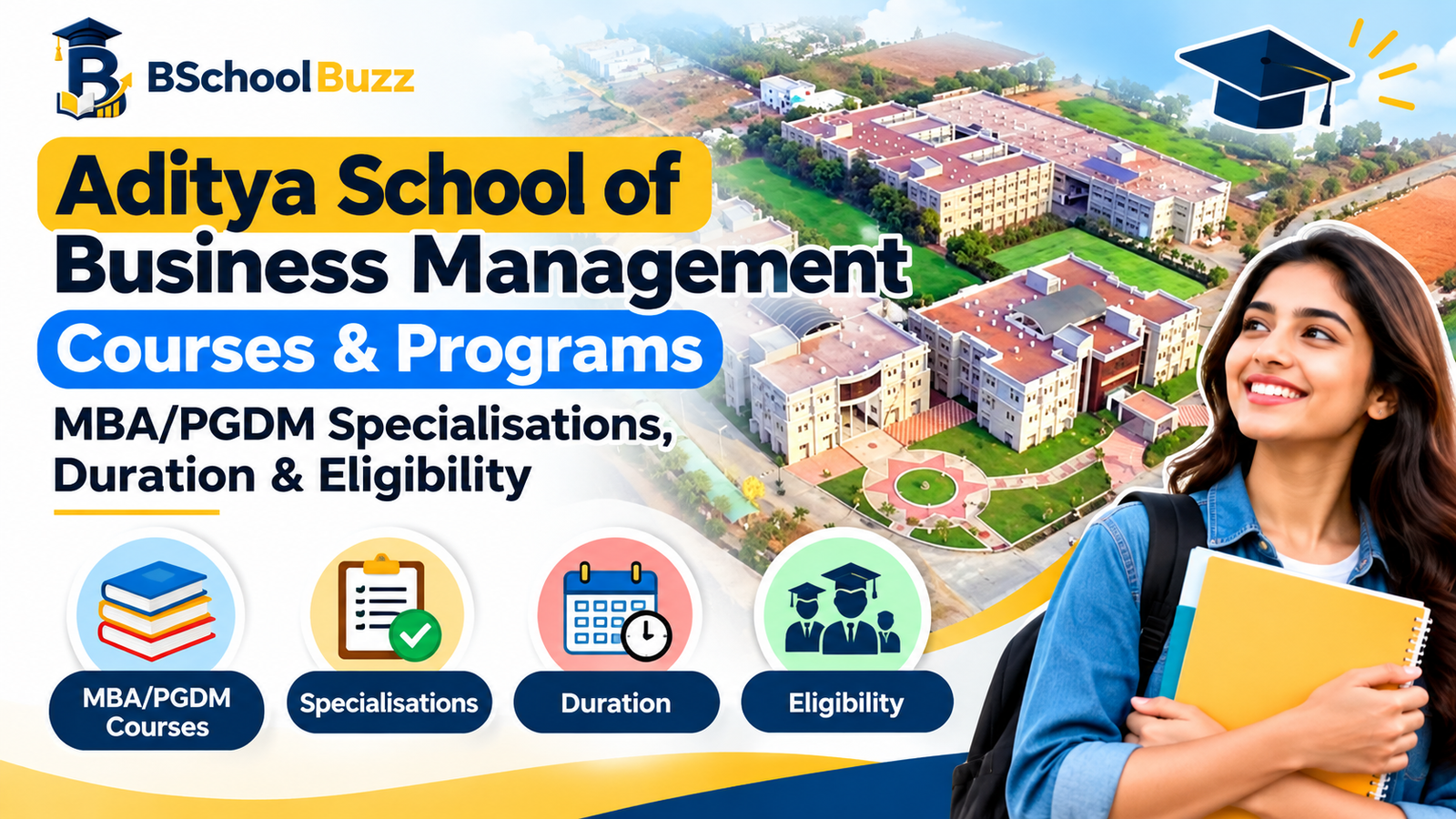
Aditya School of Business Management Courses & Programs: MBA/PGDM Specialisations, Duration & Eligibility
Introduction
Students comparing management colleges in Mumbai often look beyond the name of a programme. They want to understand what they will study, whether the qualification is an MBA or PGDM, which specialisations are available, how long the course takes, what eligibility conditions apply and how much the complete programme will cost.
Aditya School of Business Management (ASBM), Mumbai, presents itself as a management institute focused on conventional business functions as well as technology-oriented learning. Its official website lists PGDM+, PGDM in Business Analytics, and PGDM in Artificial Intelligence and Data Science. The institution also highlights case-based learning, internships, live projects, simulation activities and industry engagement.
However, applicants should pay attention to the exact qualification attached to each programme. The website sometimes uses “MBA*” alongside PGDM programme names, so students should confirm the final award title and its regulatory status in the current prospectus and admission documents before enrolling.
This article explains the courses listed by Aditya School of Business Management, the specialisation areas shown on its official programme page, the typical two-year PGDM structure, admission checks, fee verification, learning methods, placement information and questions to ask before accepting an offer. The focus is the Mumbai institution at asbm.edu.in, not other colleges with similar names.
Table of Contents
Overview of Aditya School of Business Management
Courses and Programmes Offered
PGDM+ / MBA* Programme and Specialisation Areas
PGDM in Business Analytics
PGDM in Artificial Intelligence and Data Science
Course Duration and Academic Format
Eligibility Criteria and Admission Requirements
Entrance Exams and Selection Process
Application and Admission Process
Fee Structure and Additional Expenses
Curriculum and Learning Approach
Campus and Student Learning Facilities
Placements and Career Preparation
Career Options by Programme
How to Choose the Right ASBM Programme
Documents and Questions to Prepare Before Admission
Frequently Asked Questions
Conclusion
About MBA Compass
Related Search Keywords
1. Overview of Aditya School of Business Management
Aditya School of Business Management is a management institute located in North Mumbai, Maharashtra. Its official website describes the institute as being backed by the Shree Ameya Public Charitable Trust and positions its programmes around management education, industry exposure and skill development.
The institution’s website identifies PGDM as its flagship programme in its older About Us information. Its current programme page highlights three main options: PGDM+ / MBA*, PGDM / MBA* in Business Analytics, and PGDM / MBA* in Artificial Intelligence and Data Science. The site also states that the programmes are approved by AICTE and that the institute is recognised by DTE. Applicants should check the current approval documents for the exact programme and academic session they plan to join. <Cite refs={["turn466442view0","turn466442view3"]}/>
ASBM at a glance
| Detail | Information |
|---|---|
| Institution | Aditya School of Business Management |
| Common abbreviation | ASBM |
| Location | Mumbai, Maharashtra |
| Official website | https://www.asbm.edu.in/ |
| Main qualification advertised | PGDM |
| Programme duration | The official fee page describes a two-year full-time PGDM; confirm the 2026–28 prospectus |
| Programme options currently highlighted | PGDM+, PGDM in Business Analytics, PGDM in Artificial Intelligence and Data Science |
| Approval information stated by the institute | AICTE approval and DTE recognition |
| Current admission cycle advertised | 2026–28 |
| Fee verification | Current official fee schedule and prospectus |
| Placement verification | Latest official placement report for the relevant programme and batch |
The institution’s official page advertises admissions for the 2026–28 batch. Its programme page also refers to practical learning, including internships, case studies, industry visits, capstone work and simulations. These are useful areas to investigate, but applicants should verify the specific activities included in their selected programme. <Cite refs={["turn466442view0","turn466442view3"]}/>
Important distinction: Aditya School of Business Management vs similarly named institutions
The name “Aditya” is used by multiple educational institutions in India. For this article, ASBM means the Mumbai-based institution whose official website is asbm.edu.in.
It should not be confused with Adithya School of Business Management in Coimbatore, Aditya University, Aditya Institute of Management in Pune or Aditya Global Business School in Andhra Pradesh. These are separate institutions, and their degrees, affiliations, fees, entrance examinations and specialisations may differ.
When searching for admission information, check the official domain, city, programme name and awarding body. This simple verification step helps avoid using another college’s fee structure or eligibility conditions by mistake.
2. Courses and Programmes Offered
The current official ASBM programme page highlights three programme groups. The naming on the page includes both PGDM and MBA* terminology; therefore, the exact qualification must be checked in the current prospectus and admission offer.
| Programme listed by ASBM | Main academic focus | Areas or learning elements highlighted on the website |
|---|---|---|
| PGDM+ / MBA* | Broad management education | Marketing, Human Resources, Information Technology, Finance and Operations |
| PGDM / MBA* in Business Analytics | Business decision-making using data | SQL, predictive modelling and diagnostic analytics |
| PGDM / MBA* in Artificial Intelligence and Data Science | Management and technology-oriented learning | Simulation labs, capstone and live projects, skill-first training |
Source: Official ASBM programme page. <Cite refs={["turn466442view0"]}/>
This table summarises the options currently highlighted on the website. It should not be treated as a complete semester-wise syllabus. Applicants should download the latest brochure or obtain the curriculum directly from the institute to check compulsory subjects, electives, assessment methods and the qualification awarded.
What should applicants compare?
The three programme groups serve different learning interests. The PGDM+ route presents a broader selection of management functions. Business Analytics is more directly oriented towards data interpretation and analytical decision-making. Artificial Intelligence and Data Science focuses on the intersection of management and technology.
The best choice depends on the kind of work a student hopes to pursue after graduation, the subjects they enjoy, their comfort with quantitative work and the actual curriculum available for the current intake.
Students should also confirm whether a specialisation is selected at the time of application or later in the programme. A list of subject areas on a marketing page does not necessarily mean that every option is available to every student in every batch.
3. PGDM+ / MBA* Programme and Specialisation Areas
ASBM’s current website lists PGDM+ / MBA* as one of its core programme options. The page identifies Marketing, Human Resources, Information Technology, Finance and Operations as focus areas. It also highlights summer internships, case-based learning, industry events, industrial visits, research conferences, capstone work, simulations and live projects. <Cite refs={["turn466442view0"]}/>
These areas cover several major functions within a business. Students should examine how the programme combines foundational management subjects with the subjects or electives they want to study in greater depth.
Marketing
Marketing involves understanding customers, developing a market position, communicating product value and evaluating commercial performance. Depending on the curriculum, relevant learning can include market research, consumer behaviour, sales planning, brand management and digital marketing.
Students considering marketing should look for opportunities to work on real business problems, interpret customer or market data and present recommendations. Practical work can help demonstrate analytical ability and communication skills to future employers.
Potential career directions may include marketing executive, sales analyst, brand associate, business development executive and market research associate. These are examples of possible roles, not guaranteed outcomes.
Human Resources
Human Resources focuses on the people and organisational systems that support business performance. Areas of study may include recruitment, employee relations, performance management, learning and development, organisational behaviour and workforce planning.
Students interested in HR should check whether the programme covers both people-management fundamentals and the use of data or technology in HR processes. Communication, discretion, organisation and the ability to handle workplace situations are valuable capabilities in this field.
Possible roles include HR executive, talent acquisition associate, recruitment coordinator, learning and development coordinator and HR operations associate. The actual roles available depend on employer requirements and a candidate’s experience.
Information Technology
An IT-related management focus generally concerns the business use of technology, digital systems and information resources. The emphasis may differ from a technical computer-science degree: management students often need to understand how technology supports business processes, projects, services and organisational decisions.
Applicants should inspect the curriculum to determine the extent of technical instruction, project management, systems-related learning and business applications. If they want a highly technical role, they should check whether the course provides the required depth in programming, infrastructure, software development or other specialist skills.
Finance
Finance concerns how organisations raise, allocate, monitor and manage money. Depending on the course structure, students may study financial accounting, budgeting, corporate finance, financial analysis and investment-related concepts.
Students interested in finance should look for applied work involving financial statements, spreadsheets, modelling and business cases. They should also determine whether the programme offers the depth needed for their preferred career path, because financial operations, corporate finance, research and investment-related roles can have different requirements.
Possible directions include finance associate, financial reporting assistant, budgeting analyst, accounts-related business roles and financial analysis support.
Operations
Operations management concerns the systems through which an organisation delivers products and services. It may cover process improvement, quality, capacity planning, resource allocation, service delivery and productivity.
Students considering operations should examine whether the course includes practical problem-solving and quantitative analysis. Process mapping, spreadsheet analysis, project work and the ability to coordinate teams can be useful skills in operational roles.
Potential roles include operations coordinator, process analyst, service operations executive, quality coordinator and project support associate.
How to choose a specialisation
A sensible approach is to compare the curriculum with the work you may want to do after graduation. Consider the following questions:
Which business functions interest me most?
Do I prefer customer-facing, analytical, people-focused or process-oriented work?
Does the programme provide the relevant core subjects and electives?
Are projects and internships connected to the area I want to pursue?
What technical skills do employers expect in my target roles?
Can I see evidence of relevant job roles in the institute’s latest placement report?
Do not select a specialisation based only on a job title or the expectation of a higher salary. A strong fit between interests, course content and skill development is more useful than choosing a programme because its name appears fashionable.
4. PGDM in Business Analytics
ASBM lists a PGDM / MBA* programme in Business Analytics. Its official programme page highlights SQL, predictive modelling and diagnostic analytics. It also refers to simulation labs, practical projects and placement assistance across the programme portfolio. <Cite refs={["turn466442view0"]}/>
Business Analytics uses data to help organisations understand performance, identify patterns, evaluate options and make better-informed decisions. The subject can be relevant to many business functions, including marketing, finance, operations, customer service and supply-chain management.
What is Business Analytics?
Business Analytics is the practice of using data, analytical techniques and business knowledge to answer organisational questions. A company might use sales data to understand why a product is underperforming, customer data to study purchasing patterns or operational data to identify delays.
A management student does not necessarily need to become a software engineer to use analytics. However, the student should be prepared to interpret data, understand the assumptions behind a model and communicate findings clearly.
Skills to look for in the curriculum
The programme page highlights three learning areas:
SQL: a language commonly used to query and manage data stored in relational databases.
Predictive modelling: methods used to estimate likely future outcomes from historical data and relevant variables.
Diagnostic analytics: analysis intended to investigate why a particular result or pattern occurred.
These labels indicate the kind of analytical content advertised, but they do not establish the full depth of instruction. Students should check the current syllabus for software tools, statistics, data visualisation, business intelligence, modelling, project requirements and assessment methods.
Who may find Business Analytics suitable?
The programme may appeal to students who enjoy problem-solving, working with numbers, investigating business questions and explaining evidence to others. It can also be useful for applicants who want to combine general management knowledge with data-oriented skills.
Students should not assume that a programme title alone guarantees technical proficiency. Before admission, ask how much practical work is included, which tools are taught, whether students complete individual or group projects and how the institute assesses analytical competence.
Possible career directions
Depending on the curriculum and the student’s skills, possible directions may include business analyst, reporting analyst, analytics associate, business intelligence support, operations analyst and market research analyst.
These roles have different technical requirements. Some employers expect strong SQL, spreadsheet, visualisation or statistical skills, while others emphasise business communication and reporting. Review actual job descriptions and use the curriculum to identify any skills you may need to develop independently.
5. PGDM in Artificial Intelligence and Data Science
ASBM also lists a PGDM / MBA* programme in Artificial Intelligence and Data Science. The current programme page refers to simulation labs, capstone work, live projects and skill-first training. Applicants should obtain the current curriculum to understand exactly how AI concepts and data-science methods are taught and assessed. <Cite refs={["turn466442view0"]}/>
Understanding the programme focus
Artificial Intelligence and Data Science bring together methods for working with information, identifying patterns and building or using data-driven systems. In a management setting, these areas can support business forecasting, customer analysis, automation, operational decisions and technology-enabled services.
The practical value of the programme depends on its actual content. Students should look for clear information about technical foundations, analytics, applied business cases and the balance between management subjects and computing-related learning.
Questions to ask about the curriculum
Before enrolling, applicants should ask:
Which AI and data-science subjects are compulsory?
Does the course include statistics, programming or data preparation?
Which tools and software platforms are taught?
Are projects based on business problems or mainly theoretical exercises?
Do students build models, interpret results or primarily study AI applications?
How are capstone projects assessed?
Are external certifications included in the fee, or do they require separate payment?
What technical background is recommended for incoming students?
These questions help determine whether the programme matches a student’s expectations. A management-oriented AI programme may have a different technical depth from a specialist data-science degree, so applicants should avoid assuming that the two qualifications are interchangeable.
Potential career directions
Depending on the skills developed, graduates may explore business analysis, data analysis, technology project support, digital transformation support, AI-enabled business operations or reporting roles. Highly technical positions may require additional programming, mathematics, statistics or machine-learning expertise.
Students should compare the advertised course content with the entry requirements of jobs they want to pursue. That comparison is more informative than relying on a programme title alone.
6. Course Duration and Academic Format
The ASBM fee-structure page describes a two-year full-time Postgraduate Diploma in Management. The institution’s website advertises admissions for the 2026–28 batch, which is consistent with a two-year programme cycle, but applicants should confirm the official duration and academic calendar in the current prospectus. <Cite refs={["turn466442view2","turn466442view0"]}/>
| Programme or detail | Information to confirm |
|---|---|
| PGDM+ / MBA* | Confirm the duration and award title in the 2026–28 prospectus |
| PGDM / MBA* in Business Analytics | Confirm the current programme structure and semester plan |
| PGDM / MBA* in AI and Data Science | Confirm the current programme structure and semester plan |
| Academic mode | The fee page describes the PGDM as full-time |
| Academic calendar | Obtain the dates for the current intake from admissions |
| Internship timing | Confirm the period, eligibility and assessment requirements |
| Final project | Check the curriculum for capstone, live project or dissertation requirements |
What a two-year management programme may involve
A management programme commonly combines foundational business subjects with more specialised learning, applied projects and assessment. However, the exact semester-by-semester arrangement must be taken from ASBM’s current curriculum. Students should not infer a precise list of subjects from a general programme description.
The programme calendar matters for practical planning. It can affect internship timing, examination periods, project deadlines, placement preparation and personal budgeting. Ask for the academic calendar and confirm how attendance, assessment and internship requirements work.
Why the qualification title matters
The official ASBM website uses PGDM and MBA* together on its programme page. Applicants should ask the institution to state clearly which qualification will appear on the final certificate and transcript, which body awards it, and what approval or recognition applies to the specific programme.
This is especially important if a student expects to pursue further education, apply for a particular government or private-sector role, or use the qualification for an academic equivalence process. Do not rely solely on the asterisk or the phrase “equivalent as per industry standards”; obtain the applicable explanation in writing.
7. Eligibility Criteria and Admission Requirements
Eligibility conditions can change between admission cycles and may differ by programme. ASBM’s current programme page advertises admissions for 2026–28, while some other pages on the website contain older information. Applicants should use the current prospectus and admission instructions as the authoritative source for the intended intake.
The older fee page is specifically labelled for the 2023–25 batch. It is useful as a historical record of the institute’s published fee format, but it should not be treated as a current eligibility or admission notice. <Cite refs={["turn466442view2","turn466442view0"]}/>
What applicants should verify
| Eligibility or admission item | What to check |
|---|---|
| Academic qualification | Whether a recognised bachelor’s degree is required and which qualifications are accepted |
| Minimum graduation marks | Exact percentage or grade requirement for the 2026–28 intake |
| Final-year applicants | Whether provisional applications are permitted and when final results must be submitted |
| Entrance examination | Which tests and score years are accepted |
| Selection stages | Whether an interview, group discussion, aptitude test or other stage applies |
| Programme-specific requirements | Any additional condition for Business Analytics or AI and Data Science |
| Documents | Required marksheets, certificates, identity proof and scorecards |
| Deadlines | Application, document submission and fee-payment dates |
Do not assume one percentage applies to every course
Management colleges sometimes have different conditions for general eligibility, entrance-test shortlisting and final selection. These are not the same thing. A minimum graduation percentage may determine whether an applicant can apply, while entrance-test scores and interviews may influence selection.
Applicants should therefore obtain answers to three separate questions: Am I eligible to apply? Which entrance tests or scores can I use? How are eligible applicants selected? A clear answer to each avoids confusion during the application process.
What if final-year results are pending?
Students who are still completing graduation should confirm whether ASBM accepts provisional applications. They should ask which document is required at the time of application and when the final marksheet or degree certificate must be submitted.
If a student’s result is delayed, a marksheet contains a discrepancy or a degree is awarded under a different naming convention, it is better to seek written clarification early. Do not assume that an application or provisional offer removes the requirement to meet final academic conditions.
8. Entrance Exams and Selection Process
The current ASBM programme page promotes admissions for the 2026–28 batch, but applicants should obtain the latest admission notification to confirm the entrance examinations accepted for each programme. The current course page alone does not provide a complete, unambiguous list of accepted tests and qualifying scores. <Cite refs={["turn466442view0"]}/>
How to verify accepted entrance tests
When reviewing admission information, look for the exact test name, accepted test year, score or percentile requirement, validity period and whether a separate institutional selection stage applies. A list found on an older blog or an unrelated institution’s page should not be used as confirmation.
Applicants can ask the admissions team:
Is an entrance examination mandatory for my chosen programme?
Which examinations are accepted for the 2026–28 intake?
Are scores accepted from the previous testing year?
Is there a minimum percentile or score?
Can a candidate apply before the score is released?
Is an interview or group discussion part of selection?
How is the final admission decision made?
Why the entrance route matters
Different tests use different scoring systems. A raw score, percentile and rank are not interchangeable. If a college sets a minimum percentile, applicants should not compare it directly with another test’s raw score.
Also, an entrance-test exemption does not necessarily mean automatic admission. The institution may still require academic eligibility, document verification, an interview or other selection requirements. Confirm the complete process before making plans around a particular test.
9. Application and Admission Process
Applicants can approach the ASBM application process as a series of checks. The precise sequence, application fee and deadlines should be verified on the current official portal.
Step 1: Choose the programme
Start by deciding whether you want a broad management programme, Business Analytics or Artificial Intelligence and Data Science. Read the programme description and curriculum, and confirm the exact qualification title.
Step 2: Check eligibility
Review the academic requirements for the 2026–28 intake. Confirm the minimum graduation marks, final-year application rules and any programme-specific conditions.
Step 3: Verify entrance-test requirements
Check whether an entrance examination is required and which scores are accepted. Confirm the test year, qualifying score and any additional selection stage.
Step 4: Complete the application
Use the official ASBM application route. Enter personal and academic information accurately, upload the requested documents and pay any application charge only through the institution’s authorised payment process.
Step 5: Complete selection requirements
Follow the instructions given by admissions for any interview, group discussion, aptitude test or additional assessment. Prepare to explain your academic background, interest in management, reasons for choosing the programme and career goals. These are sensible preparation areas rather than a promise about exact interview questions.
Step 6: Read the offer letter
If you receive an offer, confirm the programme name, award title, intake, total fee, payment schedule, conditions and deadline. If the offer uses both MBA and PGDM terminology, request written clarification before accepting.
Step 7: Verify documents and payment terms
Check the required academic records, identity documents and entrance-test evidence. Read the refund policy and confirm what happens if you withdraw, fail to meet a condition or cannot submit a required document on time.
Admission-stage checklist
| Stage | Applicant action |
|---|---|
| Programme selection | Compare curriculum and qualification awarded |
| Eligibility | Confirm academic requirements for the intended intake |
| Entrance test | Verify accepted exam, year and score condition |
| Application | Use the official portal and save confirmation |
| Selection | Follow interview or assessment instructions |
| Offer | Check programme name and all admission conditions |
| Fees | Obtain the current fee schedule and refund rules |
| Enrolment | Submit documents and receipts as instructed |
The most important principle is to keep a record of the programme information, fee schedule and conditions supplied by the institution. If any information differs between a webpage, prospectus and offer letter, ask admissions to clarify which document governs your admission.
10. Fee Structure and Additional Expenses
ASBM has an official fee-structure page, but the schedule currently displayed on that page is explicitly for the 2023–25 batch. It lists a two-year full-time PGDM, tuition charges of ₹3,90,000 for each year, refundable caution money of ₹10,000 and a one-time application form fee of ₹2,000. It also mentions a ₹50,000 initial payment to block a seat. <Cite refs={["turn466442view2"]}/>
These figures are historical and should not be presented as the confirmed fee for the 2026–28 batch. The correct current fee must be obtained from ASBM’s latest prospectus or a written fee schedule issued by the institute.
Historical fee schedule shown on the official website
| Fee component | Amount shown on the page | Applicability |
|---|---|---|
| First-year tuition | ₹3,90,000 | Listed for the 2023–25 batch |
| Second-year tuition | ₹3,90,000 | Listed for the 2023–25 batch |
| Tuition total for two years | ₹7,80,000 | Historical schedule only |
| Refundable caution money | ₹10,000 | Listed for the 2023–25 batch |
| Application form fee | ₹2,000 | Listed as a one-time fee |
| Initial seat-blocking payment | ₹50,000 | Mentioned on the historical fee page; confirm current terms |
Important: This table documents what the official page displays for the earlier batch. It is not a quote for 2026–28 admission. Do not use these figures to calculate the current cost of enrolment without confirmation from ASBM. <Cite refs={["turn466442view2"]}/>
How to obtain the current ASBM fee
Before accepting an offer, request a written fee structure for the precise programme and intake. It should clearly state the total tuition, instalment dates, one-time charges, refundable deposits and any additional costs. Ask whether the amount applies to PGDM+, Business Analytics or AI and Data Science, because fees can differ by programme.
Use this checklist:
Confirm the full programme name and batch.
Check whether the fee is for one year or the complete programme.
Identify the tuition and any separate development, examination or administrative charges.
Confirm whether the seat-blocking amount is adjusted against tuition.
Ask whether any deposit is refundable and what deductions may apply.
Check whether hostel accommodation and food are included or separate.
Confirm whether optional certificates, software or study materials cost extra.
Read the withdrawal and refund policy before paying.
Keep official receipts and payment confirmations.
Hostel and living expenses
A complete student budget may include accommodation, meals, local transport, books, a laptop, personal expenses and travel. The official About Us page says that assistance is provided for hostel accommodation, but that statement does not establish the current price, room availability or whether a particular hostel arrangement is mandatory. <Cite refs={["turn466442view3"]}/>
Ask ASBM for the current accommodation options and charges, whether meals are included, what the payment period is, and which refund rules apply. Students who will commute should estimate local travel costs and journey time separately.
Scholarships and financial assistance
Do not assume that a scholarship is available to every applicant or that a published award automatically reduces every fee component. Ask the institute for the current scholarship or financial-assistance policy, including eligibility, selection criteria, award amount, renewal conditions and any performance requirements.
If an education loan is being considered, provide the lender with the current official fee schedule rather than relying on an older webpage. The lender may also ask for an admission letter, payment calendar and programme documentation.
Practical fee-planning advice
The lowest quoted tuition is not always the lowest total cost. Compare the complete programme cost across institutions, including any compulsory deposits and living expenses. A clear fee schedule also helps families plan when funds are due instead of discovering an additional payment after admission.
11. Curriculum and Learning Approach
ASBM’s official website highlights a learning approach that includes case studies, internships, live projects, simulations, industry events and guest lectures. It also mentions capstone work and industrial visits. Applicants should verify which of these activities are included in the specific programme and how they are assessed. <Cite refs={["turn466442view0","turn466442view3"]}/>
Case-based learning
A business case asks students to examine a situation, identify the central problem, consider available evidence and recommend a course of action. The exercise develops structured thinking and gives students practice explaining a decision.
The value of a case depends on the quality of the discussion and the student's own preparation. Applicants should ask how frequently cases are used, whether they are linked to the chosen specialisation and how class participation or written analysis is assessed.
Live projects and capstone work
Projects give students a chance to apply management concepts to a practical question. Depending on the project, students may conduct research, analyse information, work with a team, develop recommendations and present their findings.
A capstone can help demonstrate the student's ability to connect different subjects. However, the precise project format, client involvement and assessment method should be confirmed in the current curriculum rather than assumed from a general programme page.
Internships
An internship can expose students to workplace expectations and help them test their interests before graduation. The ASBM programme page highlights summer internships. Applicants should confirm the internship calendar, eligibility requirements, assessment method and the kind of support offered in finding an opportunity.
It is also useful to ask how internships relate to final placements. An internship and a permanent job offer are different outcomes, and neither should be assumed to guarantee the other.
Simulations and labs
The website refers to simulation labs, including Martech and Finance, in its programme descriptions. Simulations can give students a controlled setting in which to practise decisions and observe possible consequences.
For students in analytics or technology-oriented programmes, ask which tools are used and whether students receive individual access to them. Confirm whether any software subscriptions or external certification charges are included in the tuition.
Guest lectures and industry engagement
ASBM highlights guest lectures, industry mentors, summits, conclaves and live consulting projects. These activities can expose students to professional perspectives and current business questions.
The number of events alone does not establish their depth or impact. Ask how often students interact with practitioners, whether sessions are open to every programme, whether participants complete related work and whether the institution provides a documented schedule.
Skill development
Management graduates need more than subject knowledge. Communication, teamwork, research, presentation, data interpretation and professional conduct can influence performance in interviews and early-career roles.
Students should use class projects and internships to build evidence of these capabilities. A completed project with a clear description of the problem, the student's contribution and the result is more useful in an interview than a general claim of being a good team player.
12. Campus and Student Learning Facilities
ASBM’s official About Us page describes a nine-storey, Wi-Fi-enabled campus with an area of 1,20,000 square feet. It also lists a convention centre, seminar hall, amphitheatre-style classrooms, an auditorium, cafeteria, IT labs, language labs, boardrooms and library facilities. The current programme page repeats the 1,20,000-square-foot campus figure and refers to a 12,000-square-foot convention centre. <Cite refs={["turn466442view0","turn466442view3"]}/>
Facilities listed by the institution
| Facility | Information stated by ASBM |
|---|---|
| Campus | Nine-storey campus |
| Campus area | 1,20,000 sq. ft. |
| Convention centre | 12,000 sq. ft. |
| Seminar hall | 2,000 sq. ft. |
| Classrooms | Eight amphitheatre-style classrooms listed on the About Us page |
| Auditorium | Capacity stated as more than 500 |
| Cafeteria | Capacity stated as more than 300 |
| IT labs | Listed among campus facilities |
| Language labs | Listed among campus facilities |
| Library | Separate library and reading zone |
| Hostel support | The institute says assistance is provided |
Source: Official ASBM website. <Cite refs={["turn466442view3"]}/>
These are institutional descriptions, not an independent assessment of the facilities. Prospective students should visit the campus where possible, inspect the rooms and labs relevant to their programme, and ask about access hours, computer availability, library resources and student services.
Why the campus matters for management students
Management education often involves group assignments, presentations, discussions and collaborative projects. Classrooms, meeting rooms, computer facilities and a suitable study environment can support these activities.
Students interested in analytics or AI should pay particular attention to the practical facilities and tools available to them. Ask whether the required software can be accessed outside scheduled lab hours, whether students work on individual projects and whether support is available when they encounter technical difficulties.
Location and commute
The institute identifies its location as North Mumbai. Before admission, check the current address, route options and daily travel time from your accommodation. Mumbai commuting can have a meaningful impact on a student's timetable and budget, so the location should be considered alongside fees and curriculum.
If you intend to stay in a hostel or rented accommodation, confirm the actual distance to campus, transport options and the time required to travel during regular class hours. Do not assume that every accommodation option advertised by a third party is affiliated with or endorsed by the institution.
13. Placements and Career Preparation
ASBM’s current programme page displays placement-related figures of ₹25 lakh per annum as the highest CTC and ₹7.75 lakh per annum as the average CTC. The same page displays an average salary of ₹7.75 LPA in connection with its Business Analytics and AI & Data Science programme descriptions. However, the page excerpt does not clearly establish the graduating batch, reporting period, number of students included or whether every figure applies to each programme individually. <Cite refs={["turn466442view0"]}/>
For that reason, applicants should treat these as figures advertised on the website and request the latest placement report before using them to compare institutions. A current, programme-specific report is more useful than a headline statistic without a clear denominator.
How to interpret placement figures
| Metric | What it means | What applicants should verify |
|---|---|---|
| Highest CTC | The highest reported cost-to-company package in a stated group | Batch, programme, domestic or international status and whether it is an annual figure |
| Average CTC | The mean CTC for the stated group | Number of students included and whether the average is for all graduates or only placed students |
| Median CTC | The middle reported CTC value | Batch, programme and calculation method |
| Placement percentage | The proportion of a defined student group placed | Number of eligible students, placed students and definition of “placed” |
| Recruiter count | Employers that participated in a placement process | Whether the number covers ASBM as a whole or one programme |
| Internship outcomes | Internship opportunities or offers | Whether the figure represents offers, students who accepted, or completed internships |
| Job roles | Types of work offered | Whether the roles match the programme's specialisation |
Why average and median both matter
The highest package represents one reported outcome and does not tell applicants what a typical student may earn. The average can be affected by a small number of unusually high salaries. A median can provide a complementary view of the middle outcome.
For a meaningful comparison, use the highest, average and median figures from the same reporting year and programme wherever possible. Also check the number of students who participated in placements, the number who received offers and the types of jobs offered.
Questions to ask about ASBM placements
Before accepting an offer, ask for the latest placement report and check:
Which graduating batch does the report cover?
Are PGDM+, Business Analytics and AI & Data Science reported separately?
How many students were eligible for placements?
How many students were placed?
Are highest, average and median CTC disclosed?
Which roles and sectors hired graduates?
What internship opportunities were available?
Does the placement process include career coaching, mock interviews and résumé preparation?
Are there any conditions for receiving placement support?
ASBM’s website highlights a dedicated Career Development Cell, placement training and internship opportunities. Applicants should ask which services are provided to their programme, how often they are offered and what students must do to participate. <Cite refs={["turn466442view0"]}/>
Placement assistance is not a job guarantee
Placement assistance generally refers to support such as recruitment coordination, training, interview preparation or access to employer opportunities. It should not automatically be interpreted as a guarantee that every student will receive a job or achieve a particular salary.
Students can improve their readiness by building subject knowledge, practising communication, completing relevant projects, developing technical skills and researching employers. The value of placement support depends partly on how actively the student participates and whether their skills match employer requirements.
14. Career Options by Programme
The job opportunities associated with a management programme depend on the curriculum, practical skills, internship experience and the requirements of individual employers. The following roles are examples of possible directions rather than guaranteed placements.
| Programme focus | Potential career directions |
|---|---|
| PGDM+ — Marketing | Marketing executive, sales analyst, brand associate, market research assistant |
| PGDM+ — Human Resources | HR executive, talent acquisition associate, recruitment coordinator |
| PGDM+ — Information Technology | IT project support, business systems support, technology operations coordination |
| PGDM+ — Finance | Finance associate, financial reporting support, budgeting or analysis roles |
| PGDM+ — Operations | Operations coordinator, process analyst, service delivery support |
| Business Analytics | Business analyst, reporting analyst, analytics associate, business intelligence support |
| AI and Data Science | Data analysis support, AI-enabled business operations, technology project support, digital transformation support |
These examples are deliberately broad because job titles and requirements vary across organisations. A business analyst role may require SQL and data visualisation, while a finance role may place more emphasis on accounting, spreadsheets and financial analysis.
Match career goals with skills
Students should identify several roles they may want to pursue and read actual job descriptions. Record the common requirements, such as Excel, SQL, communication, research, presentation, programming or financial knowledge. Then compare those requirements with the curriculum and the projects available at ASBM.
If a desired role requires a skill that is not covered in sufficient depth, plan additional learning. A certificate may be useful, but students should evaluate the course content and practical work rather than assuming that a credential alone will qualify them for a role.
Build evidence during the programme
Recruiters often ask candidates to explain what they have done, not only what they have studied. Students can prepare by keeping a record of:
Academic projects and the problem each project addressed.
Data, research methods or tools used.
Their individual contribution to group assignments.
Internship responsibilities and work completed.
Presentations, case competitions or practical exercises.
Examples of working through a difficult problem.
Feedback received and how they acted on it.
This material can help students prepare résumés and answer interview questions with specific examples.
15. How to Choose the Right ASBM Programme
Choosing between PGDM+, Business Analytics and AI & Data Science should begin with career interests and curriculum details, not with the title alone.
Step 1: Decide what you want to learn
If you want broad exposure to core business functions, compare the PGDM+ curriculum and its listed areas. If you enjoy interpreting data and using analytical tools, examine Business Analytics. If you want to explore AI and data science in a business context, study the technical content of that programme carefully.
Step 2: Check the award title
Because ASBM’s programme page uses both PGDM and MBA* wording, ask the institution to confirm the qualification awarded and the awarding body. Obtain the explanation in writing, especially if you plan to apply for further education or a role with specific qualification requirements.
Step 3: Compare the actual syllabus
Look at compulsory subjects, electives, project requirements, internships and software exposure. Ask how subjects are assessed and whether the curriculum includes hands-on work. Do not assume that a subject listed on a marketing page is necessarily a full specialisation or a compulsory module.
Step 4: Verify eligibility and entrance tests
Confirm the minimum academic requirements and the accepted entrance examinations for the 2026–28 intake. Make sure the score year and qualifying criteria apply to your chosen programme.
Step 5: Obtain the current fee schedule
The fee page currently surfaced online displays a 2023–25 schedule. Request the correct 2026–28 fee structure and identify every compulsory charge. Compare the total cost of the programme, not only tuition.
Step 6: Review placement evidence
Ask for the latest placement report and check the batch, programme, average, median and number of students placed. Look at the roles offered and determine whether they match your interests.
Step 7: Consider location and learning environment
Evaluate the campus, commute, accommodation, access to learning facilities and daily schedule. These factors affect the overall student experience and cost.
Programme decision checklist
| Question | Why it matters |
|---|---|
| Is the programme aligned with my career interests? | Helps ensure the subjects support the work I want to pursue |
| What qualification will I receive? | Clarifies the award title and awarding body |
| Do I meet the current eligibility criteria? | Prevents an unsuitable application |
| Which entrance exams are accepted? | Helps plan the correct admission route |
| What is the full fee for 2026–28? | Supports accurate financial planning |
| Are projects and internships included? | Clarifies practical-learning opportunities |
| Is the placement report programme-specific? | Makes outcome comparisons more meaningful |
| Can I manage the commute or accommodation? | Helps assess the full cost and daily routine |
16. Documents and Questions to Prepare Before Admission
The current admission portal and prospectus should determine the final document checklist. Applicants can prepare common academic records in advance, then verify which documents are required for the programme and admission route.
Documents to keep ready
Class 10 marksheet or certificate.
Class 12 marksheet or certificate.
Graduation marksheets and degree certificate, where available.
Provisional degree or final-year status documents, if applicable.
Entrance-examination scorecard, if required.
Government-issued identity document.
Recent photograph and signature in the format requested.
Additional documents specified in the current application instructions.
This is a preparation list, not a confirmed exhaustive ASBM checklist. Check the portal for file formats, attestation requirements, document deadlines and any programme-specific conditions.
Questions to ask the admissions team
Before paying a seat-blocking amount or tuition instalment, obtain clear answers to the following:
Programme and qualification
What is the exact name of the programme on the admission offer?
Is the award a PGDM, MBA or another qualification?
Which institution or body awards the qualification?
What approval or recognition applies to this programme?
Fees and policies
What is the total fee for the 2026–28 batch?
Which charges are separate from tuition?
Is the seat-blocking payment adjusted against the total fee?
What is refundable if I withdraw?
Are hostel and food costs included?
Are certifications or software charges extra?
Eligibility and selection
Which entrance exams are accepted?
What score or percentile is required?
Can final-year students apply?
Are interviews or group discussions required?
When must final academic documents be submitted?
Learning and placements
What practical projects are compulsory?
How are internships arranged?
What tools are taught in Business Analytics or AI and Data Science?
Can I review the latest placement report?
Are placement statistics available separately for each programme?
Written answers are especially useful when the website uses different terminology or when an older page remains online. Keep copies of the prospectus, offer letter, fee schedule, payment receipts and any clarifications supplied by the institute.
17. Frequently Asked Questions
1. What courses are offered by Aditya School of Business Management?
The official website lists PGDM+, PGDM in Business Analytics and PGDM in Artificial Intelligence and Data Science. It also uses MBA* wording alongside some programme names. Applicants should confirm the exact qualification awarded for their chosen course.
2. Is ASBM located in Mumbai?
Yes. The institution identifies itself as Aditya School of Business Management in North Mumbai, Maharashtra. Confirm the current address on the official website before visiting.
3. What is the duration of the ASBM PGDM?
The official fee page describes a two-year full-time PGDM. Applicants for the 2026–28 batch should confirm the duration and academic calendar in the current prospectus.
4. Which specialisations are listed for PGDM+?
ASBM lists Marketing, Human Resources, Information Technology, Finance and Operations. Confirm which options are available to the current batch and how students select them.
5. Does ASBM offer Business Analytics?
Yes. ASBM lists a PGDM / MBA* programme in Business Analytics and highlights SQL, predictive modelling and diagnostic analytics on its official programme page.
6. Does ASBM offer AI and Data Science?
Yes. The institution lists a PGDM / MBA* programme in Artificial Intelligence and Data Science. Applicants should check the current syllabus for technical depth, software, projects and the final qualification awarded.
7. What are the eligibility criteria for ASBM admission?
Applicants should check the current 2026–28 prospectus and admission notice for academic requirements, accepted entrance tests and selection stages. Do not rely on an old batch’s admission rules as confirmation of current eligibility.
8. What is the ASBM PGDM fee for 2026–28?
The fee page currently displays figures for the 2023–25 batch. Request the current 2026–28 fee schedule from ASBM before budgeting or paying an instalment.
9. What placement figures does ASBM publish?
The current programme page displays a highest CTC of ₹25 LPA and an average CTC of ₹7.75 LPA. Applicants should ask for the latest placement report to verify the batch, programme coverage and calculation method.
10. Is ASBM approved by AICTE?
The institution’s official website states that its PGDM programmes are AICTE-approved and that it is recognised by DTE. Applicants should verify the current approval documentation for the exact programme and academic year.
11. Does ASBM provide hostel facilities?
The institute’s About Us page says assistance is provided for hostel accommodation. Applicants should confirm current availability, costs, room options, meal arrangements and the applicable payment and refund conditions.
12. How can I apply to Aditya School of Business Management?
Start with the official ASBM website and current admission portal. Choose the programme, confirm eligibility and accepted entrance tests, complete the application, follow the selection instructions and review the offer and fee conditions before payment.
18. Conclusion
Aditya School of Business Management in Mumbai lists management education options that include PGDM+, Business Analytics and Artificial Intelligence and Data Science. The website highlights functional areas such as Marketing, Human Resources, Information Technology, Finance and Operations, alongside practical learning activities including internships, case studies, simulations and live projects.
The most important step for applicants is to verify the exact qualification awarded. Because the current programme page uses both PGDM and MBA* wording, obtain a clear written explanation of the award title and its applicable approval or recognition. Confirm eligibility, accepted entrance tests and selection stages for the 2026–28 intake as well.
Fees deserve the same care. The official fee page currently displays a schedule for the 2023–25 batch, so those figures should not be treated as the current cost. Request the complete fee structure for your programme and batch, including deposits, accommodation and other charges.
Finally, evaluate placement figures using the latest report that identifies the programme and graduating batch. Compare average and median outcomes, job roles and placement participation rather than relying only on a headline salary figure.
A well-informed decision should bring together programme content, qualification, eligibility, cost, practical learning and career evidence. Verify each of these areas directly with ASBM before accepting an offer.
19. About MBA Compass
MBA Compass helps prospective management students understand postgraduate business programmes, specialisations, admission requirements, fees and career-related information. Its articles aim to organise relevant details in a clear and practical format so that students can compare options more effectively. Applicants should confirm final programme, fee and admission conditions directly with the institution before making a decision.
20. Related Search Keywords
Aditya School of Business Management, Aditya School of Business Management courses, Aditya School of Business Management programmes, Aditya School of Business Management admission, Aditya School of Business Management fees, Aditya School of Business Management eligibility, Aditya School of Business Management specialisations, Aditya School of Business Management Mumbai, ASBM Mumbai, ASBM courses, ASBM PGDM, ASBM PGDM courses, ASBM PGDM admission 2026, ASBM PGDM 2026–28, ASBM MBA courses, ASBM MBA admission, ASBM Business Analytics, ASBM AI and Data Science, ASBM PGDM+ programme, ASBM official website, Aditya School of Business Management official website, ASBM Mumbai admission process, Aditya School of Business Management fee structure, ASBM fee structure 2026, ASBM fees 2026–28, ASBM PGDM total fees, ASBM tuition fees, ASBM application fee, ASBM caution money, ASBM seat blocking fee, ASBM hostel fees, ASBM accommodation, ASBM eligibility criteria, ASBM graduation eligibility, ASBM entrance exams, ASBM accepted entrance tests, ASBM admission requirements, ASBM application process, ASBM admission dates, ASBM prospectus 2026–28, ASBM PGDM duration, ASBM course duration, ASBM two year PGDM, ASBM Marketing specialisation, ASBM Finance specialisation, ASBM Human Resources specialisation, ASBM IT specialisation, ASBM Operations specialisation, ASBM Business Analytics programme, ASBM Artificial Intelligence and Data Science programme, PGDM in Business Analytics at ASBM, PGDM in AI and Data Science at ASBM, PGDM+ at ASBM Mumbai, ASBM MBA equivalent programme, ASBM PGDM qualification, ASBM qualification awarded, ASBM AICTE approval, ASBM DTE recognition, Aditya School of Business Management approval, ASBM academic curriculum, ASBM PGDM syllabus, ASBM Business Analytics syllabus, ASBM AI Data Science syllabus, ASBM SQL training, ASBM predictive modelling, ASBM diagnostic analytics, ASBM simulation labs, ASBM live projects, ASBM capstone projects, ASBM summer internship, ASBM case study learning, ASBM industry visits, ASBM guest lectures, ASBM campus facilities, ASBM campus area, ASBM campus location, ASBM North Mumbai, ASBM placement report, ASBM placement statistics, ASBM highest package, ASBM average package, ASBM highest CTC, ASBM average CTC, ASBM placement 2026, ASBM placement assistance, ASBM career development cell, ASBM recruiters, ASBM internship opportunities, jobs after ASBM PGDM, career after Business Analytics PGDM, careers after AI Data Science PGDM, career options after PGDM+ at ASBM, ASBM finance jobs, ASBM marketing jobs, ASBM HR jobs, ASBM operations jobs, ASBM business analyst careers, ASBM data analytics careers, ASBM AI career opportunities, management colleges in Mumbai, PGDM colleges in Mumbai, AICTE approved PGDM colleges in Mumbai, management courses in Mumbai, business schools in North Mumbai, Aditya School of Business Management PGDM fee 2026–28, Aditya School of Business Management admission eligibility 2026, ASBM entrance exam criteria 2026, ASBM Business Analytics admission 2026, ASBM AI Data Science admission 2026, ASBM PGDM specialisation list, ASBM course comparison, ASBM fee payment schedule, ASBM refund policy, ASBM scholarship information, ASBM education loan information, ASBM final year student eligibility, ASBM document checklist, ASBM admission offer letter, ASBM qualification recognition, ASBM PGDM vs MBA, ASBM programme comparison, ASBM placement report batch details, ASBM median salary, ASBM placement percentage, ASBM campus visit, ASBM student facilities, ASBM practical learning, ASBM management education, ASBM programme selection guide, Aditya School of Business Management 2026 admissions, Aditya School of Business Management 2026–28 batch, ASBM Mumbai PGDM course details, ASBM PGDM fees and eligibility, ASBM Business Analytics fees, ASBM AI and Data Science fees, ASBM Marketing Finance HR Operations courses, Aditya School of Business Management MBA PGDM specialisations, Aditya School of Business Management course duration and eligibility, MBA Compass ASBM guide
Key Takeaways
Verify that you are researching Aditya School of Business Management in Mumbai at asbm.edu.in.
Compare PGDM+, Business Analytics, and AI and Data Science based on the actual curriculum.
Confirm whether your selected programme awards a PGDM, an MBA or another qualification.
Check the official 2026–28 prospectus for academic eligibility and entrance-test requirements.
Do not assume that the same eligibility criteria apply to every programme.
The official fee page displays historical figures for the 2023–25 batch; request the current fee schedule before paying.
Ask whether the seat-blocking payment is adjusted against tuition and what charges are refundable.
Confirm hostel availability, accommodation costs and other living expenses separately.
Review the syllabus for practical projects, internships, software tools and assessments.
Request the latest placement report and verify the batch and programme covered by the salary figures.
Compare average and median CTC, placement participation and job roles rather than relying only on the highest package.
Keep written copies of the prospectus, fee schedule, offer letter, payment receipts and admissions clarifications.
Make the final decision by comparing qualification, curriculum, total cost and career goals—not just the programme name.
Frequently Asked Questions
What courses does Aditya School of Business Management offer?
Aditya School of Business Management in Mumbai lists PGDM+, PGDM in Business Analytics, and PGDM in Artificial Intelligence and Data Science. The institution’s programme page also uses MBA-equivalent wording for some offerings, so applicants should confirm the exact qualification awarded for their chosen course.
Where is Aditya School of Business Management located?
Aditya School of Business Management is located in North Mumbai, Maharashtra. Applicants should confirm the current campus address and travel arrangements through the official website before visiting.
What is the duration of the PGDM programme at ASBM Mumbai?
The institution describes its PGDM as a two-year full-time programme in its fee-structure information. Applicants for the 2026–28 batch should confirm the programme duration and academic calendar in the current prospectus.
Which specialisations are listed for the PGDM+ programme?
The official programme page lists Marketing, Human Resources, Information Technology, Finance and Operations as focus areas for PGDM+/MBA*. Confirm the available specialisation choices and curriculum for the current intake.
Does ASBM offer a PGDM in Business Analytics?
Yes. Aditya School of Business Management lists a PGDM in Business Analytics and highlights topics such as SQL, predictive modelling and diagnostic analytics on its programme page.
Does ASBM offer a programme in Artificial Intelligence and Data Science?
Yes. The institution lists a PGDM/MBA* programme in AI and Data Science. Applicants should verify the precise qualification title, course structure and eligibility criteria in the current official brochure.
What is the eligibility for admission to ASBM?
Applicants should consult the official 2026–28 admission information and prospectus for the current academic eligibility, accepted entrance tests and selection procedure. The older fee page refers to a previous batch and should not be treated as the current admission rule.
What is the fee for the ASBM PGDM programme?
The official fee page currently surfaced online displays a fee schedule for the 2023–25 batch, including tuition and refundable caution money. Since that schedule is historical, applicants should request the applicable 2026–28 fee structure before making a payment.
Is Aditya School of Business Management approved by AICTE?
The institution’s official website states that its PGDM programmes are AICTE-approved and that the institute is recognised by the Directorate of Technical Education (DTE). Applicants should verify the applicable approval and programme details in the current disclosure or approval documents.
Where can I check the latest ASBM admission and placement information?
Use the official ASBM website, current prospectus, admission page, fee schedule and placement report. Check the reporting year and programme covered before relying on rankings, salary figures or other statistics.
Ask a question
Still confused? Leave your question and our team will help you.