
Quick Summary
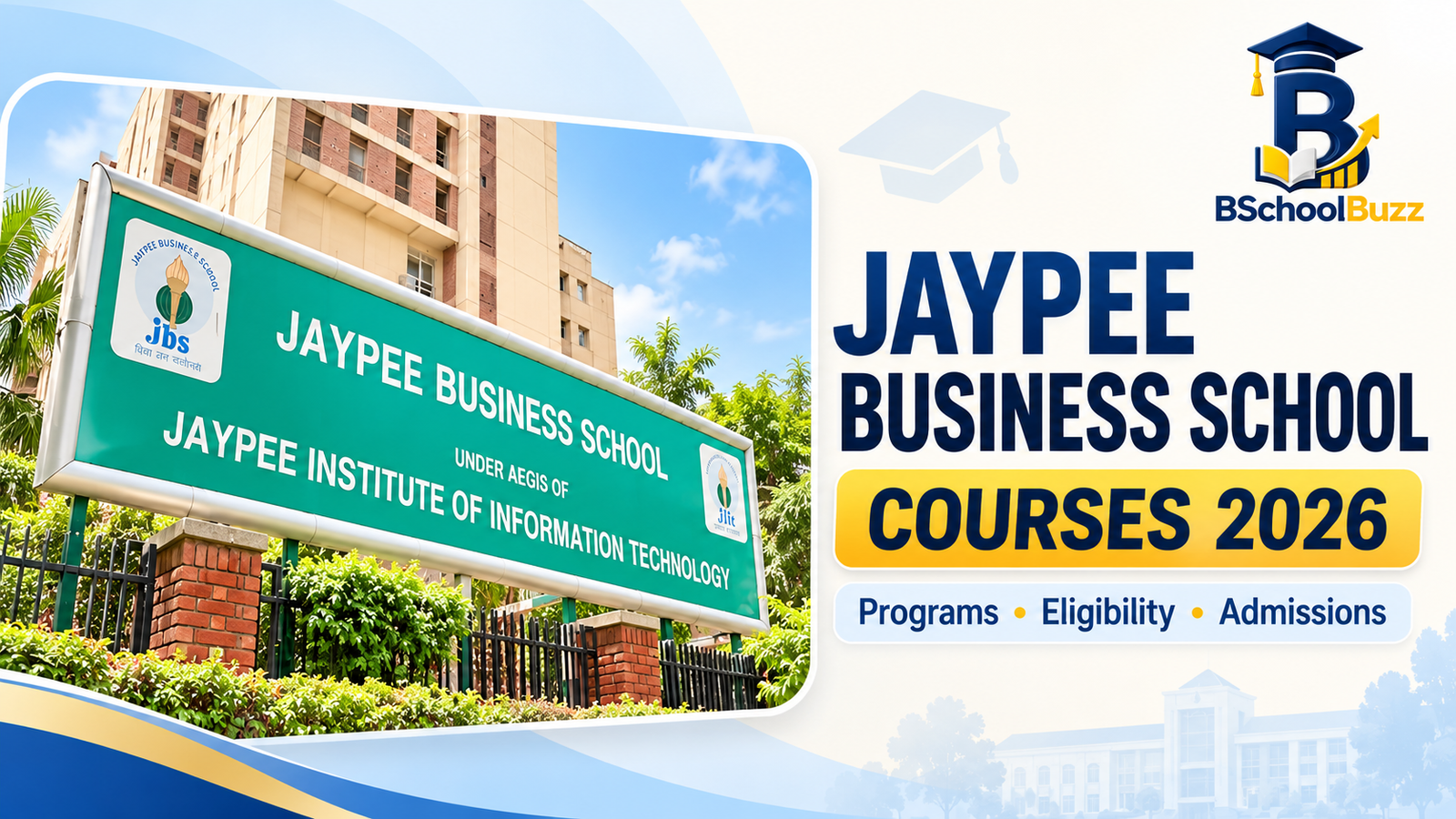
- Jaypee Business School (JBS) is a constituent of Jaypee Institute of Information Technology in Noida, Uttar Pradesh.
- The institution was established in 2007.
- Its academic portfolio includes BBA, B.Com, MBA, M.Com and PhD programmes.
- The standard MBA is a two-year full-time programme.
- Specialised MBA options include Artificial Intelligence and Data Science and Hospital and Healthcare Management.
- Published MBA specialisation areas include Marketing, Finance, Human Resource Management, Operations, IT and Business Analytics, Digital Marketing, Fintech and other functional or sectoral fields.
- The published eligibility for the standard MBA includes a bachelor's degree with at least 50% aggregate marks or equivalent CGPA and a valid accepted entrance examination score.
- MBA entrance examinations listed by JBS include CAT, MAT, CMAT, XAT, GMAT, ATMA and CUET-PG.
- The published institutional fee for the 2026–28 standard MBA is ₹13.68 lakh for two years, excluding refundable caution money.
- JBS publishes merit-based MBA scholarship opportunities of up to 50%, subject to eligibility and continuation conditions.
- Applicants should verify current fees, eligibility, curriculum, specialisation availability and admission dates through official JBS sources.
Blog Description and Details: Jaypee Business School Courses & Programs 2026
1. Overview of Jaypee Business School, Noida
Jaypee Business School (JBS) is a constituent of Jaypee Institute of Information Technology (JIIT), located in Sector 62, Noida, Uttar Pradesh. Established in 2007, the business school offers academic programmes in management and commerce for students pursuing careers in business administration, finance, analytics, healthcare management and research.
Jaypee Business School provides undergraduate, postgraduate and doctoral study options. Its academic portfolio includes BBA, B.Com, MBA, MBA in Artificial Intelligence and Data Science, MBA in Hospital and Healthcare Management, M.Com and PhD programmes.
Students exploring Jaypee Business School courses for 2026 should compare the programmes according to their educational qualifications, preferred subjects, career goals and budget. The standard MBA offers a broad management foundation, while specialised MBA programmes focus on particular areas of business. Undergraduate programmes are suitable for students beginning their business or commerce education after Class 12.
Applicants should consult the official JBS website for the latest programme availability, admission requirements, curriculum, fees and application deadlines.
2. Courses Offered at Jaypee Business School
Jaypee Business School offers programmes at different academic levels, allowing students to explore business and commerce education according to their qualifications and interests.
| Course | Level | Duration |
|---|---|---|
| Bachelor of Business Administration (BBA) | Undergraduate | Three or four years, depending on the applicable programme structure |
| Bachelor of Commerce (B.Com) | Undergraduate | Confirm the current official programme duration |
| Master of Business Administration (MBA) | Postgraduate | Two years |
| MBA in Artificial Intelligence and Data Science | Postgraduate | Two years |
| MBA in Hospital and Healthcare Management | Postgraduate | Two years |
| Master of Commerce (M.Com) | Postgraduate | Confirm the current programme structure |
| PhD in Management | Doctoral | As prescribed by the applicable doctoral regulations |
The programme portfolio includes undergraduate business education, postgraduate management programmes and doctoral study. Candidates should consult the official programme pages to verify the exact curriculum, eligibility criteria and duration applicable to their intended admission year.
2.1 Bachelor of Business Administration (BBA)
The Bachelor of Business Administration is an undergraduate programme for students who want to build a foundation in business and management after completing Class 12.
BBA education generally introduces students to management principles, marketing, accounting, economics, business communication, organisational behaviour and other business-related subjects. The exact subjects offered depend on the institution's curriculum.
Students considering BBA should review the official syllabus to understand the course structure, available electives, assessment methods and practical learning opportunities.
Who should consider BBA?
Students interested in business administration and management.
Students who want to develop business communication and analytical skills.
Students planning to pursue an MBA or another postgraduate qualification.
Students interested in entry-level roles in sales, marketing, business development or operations.
Jaypee Business School describes its BBA programme within a three- or four-year framework under the applicable National Education Policy structure. Applicants should confirm the duration and degree requirements for their intended admission year.
2.2 Bachelor of Commerce (B.Com)
The Bachelor of Commerce is an undergraduate option for students interested in accounting, finance, commerce and related business disciplines.
Compared with a general management programme, commerce education typically places greater emphasis on accounting principles, financial systems, taxation and commercial transactions. The exact subject combination depends on the official curriculum.
Before applying, students should check the current B.Com programme details for eligibility, duration, semester structure and course requirements.
Who should consider B.Com?
Students interested in accounting and financial management.
Students planning to pursue postgraduate commerce education.
Students interested in commerce-related employment.
Students who prefer a commerce-focused academic foundation before selecting a career specialisation.
2.3 Master of Business Administration (MBA)
The two-year full-time MBA is a major postgraduate management programme at Jaypee Business School. It is intended for graduates who want to develop managerial knowledge, analytical abilities and professional skills.
The programme covers business fundamentals and provides opportunities to study specialised management areas. Its published learning approach includes case studies, presentations, exercises, simulations, projects and technology-related applications in business functions.
Students can explore areas such as Marketing Management, Financial Management, Human Resource Management, Operations Management and Information Technology and Business Analytics.
Who should consider the MBA?
Graduates seeking management education.
Students interested in corporate careers.
Applicants who want to develop expertise in a particular business function.
Candidates interested in business strategy, managerial decision-making and organisational problem-solving.
Applicants should compare the curriculum with their career objectives and review the current admission requirements, fees and scholarship conditions before applying.
2.4 MBA in Artificial Intelligence and Data Science
Jaypee Business School also lists an MBA in Artificial Intelligence and Data Science. This specialised programme connects management education with the business applications of AI and data-oriented decision-making.
Students interested in this programme should examine the current curriculum to understand the balance between management subjects, analytical learning, technology-related content and applied projects.
Potential career directions may include business analytics, technology consulting, data-informed business strategy and product or project management, depending on the candidate's skills and employer requirements.
The programme may suit graduates who want to understand how organisations use data and technology to improve planning, analyse performance and support business decisions.
A specialised MBA does not automatically qualify graduates for every technical data-science position. Some roles require additional expertise in programming, mathematics or specialised analytical tools.
2.5 MBA in Hospital and Healthcare Management
The MBA in Hospital and Healthcare Management is designed for students interested in the administrative and operational side of healthcare organisations.
Healthcare management involves service delivery, resource planning, operational coordination, organisational administration and management decision-making. This programme may be relevant to graduates who want to explore management careers in hospitals and related healthcare organisations.
Before applying, candidates should review the programme-specific eligibility criteria, subjects, internship requirements and fee structure.
Potential career directions include hospital administration, healthcare operations, service coordination and related management functions. Individual roles may require additional qualifications or relevant experience.
2.6 Master of Commerce (M.Com)
The Master of Commerce is a postgraduate programme for students seeking advanced study in commerce and related business subjects.
M.Com and MBA programmes serve different academic purposes. M.Com generally provides continuity with commerce-related subjects, whereas an MBA focuses on management concepts and business decision-making across functional areas.
Students considering M.Com should verify the current eligibility requirements, duration, curriculum and application process through the official JBS website.
2.7 PhD in Management
The PhD programme is intended for candidates interested in advanced research, academic development and the systematic study of management-related subjects.
A doctoral qualification may be relevant to people pursuing university teaching, research positions or specialised research work in academia and industry.
Prospective applicants should review the current doctoral admission regulations for qualifying degrees, academic requirements, research interests, selection procedures, duration and supervision arrangements.
3. MBA Specialisations at Jaypee Business School
Choosing a specialisation is an important part of MBA planning because it determines which business subjects students study in greater depth.
Jaypee Business School lists management specialisation areas that include Marketing Management, Financial Management, Human Resource Management, Operations Management, Information Technology and Business Analytics, Digital Marketing, Financial Services, Fintech, International Business and Education Management.
The availability of specific electives or major-minor combinations should be confirmed through the current curriculum.
3.1 Marketing Management
Marketing Management focuses on understanding customers, identifying market opportunities and developing strategies to promote products and services.
Students may study consumer behaviour, branding, market research, sales, advertising and marketing strategy, depending on the curriculum.
Potential career directions include marketing associate, sales executive, brand support associate and marketing analyst.
3.2 Financial Management
Financial Management focuses on financial planning, business finance, financial analysis and resource allocation.
Students interested in financial information, business performance and investment decisions may find this specialisation relevant.
Potential career directions include financial analyst, finance executive and corporate finance associate. Some specialised finance roles may require additional professional qualifications or technical skills.
3.3 Human Resource Management
Human Resource Management deals with the people-related functions of an organisation, including recruitment, employee development, performance management and organisational behaviour.
This area may suit students interested in talent development, workplace relationships and organisational effectiveness.
Potential career directions include HR executive, talent acquisition associate and HR analyst.
3.4 Operations Management
Operations Management focuses on how organisations plan resources, improve processes and deliver products or services efficiently.
Students may explore process improvement, logistics, operational planning, supply chain management and quality-related concepts, depending on the course structure.
Potential career directions include operations analyst, logistics coordinator and supply chain associate.
3.5 Information Technology and Business Analytics
This specialisation connects business management with information systems and data-supported decision-making.
It may be relevant to students interested in analysing business performance, understanding technology-enabled processes and helping organisations make informed decisions.
Potential career directions include business analyst, reporting analyst and IT business analyst.
3.6 Digital Marketing
Digital Marketing focuses on customer acquisition and communication through digital channels. Relevant areas may include search engine optimisation, online advertising, social media marketing and campaign performance analysis.
Students interested in digital business and online customer engagement may consider this specialisation.
Potential career directions include digital marketing executive, SEO associate and campaign analyst.
3.7 Financial Services and Fintech
Financial Services focuses on financial products, services and related business operations. Fintech examines the intersection of financial services and technology.
These areas may interest students seeking careers in banking-related operations, financial services, digital financial products or technology-enabled financial businesses.
The precise career opportunities depend on the curriculum, practical experience and employer requirements.
3.8 International Business
International Business focuses on business activity across national borders, including international markets, trade and global business strategy.
Students interested in cross-border business operations may explore this area.
Potential career directions include international business associate, trade operations coordinator and export-related roles.
3.9 Education Management
Education Management concerns the administration and organisation of educational institutions and programmes.
It may be relevant to students interested in educational operations, programme coordination, institutional administration and related management responsibilities.
Candidates should confirm the availability of individual electives and specialisation combinations for their intended intake.
4. Course Duration and Academic Structure
Course duration varies according to the programme and applicable academic regulations.
The standard MBA is a two-year full-time programme. JBS describes its BBA within a three- or four-year framework. The duration and structure of other programmes should be confirmed through their current official documents.
4.1 Core management subjects
An MBA curriculum commonly covers marketing, finance, accounting, economics, organisational behaviour and business strategy. These subjects help students understand how different business functions influence organisational performance.
The precise courses offered in each semester should be checked against the official JBS curriculum for the relevant batch.
4.2 Practical learning
JBS describes a learning approach that includes case studies, presentations, group exercises, business simulations, guest lectures and live corporate projects.
These activities can help students develop analytical reasoning, communication, teamwork and decision-making skills.
4.3 Internships and projects
Internships provide opportunities to apply academic knowledge to practical business situations. Students should confirm the current internship requirements, duration, assessment criteria and project arrangements applicable to their batch.
An internship's value depends on the quality of the assignment, the student's contribution and the relevance of the experience to their intended career.
5. Eligibility Criteria for Jaypee Business School Courses
Eligibility depends on the programme selected. Applicants should not assume that the same requirements apply to undergraduate, postgraduate and doctoral courses.
5.1 MBA eligibility
The published standard MBA admission requirements include:
A bachelor's degree or equivalent qualification in any discipline from a recognised university.
At least 50% aggregate marks or equivalent CGPA.
A valid score in an entrance examination accepted by JBS.
Compliance with the relevant application and document-submission deadlines.
The published admission information lists CAT, MAT, CMAT, XAT, GMAT, ATMA and CUET-PG among the accepted examinations.
Final-year graduation students may be eligible to apply if they meet the applicable completion and documentation deadlines. Candidates should confirm the precise requirements for the current admission cycle.
5.2 Undergraduate eligibility
Students applying for BBA or B.Com should consult the current undergraduate admission information for Class 12 qualifications, subject requirements, minimum marks and other applicable conditions.
The MBA's graduation requirement should not be applied automatically to undergraduate programmes.
5.3 M.Com and PhD eligibility
Applicants interested in M.Com should check the accepted undergraduate qualifications and minimum academic requirements.
PhD applicants should review the current doctoral regulations for the qualifying degree, research requirements, selection procedure and any other programme-specific conditions.
6. Jaypee Business School MBA Admission Process
The MBA admission process involves application submission, evaluation of entrance examination scores and further selection stages.
Step 1: Review the programme
Visit the official website and examine the MBA curriculum, specialisations, eligibility requirements, fee structure and scholarship conditions.
Step 2: Complete the application
Fill out the application form using accurate academic and personal details. Follow the current instructions for submitting documents and paying the application fee.
Step 3: Submit the entrance examination score
Provide a valid score from an examination accepted for the relevant programme and admission cycle.
Step 4: Participate in the selection process
According to the published JBS admission information, shortlisted candidates are invited for a Group Discussion and Personal Interview.
Step 5: Await the admission decision
The published selection process considers entrance examination performance, language proficiency and performance in the Group Discussion and Personal Interview.
Step 6: Complete admission formalities
Candidates who receive an admission offer should review the payment schedule, required documents and registration instructions before confirming their admission.
Application deadlines, selection-round dates and payment instructions can change. Applicants should rely on the current official admission portal.
7. Jaypee Business School MBA Fees for 2026–28
The published fee structure for the standard MBA provides a year-wise breakdown of institutional charges.
| Fee component | First year | Second year |
|---|---|---|
| Admission fee | ₹25,000 | Not separately listed |
| Tuition fee | ₹5,50,000 | ₹5,78,000 |
| Development fee | ₹90,000 | ₹95,000 |
| Study material | ₹15,000 | ₹15,000 |
| Total institutional fee | ₹6,80,000 | ₹6,88,000 |
The published two-year institutional fee is ₹13,68,000. An additional ₹20,000 one-time refundable caution money is listed, making the total including caution money ₹13,88,000, subject to the applicable conditions.
7.1 Other expenses to consider
Students should budget separately for expenses that are not itemised in the institutional fee table. These may include accommodation, food, transportation, personal expenses and additional learning resources.
Applicants who require hostel accommodation should obtain the current hostel and mess charges directly from the institution before calculating the complete cost of attendance.
7.2 Scholarship opportunities
JBS publishes merit-based scholarship or fee-waiver opportunities of up to 50% for eligible MBA students.
The published criteria include qualifying-degree CGPA or equivalent marks and CAT percentile. Scholarship continuation is subject to the institution's academic conditions.
Students should confirm which fee components are eligible for a waiver, the amount awarded and the continuation requirements before calculating their expected payable fee.
8. Career Opportunities After Jaypee Business School Courses
Career opportunities depend on the qualification completed, academic performance, skills, internships and employer requirements.
After an MBA
MBA graduates may explore roles across marketing, finance, human resources, operations, business analytics, financial services and other management functions.
Illustrative entry-level roles include:
Marketing associate
Financial analyst
HR executive
Operations analyst
Business analyst
Digital marketing executive
Financial services associate
Healthcare operations executive
International business associate
These are potential career directions rather than guaranteed employment outcomes.
After BBA or B.Com
BBA graduates may explore entry-level opportunities in sales, business development, marketing support and operations. B.Com graduates may consider commerce-related roles in accounting support, finance operations and administration, depending on their skills and any additional qualifications required.
Both qualifications can also provide a foundation for further education.
After M.Com or PhD
M.Com graduates may pursue commerce-related employment, further study or teaching-related pathways, subject to relevant qualification requirements.
A PhD is more directly aligned with research and academic careers. Candidates interested in university teaching should check the applicable eligibility requirements for their intended positions.
Evaluating placement information
When comparing programmes, review the latest official placement report, if available. Check the graduating batch, number of eligible students, number placed, average salary, median salary and highest salary.
The highest package should not be interpreted as the salary every graduate can expect. Placement outcomes vary according to individual skills, experience, role availability and employer selection criteria.
9. How to Choose the Right Programme
Choosing the right course requires more than comparing programme names. Students should consider their existing qualifications, subject interests, budget and intended career direction.
Choose BBA if you want to begin studying business administration after Class 12.
Consider B.Com if you prefer a commerce-oriented academic foundation.
Explore the standard MBA if you want broad management education and functional specialisation.
Consider the MBA in Artificial Intelligence and Data Science if you are interested in data-oriented business applications.
Explore the MBA in Hospital and Healthcare Management if you want to focus on healthcare administration.
Consider M.Com if you want further study in commerce-related subjects.
Investigate the PhD pathway if your long-term goal involves advanced research or academic work.
Before applying, compare the curriculum, duration, eligibility, complete fee structure, internship requirements and available career-related information.
10. Important Points to Check Before Applying
Before making a final decision, verify the following:
Programme availability: Confirm that the course is offered for your intended admission year.
Eligibility: Check the programme-specific academic requirements and accepted entrance examinations.
Curriculum: Review the current syllabus, electives, semester structure and internship requirements.
Fees: Confirm institutional charges, refundable caution money, hostel costs and additional expenses.
Scholarships: Read the eligibility and continuation conditions rather than assuming that every applicant will receive the maximum waiver.
Admission dates: Check the official portal for the current application status and selection-round schedule.
Placement information: Review programme-specific placement reports and understand the difference between average, median and highest salaries.
Official documentation: Use current JBS admission notices, fee documents and curriculum information as the final reference for your application.
Conclusion
Jaypee Business School offers undergraduate, postgraduate and doctoral pathways for students interested in management, commerce and research. Its academic portfolio includes BBA, B.Com, the two-year MBA, specialised MBA programmes, M.Com and PhD.
The standard MBA provides a broad management foundation, while specialised programmes offer opportunities to focus on areas such as AI and Data Science or Hospital and Healthcare Management. Undergraduate and postgraduate commerce programmes serve students with different academic interests and career objectives.
The best programme depends on your qualifications, interests, budget and long-term goals. Review the current eligibility requirements, curriculum, fee structure, scholarship conditions and admission deadlines before applying. Consulting the official JBS website will help you make an informed decision based on the requirements applicable to your intended intake.
Key Takeaways
Choose BBA or B.Com if you are planning to begin undergraduate business or commerce studies after Class 12.
Consider the standard MBA if your goal is to develop broad management knowledge and specialise in a business function.
Explore the MBA in AI and Data Science if you want to combine management education with data-oriented business applications.
Consider the MBA in Hospital and Healthcare Management if you are interested in healthcare administration and operations.
Compare MBA and M.Com based on whether you prefer general management or further commerce-focused study.
Check the programme-specific eligibility criteria rather than applying the MBA admission requirements to every course.
Confirm that your entrance examination is accepted for the intended programme and admission cycle.
Review the complete fee structure, including caution money, accommodation and other expenses.
Read scholarship conditions carefully; a published maximum scholarship is not a guarantee of an individual award.
Check the current curriculum, internship requirements and official placement information before making a final decision.
Use the official JBS website for current admissions, course details and fee-related decisions.
Frequently Asked Questions
What courses are offered by Jaypee Business School, Noida?
Jaypee Business School lists BBA, B.Com, MBA, M.Com and PhD programmes. Its postgraduate management options include the standard MBA, MBA in Artificial Intelligence and Data Science, and MBA in Hospital and Healthcare Management.
Is Jaypee Business School's MBA a two-year programme?
Yes. JBS lists its standard full-time MBA as a two-year programme. Its specialised MBA programmes are also listed with a two-year duration.
What are the MBA specialisations at Jaypee Business School?
Published specialisation areas include Marketing Management, Financial Management, Human Resource Management, Operations Management, Information Technology and Business Analytics, Digital Marketing, Financial Services, Fintech, International Business and Education Management. Check the current curriculum to confirm which options are available for your batch.
What is the eligibility for the JBS MBA?
The published standard MBA criteria require a bachelor's degree or equivalent in any discipline, with at least 50% aggregate marks or equivalent CGPA, along with a valid score in an accepted entrance examination. Applicants should check the current admission notice for exact conditions.
Which entrance exams does Jaypee Business School accept for MBA admission?
JBS lists CAT, MAT, CMAT, XAT, GMAT, ATMA and CUET-PG among the accepted examinations. Verify the current admission requirements before applying.
What is the MBA fee at Jaypee Business School for 2026–28?
The published two-year institutional fee for the standard MBA is ₹13.68 lakh. An additional ₹20,000 refundable caution money is listed, making the total including caution money ₹13.88 lakh, subject to applicable conditions.
Does Jaypee Business School offer MBA scholarships?
Yes. JBS publishes merit-based scholarship or fee-waiver opportunities of up to 50% for eligible MBA students. The award and continuation depend on the institution's stated academic and entrance-score conditions.
Does JBS offer an MBA in Artificial Intelligence and Data Science?
Yes. JBS lists a two-year MBA in Artificial Intelligence and Data Science. Candidates should consult its current programme curriculum and admission information for the relevant intake.
Is work experience compulsory for admission to the JBS MBA?
No. The JBS FAQ states that prior work experience is not required for the standard MBA, subject to the other applicable admission criteria.
Where can I find official information about Jaypee Business School courses?
Visit the official JBS website at https://jbs.ac.in/. Review its programme overview, admissions portal, MBA curriculum, specialisation details, fee structure and FAQs for the latest applicable information.
Ask a question
Still confused? Leave your question and our team will help you.